The History of the Word “Marijuana”
The History of the Word "Marijuana"
How a Mexican Spanish word crossed into English, got drafted into a prohibition campaign, and ended up in a twenty-first-century argument about what we should call the plant.
The history of the word marijuana is a borrowing story. English took the noun from Mexican Spanish, where it appeared as mariguana or marihuana, and the Oxford English Dictionary dates the first English use to 1894. The deeper origin is not settled: the OED calls it uncertain, and a century of proposed roots has produced theories but no proof.
It is a story about spelling and politics rather than a tidy line back to a single ancient language. The plant already had an English name long before this one arrived.
So the real question is not where the syllables came from. It is why English speakers replaced a word they had used for three centuries, and what that replacement did to the plant's reputation.
Where Does the Word Marijuana Come From?
English took the noun from Mexican Spanish. Spanish speakers in Mexico used mariguana and marihuana for the psychoactive preparation, and English borrowed the term in the late nineteenth century. [1]
The Oxford English Dictionary dates the first English use to 1894 and gives the source as Mexican Spanish. It also records the deeper etymology as uncertain, which is a deliberately modest verdict from a reference work that is happy to name a root when the evidence carries one. [1]
One detail surprises most people: the -j- is English. Spanish printed mariguana and marihuana, with a g or an h. The j-form is an English innovation that later traveled back into Spanish and French. [1]
- First English attestation: 1894, per the Oxford English Dictionary
- Borrowed from Mexican Spanish mariguana or marihuana
- The -j- spelling is an English change, not a Spanish one
- The deeper origin is recorded as uncertain, not as a settled root
Three families of explanation still circulate. The first traces the word to Nahuatl mallihuan, glossed as prisoner. The second treats it as a folk pairing of the common Spanish names María and Juana. The third looks to African languages, a possibility the OED's editors have also weighed. [1]
None has been demonstrated, and the reference work says so plainly. That matters for everything below, because most popular retellings pick one of those three and present it as settled fact.
The two-spelling problem is worth naming early, since it confuses people who go looking. Older Spanish-language sources print mariguana or marihuana, English and French sources print marijuana, and modern Spanish has largely settled on marihuana. All four forms point at the same word. Chasing the difference will not lead you to the root; it will only lead you through a century of competing house styles.
The word also arrived in English just in time to be conscripted into a political campaign. That longer sequence is traced in Why Is Cannabis Illegal? A History of Marijuana Prohibition in America.
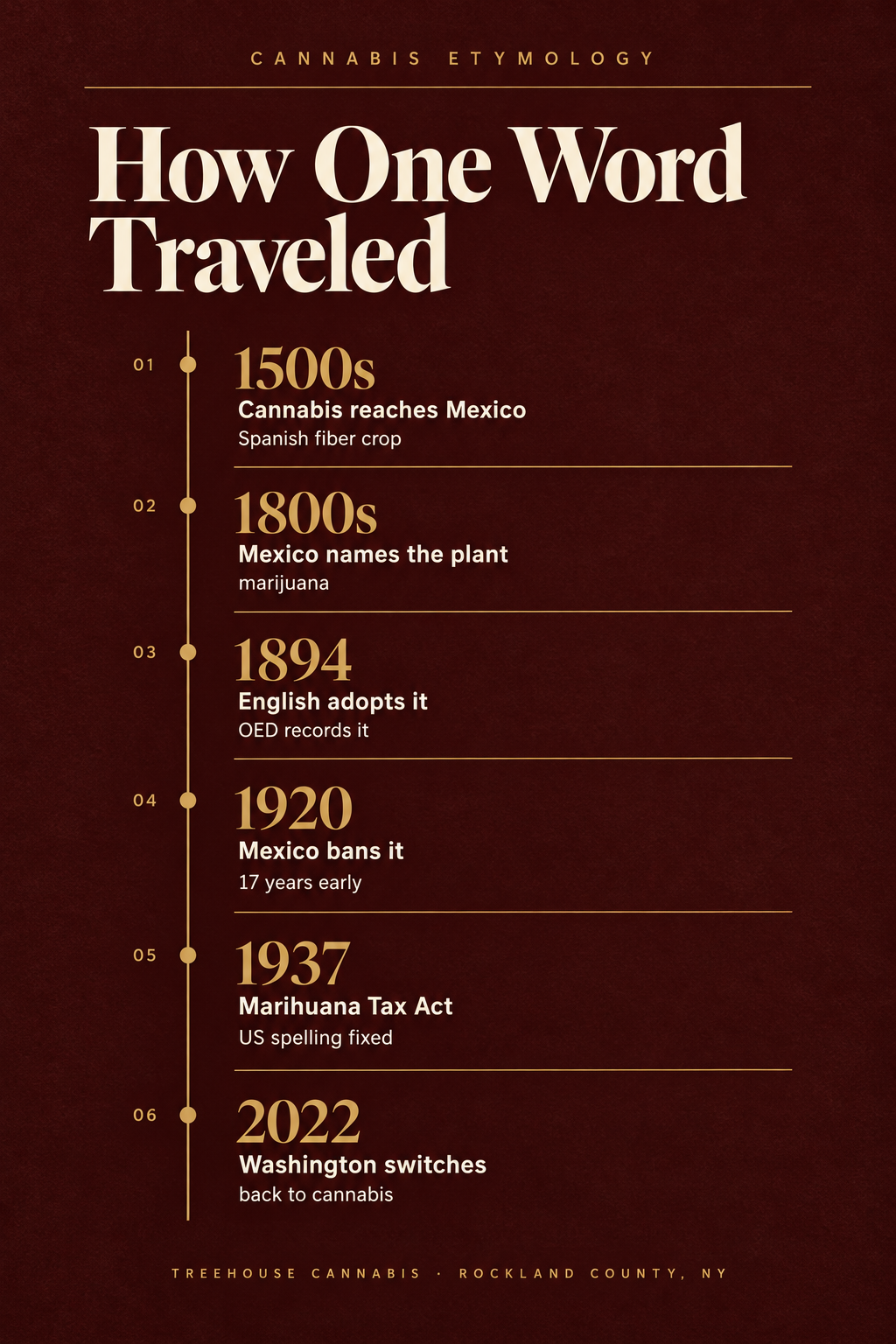
The full arc, from a sixteenth-century fiber crop to a 2022 state statute, fits on one timeline.
What Did English Call Cannabis Before "Marijuana"?
Cannabis. The word came into English through Latin from Greek kannabis, a term traced to Scythian or Thracian, and it has named the hemp plant in English since the sixteenth century. [2]
Hemp is the older word of the two, Germanic in origin, and for centuries English split the labor between them. Hemp covered fiber, seed, and rope. Cannabis covered the plant itself and the preparations made from it.
| Term | Where it came from | What it covered in English |
|---|---|---|
| Hemp | Older Germanic word | Fiber, seed, and rope |
| Cannabis | Greek kannabis by way of Latin, in use since the 1500s | The plant itself and its preparations |
| Marijuana | Mexican Spanish mariguana or marihuana, borrowed 1894 | The psychoactive preparation, once the term spread in the 1930s |
That division held until the twentieth century. Nineteenth-century American newspapers and medical journals almost always wrote cannabis, not marijuana. [7]
- Cannabis: Greek kannabis by way of Latin, in English since the 1500s
- Hemp: an older Germanic word, once the ordinary term for fiber, seed, and rope
- Cannabis: the plant and its preparations in scientific and medical writing
- Marijuana: essentially absent from ordinary American usage until the late 1800s
So marijuana was the newcomer, not the default. English had a working vocabulary for this plant for three hundred years before the borrowed word showed up, and that vocabulary did not disappear when the new one arrived. It is still the vocabulary of botany, of regulation, and increasingly of state law.
The older word also carried institutional weight. Cannabis was the term in botanical classification, in the medical press, and in the reference works that nineteenth-century editors trusted, which is why swapping it for a slangy borrowing read to some contemporaries as a deliberate demotion rather than a neutral change of label. The older American story, including how New York handled the plant long before federal prohibition, is covered in The History of Cannabis in New York.
Is "Marijuana" a Mexican Word?
The form is. Cannabis reached Mexico with Spanish colonists in the sixteenth century, arriving as an industrial fiber crop rather than a drug. The name marijuana for the psychoactive preparation is Mexican Spanish, and that is the word English borrowed. [9]
Isaac Campos traces the path. Over roughly three centuries the plant moved through indigenous pharmacopoeias, prisons, and barracks, and the psychoactive preparation acquired a local name of its own along the way. [9]
By the early 1900s cannabis cigarettes were common in Mexico and their contents were called marijuana. The word was already ordinary enough to turn up in popular song: the Mexican Revolution-era corrido "La Cucaracha" carries a marijuana verse. [10]
Mexico also moved first on prohibition. The country outlawed the drug nationwide in 1920, seventeen years before the United States passed the Marihuana Tax Act. [5]
- 1500s: Spanish colonists bring cannabis to Mexico as a fiber crop
- 1800s: the psychoactive preparation takes the Mexican Spanish name marijuana
- Early 1900s: the word appears in ordinary speech and in popular song
- 1920: Mexico prohibits the drug nationwide
- 1937: the United States follows, seventeen years later
That chronology is worth holding onto, because it reverses a common assumption. The word did not travel south from the United States along with prohibition. It traveled north with the plant, the people, and the language.
The itinerary also explains why a separate name took hold at all. A plant grown openly for fiber needed no slang; the preparation that moved through institutions needed one, and a local name did the work that a botanical label could not. That is a pattern that repeats wherever a plant has one legal use and one contested one. The wider arc, from colonial cash crop to controlled substance, is laid out in USA Cannabis History: From Colonial Cash Crop to Controlled Substance.
Did the Nahuatl "Mallihuan" Theory Hold Up?
Not on the evidence available. The theory holds that marijuana descends from Nahuatl mallihuan, glossed as prisoner, and it is the most frequently repeated explanation in print. It is also the one the Oxford English Dictionary lists as improbable. [1]
Jason Haugen's test is the useful part. He catalogs 93 English words with definitive Nahuatl etymologies in the OED, then lists marijuana separately as an improbable borrowing. [1]
The objection is structural rather than aesthetic. Genuine Nahuatl loans into English carry a recognizable sound pattern, and marijuana does not have it. The semantic bridge is strained too: prisoner to a name for a plant is a long walk, and the theory needs that walk to feel obvious.
- The claim: marijuana comes from Nahuatl mallihuan, "prisoner"
- The phonological problem: the word lacks the shape shared by confirmed Nahuatl loans
- The scale check: 93 proven Nahuatl loanwords are catalogued, and marijuana is not among them
- The verdict: possible, unsupported, and listed by the OED as improbable
Unsupported is not the same as absurd. The theory has circulated in reputable places for decades, and a future archival find could change the picture. What it does not have is evidence, and etymology runs on attestation rather than on how good a story sounds.
The method is worth spelling out, because it is the difference between etymology and guesswork. A loanword claim needs dated attestations that show the word crossing from one language into another, and it needs the sounds to line up with how that language family actually adapts foreign words. Marijuana fails the second test and has no documentation for the first beyond its Spanish appearance. That is why the OED's editors used the word improbable rather than impossible.
Is the "Mary Jane" Story Real?
Almost certainly not. The story says marijuana is a coded pairing of the Spanish names María and Juana, a discreet way of naming the plant in polite company. It is a good story, which is exactly why it survives. [10]
The chronology is the problem. Spanish-language printing used mariguana and marihuana for decades before any spelling with a j appears. If the word had been built from María and Juana, the j would come first, not last. [1]
What actually looks borrowed is the j itself. English usage introduces the -j- form, and Spanish and French then pick up spellings influenced by it. That is the opposite direction from the folk etymology. [1]
- The claim: marijuana is a disguised pairing of the names María and Juana
- The problem: marihuana and mariguana predate any j-spelling by decades
- The direction of travel: the j-form appears in English first, then echoes back
- What survives: Mary Jane as English slang built from the English spelling
Mary Jane is real slang. It is simply downstream of marijuana rather than upstream of it. The nickname is a back-formation from a word English speakers already had, and treating it as evidence of origins puts the cart several centuries in front of the horse.
The story is seductive because it explains two things at once: the shape of the word and a reason anyone would have coined it. Folk etymologies usually work that way. They supply a motive, the motive feels like proof, and the sound of the word seems to confirm it. What they rarely survive is a date. Spanish speakers used a perfectly ordinary word for the plant, in print and in song, which is not how people treat a code.
Why Did Americans Switch to "Marijuana" in the 1930s?
Because the campaign that criminalized the plant preferred a word that sounded foreign. Marijuana entered English around 1894 but spread widely only in the 1930s, when prohibition advocates needed a term that separated the drug from hemp rope and from the botanical cannabis of medical textbooks. [7]
The racialized part is documented. George Fisher traces the slanted homicide narratives and the racialized imagery used to sell prohibition, including the Victor Licata case and Anslinger's "Assassin of Youth" writing. [6] Fisher also notes that the direct evidence of Anslinger deploying race in testimony on the 1937 Act is thinner than commonly asserted. Both things can be true: the propaganda was racialized, and the specific courtroom quote everyone repeats is harder to source than the internet suggests.
The myth to retire is simpler. Anslinger did not invent the word. It predates him by decades and already appeared in American newspapers and state statutes before he had any role in the question. [7]
What the 1937 Marihuana Tax Act did was entrench a spelling. The statute used marihuana with an h, and that form sat in federal law for generations afterward. [5]
Recent scholarship has also narrowed Anslinger's role in the Act itself. Wayne Hall and Sarah Yeates show he was less central to its passage than popular histories claim, that Reefer Madness sought his endorsement in May 1938, after the Act had passed, and that he refused. They also note the Act did not ban hemp fiber production. [5]
- 1894: the word enters English
- 1930s: it spreads widely in American usage
- 1937: the Marihuana Tax Act fixes the marihuana spelling in federal law
- 1938: Reefer Madness seeks Anslinger's endorsement after the Act, and he declines
- Later scholarship: his role shrinks, and the hemp-ban story does not hold
The word outlived the campaign that popularized it. It sits today on state labels and dispensary menus, from a jar of Small Buds Flower to a full-size eighth, and most people who read it have no idea it arrived as a piece of political staging.
Why Are States and Agencies Switching Back to "Cannabis"?
Because the word carries a history some legislatures no longer want sitting in statute. In 2022 Washington State enacted 2SHB 1210, whose intent section finds that US use of the term marijuana has discriminatory origins and should be replaced with the more scientifically accurate term cannabis. [3]
The bill did not stop at a statement of intent. It replaced the term throughout the Revised Code of Washington and Title 314 of the state administrative code. [4]
Federal health agencies have moved in a similar direction without abandoning the older word entirely. The National Center for Complementary and Integrative Health uses cannabis as the umbrella term for all products derived from Cannabis sativa and reserves marijuana for plant material with substantial THC. [2]
The legal line itself is precise. Material at or below 0.3 percent delta-9-THC on a dry weight basis is hemp; above that threshold it is marijuana. [8] Congress placed marijuana in Schedule I under the 1970 Controlled Substances Act, and that classification is where the federal word still does most of its work. [8]
- 2022: Washington replaces marijuana with cannabis across statute and administrative code
- Stated finding: the older term has discriminatory origins, and cannabis is more scientifically accurate
- Federal practice: cannabis is the umbrella term, marijuana reserved for high-THC material
- Legal line: 0.3 percent delta-9-THC on a dry weight basis separates hemp from marijuana
- Scale: roughly 540 chemical substances and more than 100 cannabinoids sit under one word
That last number explains part of the difficulty. A plant with hundreds of compounds and a dozen product forms is hard to name with a single noun, and both words are doing work neither was designed for. Retail labeling follows the same logic. A jar of Pre Ground Flower lists its THC percentage because that number decides which legal category the product occupies.
So What Should You Call It?
Cannabis is the safer default. It is the botanical umbrella term, it is what most regulators and health agencies now use, and it does not drag the 1930s campaign along with it. That is a reason to prefer it in your own writing, not a rule about anyone else's speech.
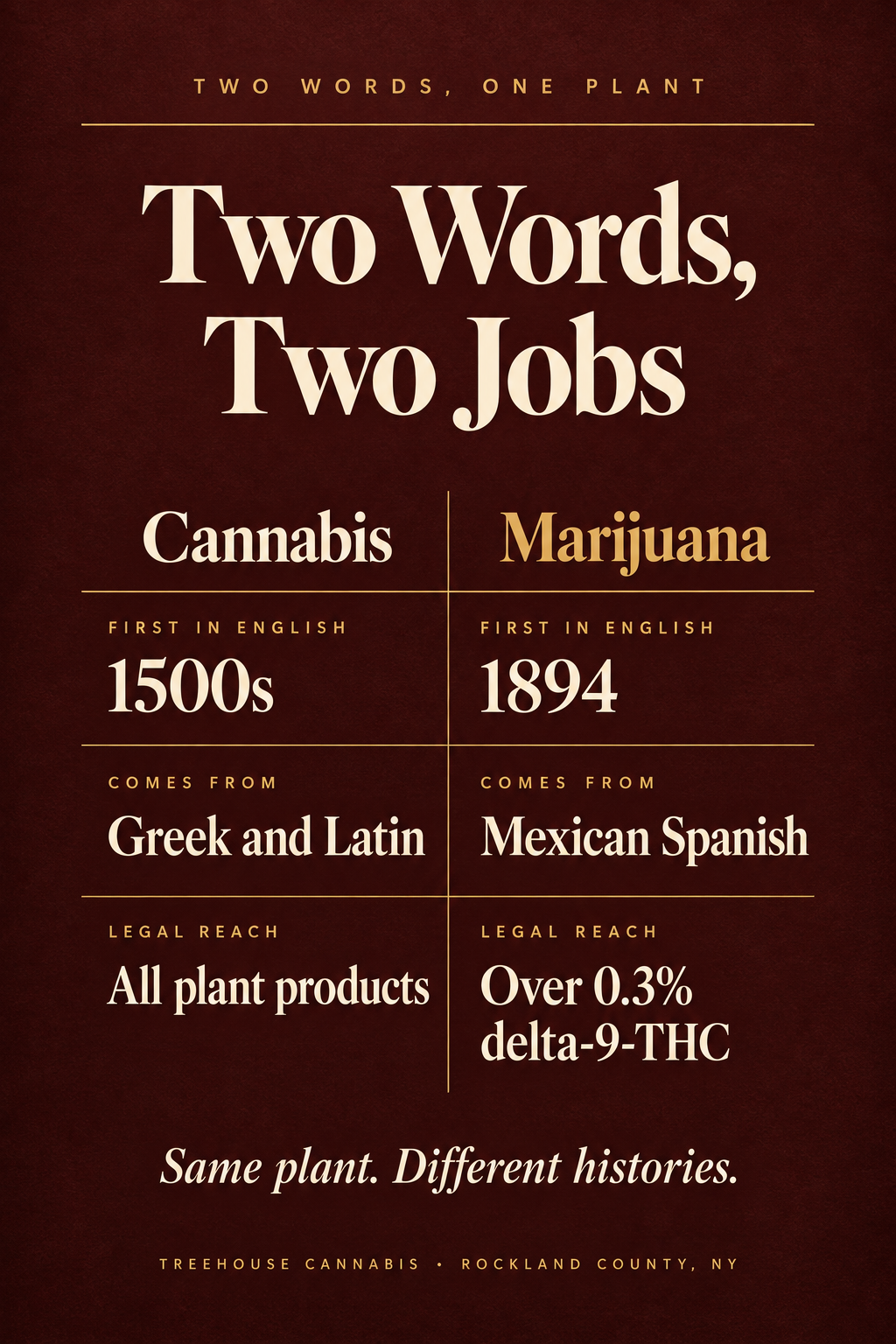
| Distinction | Cannabis | Marijuana |
|---|---|---|
| What it names | The plant and everything derived from it | Plant material above 0.3 percent delta-9-THC |
| First in English | 1500s | 1894 |
| Where it comes from | Greek kannabis by way of Latin | Mexican Spanish mariguana or marihuana |
| How agencies use it | Umbrella term for all plant-derived products | Reserved for high-THC material |
| Best used for | Writing, labels, the whole category | Quoting a law, a label, or high-THC material specifically |
Marijuana is not a slur, and using it does not make anyone a villain. It remains the operative word in plenty of state statutes, product labels, and everyday conversation, and it is the word most customers actually search for. [2]
- Use cannabis when you mean the plant or the whole category
- Use marijuana when you mean high-THC material specifically
- Use marijuana when you are quoting a law, a label, or a historical document
- Use whichever word the person in front of you is using
The honest summary is that the two words describe overlapping but not identical things. Cannabis is the wider category; marijuana is the narrower legal slice above 0.3 percent THC. [8] The choice is partly about precision and partly about history, and it is not worth a fight at the counter. On a menu the distinction shows up in plain product terms, from Infused Bud Flower to a single-strain eighth like NY Diesel | Flower | 28g.
If you want to see what the vocabulary actually refers to, Treehouse Cannabis stocks NY Diesel | Flower | 28g, Halftime Haze • Glass Tip Infused 5 pack Pre-Roll • 2.5g, and Peach x Oishii Live Resin Gummies | 10 pk for adults 21 and older at the Rockland County shop, and the team is happy to walk you through labels and potency before you buy.
Frequently Asked Questions
Where does the word marijuana come from?
English borrowed marijuana from Mexican Spanish, where it appeared as mariguana or marihuana. The deeper origin is genuinely unknown: the Oxford English Dictionary calls it uncertain. Proposed roots include Nahuatl mallihuan, meaning prisoner, and the folk pairing of the names Maria and Juana, but no theory has been demonstrated. [1] [7]
Is marijuana a Mexican word?
The form is. Cannabis reached Mexico with the Spanish in the sixteenth century as a fiber crop, and by the nineteenth century Spanish speakers there had a distinct name for the psychoactive preparation. That Mexican Spanish term, not the older European word, is what crossed into English. [9] [10]
Why did Americans start saying marijuana instead of cannabis?
Cannabis and hemp were the ordinary English words for the plant through the nineteenth century. Marijuana entered English around 1894 and spread widely during the 1930s, when prohibition campaigns preferred an unfamiliar, foreign-sounding term over the plant's long-established botanical and industrial names. [7] [5]
Did Harry Anslinger invent the word marijuana?
No. The word predates him by decades and was already in American newspapers and state statutes. Anslinger promoted the spelling marihuana in the 1937 Marihuana Tax Act, which entrenched it in federal law, but he did not coin it, and recent scholarship questions how central he was to the Act itself. [5] [6]
Is the Mary Jane story true?
Almost certainly not. The Maria Juana explanation is folklore. Spanish-language printing used mariguana and marihuana for decades before any spelling with a j appeared, and the j-form looks like an English innovation later echoed back into Spanish and French. It is a good story, not a documented etymology. [1] [10]
When did cannabis first appear in English?
Cannabis is old. It descends through Latin from Greek kannabis, a word traced to Scythian or Thracian, and has referred to the hemp plant in English since the sixteenth century. Hemp itself is the older Germanic word, which is why English once used hemp for the fiber and cannabis for the plant. [2] [7]
Why are some states and agencies switching back to cannabis?
Because marijuana carries a racialized history. In 2022 Washington State formally replaced marijuana with cannabis throughout its code, with the legislature finding the older term has discriminatory origins. Federal health agencies now generally use cannabis as the umbrella term and reserve marijuana for high-THC material. [3] [4] [2]
Does marijuana mean something different from cannabis legally?
Yes, in US law. Cannabis covers everything derived from the plant, while marijuana refers specifically to material containing more than 0.3 percent delta-9-THC on a dry weight basis. Plant material below that threshold is legally hemp. The distinction is regulatory, not botanical. [8] [2]
Sources
- Lexis: e-Journal in English Lexicology (Jason D. Haugen, Oberlin College) — Quotes the Oxford English Dictionary entry dating English 'marijuana' to 1894 fr
- National Center for Complementary and Integrative Health (NIH) — Establishes the current federal-scientific distinction that 'cannabis' names all
- Washington State Legislature (Revised Code of Washington) — Records the Washington Legislature's official finding that use of the term 'mari
- Washington State Liquor and Cannabis Board — Official agency fact sheet confirming the intent section of 2SHB 1210 declares a
- Addiction (Wayne Hall & Sarah Yeates, University of Queensland); indexed in PubMed — Peer-reviewed correction showing Anslinger played a far less central role in pas
- Boston University Law Review (George Fisher) — Documents the racialized imagery and slanted homicide narratives used to sell ca
- NPR (Matt Thompson), republished by Maine Public — Reports that nineteenth-century American news and medical writing almost always
- National Cancer Institute PDQ via NCBI Bookshelf (NIH) — Provides the federal terminology table contrasting hemp (under 0.3% delta-9-THC)
- University of North Carolina Press (Isaac Campos) — Historian Isaac Campos shows cannabis arrived in Mexico in the sixteenth century
- Leafly — Describes cannabis cigarettes becoming common in Mexico by the early 1900s with
About Treehouse Cannabis
Treehouse Cannabis is a licensed adult-use dispensary in Rockland County, New York, serving customers 21 and older across Rockland, Orange and Westchester Counties. The budtender team walks customers through product formats, potency listings and what is actually in stock before they buy, and can explain how current New York State labeling uses the terms cannabis and marijuana.
Cannabis is for adults 21 and older. Keep all cannabis products out of reach of children and pets. Do not drive or operate machinery after use. This article is for educational purposes only, is not medical or legal advice, and does not replace current state or federal law. Product availability and regulations change; check current New York State adult-use rules before you buy.

Shop our products

Shop All

Deals

Flower

Pre-rolls
Vaporizers

Edibles
Drinks

Concentrates
Tinctures

Topicals

CBD

Pet CBD

Accessories