
What Is CBC? A Guide to Cannabichromene
What Is CBC? A Guide to Cannabichromene
CBC, or cannabichromene, is a non-intoxicating cannabinoid the cannabis plant produces itself, and it acts mainly outside the CB1 receptor that makes THC intoxicating. It is usually a minor component of dried flower, measured at 0.05% to 0.3% by weight. Nearly all published evidence comes from cells and rodents rather than from people.
What Is the CBC Cannabinoid (Cannabichromene)?
CBC stands for cannabichromene, a phytocannabinoid the plant makes on its own rather than something created during extraction or added afterward. It is not a synthetic ingredient and it is not a marketing invention, though the way it gets marketed sometimes suggests otherwise.
The biosynthetic route is straightforward once you break it into steps. CBC synthase acts on CBGA, the same parent molecule that other cannabinoids branch from, and converts it into CBCA. CBCA then loses its acid group through decarboxylation and becomes CBC. Heat and time drive that second step, which is why a fresh plant sample and a cured one can test differently for the same cannabinoid.
- CBC is a phytocannabinoid, meaning the cannabis plant produces it rather than a lab
- CBGA is converted into CBCA by CBC synthase, and CBCA becomes CBC after decarboxylation
- A 2026 comprehensive review describes CBC as the fourth most abundant phytocannabinoid in many chemovars [5]
- Measured concentrations in seized cannabis tested across the United States, United Kingdom and Australia ran 0.05% to 0.3% by weight [2]
- CBC shows minimal direct engagement with the CB1 receptor, which is the receptor THC activates to produce intoxication
Fourth most abundant sounds impressive until you put it next to the range. In a plant that routinely reads 18% to 28% THC, a cannabinoid sitting at three-tenths of one percent is a rounding error on the panel, and that gap is why CBC products are usually built from concentrate rather than from flower alone. The abundance ranking describes how CBC compares with other minor cannabinoids, not how it compares with THC or CBD.
What draws researchers is not the abundance. Interest centers on CBC's activity at TRP channels, a family of receptors involved in sensing heat, irritation and pain signaling, rather than at CB1 [5]. Consumer-facing references now group CBC among the major cannabinoids studied in research for exactly that reason [10].
One framing note before going further: this article separates what has been measured from what has been claimed. If you want to understand where CBC sits beside the rest of the plant, the comparison to CBD is the useful one, and if you are sorting out how much cannabis you can legally carry home in New York, that is a separate question with a clear answer in How Much Cannabis Can You Legally Possess in New York?.
Does CBC Get You High?
No. CBC is not established as intoxicating in humans, and the best human evidence available is more than twenty years old but still holds up.
In a randomized, blinded study of 23 healthy cannabis users, participants smoked cigarettes containing CBC at 0.1% and at 0.5%. No subjective, cognitive or EEG/ERP measure changed between the two conditions [6]. The same study design captured THC's expected effects at higher THC concentrations, which is what makes the null result meaningful rather than a failed experiment. If the measurement could not detect intoxication at all, finding nothing for CBC would prove nothing.
The mechanism explains the result. Intoxication from cannabis tracks THC activity at CB1, and CBC shows minimal direct CB1 engagement in receptor work [1]. A cannabinoid that does not activate CB1 in a meaningful way should not produce a THC-shaped experience, and in controlled testing it does not.
- A blinded study of 23 cannabis users found no subjective, cognitive or EEG change when CBC rose from 0.1% to 0.5% [6]
- THC at higher concentrations produced its usual measurable effects in the same study design
- Intoxication follows THC activity at CB1, and CBC shows minimal direct CB1 engagement
- Full-spectrum CBD and CBC oils can carry trace THC that accumulates with repeated use
- The number that predicts a high is total THC on the panel, not the cannabinoid named on the front of the package
Here is the qualifier that actually matters at the counter. Most CBC products sold are not pure CBC. They are full-spectrum or broad-spectrum extracts where CBC appears alongside CBD and whatever THC the batch carried, and trace THC accumulates with repeated use. Any high felt from a CBC product is coming from the THC content, not from the cannabinoid on the label.
The practical version: read total THC on the panel and ignore the front of the package. If a product lists 0.0% THC, that is a measurable claim worth checking against the batch certificate. If it lists 2 mg of THC per serving, that is a real dose regardless of how much CBC sits beside it.
Two things people often ask in the same breath. First, whether terpenes explain the difference between one product and another, which the The Cannabis Terpene Wheel: A Visual Guide to Every Common Terpene walks through compound by compound. Second, where you are allowed to consume any of this once you get it home, which Where Can You Legally Use Cannabis in New York? covers for New York specifically.
How Does the CBC Cannabinoid Work in the Body?
The mechanism story comes in layers, and each layer sits at a different distance from human evidence. Take them one at a time.
The receptor layer is the most cited. In engineered AtT20 cells, CBC activated CB2 but not CB1, reaching about 52% of the maximum response produced by the synthetic agonist CP55,940, compared with about 22% for THC in the same assay [2]. The CB2 antagonist AM630 blocked the effect, which supports the receptor assignment rather than leaving it as a correlation.
The channel layer is where current interest sits. The 2026 review reports potent agonism at TRPV1, TRPA1, TRPV3 and TRPV4 [5]. These are not cannabinoid receptors. They are ion channels involved in detecting heat, chemical irritants and inflammatory signals, which is why the CBC literature looks more like pain and inflammation research than like intoxication research.
The endocannabinoid layer is indirect. CBC inhibits anandamide reuptake, which could raise endocannabinoid levels by slowing their clearance [5]. That is a plausible mechanism, not a demonstrated human effect, and the distinction matters because "raises anandamide" gets repeated online as if it were a measured outcome in people.
- CBC activated CB2 but not CB1 in engineered cells, at roughly 52% of the CP55,940 maximum versus about 22% for THC [2]
- The CB2 antagonist AM630 blocked that effect, which supports the receptor assignment
- CBC is a potent agonist at TRPV1, TRPA1, TRPV3 and TRPV4, and the TRP channels attract most current research interest
- CBC inhibits anandamide reuptake, which could raise endocannabinoid tone indirectly
- A mouse study found CBC's tetrad effects were not blocked by rimonabant and that CBC raised brain THC levels, so the CB1 story is unsettled [3]
- Every mechanism listed here was measured in cells or rodents, not in human participants
The honest complication is worth spelling out. A mouse study found that CBC produced tetrad effects which the CB1 antagonist rimonabant did not block, and that CBC dose-dependently raised THC levels in brain tissue [3]. That points to a pharmacokinetic interaction, meaning CBC changes how much THC reaches the brain, rather than to a clean CB1 mechanism of its own. The 2026 review notes that CBC activity at CB1 remains disputed [5].
So the accurate summary is narrow. CBC looks like a CB2 agonist and a TRP channel agonist in cells, it slows anandamide clearance in vitro, and its CB1 activity is contested. None of that is a health claim, and none of it has been confirmed in people.
This is also why older customers and people avoiding intoxication keep asking about minor cannabinoids, a pattern covered in How Seniors Are Using Cannabis in New York. The appeal is a product that does not produce a high, and CBC fits that description so far, with the caveat that the products carrying it are rarely CBC alone.
How Is CBC Different From CBD?
Both are non-intoxicating, both descend from CBGA, and both get sold as the calm alternative to THC. Past that, they diverge fast: different enzymes, different concentrations in the plant, different receptors, and very different evidence bases.
CBDA synthase routes CBGA toward CBDA, which becomes CBD. CBC synthase routes the same starting material toward CBCA, which becomes CBC. Same parent molecule, different branch [5].
The abundance gap is the biggest practical difference. CBC typically measures 0.05% to 0.3% of dried flower weight, while CBD is routinely bred to dominate an entire plant [2]. You can buy a flower cultivar that is 20% CBD. You cannot buy one that is 20% CBC, and that ceiling shapes everything about how CBC products are made.
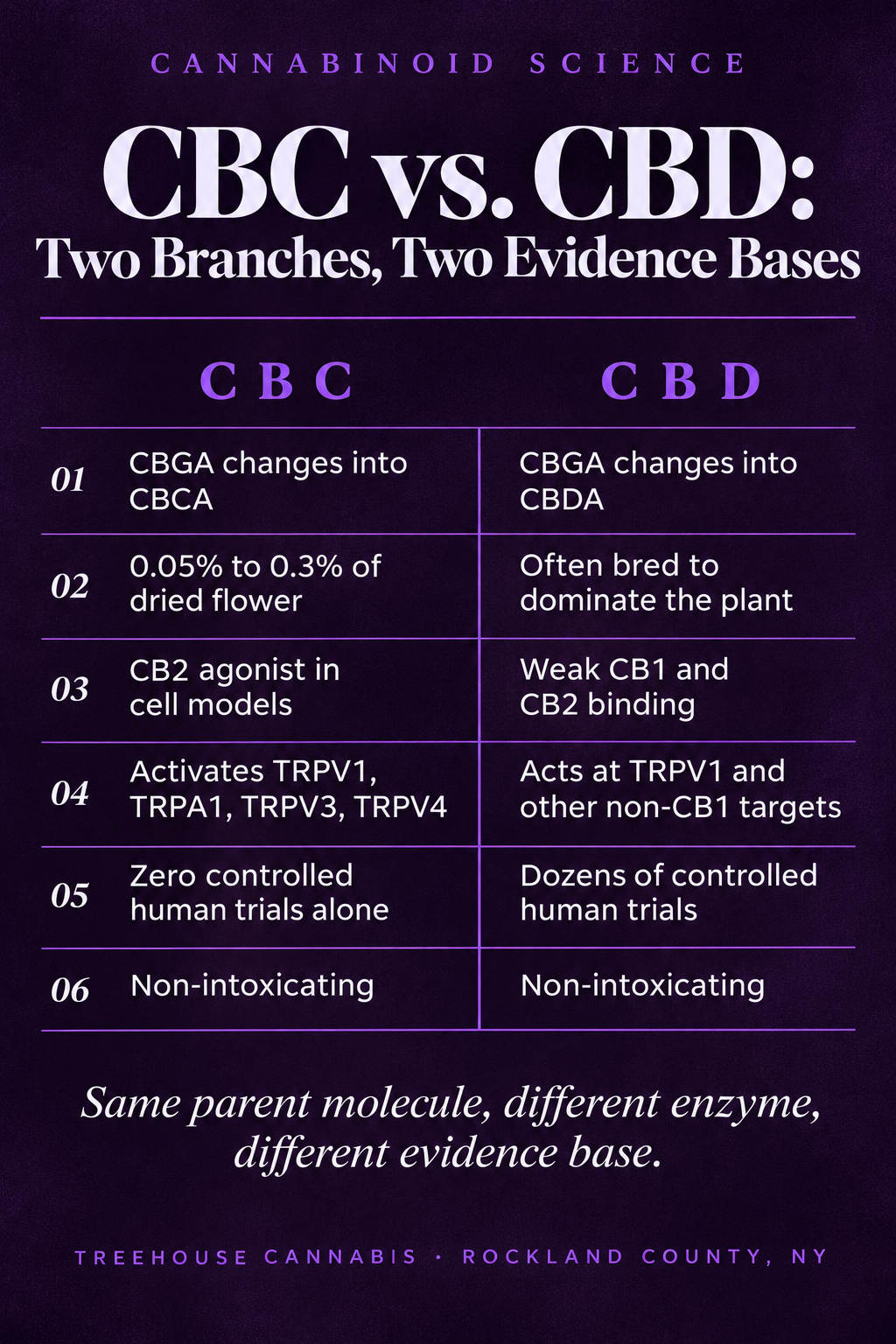
The comparison that matters most for a shopper is the evidence one.
| Feature | CBC | CBD |
|---|---|---|
| Parent molecule branch | CBGA to CBCA via CBC synthase | CBGA to CBDA via CBDA synthase |
| Typical plant abundance | 0.05% to 0.3% of dried flower | Often bred to dominate the plant |
| Receptor profile | CB2 agonist in cell models, potent TRP channel agonist | Weak CB1 and CB2 binding, acts at TRPV1 and other non-CB1 targets |
| Controlled human trials of the cannabinoid alone | Zero, as of the 2026 review | Dozens |
| Intoxicating | No | No |
- Both come from CBGA: CBDA synthase routes it to CBDA, CBC synthase routes it to CBCA
- CBC typically measures 0.05% to 0.3% of dried flower while CBD is routinely bred to dominate a plant
- CBC is a CB2 agonist and a potent TRP channel agonist, while CBD engages CB1 and CB2 only weakly
- CBD has dozens of controlled human trials and an FDA-approved prescription medicine, while CBC has zero trials in which it was given alone to people [5]
- Neither one is intoxicating, so "stronger" has no defined meaning without a specific outcome
That last row is the one that gets abused in marketing. A dispensary menu cannot tell you CBC is more potent than CBD, because no head-to-head human comparison exists to answer the question. What does exist is cell data showing CBC reaching higher efficacy than THC at CB2 [2], which is interesting pharmacology and not a statement about what a person will feel.
The shopper's version: a CBD product at a licensed dispensary has human pharmacokinetic and clinical literature behind it. A CBC product has cell and animal work plus one incidental human dataset in which CBC was a minor ingredient. Both are legal, both are non-intoxicating, and only one of them has been studied in people on purpose.
What Does CBC Research Actually Show So Far?
The research is real, it is consistent in direction, and almost all of it involves mice. Every finding below carries its species and dose for that reason.
Pain. In both male and female mice, CBC at 10 and 20 mg/kg reduced neuropathic mechanical sensitivity, acute and inflammatory formalin pain responses, and radiant-heat tail-flick responses [4]. No catalepsy was observed at those doses, which separates the effect from a THC-like sedative state. The sex-inclusive design is a genuine strength, since a lot of cannabinoid work uses male animals only.
Seizures. In a mouse model of Dravet syndrome, CBC, CBCA and CBCVA were absorbed, penetrated the brain with brain-to-plasma ratios of 0.2 to 5.8, and raised the seizure temperature threshold [7]. The acid forms working too is notable, since it suggests decarboxylation is not required for that particular effect in that model.
Inflammation. In mice, CBC and THC reduced LPS-induced paw edema additively [3]. Additive means the combination worked better than either alone, not that CBC suppressed inflammation by itself at a meaningful level. This is a combination finding reported as a CBC finding in a lot of secondary coverage.
Skin. In a mouse atopic dermatitis model, topical CBC at 0.1 mg/kg reduced lesion severity, ear and epidermal thickness, and mast cell infiltration, with lower Th2 cytokine and JAK/STAT pathway expression [9]. Topical application is the route here, not ingestion, and the dose is an animal dose.
Cells. CBC increased the viability of mouse adult neural stem progenitor cells during differentiation and inhibited their conversion into astroglia, an effect a selective adenosine A1 antagonist counteracted [8]. That last detail is the useful part: it points at a mechanism rather than just an observation.
- Pain: CBC at 10 and 20 mg/kg reduced neuropathic and inflammatory pain measures in both male and female mice, with no catalepsy [4]
- Seizures: CBC and its acid forms crossed into mouse brain and raised the seizure temperature threshold in a Dravet syndrome model [7]
- Inflammation: CBC and THC reduced paw edema additively in mice, a combination effect rather than a CBC-alone effect
- Skin: topical CBC at 0.1 mg/kg reduced lesion severity and mast cell infiltration in a mouse atopic dermatitis model [9]
- Cells: CBC kept adult neural stem cells viable and slowed their conversion to astroglia, blocked by an adenosine A1 antagonist [8]
- Zero controlled clinical trials have given CBC alone to human participants as of the 2026 review [5]
That final bullet is the whole ballgame. The 2026 review reports no published controlled clinical trial in which CBC was administered alone to humans [5]. Everything above is a reason to keep studying CBC, not a reason to expect a specific outcome from a product. If you see a label or a menu describing what CBC does for a condition, it is translating mouse data into a human promise, which is exactly the leap the research does not support.
The one plausible bridge between mouse data and a shelf is topical format, since a topical is the easiest way to deliver a cannabinoid locally without systemic exposure. If that is what you are curious about, ayrloom | Rescue 1:1 Topical | 1000MG THC : 1000MG CBD is where the format lives at a licensed shop, and the potency panel tells you what is actually in the tube.
How Much CBC Is in Cannabis Flower and Other Products?
Start with tested flower. Seized cannabis analyzed across the United States, United Kingdom and Australia carried CBC at 0.05% to 0.3% by weight [2]. For context, that is roughly one one-hundredth the concentration of THC in a modern cultivar.
The 2026 review places CBC fourth in abundance among phytocannabinoids in many chemovars, which means some batches test above that range [5]. Fourth of a large group is still small in absolute terms, and no breeder has pushed CBC the way they pushed THC or CBD.
- Tested flower across three countries carried CBC at 0.05% to 0.3% by weight, far below THC or CBD [2]
- The 2026 review places CBC fourth in abundance among phytocannabinoids in many chemovars, so some batches test higher
- CBC-forward tinctures and vapes exist because a minor cannabinoid can be concentrated during extraction
- In a human oil study CBC peaked at about 3.3 hours and CBD at about 4.5 hours, with CBC exposure far lower for a far smaller dose [1]
- The highest daily CBC dose in a human tolerability study was 26.4 mg, given alongside CBD and THC rather than alone
- Oral bioavailability is low, so an edible milligram count does not translate into a predictable blood level
That is why CBC-forward products exist at all. Extraction can concentrate a cannabinoid that the plant produces at a fraction of a percent, so a tincture or a vape cartridge can carry a meaningful CBC number that no flower sample would ever reach. Those formats are available in Flower as well as in tinctures and vaporizers, and the package panel matters far more than the plant's natural share.
The only human blood-level data is worth knowing, with a large caveat attached. In a cannabis oil study where CBC was a minor component alongside CBD and THC, CBC peaked in blood at about 3.3 hours versus 4.5 hours for CBD, and CBD exposure ran 6.6 to 9.8 times higher than CBC exposure even though the CBD dose was roughly 18 times larger [1]. The highest daily CBC dose reached in a tolerability study was 26.4 mg, again delivered alongside CBD and THC rather than alone.
Read that as pharmacokinetics, not as guidance. The review also notes low oral bioavailability for CBC [5], which means an edible milligram count does not translate into a predictable blood level. Two products listing the same CBC milligrams can behave differently depending on the carrier oil, the serving size and what else is in the formula.
If you are comparing CBC tinctures, High Dose "UP" | Tincture | 1000MG is the category where the label is most likely to carry a cannabinoid breakdown by milligram. Read the total CBC and the total THC on the same panel before comparing anything else.
Is CBC Legal in New York, and What Should You Check Before Buying?
Yes. CBC is treated as a cannabis cannabinoid, so adult-use products containing it are sold through licensed New York dispensaries to customers 21 and older. Hemp-derived CBC falls under separate state hemp rules rather than the adult-use program, which is why the same word can appear on very different products with very different testing requirements.
The licensed channel matters more for a minor cannabinoid than for a major one. Batch testing, potency labeling and age verification are the parts an unlicensed seller skips, and CBC is exactly the kind of claim that is easy to make on a label nobody checked. If a package says 50 mg of CBC and no certificate exists for the batch, the number is a design element.
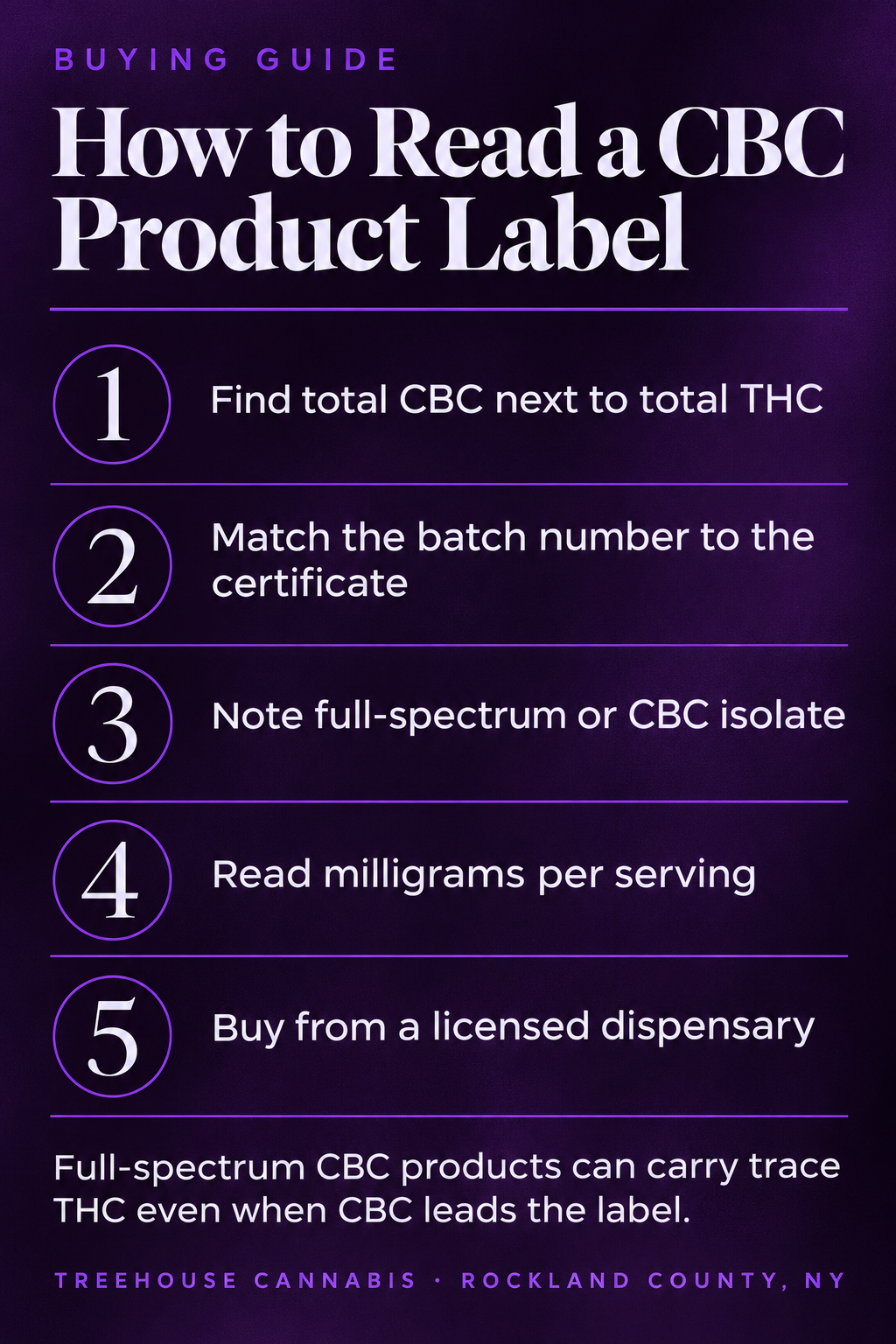
Here is how to read a CBC product label in practice:
- Find total CBC next to total THC, not on a separate part of the panel
- Match the batch or lot number to the certificate so the numbers belong to the product in your hand
- Note whether the product is full-spectrum, broad-spectrum or a CBC isolate
- Read milligrams per serving rather than milligrams per package
- Buy from a licensed dispensary, where the panel and the certificate are required rather than optional
The drug test question deserves a straight answer. Standard cannabis screens look for THC metabolites, not CBC itself. The practical risk is different: most CBC products are full-spectrum and carry trace THC that accumulates with repeated use, so a CBC product can produce a positive result even when CBC leads the label.
Anyone facing a test should treat these products as capable of doing exactly that, and no label can promise otherwise. A 1:1:1 format like Good Mood | Peach Gummies | Organic Adaptogens | 1:1:1 THC:CBD:CBC | 100mg | 20pk is a good example of a product where CBC, CBD and THC share the panel, which is precisely why the THC number needs reading.
For customers in Rockland, Orange and Westchester County, the short version is that a licensed dispensary is the only place where the CBC number on the package was measured by a lab instead of typed into a template. Bring the package to the counter and ask for the certificate for that batch.
Where Should You Start With CBC?
CBC is a real cannabinoid with real laboratory research behind it and almost no human outcome data in front of it. That combination is exactly what makes it easy to oversell and hard to shop for.
The practical takeaways are short:
- CBC is not intoxicating, so any high from a CBC product is THC
- The plant makes very little CBC, so most CBC products are built from concentrate
- The mechanism work points at CB2 and TRP channels, all of it in cells or rodents
- No controlled trial has given CBC alone to people, so no honest label can tell you what it will do for you
- Read total CBC next to total THC on the same panel before comparing two products
If you want to see what CBC looks like on a real package, Treehouse Cannabis in Rockland County stocks flower, vape cartridges, tinctures and topicals with their potency panels printed on the label, and staff can pull the certificate of analysis for the batch you are holding. Ask which products list CBC as a minor cannabinoid and compare total THC across the packages before you decide. Customers in Orange and Westchester County are welcome to make the trip or call ahead about a specific batch.
Frequently Asked Questions
What is CBC (cannabichromene)? CBC is a non-intoxicating phytocannabinoid produced by cannabis. The plant converts CBGA into CBCA using CBC synthase, and CBCA becomes CBC once it decarboxylates. It is usually a minor component, measured at 0.05% to 0.3% by weight in tested flower. Research interest focuses on its activity at TRP channels rather than at the CB1 receptor.
Does CBC get you high? No. CBC is not established as intoxicating in humans. In a blinded study of 23 cannabis users, raising CBC in smoked cannabis from 0.1% to 0.5% changed no subjective, cognitive or EEG measure, while THC produced its usual effects. Any high from a CBC product comes from the THC it also contains.
What is the difference between CBC and CBD? Both are non-intoxicating and both descend from CBGA, but they branch through different enzymes and act differently. CBC is far scarcer in the plant, is studied mainly for CB2 and TRP channel activity, and has no controlled human trials. CBD has dozens of human trials and an FDA-approved prescription medicine.
What does CBC do in the body? CBC binds weakly or not at all at CB1, acts as a CB2 agonist in cell models, and activates TRPV1, TRPA1, TRPV3 and TRPV4 channels. It also inhibits anandamide reuptake, which may indirectly raise endocannabinoid levels. Every one of those findings comes from cells or rodents rather than from people.
How much CBC is in cannabis flower? Usually very little. Testing of seized cannabis in the United States, United Kingdom and Australia found CBC at 0.05% to 0.3% by weight. Some chemovars carry more, and producers now sell CBC-forward oils and vapes, but a typical flower label lists CBC as a minor cannabinoid.
Is CBC legal in New York? CBC is treated as a cannabis cannabinoid, so adult-use products containing it are sold through licensed New York dispensaries to customers 21 and older. Hemp-derived CBC falls under separate state hemp rules. Buying from an unlicensed seller removes the batch testing and age checks the regulated market requires.
Does CBC show up on a drug test? Standard cannabis screens look for THC metabolites rather than CBC itself. The practical risk is different: most CBC products are full-spectrum and can carry trace THC that accumulates with repeated use. Anyone facing a test should treat CBC products as capable of producing a positive result.
Is CBC stronger than CBD? There is no head-to-head human data to rank them, so the claim cannot be settled. In isolated laboratory assays CBC has shown higher efficacy than THC at CB2 receptors and inhibits anandamide reuptake more strongly than CBD. Those are cell results, not effects measured in people.
Sources
- Journal of Pharmacology and Experimental Therapeutics (Sepulveda et al., Penn State College of Medicine) — Peer-reviewed review establishing that CBC is non-intoxicating, that its reporte
- British Journal of Pharmacology (Udoh, Hiley, Hoi & Ruiz, University of Sydney) — Laboratory study showing CBC activates CB2 but not CB1 receptors in engineered A
- Pharmacology Biochemistry and Behavior (DeLong, Wolf, Poklis & Lichtman, Virginia Commonwealth University) — Mouse study showing CBC produced tetrad effects that the CB1 antagonist rimonaba
- Biomedicines (Raup-Konsavage et al., Penn State College of Medicine) — Rodent study in both male and female mice finding that CBC at 10 and 20 mg/kg re
- Journal of Cannabis Research (Elbouzidi et al.) — Open-access comprehensive review describing CBC as the fourth most abundant phyt
- Behavioural Pharmacology (Ilan, Gevins, Coleman, ElSohly & de Wit, UCSF and University of Chicago) — Randomized, blinded human study in 23 healthy cannabis users in which smoking ci
- ACS Chemical Neuroscience (Anderson et al., University of Sydney) — Mouse study reporting that CBC, CBCA and CBCVA are absorbed, penetrate the brain
- Neurochemistry International (Shinjyo & Di Marzo, Institute of Biomolecular Chemistry, CNR Italy) — In vitro study finding CBC increased the viability of mouse adult neural stem pr
- International Journal of Molecular Sciences (Kim et al., Catholic University of Korea) — Mouse model of atopic dermatitis in which topical CBC at 0.1 mg/kg reduced skin
- Leafly — Consumer-facing reference that groups CBC among the 'big six' cannabinoids studi
About Treehouse Cannabis
Treehouse Cannabis is a licensed adult-use dispensary in Rockland County, New York, serving customers 21 and older across Rockland, Orange and Westchester Counties. Staff can pull the certificate of analysis for the batch of any CBC product on the shelf, and the potency panel travels with the package. This article is a guide to reading cannabinoid labels and research claims, not a recommendation for any individual product.
Cannabis is for adults 21 and older. Keep all cannabis products out of reach of children and pets.
Do not drive or operate machinery while impaired. This article is educational and is not medical advice; it does not diagnose, treat or cure any condition. Cannabis affects people differently, and anyone with a health condition, anyone taking medication, and anyone who is pregnant or breastfeeding should speak with a licensed healthcare provider before using cannabis.
Shop our products

Shop All

Deals

Flower

Pre-rolls
Vaporizers

Edibles

Drinks

Concentrates
Tinctures

Topicals

CBD

Pet CBD

Accessories