
The Cannabis Terpene Wheel: A Visual Guide to Every Common Terpene
The Cannabis Terpene Wheel: A Visual Guide to Every Common Terpene
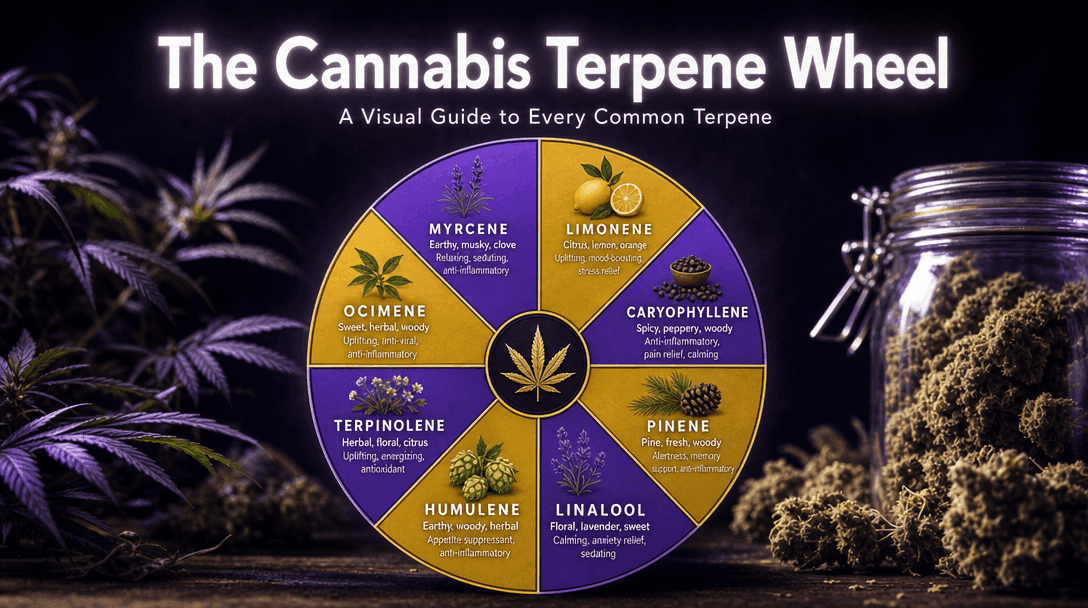
A cannabis terpene wheel is a circular chart that organizes the most common cannabis terpenes by aroma family (citrus, earthy, floral, piney, spicy, and sweet) and pairs each terpene with its dominant scent notes and reported effects. The wheel gives customers a fast way to translate a flower's smell into a predicted session without leaning on indica or sativa labels.
What Is the Cannabis Terpene Wheel?
The cannabis terpene wheel is a reference chart that places the six terpenes most often dominant in modern flower at the center of a circle, surrounded by their aroma families, scent notes, and reported effects. Customers and budtenders use it as a translation tool: smell a jar, look up the dominant terpene, and find what that terpene tends to feel like.
The wheel has replaced, for many shoppers, the older indica and sativa shorthand. Indica and sativa describe plant morphology, not the chemical profile that drives the experience; the terpene chart describes the chemistry directly [6]. Most published versions include a short list of six terpenes, the ones that show up in the largest share of modern flower.
How the cannabis terpene wheel organizes information at a glance:
- Inner ring: dominant aroma family (citrus, earthy, floral, piney, spicy, sweet).
- Middle ring: the specific terpene name paired with its primary scent notes.
- Outer ring: reported effect and the percentage of the total terpene fraction.
- Surrounding callouts: strain examples and the modern flower profiles where that terpene dominates.
How Do Terpenes Shape the Cannabis Experience?
Terpenes are aromatic oils that share the trichomes with THC and other cannabinoids, and they shape how a given flower feels in two documented ways.
The first is the entourage effect, the hypothesis that cannabinoids and terpenes modulate each other when consumed together rather than acting alone [1]. The original British Journal of Pharmacology review laid out specific synergy examples, including THC paired with pinene acting as a bronchodilator and THC paired with linalool showing muscle-relaxant relevance [7].
The second is direct receptor activity. Select cannabis terpenes modulate how THC binds to the CB1 receptor in a dose-dependent way [8], and beta-caryophyllene is the only terpene confirmed to bind the CB2 receptor directly [4]. That is why two jars with identical THC percentages can feel noticeably different from each other.
A useful framing note: monoterpenes (C10) evaporate faster than sesquiterpenes (C15), so the lighter, brighter notes on a flower tend to lift first when the jar opens, and the heavier, woody notes tend to linger [3].
Why the terpene fraction matters for the felt effect:
- The terpene fraction in dried flower is small (typically 1 to 3.5 percent of total weight) [1], so small percentage swings translate into noticeable session differences.
- Select terpenes enhance THC's binding at the CB1 receptor in a dose-dependent manner [8], meaning the percentage on a COA predicts felt intensity, not just aroma.
- Beta-caryophyllene binds CB2 directly [4], giving it a pharmacological signature the other five dominant terpenes lack.
- Two jars with identical THC percentages can still feel different because their terpene percentages diverge [7].
What Are the Six Most Common Cannabis Terpenes?
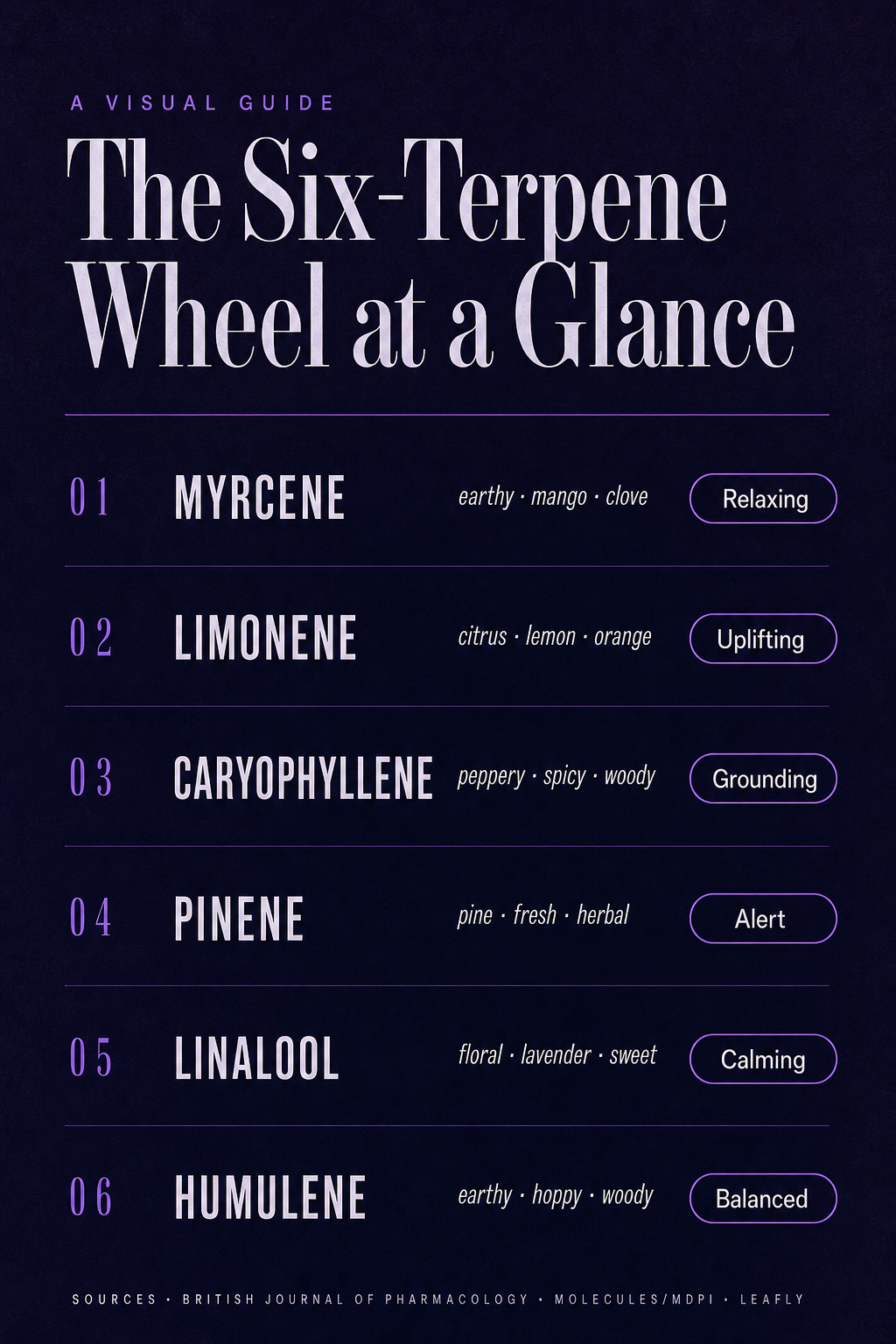
Six terpenes account for the dominant profile of most lab-tested flower: myrcene, limonene, caryophyllene, pinene, linalool, and humulene [5]. Each entry below covers the dominant aroma, common strain examples, and reported effect.
Myrcene carries an earthy, mango-and-clove scent. It is often the single most dominant terpene in modern flower, sometimes accounting for 20 to 65 percent of the total terpene profile. When myrcene crosses the 0.5 percent threshold of the terpene fraction, the chemotype tends toward the heavy, sedating feel customers associate with some indica-leaning flower [2]. For a deeper read on the chemistry and the cultural side, see Understanding Myrcene: The Aromatic Terpene Found Across Nature and Cannabis.
Limonene carries a bright citrus note, lemon and orange, and tends to anchor the more uplifting end of the wheel. It shows up in strains like Wedding Cake and Super Lemon Haze and is widely used in aromatherapy [5]. For a closer look at limonene's role across the plant kingdom, see A Guide to Limonene in Cannabis.
Caryophyllene carries a peppery, spicy, woody aroma. It is the only terpene known to bind the CB2 receptor, which gives it a unique pharmacological profile among the six [4]. Black pepper and cloves share the same compound. For a deeper dive, see Beta-Caryophyllene: Exploring the Peppery, Herbaceous Terpene Found Across the Plant Kingdom.
Pinene brings the fresh pine-needle character. It is one of the most abundant terpenes in nature, found in pine needles, rosemary, and basil, and in cannabis it tends to anchor the alert, clear-headed end of the experience. Classics like Jack Herer and Blue Dream carry it prominently [6].
Linalool carries a floral, lavender-like sweetness. It is widely used in aromatherapy for its calming associations and shows up in strains with a candy-shop floral note [2]. For a botanical and cultural look at linalool, see Understanding Linalool: A Botanical and Cultural Look at One of Cannabis’s Most Recognized Terpenes.
Humulene carries an earthy, hoppy, woody character, the same compound that gives beer its aromatic backbone. In cannabis, it tends to anchor the balanced, appetite-aware middle of the wheel [5]. For a closer look at where humulene shows up across the plant kingdom, see What Is Humulene and Why Does It Show Up in Herbs, Black Pepper, and Cannabis?.
Beyond the big six, three other cannabis terpenes show up often enough to be worth knowing: ocimene, a sweet and uplifting note found in some tropical-fruit-leaning strains What Is Ocimene? The Sweet, Uplifting Terpene in Cannabis; terpinene, an herbal and citrus-leaning terpene that rounds out the brighter side of the wheel What Is Terpinene in Cannabis? An Educational Overview; and farnesene, a lesser-known terpene that contributes a green-apple note in some cultivars.
Six dominant terpenes and where each lands on the wheel:
- Myrcene: earthy, mango, clove; relaxing, body-heavy [2].
- Limonene: citrus, lemon, orange; uplifting, mood-lifting [5].
- Caryophyllene: peppery, spicy, woody; grounding, anti-inflammatory [4].
- Pinene: pine, fresh, herbal; alert, clear-headed [6].
- Linalool: floral, lavender, sweet; calming, soothing [2].
- Humulene: earthy, hoppy, woody; appetite-aware, balanced [5].
How Do You Read a Terpene Chart by Aroma Family?
Read a terpene chart outward from the center. The center groups terpenes by dominant aroma family (citrus, earthy, floral, piney, spicy, sweet). Each ring adds detail (the terpene's name, its primary scent notes, its reported effect, its percentage of the total terpene fraction), and higher percentages usually mean that terpene's character is more likely to dominate the experience.
Key points:
- Read outward from center; each ring adds detail about a terpene (name, scent, effect, percentage).
- The center ring groups terpenes by dominant aroma family, like citrus, earthy, or floral.
- Higher terpene percentages mean that terpene's character is more likely to dominate the experience.
- The middle ring pairs each terpene name with its primary scent notes for quick lookup.
- The outer ring shows reported effect and the percentage of the total terpene fraction on the COA.
| Aroma family | Representative terpene | Scent notes |
|---|---|---|
| Citrus | Limonene | Lemon, orange, grapefruit |
| Earthy | Myrcene | Mango, clove, damp soil |
| Floral | Linalool | Lavender, sweet candy |
| Piney | Pinene | Pine needle, fresh herbs |
| Spicy | Caryophyllene | Black pepper, woody |
| Sweet | Ocimene | Tropical fruit, herbal sweet |
If a flower's COA shows 0.8 percent myrcene and 0.3 percent limonene, the myrcene character will likely dominate the experience; if those numbers flip, the limonene character likely will [6].
Which Terpenes Pair with Which Cannabis Products?
Different product categories preserve the native terpene profile to very different degrees, which means the same terpene wheel reads differently across the menu.
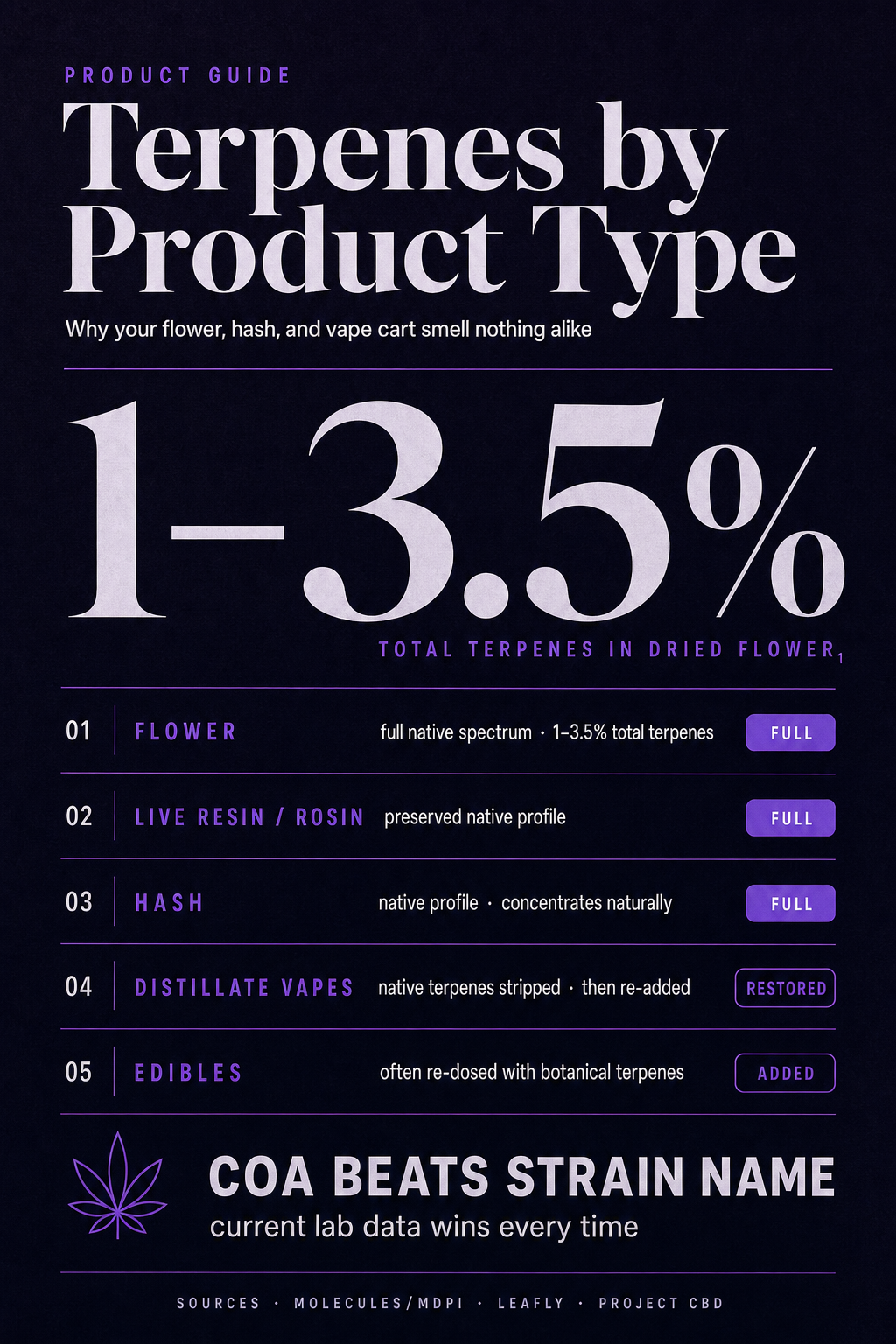
Flower shows the full native spectrum. Dried flower typically carries between 1 and 3.5 percent total terpenes by weight, which is what gives each jar its distinctive scent when you crack the seal [1]. To see this in the menu, browse current .
Full-spectrum concentrates (live resin, live rosin, hash) preserve the native terpene profile by skipping the harsh winterization steps that strip volatiles. For concentrates on the Treehouse menu, look at .
Distillate vapes are the counter-example. Distillation strips native terpenes out and then re-adds them, or adds botanical terpenes, for flavor. The aroma reading on the package reflects what was added back rather than what the original plant produced [6]. The Treehouse menu's include both distillate and live-resin carts; the COA tells you which is which.
Product formats and how each treats the terpene wheel:
- Flower: full native terpene spectrum, 1 to 3.5 percent total terpenes by weight [1].
- Live resin and live rosin: native profile preserved because the process skips the harsh winterization steps that strip volatiles.
- Hash: native profile carried through solventless mechanical separation.
- Distillate vapes: native terpenes stripped during distillation, then re-dosed with cannabis-derived or botanical terpenes for flavor [6].
- Commercial edibles: distillate or isolate base, with a terpene blend added for flavor.
Why Does the Same Strain Smell Different Jar to Jar?
Two jars of the same cultivar can carry noticeably different terpene profiles, and the difference usually traces back to one of four variables.
- Grow conditions: light spectrum, temperature swings, and nutrient timing each shift which terpenes the plant expresses most strongly.
- Harvest timing: pulling a plant a week earlier or later can move a terpene from dominant to background.
- Cure: a slow, controlled cure preserves volatile terpenes; a fast or hot cure lets them off-gas.
- Storage: heat, light, and oxygen each degrade terpenes over time, so the same flower smells different fresh versus six months old.
The Leafly guide on cannabis terpenes makes the same point: aroma profiles vary harvest to harvest, and a current COA is more useful than a strain name [6]. For farnesene especially, which sits at lower concentrations in most cultivars, harvest and cure can move it from detectable to background What Is Farnesene? A Closer Look at One of Cannabis’s Lesser-Known Terpenes.
Does the Terpene Wheel Apply to Vapes and Edibles?
The wheel works best for flower and full-spectrum concentrates because the native terpene profile survives the production process in those formats. Distillate vapes and many commercial edibles break that chain.
During distillation, native terpenes are stripped along with other volatile compounds. Producers then re-dose the distillate with cannabis-derived or botanical terpenes for flavor and effect. The aroma reading on a distillate cart reflects what was added back, not what the original flower produced [6].
Edibles follow a similar pattern. Many commercial gummies and baked goods use distillate or isolate as the cannabinoid base and then add a terpene blend for flavor. The same wheel still applies to what you smell on the package, but it does not necessarily reflect the terpene profile of the source flower.
For customers who care about the native spectrum, the short version is: flower and full-spectrum concentrates show the wheel; distillate vapes and most commercial edibles show a re-dosed version of it.
How the wheel reads across product types:
- Flower and live resin: native spectrum intact, wheel maps directly to the COA [6].
- Distillate vapes: native terpenes stripped, then re-dosed with botanical or cannabis-derived terpenes [1].
- Edibles using distillate: same re-dosing pattern as vapes, so the package aroma is added, not native.
- Hash and rosin: native profile carries through because no harsh winterization or distillation strips volatiles.
What Are the Most Common Questions About the Cannabis Terpene Wheel?
Quick answers:
- A cannabis terpene wheel groups the most common cannabis terpenes by aroma family.
- Researchers have identified more than 100 individual terpenes in the cannabis plant.
- Myrcene and linalool are the two terpenes most often linked to calming, body-heavy sessions.
- Limonene and pinene tend to anchor the more uplifting, alert end of the terpene wheel.
- Terpenes are aromatic oils, not cannabinoids, but they can shape how cannabinoids feel.
What is a cannabis terpene wheel?
A cannabis terpene wheel is a circular visual chart that groups the most common cannabis terpenes by aroma family (citrus, floral, earthy, piney, spicy, sweet) and pairs each with its sensory notes and reported effects. The wheel gives adult-use customers a fast way to translate a strain's smell into a predicted experience without relying on indica or sativa labels.
How many terpenes are in cannabis?
Researchers have identified more than 100 individual terpenes in the cannabis plant, though most lab-tested flower shows a dominant profile of six to ten. Six of them (myrcene, limonene, caryophyllene, pinene, linalool, and humulene) appear in the largest share of modern flower and anchor nearly every published terpene wheel [6].
Which terpene is best for relaxation?
Myrcene and linalool are the two terpenes most often associated with calming, body-heavy sessions. Myrcene in particular is linked to the heavy, sedating feel attributed to some indica-leaning flower, especially when it crosses the 0.5 percent threshold of the terpene fraction [2]. Linalool contributes the lavender-like floral note and is widely used in aromatherapy for the same reason.
Which terpene is most energizing?
Limonene and pinene tend to anchor the more uplifting, alert end of the terpene wheel. Limonene carries the bright citrus note common in strains like Wedding Cake and Super Lemon Haze, while pinene brings the fresh pine-needle character found in classics like Jack Herer and Blue Dream [5].
Do terpenes actually change how cannabis feels?
Yes. Peer-reviewed research shows select cannabis terpenes modulate how THC interacts with the CB1 receptor and bind to their own receptor targets, including beta-caryophyllene at the CB2 receptor [4]. Combined with the entourage-effect hypothesis [1], this is why two flower jars with identical THC percentages can feel noticeably different.
How do you read a terpene chart?
Read a terpene chart outward from the center. The center groups terpenes by dominant aroma family (citrus, earthy, floral, piney, spicy, sweet). Each ring adds detail: the terpene's name, its primary scent notes, its reported effect, and its percentage of the total terpene fraction. Higher percentages usually mean that terpene's character is more likely to dominate the experience [6].
Are terpenes the same as cannabinoids?
No. Terpenes are aromatic oils produced in the same trichomes that make cannabinoids like THC and CBD, but they are a different class of compound. Cannabinoids primarily act on the body's endocannabinoid system, while terpenes contribute aroma, flavor, and their own mild receptor activity that can shape how cannabinoids feel [3].
Does the terpene wheel work for vapes and edibles?
The wheel works best for flower and full-spectrum concentrates. Distillate-based vapes and many commercial edibles are often stripped of native terpenes and re-dosed with botanical or cannabis-derived terpenes for flavor, so the aroma reading on the package reflects what was added back rather than what the original plant produced [6].
Sources
- British Journal of Pharmacology (Russo, 2011) — Defines the entourage-effect hypothesis and documents synergy examples such as T
- Molecules / MDPI (Maccarrone, et al., 2021) — Catalogs pharmacological activities of major cannabis terpenes (myrcene, limonen
- Molecules / MDPI (Chittasupho et al., 2020) — Details monoterpene vs. sesquiterpene classification (C10 vs. C15) for cannabis
- Pharmacological Research (Pavlovic et al., 2024) — Documents receptor-level interactions of myrcene, linalool, limonene, pinene, an
- Leafly — Consumer-facing reference that links myrcene to relaxing effects, limonene to st
- Leafly — Explains the botanical origin of terpenes (trichomes), the three most abundant t
- Project CBD — Patient- and clinician-oriented explainer of how terpenes interact with cannabin
- NORML — Summarizes a peer-reviewed study showing select terpenes enhance THC's binding a
About Treehouse Cannabis
Treehouse Cannabis is an adult-use dispensary serving Rockland County, Orange County, and Westchester County from its location in Rockland County, New York. Our menu is organized around lab-tested flower, full-spectrum concentrates, and re-dosed vapes, and every product page links to the current COA so customers can see the exact terpene percentages before they buy. Browse the current Treehouse Cannabis menu and use the terpene percentages on each lab-tested COA to match a flower or concentrate to the aroma and effect you are after. Our budtenders in Rockland County can walk you through the terpene profile on anything in stock.
Cannabis is for adults 21 and older. Keep all cannabis products out of reach of children and pets. The content in this article is intended for educational and informational purposes only and is not a substitute for professional medical advice, diagnosis, or treatment. Always seek the advice of a qualified health provider with any questions you may have regarding a medical condition. Cannabis laws vary by jurisdiction; please follow your local regulations.


Shop our products

Shop All

Flower

Pre-rolls
Vaporizers

Edibles
Drinks

Concentrates
Tinctures

Topicals

CBD

Pet CBD

Accessories