

Runtz Strain Family: Genetics, Variations, and Terpenes
Runtz Strain Family: Genetics, Variations, and Terpenes
The Runtz strain is a hybrid cannabis cultivar made by crossing Zkittlez with Gelato, most often identified as Gelato #33. It carries a fruit-candy and gas aroma over a balanced, calming high, and it is one of the few modern strain names with a documented pedigree. What the name still cannot tell you is which cut is in the jar in front of you.
Most strain names are a promise with nothing behind them. Runtz is the case where the plants can actually be traced: two named parents, two named grandparents, a breeder, and a dated arrival on the scene. That gap between the documented pedigree and the jar on the shelf is the whole story of this family.
What Is the Runtz Strain?
The Runtz strain is a hybrid cannabis cultivar made by crossing Zkittlez with Gelato, most often identified as Gelato #33. It is known for a fruit-candy and gas aroma and a balanced, calming high that opens with cerebral energy before settling into the body.
The short version of the family, in the order it happened:
- The cross: Zkittlez with Gelato, most often identified as Gelato #33
- The breeder: Nick Corwin, with the Runtz crew on branding and Cookies on distribution from 2018
- The launch: a December 2017 Emerald Cup soft launch that became a national strain the following year
- The recognition: Leafly's Strain of the Year for 2020, two years after Gelato held the same title
- The caveat: at least 20 named variations exist, and only selections of the original cross are true Runtz phenotypes
On who made it, credit generally goes to Nick Corwin, who crossed an indoor Zkittlez with Gelato 33. The Runtz crew handled the branding, and Cookies took distribution national in 2018 [4] [2]. That distribution deal is the reason a strain that debuted quietly became a name you see on menus in states that never grew it.
The pedigree is unusually decorated for a modern cultivar. Both parents were already award winners before the cross existed, with the Zkittlez line taking 1st Place at the 2016 Emerald Cup and Gelato named Leafly's Strain of the Year in 2018 [7] [3]. Runtz then won the same title for 2020 [3].
Here is the caveat that frames everything below. Leafly records at least 20 named variations of Runtz, and only selections of the original Zkittlez-and-Gelato cross are properly called Runtz phenotypes [1]. Names like Rainbow Runtz or Runtz Cake usually describe separate crosses built on Runtz as one parent, which is a different thing wearing the same word.
The rest of this article separates the documented pedigree from the directory listings. It shows where the family splits into true phenotypes and lookalike crosses, what the terpene panels actually say, and how to read a package before you buy. If you want the same treatment applied to another heavily copied name, Sour Diesel Strain Family: History, Genetics, and Terpenes walks through a family with a far messier paper trail.
Where Do Runtz Genetics Come From?
Runtz genetics come from a two-parent cross: Zkittlez on one side and Gelato, usually Gelato #33, on the other. That gives the family something most modern strain names cannot offer, a documented set of named grandparents rather than a vague claim of mysterious origins.
Build the tree one generation at a time and the parent lines hold up. Zkittlez is itself a Grape Ape and Grapefruit cross with an undisclosed third strain, and it took 1st Place at the 2016 Emerald Cup at the same event where Runtz would soft-launch a year later [7].
Gelato is Sunset Sherbet crossed with Thin Mint Girl Scout Cookies, with caryophyllene, limonene, and humulene as its leading terpenes [8]. Gelato's own 2018 Strain of the Year title came before Runtz had national distribution [3].
The cross itself is credited to Nick Corwin, who put an indoor Zkittlez over Gelato 33. Abstrax Tech places the resulting family in the candy-gas aroma category rather than the older skunky or citrus families, which is a useful way to think about what Zkittlez contributed and what Gelato contributed [4]. If you want the background on how those compounds produce aroma in the first place, A Guide to Terpenes and Their Effects covers the chemistry.
The selections deserve their own line, because they are the reason a family exists instead of a single plant. The #3 and #7 phenotype picks are part of the documented origin story, chosen from a run of the same cross for different expressions [2]. One of those lines went on to take 1st Place for Sungrown Flower at the 2019 Emerald Cup against more than 700 entries [4].
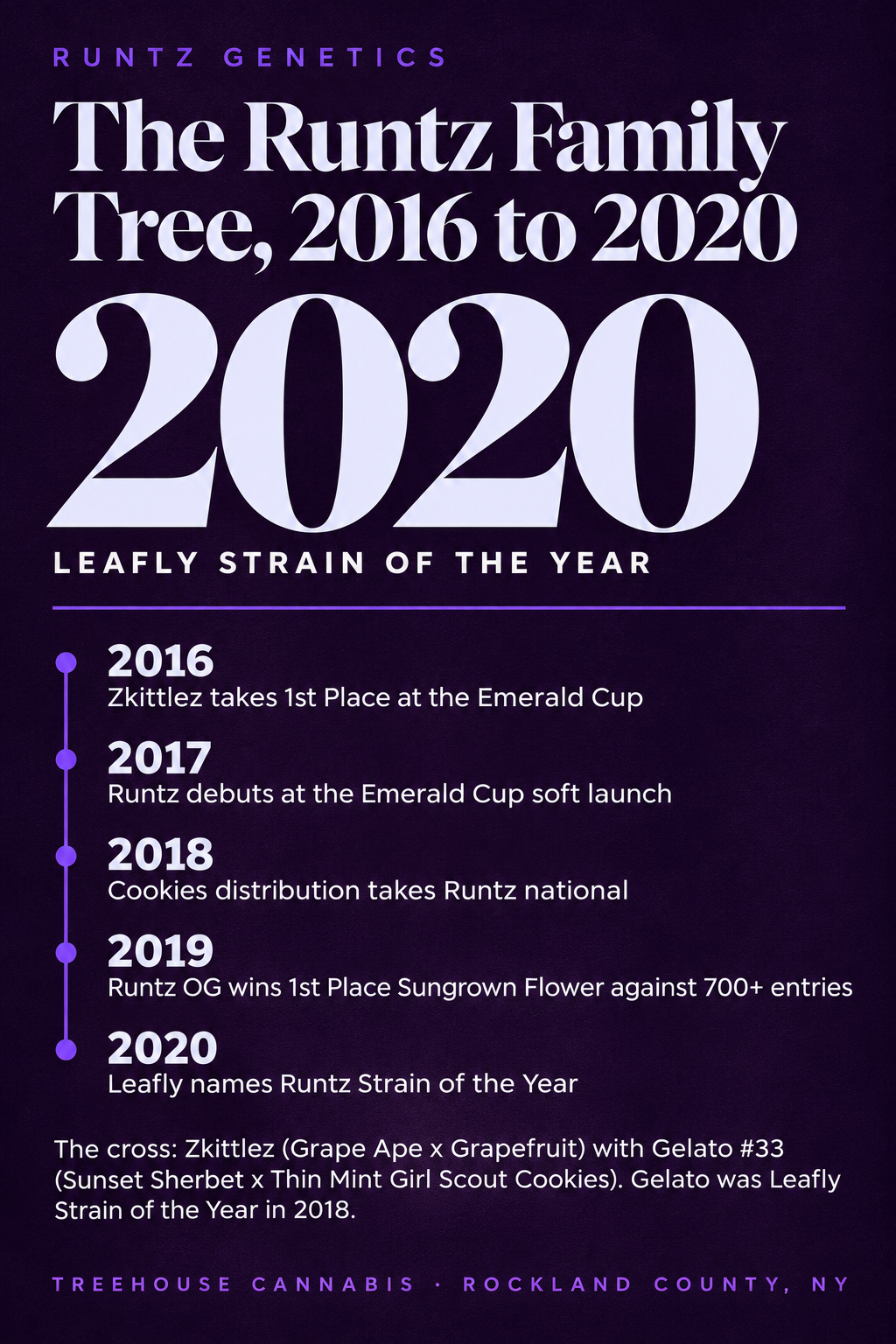
What that pedigree proves is narrow and worth stating plainly. It tells you which two plants were involved and roughly when the cross was made. It does not tell you which cut ended up in a given jar, because no authority enforces a strain name. Two growers can both label a harvest Runtz and be working from different selections, or from something else entirely.
Read as a family tree, the lineage looks like this:
- Zkittlez: Grape Ape crossed with Grapefruit, plus one undisclosed line, 1st Place at the 2016 Emerald Cup
- Gelato: Sunset Sherbet crossed with Thin Mint Girl Scout Cookies, Leafly Strain of the Year for 2018
- Runtz: an indoor Zkittlez pollinated by Gelato 33, credited to Nick Corwin
- Runtz OG: a selected line from that cross that took 1st Place for Sungrown Flower at the 2019 Emerald Cup
Is the Runtz Strain Indica or Sativa?
Runtz is a balanced hybrid, generally listed near 50/50, and reported effects blend cerebral euphoria with body relaxation. Most consumers describe the finish as calming rather than energizing, which is why the strain reads slightly heavier than a true even split on paper.
The label is a weak guide, and it is worth understanding why instead of pretending the split is measured. No laboratory test outputs an indica-to-sativa percentage. Any published figure is a directory's editorial call, compiled from grower submissions and effect reports, which is why the same strain can read as a 50/50 hybrid in one place and a slight indica lean in another [1].
Something more reliable sits in its place: the shape of the reported experience across the family. Standard Runtz is described as balanced.
White Runtz reads creamier and calmer, with its linalool-forward panel pulling the finish toward vanilla [5]. Pink Runtz is commonly reported as giggly and talkative rather than heavy [6]. Same name, three different experiences, all from plants sold under the same word.
Three variables move a batch along that spectrum:
- Which phenotype was grown, since a selection is not the same plant as its sibling
- When it was harvested, because trichome maturity shifts the reported effect
- How much is consumed, which changes the experience more than the label does [1] [5]
For a store visit, that has a practical consequence. A budtender quoting a percentage split is repeating a directory rating, not a lab result, and other hybrids carry the same kind of rating rather than a measured number - White Durban Strain: Genetics and Terpene Profile is a good example of how directory language describes a family rather than chemistry.
The more useful question is how people describe the batch on the shelf. The terpene and potency sections below give you measured information to work with instead of a label.
What Terpenes Are in the Runtz Strain?
Leafly lists caryophyllene, limonene, and myrcene as the most abundant terpenes in Runtz, with caryophyllene at the front. That panel explains the pepper-and-spice base sitting under the fruit-candy top notes, which is the aroma the family is named for.
Each compound has a documented role, and none of them needs a marketing story.
- Caryophyllene carries the pepper and spice note, and it is the one with the clearest pharmacological description on record, demonstrated as a selective CB2 receptor agonist in a review of cannabis terpenoid effects [9]
- Limonene supplies the citrus lift that reads as candy in this family
- Myrcene supplies the earthy fruit depth sitting underneath the sweetness [1]
Read together, that trio accounts for the sweet-spice-and-gas impression better than any single compound does. A high-caryophyllene batch smells like cracked pepper and cedar. A high-limonene batch smells like orange peel and candy. Runtz usually reads as both at once, with the fruit on top.
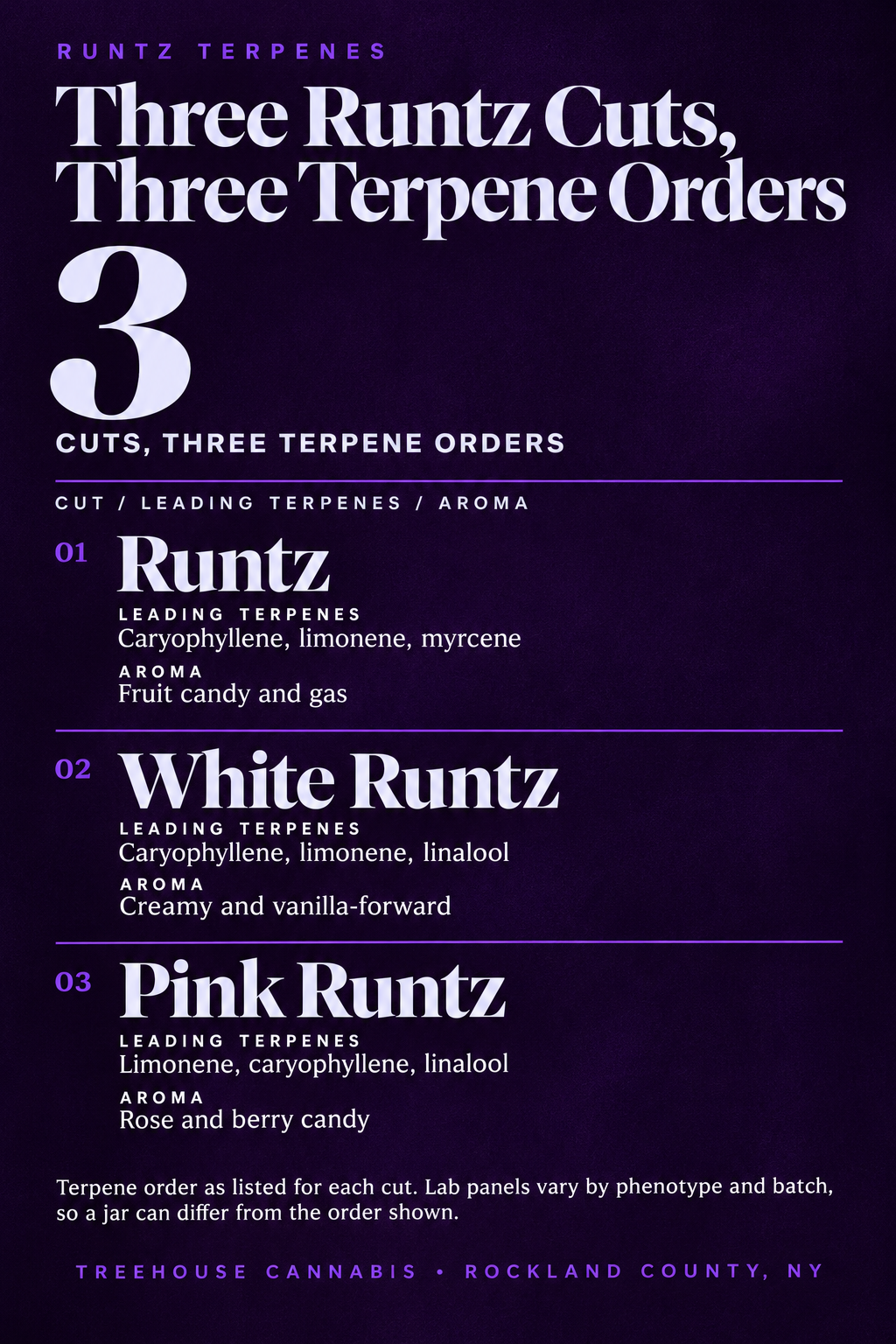
Then the disagreement, which is the real argument in this section. The order is not stable across the family; Pink Runtz reads limonene first, followed by caryophyllene and linalool [6], while White Runtz reads caryophyllene first with linalool close behind [5].
Three cuts sold under one name present three different panels, and each panel describes the plant in the package rather than the strain in the abstract.
Why that happens is answerable at the level the evidence supports. Terpenoids contribute to strain-level differences in aroma and experience, so the ratios matter as much as the compounds present [9]. The plant itself carries roughly 540 chemical substances and more than 100 cannabinoids beyond THC and CBD, which makes any terpene panel a map of a few peaks rather than the whole terrain [10].
The defensible position is this: a terpene panel is the most reliable description available of how a specific batch will smell, and it describes that batch. It does not describe the strain as a fixed thing, and it does not predict potency. A jar with a limonene-forward panel will smell citrusy. That is the promise it can keep.
Which Runtz Variations Are Worth Knowing?
The two variations you will actually see labeled as Runtz are White Runtz and Pink Runtz, and both are phenotype selections of the original Zkittlez-and-Gelato cross rather than new hybrids. Most other Runtz names are separate crosses that use Runtz as one parent, which is a different category entirely.
Defining that difference properly is the most useful thing this article can do. A phenotype is the same cross, selected differently. A cross is Runtz used as one parent of something new.
White Runtz is described as a Gelato and Zkittlez hybrid phenotype with a dense white-trichome appearance and a listed panel of caryophyllene, limonene, and linalool, reading creamier and more vanilla-forward than the standard cut [5].
Pink Runtz is described as a phenotype of the original Runtz, with limonene, caryophyllene, and linalool leading its panel and a dense green-to-purple bud structure that pushes the aroma toward rose and berry candy [6].
| Cut | Relationship to Runtz | Listed leading terpenes | Aroma |
|---|---|---|---|
| Runtz | The original cross | Caryophyllene, limonene, myrcene | Fruit candy and gas |
| White Runtz | Phenotype selection | Caryophyllene, limonene, linalool | Creamy, vanilla-forward |
| Pink Runtz | Phenotype selection | Limonene, caryophyllene, linalool | Rose and berry candy |
The size of the family is the thing to hold onto. Leafly records at least 20 named variations of Runtz, which means a single menu can carry a dozen names that share almost nothing but a word [1]. That is not a knock on the growers. It is what happens when a name becomes valuable.
Strain names are marketing terms with no enforced genetic standard behind them, so a name that sells gets reused on whatever a grower has available. The drift shows up everywhere, including hardware. If you would rather skip flower, note that oil in All In One Vaporizers carries the same problem: the strain on the cartridge is a labeling decision, not a genetic record.
The two categories, separated:
- Phenotype selections - White Runtz and Pink Runtz, the same cross chosen for different traits
- Crosses - Rainbow Runtz, Runtz Cake, and Lemon Cherry Runtz are usually Runtz used as one parent of something new, with records varying by breeder
The practical rule follows from that. Read the package, not the name. Any Runtz label without a stated cut is a starting point, not an answer.
How Potent Is the Runtz Strain?
Runtz is THC-dominant, with tested flower commonly reported from the high teens into the high twenties depending on the batch and the phenotype. The number on the label describes one tested lot, not the strain, and that distinction is where most potency conversations go wrong.
THC content varies across cannabis products generally, so two jars with the same name can land at very different percentages [12]. A 19% batch and a 27% batch can both be honestly labeled Runtz, grown from the same selection, harvested months apart. Current Flower listings show exactly that spread across the same category.
Potency is also not the same measurement as experience. Terpene ratios, how much is consumed, and delivery method all shape how a given batch feels, so a higher percentage is not automatically a stronger experience [9]. Anyone who tells you otherwise is quoting a menu, not a result.
Reading a regulated label is a skill worth having. Under a licensed adult-use framework like California's, products carry testing and labeling requirements, which means a package should tie a potency figure to a specific tested lot with a date [11]. A figure floating on a menu screen with no lot behind it is a claim, not a test.
A certificate also has a limit worth naming. It identifies a sample, not a breeder or a cut, so flower tested under the Runtz name is not proof of the original Corwin selection [5] [6]. The lab can tell you what was in the jar it received. It cannot tell you whose plant it was.
Context for the number itself: the plant contains roughly 540 chemical substances and more than 100 cannabinoids beyond THC and CBD, and the FDA has not approved the cannabis plant for any medical use [10]. A potency figure is one number pulled from a large set.
One more point, stated plainly. Cannabis can affect attention, coordination, reaction time, and judgment, which is why the percentage matters less than how much is consumed and how [12].
What the potency line on a package is and is not:
- It is a measurement of one tested lot, tied to a date and a sample
- It is not a description of the strain, since the same selection lands differently harvest to harvest
- It is not a prediction of experience, because terpene ratios and method move that independently
- It is not proof of a specific cut, since the certificate names a sample rather than a breeder [11] [5]
How Do You Choose a Runtz Strain at a Dispensary?
Judge the batch, not the name. Check the aroma when the package opens, look at the bud structure and trichome condition, and confirm the label carries a terpene panel that matches the lot you are buying rather than a generic strain description.
Aroma first, because it is the fastest honest signal. Fruit candy and gas should be immediate when a sealed package is opened, since those volatile compounds are what the family is named for. A jar that smells of hay has lost them, and no label fixes that.
Structure next. White Runtz is described with dense white trichome coverage and Pink Runtz with a dense green-to-purple structure, so a pale, loose, or heavily machined sample is not showing the traits either cut is known for [5] [6].
Trichomes tell you about condition rather than strength. Frosty and intact reads as fresh resin. Dull and matte reads as oxidation already underway. Neither is a potency test, and neither is a substitute for the panel.
The label carries the most weight. A terpene panel matters as much as the THC line, because a batch with low limonene will not deliver the citrus the name promises, and the family's own cuts disagree on which terpene leads [1] [6].
Then the one question worth asking at the counter: which cut is this, and can you show me the test for this batch? With at least 20 variations in circulation and no enforced genetic standard, the cut and the lot are the only things separating one jar from another [1].
When the answer is vague, treat the name as a starting point and buy the batch whose numbers and aroma you can verify. Bulk formats make this easier to judge per gram, and an option like Unruly Cookies • Flower • 70g lets you evaluate a larger package on the panel rather than on the label alone.
Boss Prophet | 28pk Pre-rolls | 14g
If you would rather skip flower entirely, pre-rolls and vape hardware are a reasonable route - though the same rule applies, since the strain name on a cartridge is a labeling decision rather than a genetic record.
Strawberry Jam | House Of Sacci | Disposable Vape | 2g
Sales are for adults 21 and older under licensed adult-use rules [11], and the package is the only part of the transaction that carries a test behind it.
A short checklist for the counter:
- Smell it the moment the package opens, and walk away from hay
- Look for dense structure with intact, frosty trichomes
- Read the terpene panel before the THC line
- Ask which cut it is, and ask to see the test for that batch
- Buy the batch you can verify rather than the name you recognize
The Runtz family is worth buying on the batch in front of you rather than the name on the jar. The terpene panel tells you which cut you are actually holding, and the aroma when the package opens tells you whether it still has what the name promises. Treehouse Cannabis in Rockland County, NY carries Runtz flower, pre-rolls, and vape cartridges across the family, lists the terpene and potency details on the shelf, and will pull a package so you can read the label before it goes in the bag. Browse the current menu or order online for pickup and delivery across Rockland, Orange, and Westchester Counties.
Frequently Asked Questions
What strain is Runtz made from?
Runtz is a cross of Zkittlez and Gelato, most often identified as Gelato #33. Zkittlez supplies the candy-fruit top notes from a Grape Ape and Grapefruit line, while Gelato adds cream, dessert sweetness, and a gas backbone. Breeding credit generally goes to Nick Corwin. [1] [4]
Is the Runtz strain indica or sativa?
Runtz is sold and referenced as a balanced hybrid, roughly 50/50. Reported effects blend cerebral euphoria with body relaxation, though many consumers describe it as more calming than energizing. Phenotype, harvest timing, and dose all shift where a given batch lands on that spectrum. [1]
What terpenes are in the Runtz strain?
Leafly lists caryophyllene, limonene, and myrcene as Runtz's most abundant terpenes. Caryophyllene contributes pepper and spice, limonene adds citrus lift, and myrcene supplies earthy fruit depth. Lab panels vary by phenotype: Pink Runtz reads limonene-first, while White Runtz reads caryophyllene-first with linalool close behind. [1] [5] [6]
What is the difference between Runtz and White Runtz?
White Runtz is a phenotype selection of the original Runtz, not a separate cross. It typically reads creamier and more vanilla-forward with heavy white trichome coverage, and its listed terpenes are caryophyllene, limonene, and linalool. Standard Runtz is brighter, more fruit-candy, and slightly more gassy on the finish. [5]
How is Pink Runtz different from regular Runtz?
Pink Runtz is a phenotype of the original cross, selected for floral sweetness and green-to-purple coloration. Leafly lists limonene first, followed by caryophyllene and linalool, which pushes the aroma toward rose and berry candy. Consumers commonly report giggly, talkative effects rather than a heavy body finish. [6]
Why is the Runtz strain so popular?
Runtz debuted at the December 2017 Emerald Cup and reached a national audience after Cookies added it to its lineup in 2018. Leafly named it Strain of the Year in 2020. Both parent lines were already award winners before the cross existed, which gave the name an unusually strong pedigree to build on. [2] [3]
Do Runtz crosses count as Runtz genetics?
No. Only selections of the original Zkittlez and Gelato cross are properly called Runtz phenotypes. Names like Rainbow Runtz, Runtz Cake, or Lemon Cherry Runtz usually describe separate crosses that use Runtz as one parent. Records vary by breeder, so the package label is the reliable source. [1]
How potent is the Runtz strain?
Runtz is THC-dominant, with tested flower commonly reported from the high teens into the high twenties depending on the batch and phenotype. Potency is not the same as experience, since terpene ratios and delivery method shape how a batch feels. The figure describes one tested lot, not the strain. [12] [9]
Sources
- Leafly — Leafly lists Runtz as a Zkittlez and Gelato cross with caryophyllene, limonene a
- Weedmaps — Documents the Runtz origin story, the #3 and #7 phenotype selections, the 2017 E
- Leafly — Leafly named Runtz its 2020 Strain of the Year and confirms both parents were pr
- Abstrax Tech — Traces Runtz to breeder Nick Corwin crossing indoor Zkittlez with Gelato 33, not
- Leafly — Describes White Runtz as a Gelato and Zkittlez hybrid phenotype with caryophylle
- Leafly — Describes Pink Runtz as a phenotype of the original Runtz with limonene, caryoph
- Leafly — Identifies the Zkittlez parent line as a Grape Ape and Grapefruit cross with an
- Leafly — Identifies the Gelato parent line as a Sunset Sherbet and Thin Mint Girl Scout C
- British Journal of Pharmacology (NIH PubMed Central) — Reviews evidence that cannabis terpenoids contribute to strain-level differences
- National Center for Complementary and Integrative Health (NIH) — Confirms the cannabis plant contains roughly 540 chemical substances and more th
- California Department of Cannabis Control — Establishes the adult-use regulatory framework for licensed cannabis in Californ
- National Institute on Drug Abuse (NIH) — Describes how THC content varies across cannabis products and that cannabis use
About Treehouse Cannabis
Treehouse Cannabis is a licensed adult-use dispensary in Rockland County, New York, serving customers across Rockland, Orange, and Westchester Counties. This article is a guide to reading strain names and terpene panels, not a recommendation for any individual product.
Cannabis is for adults 21 and older. Keep all cannabis products out of the reach of children and pets, and do not drive or operate machinery after use. This article is educational only, is not medical advice, and does not recommend cannabis for any health condition. Cannabis affects people differently, and laws vary by state and locality.


Shop our products

Shop All

Deals

Flower

Pre-rolls

Vaporizers

Edibles

Drinks

Concentrates

Tinctures

Topicals

CBD

Pet CBD

Accessories