
Cannabis and PMS: What Women Should Know
Cannabis and PMS: What Women Should Know
What the research actually shows about cannabis for cramps and premenstrual mood, how the endocannabinoid system shifts across the cycle, and where the evidence stops.
The evidence on cannabis and PMS is early, mostly self-reported, and not strong enough to call cannabis proven for premenstrual symptoms, though many people already use it. No large placebo-controlled trial exists yet, so promising is the honest word.
Cannabis and PMS: What Does the Research Actually Show?
Cannabis may ease some premenstrual symptoms for some people, and that is the whole claim the evidence currently supports. Anyone who tells you otherwise is selling something.
The scale of the problem is not small. More than 90 percent of women report some premenstrual symptoms, pooled worldwide PMS prevalence among reproductive-age women sits at 47.8 percent, and 2.5 to 3 percent meet criteria for premenstrual dysphoric disorder [1] [4]. PMS is defined as physical and emotional symptoms that arrive after ovulation and before menstruation, and the recognized list runs from irritability and anxiety to breast tenderness, bloating, headache, fatigue and abdominal pain [1] [2].
What is striking is how many people have already voted with their own money. In a 2026 survey of 634 respondents with a recent menstrual cycle, cannabis was the most commonly used substance for premenstrual mood symptoms — 30.0 percent overall, and 51.5 percent among those with PMDD. Use was more frequent in the luteal phase than the follicular phase [8].
Then there is the gap between that behavior and the evidence base:
- More than 90 percent of women report some premenstrual symptoms, and pooled PMS prevalence is 47.8 percent [1] [4]
- 2.5 to 3 percent of reproductive-age women meet criteria for PMDD [4]
- 30.0 percent of surveyed respondents used cannabis for premenstrual mood symptoms, rising to 51.5 percent among those with PMDD [8]
- No large placebo-controlled trial of cannabis for PMS exists yet
- Most PMS-specific cannabis research tests CBD, not THC
Almost every cannabis-and-PMS study is a survey or an open-label trial without a placebo arm, which is why researchers describe the benefits as promising rather than established.
Premenstrual symptoms also tend to wreck sleep, and sleep is one of the few areas where cannabis has been studied in more depth — Cannabis and Sleep Quality: What Actually Works (and What Doesn't) covers what that research actually supports.
The rest of this article walks through cramps, the endocannabinoid system, cycle timing, CBD versus THC, product formats and the risks that do not get enough airtime.
Can Cannabis Help With Period Cramps?
Maybe. The small studies that exist report real reductions in period pain, but none of them were randomized placebo-controlled trials, so "promising" is the honest word and "proven" is not.
Start with what cramps actually are. Period pain is driven by prostaglandins that make uterine muscles and blood vessels contract, more than half of women who menstruate have pain for one to two days each month, and NSAIDs remain the standard first-line treatment [3]. That last point matters: nothing below replaces it.
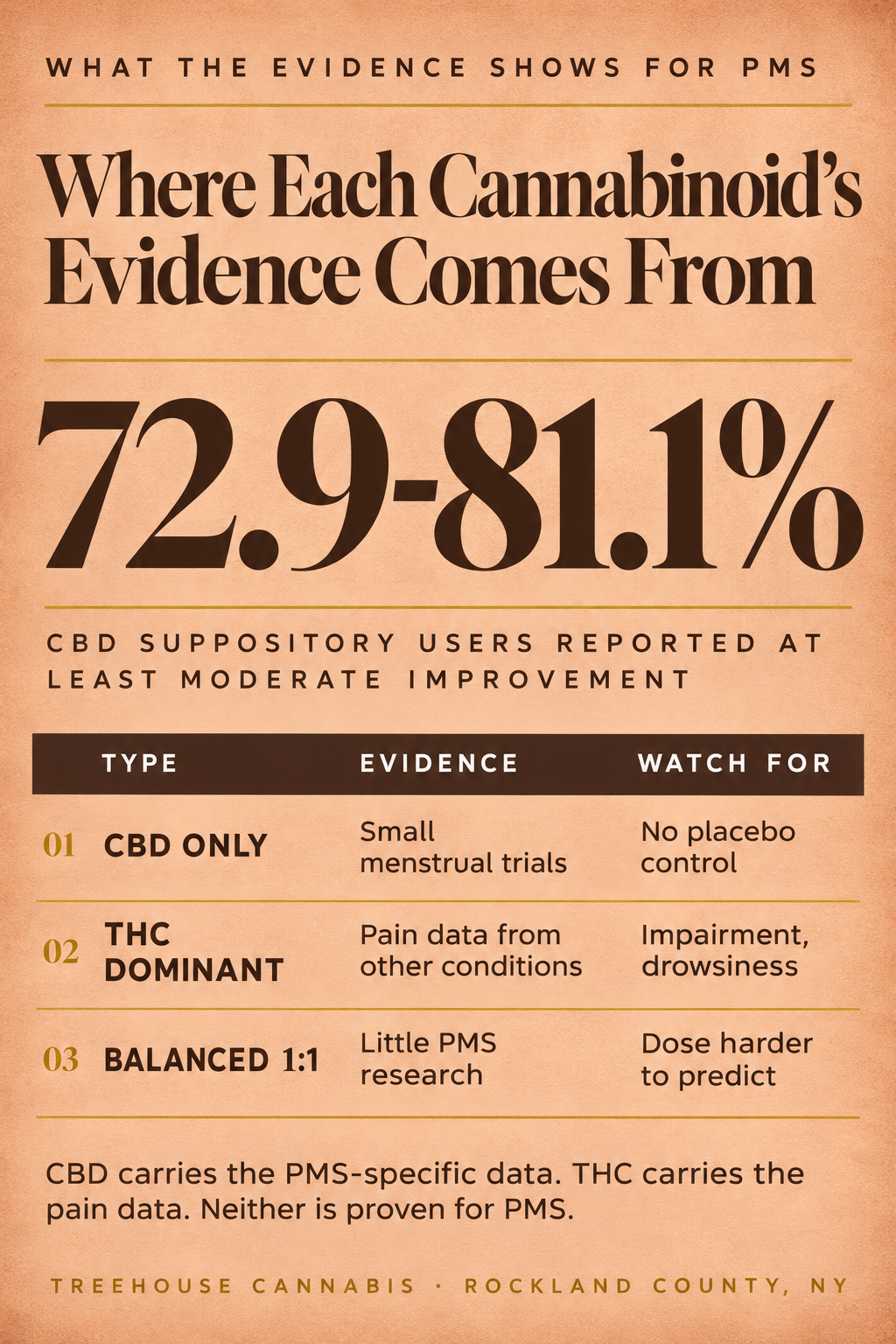
Two studies are worth citing. A 2024 quasi-experimental survey followed 77 people using a 100 mg high-CBD vaginal suppository against 230 treatment-as-usual controls, and found significantly reduced symptom frequency and severity, less impact on daily functioning, and fewer analgesics used over roughly two cycles. Between 72.9 and 81.1 percent of users reported at least moderate improvement at follow-up [5]. A second, open-label pre-post trial of oral CBD isolate at 160 mg or 320 mg twice daily for five days per month across three months reported reductions in menstrual-related symptoms, irritability, anxiety and stress — but no change in depression, and no placebo control [6].
The boundary conditions:
- Cramps are prostaglandin-driven contractions of uterine muscle and blood vessels [3]
- More than half of menstruating women have period pain one to two days per month [3]
- NSAIDs remain the standard first-line treatment [3]
- The 100 mg CBD suppository survey reported less pain and fewer analgesics versus 230 controls [5]
- The oral CBD trial reduced symptoms, irritability and anxiety but not depression [6]
- Neither study randomized participants and neither had a placebo arm
A 2022 review notes that cannabinoids acting on CB1 and CB2 receptors are being studied for analgesic and muscle-relaxant effects on uterine pain, while concluding that dosing and safety data remain insufficient [11]. Period pain affects up to 90 percent of women of reproductive age, and pain severe enough to disrupt work, school or sleep is a reason to get evaluated rather than self-manage [11]. For the intimacy angle specifically, Cannabis and Sex: What Research Says About Intimacy and THC goes deeper.
One clarification that saves confusion later: the CBD suppository in that study was a research product, not something sold in New York dispensaries. Vaginal suppositories are not standard adult-use retail items.
How Does the Endocannabinoid System Change During the Menstrual Cycle?
The endocannabinoid system is cycle-responsive in reproductive tissue, and that is the strongest biological reason researchers keep looking at cannabis for menstrual symptoms. It is a reason to study, not a reason to expect relief.
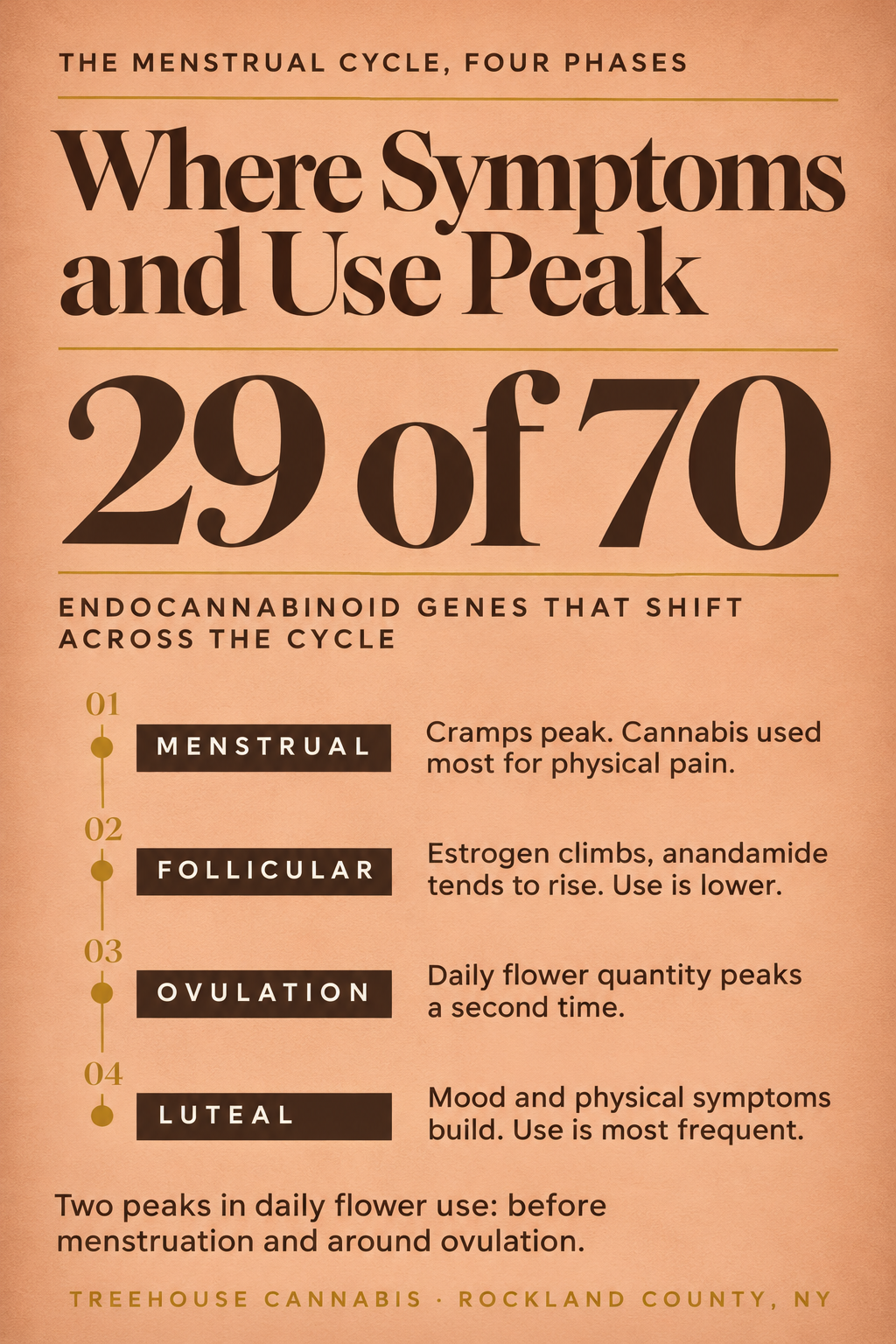
The gene-expression evidence is the concrete part. Of 70 endocannabinoid-system genes examined in endometrial tissue, 40 were expressed in more than 90 percent of samples, and 29 showed significant differential expression across the menstrual cycle [10].
The hormone link explains the rest. Estrogen inhibits the FAAH enzyme that breaks down anandamide, so circulating anandamide tends to rise when estrogen is high, and the endocannabinoid system is involved in folliculogenesis, ovulation and the menstrual cycle itself [12]. Read that as biology, not as a lever you can pull with a gummy.
- 70 endocannabinoid-system genes were examined in endometrial tissue [10]
- 40 were expressed in more than 90 percent of samples [10]
- 29 showed significant differential expression across the cycle [10]
- Estrogen inhibits FAAH, so anandamide tends to rise when estrogen is high [12]
- The endocannabinoid system is involved in folliculogenesis and ovulation [12]
Now the brake. A system being involved is not the same as a product fixing it. Nothing in this gene-expression work measures pain, mood or relief. A mechanism is a hypothesis generator, not evidence of benefit, and it does not establish that cannabis corrects anything or restores a balance. The hormonal overlap with perimenopause is laid out separately in The Menopause-Cannabis Connection: How Women Are Finding Natural Relief.
That is also why the next section looks at when people actually reach for cannabis during the cycle, rather than assuming use tracks symptoms.
When Do Women Use Cannabis Most During Their Cycle?
Use climbs in the days before menstruation and again during the menstrual phase, and the reason shifts with the phase: mood before bleeding, pain during it.
The cleanest data here comes from daily tracking. Following 40 normally cycling women every day for 65 days, cannabis use was more frequent in the premenstrual phase, while using cannabis specifically for physical pain and discomfort was higher during the menstrual phase [7]. A second longitudinal analysis found daily dried flower quantity showed menstrual cyclicity, peaking before menstruation and again around ovulation, with higher daily emotional symptoms associated with greater premenstrual flower use [9]. The 2026 survey of 634 respondents found the same direction: cannabis used more often in the luteal phase than the follicular phase [8].
Read as a pattern, it looks like this:
- 40 normally cycling women tracked daily for 65 days [7]
- Cannabis use was more frequent in the premenstrual phase [7]
- Use specifically for physical pain was higher during the menstrual phase [7]
- Daily flower quantity peaked before menstruation and again around ovulation [9]
- Higher daily emotional symptoms tracked with greater premenstrual flower use [9]
- 634 survey respondents reported more use in the luteal than the follicular phase [8]
Mood-driven use clusters in the premenstrual stretch, pain-driven use clusters during bleeding, and there is a second smaller peak around ovulation that is not obviously symptom-driven. Do not over-read it. These are small studies of existing users describing what they already do, not trials showing that this timing works, and a self-reported motive is not the same as measured relief. If pre-ground flower is what makes a purchase simple, Pre Ground Flower lists the ready-to-grind options.
Is CBD or THC Better for PMS?
CBD is what PMS-specific research has actually tested. THC has better pain evidence in other conditions and a much larger impairment cost. That is the whole comparison in two sentences.
On CBD: most PMS studies use it because it does not intoxicate and participants generally tolerate it well. Both cited trials — the suppository survey and the oral isolate trial — reported reductions in cramping, irritability and anxiety, and both lacked placebo controls [5] [6]. On THC: it is the primary intoxicating compound in cannabis, product potency and consumption methods vary widely, and it comes with documented risks to brain and body health [14]. THC's stronger analgesic reputation comes from pain research in other conditions, not from menstrual studies.
| Type | What it does | PMS evidence | Watch for |
|---|---|---|---|
| CBD only | Non-intoxicating; studied for cramping, irritability and anxiety | Small menstrual trials and surveys, no placebo arm [5] [6] | Benefits are self-reported; product labels vary |
| THC dominant | Intoxicating; stronger analgesic reputation from other pain conditions | No PMS-specific trials [14] | Impairment, drowsiness, potency variability |
| Balanced ratio | Blends both effects; harder to predict | Very little PMS research | Dose is harder to anticipate, especially in edibles |
What the comparison comes down to:
- Most PMS-specific studies test CBD, not THC [5] [6]
- CBD does not intoxicate, which is why it dominates this research
- Neither CBD trial had a placebo arm, so benefits are reported rather than proven
- THC is the primary intoxicating compound in cannabis, with documented risks to brain and body health [14]
- THC's analgesic reputation comes from pain research in other conditions, not from menstrual studies
- Non-intoxicating formats are easier to fit around a workday
The practical frame is not which cannabinoid wins but which effect the person wants and can manage. Non-intoxicating options are easier to fit around a workday. And potency labels on regulated products make comparison possible in a way black-market products never did — a stated milligram amount on a tested package is the only reliable basis for comparing one product to another [14]. The underlying science of the two compounds is unpacked in CBD vs THC: The Science Behind the Two Most-Discussed Cannabinoids.
Which Cannabis Products Make Sense for Cramps and Mood?
The format matters as much as the cannabinoid, because onset speed and whether a product intoxicates decide whether it fits into a workday at all.
Topicals are applied to skin, are not intended to intoxicate, and suit localized cramp discomfort — the trade-off is that a patch or balm is not going to touch mood Candy Rain All night Affair Intimacy Oil | 60ml. Tinctures are liquid, taken under the tongue or added to food, and are easy to measure in small, repeatable amounts High Dose "UP" | Tincture | 1000MG. Flower is inhaled, so effects arrive in minutes and fade faster, which helps when someone wants to gauge an effect before committing further Bottomless Mints Flower - 70g. A single listing, such as Bottomless Mints Flower - 70g, states the potency you are actually buying.
The trade-offs sit in a predictable order:
- Topicals are applied to skin, are not intended to intoxicate, and address localized discomfort only
- Tinctures are measurable in small, repeatable amounts and last longer than inhalation
- Flower acts in minutes and fades faster, which makes it easier to gauge
- Edibles are the slowest format and the one most often overshot by first-time users
- Labeled potency on regulated products makes comparison possible [14]
- How a product lands varies with the person, tolerance and body weight
Two practical notes. Edibles deserve their own caution because onset can run an hour or more, which is exactly how people end up taking a second serving too early — the timeline on redosing is covered in How Long Should You Wait Before Taking More Cannabis?. And appetite changes are part of the premenstrual picture for many people, which is its own well-documented effect: Why Does Cannabis Give You the Munchies?.
A product that works for a friend says nothing about how it will land for you. That is not a disclaimer, it is the pharmacology.
What Are the Risks of Using Cannabis for PMS?
The main risks are leaning on cannabis instead of proven care for severe symptoms, driving or working while impaired, tolerance and dependence with frequent use, and airway irritation from smoking.
Start with severity, because that is where the real harm lives. Premenstrual dysphoric disorder affects 2.5 to 3 percent of reproductive-age women and is a distinct condition from PMS, not a worse mood day [4]. Severe premenstrual symptoms warrant clinical care, and proven options exist — NSAIDs for pain, and hormonal contraception or SSRIs for mood symptoms [1] [3].
- PMDD affects 2.5 to 3 percent of reproductive-age women and is distinct from PMS [4]
- Proven options include NSAIDs for pain and hormonal contraception or SSRIs for mood [1] [3]
- Impairment makes driving and some kinds of work unsafe
- Frequent use brings tolerance, rising cost and dependence risk
- Smoked cannabis irritates the airways
- Cannabis is not established as safe in pregnancy or when trying to conceive [13]
The cannabis-specific cautions are unglamorous but real: impairment, potency variability, drowsiness, dizziness, dry mouth, and a bill that quietly grows month over month. A clinician can also review medications and rule out other conditions that mimic PMS, which is worth doing before anyone decides cannabis is the answer.
On pregnancy, be explicit rather than polite: the reviewed literature on cannabis and female reproductive health does not establish safety in pregnancy, so anyone pregnant or trying to conceive should not treat cannabis as a premenstrual remedy [13].
The bottom line for the whole article: use is common, the evidence is thin, and the sensible posture is a conversation with a clinician plus a product you can actually measure.
If you want to compare formats for yourself instead of guessing, Treehouse Cannabis in Rockland County, NY lists potency, cannabinoid ratio and format for every product on the menu, so a topical, a tincture and a flower option can be read side by side before you walk in. For adults 21 and older in Rockland, Orange and Westchester Counties.
Frequently Asked Questions
Does cannabis help with PMS symptoms? The evidence is early and mostly self-reported. Surveys show many consumers use cannabis for premenstrual mood and physical symptoms, and small studies of CBD report reduced cramping, irritability and anxiety. But most trials were open-label or survey-based without placebo controls, so researchers describe the benefits as promising rather than proven.
What does research say about cannabis for period cramps? Period cramps are driven by prostaglandins that tighten uterine muscle, and NSAIDs remain the standard first-line treatment. Cannabinoid research, including a 100 mg CBD suppository survey and an open-label oral CBD trial, reported meaningful pain and symptom reductions. Reviewers still call for randomized controlled trials before drawing firm conclusions.
How does cannabis interact with the menstrual cycle? The endocannabinoid system responds to shifting hormones. Estrogen suppresses the enzyme that breaks down anandamide, so anandamide tends to rise when estrogen is high, and dozens of endocannabinoid genes change expression across the cycle in endometrial tissue. Daily tracking studies also show cannabis use itself fluctuates with cycle phase.
Is CBD or THC better for PMS? Most PMS-specific studies use CBD because it does not intoxicate, and participants generally tolerate it well. THC has stronger evidence for pain and muscle relaxation in other conditions, but it also brings drowsiness, dizziness and impairment. What matters most is matching the product, format and timing to your own symptoms, and talking to a clinician about anything severe.
When do women typically use cannabis for PMS? Daily tracking studies show use increases in the days before menstruation, when mood and physical symptoms peak, and again during the menstrual phase when pain is the main motive. A 2026 survey of 634 respondents found cannabis was used more often in the luteal phase than the follicular phase.
Should I talk to a doctor before using cannabis for PMS? Yes, particularly if symptoms disrupt work, sleep or relationships, since severe PMS or PMDD may need targeted treatment. A clinician can rule out other conditions, review medication interactions, and discuss proven options like NSAIDs, hormonal contraception or SSRIs before you rely on cannabis alone.
Sources
- U.S. Office on Women's Health — Defines PMS as physical and emotional symptoms occurring after ovulation and bef
- American College of Obstetricians and Gynecologists — Lists the recognized emotional and physical PMS symptoms (irritability, anxiety,
- American College of Obstetricians and Gynecologists — Explains that more than half of women who menstruate have period pain for one to
- National Center for Biotechnology Information (StatPearls) — Reports a pooled worldwide PMS prevalence of 47.8% among reproductive-age women,
- npj Women's Health (Nature) — In a quasi-experimental survey of 77 people using a 100 mg high-CBD vaginal supp
- Experimental and Clinical Psychopharmacology (PubMed) — An open-label pre-post trial of oral CBD isolate at 160 mg or 320 mg twice daily
- Addictive Behaviors (PubMed Central) — Tracking 40 normally cycling women daily for 65 days, cannabis use was more freq
- Journal of Women's Health (PubMed) — Among 634 survey respondents with a recent menstrual cycle, cannabis was the mos
- Addictive Behaviors (PubMed) — A longitudinal analysis found daily dried flower quantity showed menstrual cycli
- Scientific Reports (Nature) — Of 70 endocannabinoid-system genes examined in endometrial tissue, 40 were expre
- International Journal of Environmental Research and Public Health (PubMed Central) — Reviews evidence that dysmenorrhea affects up to 90% of women of reproductive ag
- Journal of Medicine and Life (PubMed Central) — Describes how estrogen inhibits the FAAH enzyme that breaks down anandamide, so
- Journal of Women's Health (PubMed Central) — Reviews the Slavin cross-sectional study of 145 women with PMS or PMDD, which fo
- National Institute on Drug Abuse — Summarizes that THC is the primary intoxicating compound in cannabis, that produ
About Treehouse Cannabis
Treehouse Cannabis is a licensed adult-use dispensary in Rockland County, New York, serving customers across Rockland, Orange and Westchester Counties. Our menu lists potency, cannabinoid ratio and format for every product, so a topical, a tincture and a flower option can be compared before you walk in. Nothing here is medical advice.
Cannabis is for adults 21 and older. Keep all cannabis products out of reach of children and pets. This article is educational and is not medical advice; it does not diagnose, treat or cure any condition. Cannabis affects people differently, and anyone with a health condition, anyone taking medication, and anyone who is pregnant or breastfeeding should speak with a licensed healthcare provider before using cannabis. Do not drive or operate machinery while impaired. Buy only from licensed New York dispensaries and follow local possession and consumption laws.
Shop our products

Shop All

Deals
Flower

Pre-rolls
Vaporizers

Edibles
Drinks

Concentrates
Tinctures

Topicals

CBD

Pet CBD

Accessories