
What Is Alpha-Pinene vs Beta-Pinene?
What Is Alpha-Pinene vs Beta-Pinene?
A practical guide to the two pinene isomers in cannabis: how their structures differ, why alpha-pinene almost always outweighs beta-pinene on a lab report, and what that means for smell, storage, and heat.
Alpha-pinene vs beta-pinene is a difference of one double bond. Both are C10H16 isomers, but alpha-pinene keeps that bond inside its six-membered ring while beta-pinene places it outside the ring. That shift sets their boiling points about ten degrees Celsius apart and changes how each one smells.
The same structural detail explains a pattern you see on almost every certificate of analysis: alpha-pinene occupies the larger share of the two pinene rows, and beta-pinene shows up as the smaller second line. Neither compound is a separate chemical family, and neither is a stronger or weaker version of the other. They are two arrangements of the same twelve atoms, which is why a total terpene number tells you nothing about the split between them [1].
What Is the Difference Between Alpha-Pinene and Beta-Pinene?
Alpha-pinene and beta-pinene are structural isomers of the monoterpene C10H16, and the only meaningful difference between them is the position of the double bond. In alpha-pinene that bond sits inside the six-membered ring; in beta-pinene it sits outside the ring, on an exocyclic carbon [2] [3].
Both are bicyclic monoterpenes, and both appear together in conifer essential oils and in the resin of the cannabis plant. They are not separate chemical families or a "weaker" and "stronger" version of the same thing. They are two arrangements of the same twelve atoms [1].
The practical consequences of that one bond position:
- Same formula: both are C10H16 monoterpenes, so a total terpene number tells you nothing about which one you have [1]
- Alpha-pinene: double bond inside the ring, boiling point around 156 C (313 F) at 760 mmHg [2]
- Beta-pinene: double bond outside the ring, boiling point around 166 C (331 F) [3]
- Both occur together in conifer oils and in cannabis resin rather than in isolation [3]
- Alpha-pinene exists as two enantiomers, (+)-alpha-pinene and (-)-alpha-pinene, and the two do not behave identically in laboratory studies [2] [6]
Side by side, the isomer comparison looks like this:
| Feature | Alpha-pinene | Beta-pinene |
|---|---|---|
| Molecular formula | C10H16 | C10H16 |
| Double bond position | Inside the ring | Outside the ring, exocyclic |
| Boiling point | About 156 C (313 F) | About 166 C (331 F) |
| Aroma | Sharp pine needle, resin, turpentine edge | Drier, woodier, more herbal |
| Typical share in cannabis | The larger of the two | The smaller of the two |
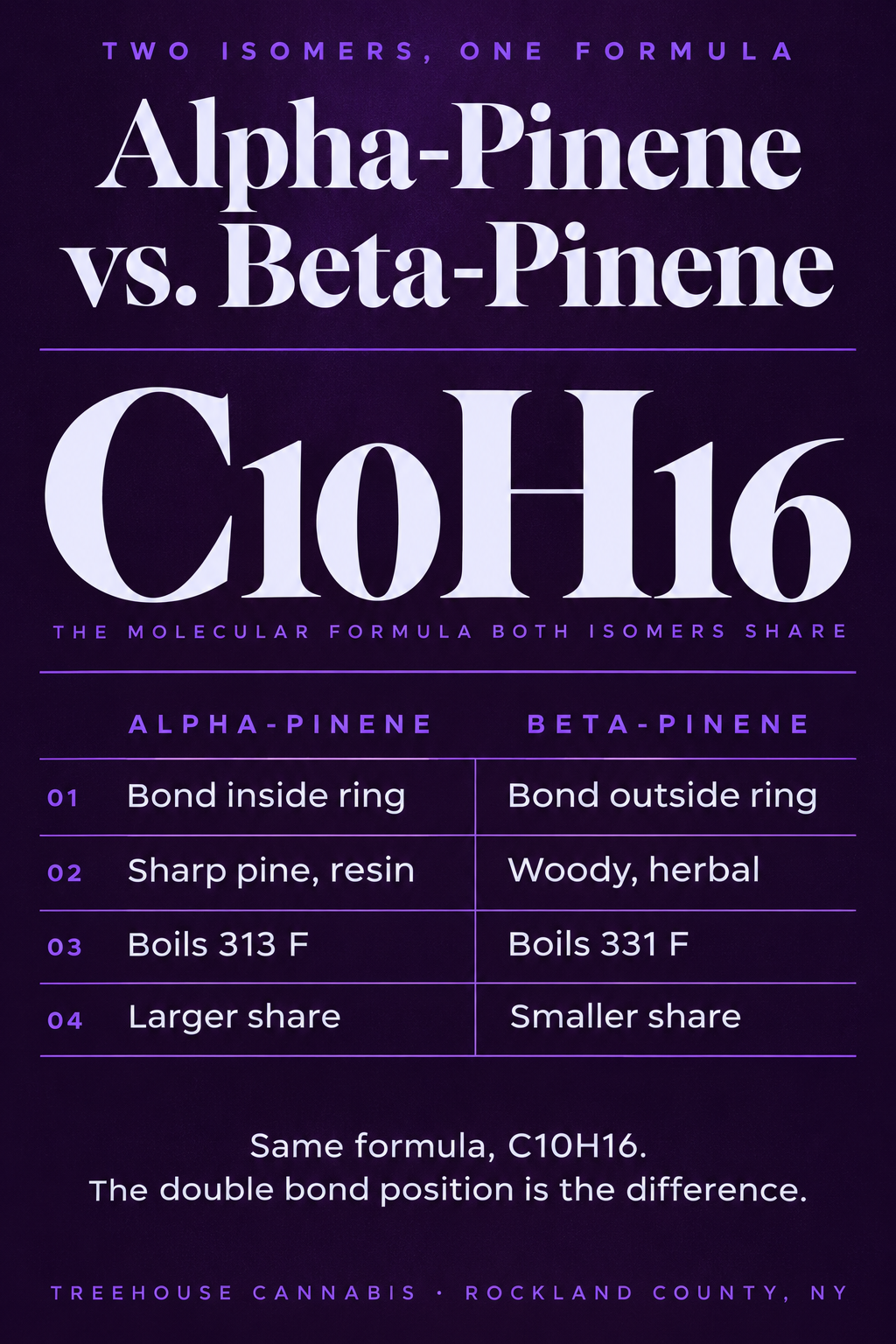
That ten-degree gap matters more than it sounds. It means a vaporizer or an oven does not necessarily release the two isomers at the same moment, and it is part of the reason the pine note on a jar changes character as heat climbs.
If you want the broader picture of how pinene fits alongside the other aromatic compounds in cannabis, What Is Pinene? The Pine-Scented Terpene That May Sharpen Focus covers the terpene as a whole, including the parts that get overstated online.
What Do Alpha-Pinene and Beta-Pinene Smell Like?
Alpha-pinene smells like sharp pine needles and fresh resin, with a turpentine edge that most people recognize instantly. Beta-pinene is drier and woodier, with a herbal note closer to dill, parsley, basil, or hops than to a Christmas tree [9] [1].
The distinction is real but subtle in practice:
- Alpha-pinene: sharp pine needle, resin, and a turpentine edge [2]
- Beta-pinene: drier, woodier, more herbal, closer to dill, parsley, basil, or hops [9]
- Both register as pine on the nose, so smell alone cannot reliably separate them
- Terpene aroma fades as compounds evaporate, so a weak pine note often means old or badly stored flower
This is why two jars can both read "piney" while carrying very different terpene tables. The nose is good at detecting that pinene is present and poor at telling you which isomer is doing the work, or in what proportion.
It also means smell is a freshness signal more than a chemistry readout. A flower that opens with a bright pine note has kept its volatiles; one that smells flat has lost them somewhere between harvest and shelf. Neither reading tells you anything about potency.
For a visual tour of where pinene sits next to the other common terpenes, The Cannabis Terpene Wheel: A Visual Guide to Every Common Terpene maps the whole wheel. And if you are wondering how much flower you can legally carry home from a New York dispensary, How Much Cannabis Can You Legally Possess in New York? covers the current possession limits.
Which Pinene Is More Common in Cannabis?
Alpha-pinene is more common in cannabis, and it is usually present in larger amounts than beta-pinene. That pattern held in every published cannabis measurement reviewed here, across essential-oil analysis, headspace testing of flower, and mature-flower sampling.
The specific ranges:
- Essential oils from 9 commercial varieties: alpha-pinene 0.73 to 21.19 grams per 100 grams of oil, beta-pinene 0.68 to 7.45 grams per 100 grams [10]
- Hybrid flower and leaf tissue: alpha-pinene 9.8 to 2,270 micrograms per gram, beta-pinene 2.6 to 930 micrograms per gram [7]
- Mature flower across 6 cultivars: (+)-alpha-pinene up to 1,849 micrograms per gram dry weight, with (-)-beta-pinene from 312 to 1,337 [8]
- Genetics matter: cultivars that expressed little alpha-pinene synthase carried the least alpha-pinene [8]
- Pinene is usually a supporting terpene, not the headline number on a certificate of analysis [9]
The same data in table form:
| Sample set | Alpha-pinene | Beta-pinene |
|---|---|---|
| Essential oils, 9 commercial varieties | 0.73 to 21.19 g per 100 g | 0.68 to 7.45 g per 100 g |
| Hybrid leaves and inflorescences | 9.8 to 2,270 mcg per g | 2.6 to 930 mcg per g |
| Mature flower, 6 cultivars | Up to 1,849 mcg per g dry weight | 312 to 1,337 mcg per g |
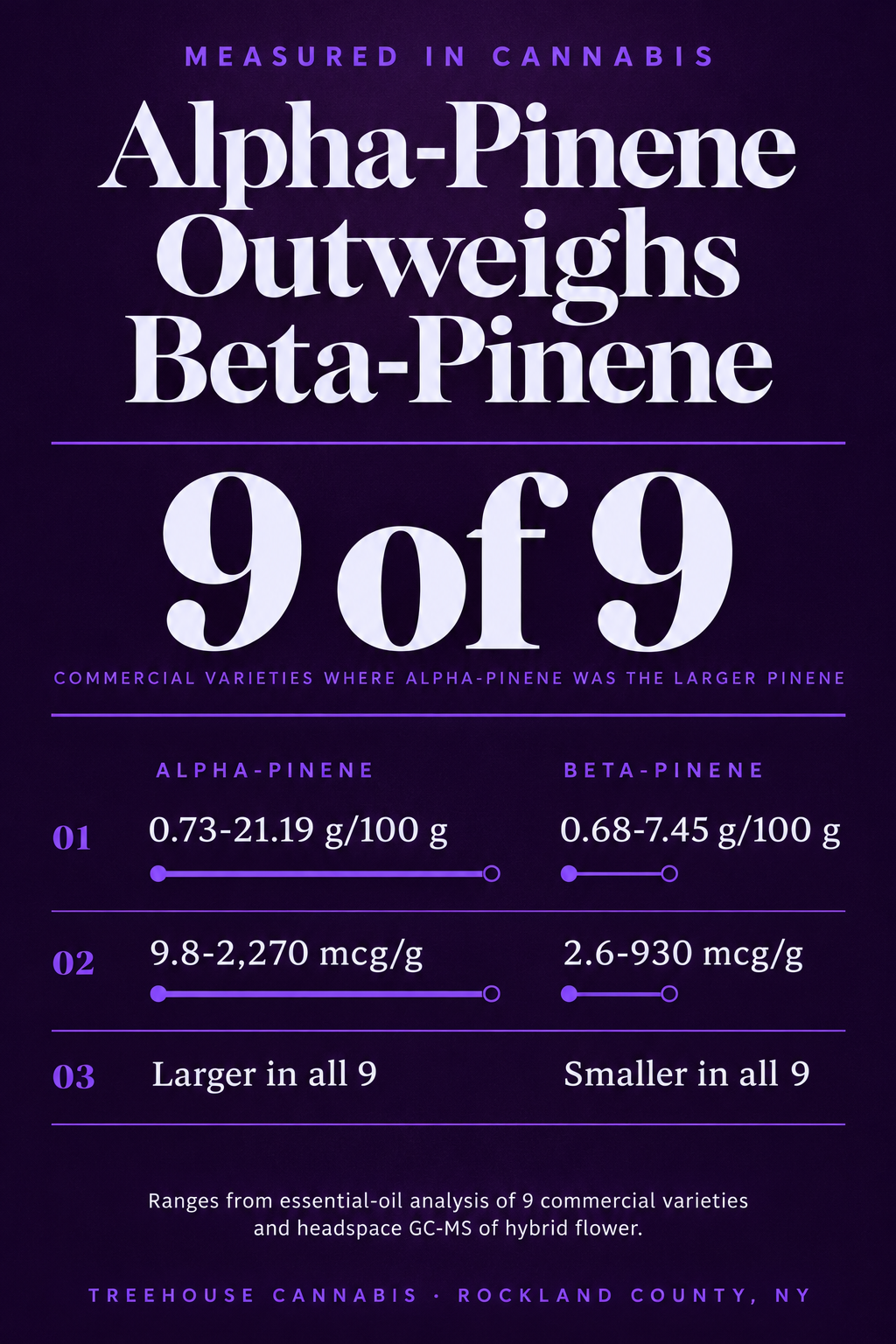
Note what those ranges actually say. Alpha-pinene was the dominant pinene in all nine commercial varieties sampled, but the spread runs from under 1 gram per 100 grams to more than 21, which is a thirty-fold difference. There is no single typical pinene percentage, and anyone quoting one is quoting a single batch.
The ratio is also not fixed by anything visible on the label. Two cultivars with similar names, similar smell, and similar THC content can land on opposite ends of that spread, because the enzyme that builds alpha-pinene is expressed at different levels in different plants [8].
Worth keeping in perspective: pinene rarely tops the terpene table overall. Myrcene, limonene, beta-caryophyllene, and terpinolene usually outrank it. If you are tracking how a product is likely to feel over time rather than all at once, How Long Should You Wait Before Taking More Cannabis? covers the timing question separately from the terpene question.
Does Pinene Affect THC or Change How Cannabis Feels?
Pinene is a terpene, not a cannabinoid, so it does not produce intoxication on its own. Any high you feel from a pinene-rich cultivar comes from that product's THC and other cannabinoids.
The most repeated claim about pinene is that it buffers THC, and that claim got a direct test in 2025. In a double-blind study of 19 healthy adults, inhaled alpha-pinene at 15 mg produced no significant effects compared with placebo, and pairing it with 30 mg of delta-9-THC did not reduce THC-induced memory impairment or change other acute THC effects [4].
That is one small trial, not a final word, but it is human data and it points away from the buffering story:
- Pinene is a terpene, not a cannabinoid, and it does not intoxicate on its own
- 2025 human trial: 15 mg inhaled alpha-pinene showed no significant effect versus placebo in 19 adults [4]
- Same trial: alpha-pinene plus 30 mg THC did not reduce memory impairment or other acute effects [4]
- Mice: oral (-)-alpha-pinene lengthened non-REM sleep and shortened sleep latency through the GABA-A benzodiazepine site, an effect reversed by flumazenil [5]
- Zebrafish: (+)-alpha-pinene and (-)-alpha-pinene produced different dose-dependent effects on anxiety-like behavior and movement [6]
- In vitro work reports large potency gaps between isomers, with (+)-alpha-pinene showing roughly 250 times the antimalarial activity of (+)-beta-pinene [1]
- Preclinical and in vitro results are not evidence of a human effect
Read those carefully, because the sourcing matters. The sleep finding comes from mice given pinene orally, not from people inhaling cannabis. The anxiety and movement findings come from zebrafish, and the antimalarial comparison happened in a dish. None of that is a reason to expect a specific experience from a jar of flower [5] [6] [1].
What the enantiomer work does establish is narrower and more useful: the (+) and (-) forms of the same molecule are not interchangeable in a lab setting [6]. Since standard cannabis testing does not separate them, that distinction is invisible on any label you will read.
The honest summary is that pinene contributes aroma, and the case for it modulating a high in people is weak. If you are choosing a consumption method and want something where heat is controllable, All In One Vaporizers is one place to compare battery-free options, and our current Strawberry Jam | House Of Sacci | Disposable Vape | 2g listings show what is in stock.
How Do You Read Pinene on a Cannabis Lab Report?
Terpene results on a certificate of analysis appear as a separate table listing each compound by name, and alpha-pinene and beta-pinene should show up as two distinct rows. A report that lists only "pinene" is not telling you which isomer you have.
What to check, in order:
- Look for two separate rows, alpha-pinene and beta-pinene, never one combined "pinene" line [9]
- Check the units: percentage of total weight and milligrams per gram are different scales and are not interchangeable [2]
- Match the lot or batch number on the report to the one printed on your package [7]
- Treat total terpenes as a sum rather than a score, and remember a low beta-pinene number is a normal result [10]
- Expect the (+)- and (-)-enantiomer split to be absent, because standard panels do not separate them [6]
The unit question trips people up most often. A terpene reported at 0.4 percent of total weight and one reported at 4 milligrams per gram are not the same statement, and comparing across two reports that used different conventions will mislead you.
Batch identity is the other thing worth the thirty seconds. A certificate describes the specific lot that was tested, so the number on the report has to match the number on the package in your hand. A report for a different batch tells you nothing about what is in the jar [7].
Expect beta-pinene to look small next to alpha-pinene. That is the normal pattern rather than a red flag, and it does not mean the product is deficient [10].
If you want to practice on real listings, small-format flower like Small Buds Flower is a reasonable place to start comparing rows side by side, and a specific example such as Hickory Hash • Flower • 28g shows how a single product page pairs strain information with testing detail.
How Do Vaporizer Temperatures and Storage Affect Pinene?
Start a dry herb vaporizer low, in the low-to-mid 300s Fahrenheit, and step up only if the vapor is thin. Alpha-pinene volatilizes around 313 F and beta-pinene around 331 F, so both sit at or below the range these devices reach, which is why the pine note arrives on the first draws and flattens as heat climbs [2] [3].
Handling rules that follow from the chemistry:
- Start low, in the low-to-mid 300s F, where both pinene isomers volatilize [2] [3]
- Step the temperature up gradually, because high heat flattens the pine note first
- Store in an airtight container, cool and dark, since terpenes evaporate and degrade [9]
- Grind only what you are about to use, because grinding releases surface area and aroma immediately
- Ask for the certificate of analysis on the batch and read both pinene rows before you buy
Storage is where most of the loss happens. An open jar on a warm shelf gives up its volatiles to the room; an airtight container in a cool, dark drawer keeps them where you want them. Light and heat both cost you aroma, and the loss is one-way.
Grinding is the other quiet culprit. Breaking up flower increases surface area and releases the aromatic compounds all at once, so a jar ground on Monday smells noticeably flatter by Friday. Grind what you are about to use.
If you lean on a battery-powered device instead of flower, Disposables Vaporizers covers the sealed format, where the terpene question becomes mostly a question of how the device was stored before you bought it. Our current Hickory Hash • Flower • 28g and Fruity Pebbles | Live Resin Badder | 1g listings carry strain and testing detail so you can compare before you come in.
The simplest version of all of this: read the two pinene rows, smell the jar, and buy the batch the report describes. If you want to do that in person, our Rockland County dispensary serves Orange and Westchester County customers and the flower case is the place to start. Ask a budtender for the certificate of analysis on the batch you are considering, find the alpha-pinene and beta-pinene rows, then smell the jar and see whether the numbers match your nose.
Frequently Asked Questions
What is the difference between alpha-pinene and beta-pinene? They are structural isomers sharing the formula C10H16, but the double bond sits in a different place. Alpha-pinene has it inside the ring, beta-pinene has it outside. That single shift changes the boiling point and the smell: alpha-pinene runs sharp and piney, beta-pinene reads woodier and more herbal.
Which pinene is more common in cannabis? Alpha-pinene, almost always. In nine commercial varieties analyzed by GC-FID, alpha-pinene ranged from 0.73 to 21.19 grams per 100 grams of essential oil while beta-pinene topped out at 7.45. Lab reports typically list both, with alpha-pinene occupying the larger share.
Do alpha-pinene and beta-pinene smell different? Yes, noticeably. Alpha-pinene carries the sharp pine-needle and resinous note most people associate with a Christmas tree or fresh turpentine. Beta-pinene is drier and woodier with an herbal edge, and it shows up in plants like dill, parsley, basil and hops.
Does pinene get you high? No. Pinene is a terpene, not a cannabinoid, and it does not bind cannabis receptors to produce intoxication. Any psychoactive effect you feel from a pinene-rich cultivar comes from its THC and other cannabinoids.
What temperature does pinene vaporize at? Alpha-pinene boils near 156 C (313 F) at standard pressure and beta-pinene near 166 C (331 F). Both sit at or below the temperatures a dry herb vaporizer typically reaches, which helps explain why pinene-forward cultivars read piney and resinous on the first draws at moderate heat.
Does alpha-pinene counteract THC? A 2025 double-blind human trial says not the way internet claims do. Nineteen adults inhaled alpha-pinene alongside delta-9-THC and the terpene did not reduce THC-induced memory impairment or change other acute effects. That contradicts some industry claims about pinene as a THC buffer.
Is beta-pinene used for anything besides cannabis? Quite a lot. Beta-pinene is a major turpentine constituent and serves as a chemical intermediate for fragrances and flavorings, a monomer for terpene resins, and a substitute for alpha-pinene in industrial applications. It is also listed as a synthetic flavoring substance for food use.
What cannabis strains are high in pinene? Pinene-dominant cultivars are uncommon. Published lab compilations list only a rare handful of pinene-dominant profiles, with names like Big Smooth, Crunch Berries, Blue Dream, Cannatonic, Cherry Bomb, Grape Ape, Harlequin and White Wedding tending toward elevated pinene. More often pinene lands second or third, so read the certificate of analysis rather than the strain name.
Sources
- Biomolecules (MDPI) / National Library of Medicine — Alpha-pinene and beta-pinene are structural isomers of the monoterpene C10H16 fo
- PubChem, National Library of Medicine (NIH) — Alpha-pinene (CAS 80-56-8) is a clear colorless liquid with a turpentine odor, a
- PubChem, National Library of Medicine (NIH) — Beta-pinene (CAS 127-91-3) is a pinene isomer distinguished by an exocyclic doub
- Medical Cannabis and Cannabinoids (Karger) / National Library of Medicine — In a double-blind human study of 19 adults, inhaled alpha-pinene at 15 mg produc
- Molecular Pharmacology (ASPET) / PubMed — Oral (-)-alpha-pinene increased non-rapid eye movement sleep duration and shorte
- Scientific Reports (Nature) / National Library of Medicine — In zebrafish open-field testing, (+)-alpha-pinene and (-)-alpha-pinene produced
- Molecules (MDPI) / National Library of Medicine — Across hybrid cannabis leaves and inflorescences, alpha-pinene was quantified fr
- Plant Direct (Wiley) / National Library of Medicine — Mature flower measurements across six cannabis cultivars show (+)-alpha-pinene r
- Leafly — Alpha-pinene and beta-pinene are isomers with slightly different structures; alp
- Plants (MDPI) / National Library of Medicine — In essential oils from nine commercial cannabis varieties, alpha-pinene ranged f
About Treehouse Cannabis
Treehouse Cannabis is a licensed adult-use dispensary in Rockland County, New York, serving customers 21 and older across Rockland, Orange and Westchester Counties. Terpene panels are available on request for the flower and concentrates on the shelf, and the team will walk you through the alpha-pinene and beta-pinene rows on a certificate of analysis before you buy. This article is a guide to reading a lab report, not a recommendation for any individual product.
Cannabis is for adults 21 and older. Keep all cannabis products out of reach of children and pets. Do not drive or operate machinery while impaired. Buy only from licensed New York dispensaries and follow local possession and consumption laws.
This article is educational and is not medical advice; it does not diagnose, treat or cure any condition. Cannabis affects people differently, and anyone with a health condition, anyone taking medication, and anyone who is pregnant or breastfeeding should speak with a licensed healthcare provider before using cannabis.
Shop our products

Shop All

Deals

Flower
Pre-rolls
Vaporizers

Edibles
Drinks
Concentrates
Tinctures

Topicals

CBD

Pet CBD
Accessories