Death Star Strain: Genetics, Aroma, and Profile
Death Star Strain: Genetics, Aroma, and Profile
The Death Star strain is an indica-dominant hybrid made by crossing Sensi Star with Sour Diesel, reported at roughly 75 percent indica to 25 percent sativa with 18 to 27 percent THC. It smells of diesel and skunk, and it hits as a sharp fuel-forward lift followed by heavy body relaxation.
What Is the Death Star Strain?
The Death Star strain is an indica-dominant hybrid of Sensi Star and Sour Diesel. AllBud rates it at roughly 75 percent indica to 25 percent sativa with THC reported from 18 to 27 percent, and describes a sharp fuel aroma that gives way to heavy body relaxation.[2]
The two directories a customer is most likely to check do not quite agree. AllBud publishes a specific split, while Leafly simply files Death Star under indica without offering a ratio.[1] Neither is wrong. One describes a reported ratio across the population of plants sold under the name, and the other sorts the strain into a category for browsing. "Indica" here describes a family resemblance, not a measured property of the plant in front of you.
- Classification: an indica-dominant hybrid, rated 75 percent indica to 25 percent sativa by AllBud and filed simply as indica by Leafly
- Lineage: Sensi Star crossed with Sour Diesel, usually specified as the East Coast Diesel cut and Paradise Seeds' Sensi Star
- Potency: reported across an 18 to 27 percent THC band, with individual sources landing inside it
- The arc: Diesel shows up first as fuel aroma and a brief cerebral lift, then Sensi Star takes the back half into heavy body relaxation
- The trap: the effect is a creeper, so a session judged in the first two minutes is a session judged too early
- The caveat: the original is a clone-only cut passed as plant material, so the name on a menu is not proof of the genetics
On lineage, the cross is usually identified as Sensi Star and Sour Diesel, with the Diesel side being the East Coast cut circulating among growers and the Sensi Star side coming from Paradise Seeds.[3][4] The distinction matters because Sour Diesel is not one plant but a family of related cuts, and the differences between them show up in the finished flower. The Sour Diesel Strain Family: History, Genetics, and Terpenes traces how that family branched.
The shape of the experience comes from the two parents pulling in sequence rather than blending. Sour Diesel contributes the sharp fuel nose and a brief lift at the front. Sensi Star contributes density and a heavy finish that takes over once the lift fades. Customers describe the result as relaxed, sleepy, and euphoric, which lines up with that two-stage structure.[1]
That is why Death Star creeps. The full effect arrives several minutes after smoking rather than at once, and that single characteristic shapes most of the practical advice in this article.
One caveat sits underneath everything else. The original Death Star is a clone-only cut, circulated as plant material rather than stabilized seed.[4] A menu using the name is selling either a seed-line reproduction or a copy, not a verified specimen of the original plant.
Where Did the Death Star Strain Come From?
Death Star came out of Columbus, Ohio in the early 2000s. A crew calling themselves Team Death Star crossed a prized East Coast Sour Diesel cut with Paradise Seeds' Sensi Star and kept the winning phenotype, which makes this a documented origin story rather than strain folklore, because the breeders told it themselves.[4]
- The breeders: Team Death Star, working in Columbus, Ohio in the early 2000s
- The mother side: a prized East Coast Sour Diesel cut already circulating among growers
- The father side: Sensi Star from Paradise Seeds
- Why the pairing worked: Diesel brought fuel aroma and lift, Sensi Star brought density and a heavy finish
- The name: a batch taken to Bonnaroo in Tennessee drew the line that it was "the death", and a friend answered "call it Death Star"
- The limit: the winner was kept as a clone, so the original survives as cuttings and everything sold today is a reproduction or a lookalike seed-line
- The dispute: some older grower accounts name different parents, so treat the lineage as the most commonly reported version, not a certified pedigree
The pairing produced something distinct because the two parents contribute opposite halves of the experience. Diesel adds fuel aroma and cerebral energy, Sensi Star adds density and a body-heavy finish. Together they read as a strain that starts sharp and ends flat on the couch, which is a different product from either parent alone.
The name has nothing to do with space. According to the breeders, a batch taken to the Bonnaroo festival in Tennessee drew the comment that the weed was "the death", and a friend replied that they should call it Death Star. The Star Wars reference entered afterward, attached to a strain with no other connection to the films.[4]
There is an honest limit to how far any of this can be verified. The winning plant was kept as a clone rather than bred to seed, so the original exists only as cuttings. Anything sold under the name today is a reproduction of that cut or a lookalike seed-line bred to resemble it.
The lineage is also less settled than the summary suggests. Some older grower accounts name different parents entirely, so the Sensi Star and Sour Diesel version is the most commonly reported account rather than a certified pedigree.[3]
For a deeper look at the aroma compounds behind those Diesel notes, the The Cannabis Terpene Wheel: A Visual Guide to Every Common Terpene maps the whole set. And because Diesel genetics keep showing up in modern breeding, the Black Diesel Strain: Genetics and Terpene Profile covers how a related fuel-forward line carries its terpenes.
What Does the Death Star Strain Smell and Taste Like?
Diesel and skunk lead, with a sweet jet-fuel edge up front and earthy, rubbery notes underneath. The finish is sweeter than the smell predicts, which surprises people who brace for fuel all the way through.
The two main descriptions mostly agree on the top notes. Leafly describes skunky, sweet jet-fuel aromas with diesel, pungent, and tea flavors.[1] AllBud adds earthy and rubber notes plus a sweet finish alongside the diesel, pungent, and skunky descriptors.[2] Where they converge, a customer can rely on it: fuel, skunk, and general pungency are the core of this nose. Where they diverge, mostly tea versus rubber in the base notes, you are seeing the cut-to-cut variation that comes from a clone-only strain reproduced by different growers.
- The lead notes: diesel and skunk, present in both source descriptions
- The sweet edge: a jet-fuel sweetness up front that reads almost solvent-like before it fades
- The base notes: earthy and rubber, plus tea or hash depending on the cut, which is where descriptions diverge
- The finish: sweeter than the smell predicts
- The terpene mapping: caryophyllene gives the pepper and spice, myrcene the earthy herbal body, limonene the citrus lift, humulene a dry hop note
- The honest limit: those four do not fully explain the fuel and skunk character, so treat them as the identifiable part of the profile
- The practical note: this is a loud strain, so a flat jar means the volatiles are gone
The aroma maps onto the chemistry, up to a point. Averaged lab results for products sold as Death Star put caryophyllene first, then myrcene, limonene, and humulene.[3] Caryophyllene contributes the peppery, spicy edge, myrcene carries the earthy herbal body, limonene adds a citrus lift, and humulene supplies a dry, hop-like note.
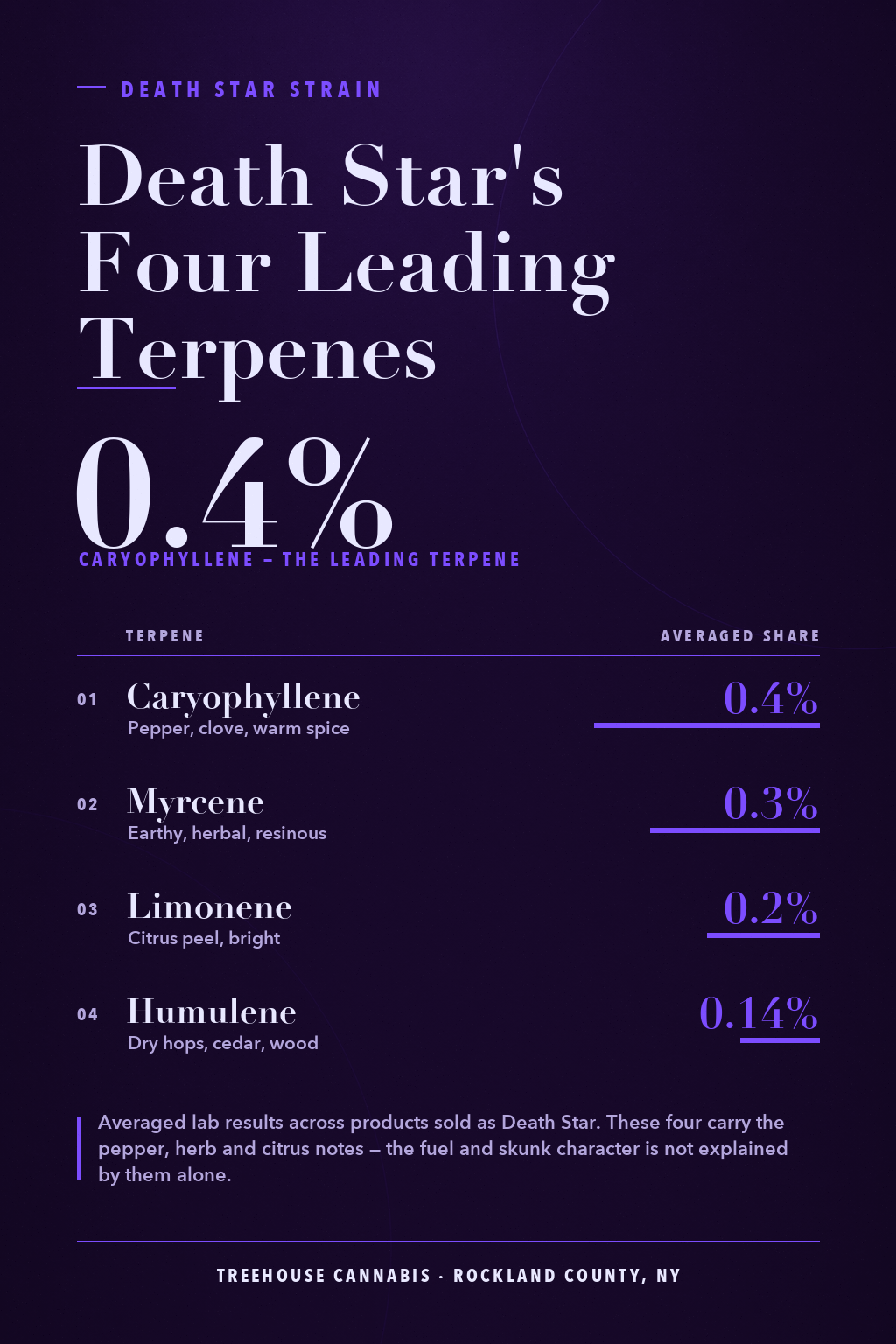
That mapping is useful but incomplete. The fuel and skunk character is the most distinctive thing about this strain and it is not fully accounted for by those four compounds, so the terpenes are the identifiable part of the profile rather than the whole story.
One practical note follows. This is a loud strain and the smell carries, so storage matters more here than with a quiet variety. A jar that has gone flat has lost the volatile compounds that made it worth buying. If a package opens to hay or weak tea instead of fuel, that is the clearest sign something went wrong between harvest and shelf.
For a comparison point on a citrus-forward line, the White Durban Strain: Genetics and Terpene Profile walks through a profile built around limonene rather than caryophyllene, and the contrast makes the Death Star nose easier to place.
Which Terpenes Dominate the Death Star Strain?
Caryophyllene leads, followed by myrcene, limonene, and humulene. Averaged lab results for products sold as Death Star put them near 0.4, 0.3, 0.2, and 0.14 percent respectively, and those are averages across tested products rather than constants for the strain.[3]
- Caryophyllene, about 0.4 percent: pepper and spice, and the only one of the four with a well-characterized receptor interaction
- Myrcene, about 0.3 percent: earthy and herbal, with a sedation reputation that rests on animal data rather than controlled human trials
- Limonene, about 0.2 percent: citrus peel, the note that keeps the profile from reading flat
- Humulene, about 0.14 percent: dry hops and wood, the quietest of the four
- The threshold myth: flower myrcene levels are similar across indicas, hybrids, and sativas, and the 0.5 percent "couch-lock" figure is not supported by controlled study
- The entourage test: six common terpenes did not meaningfully change CB1 or CB2 signaling or THC potency in vitro
- The defensible position: terpenes drive aroma and flavor for certain, and plausibly influence how a strain feels, but not through a demonstrated cannabinoid-receptor mechanism
Caryophyllene is the interesting one. It is a sesquiterpene that the pharmacological literature describes as a selective CB2 receptor agonist with anti-inflammatory and immunomodulatory activity and no CB1-driven psychoactivity.[7] That makes it the only common cannabis terpene with a well-characterized receptor interaction, which is genuinely unusual and also the reason it gets over-interpreted.
Myrcene has the loudest reputation and the thinnest human evidence. A mouse study found that beta-myrcene shortened sleep latency, lengthened sleep duration, and shifted GABA and glutamate balance.[8] That is preclinical animal work, and it is the strongest recent support for myrcene's sedative reputation. It is not evidence about people. Leafly's review of the literature finds no well-controlled human trials showing myrcene causes sedation, notes that flower myrcene levels are similar across indicas, hybrids, and sativas, and flags the widely repeated 0.5 percent "couch-lock threshold" as unsupported.[5]
That point deserves stating plainly, because it is the most repeated claim in strain writing: myrcene does not make a strain indica. If it did, the terpene numbers would track the label, and they do not.
The entourage effect is the claim this section exists to test, so it is worth being precise. An in vitro study found that alpha-pinene, beta-pinene, beta-caryophyllene, linalool, limonene, and beta-myrcene did not meaningfully alter CB1 or CB2 signaling or change THC potency.[6] That does not prove terpenes do nothing. It proves they do not work by binding cannabinoid receptors, which is a narrower and more useful finding than "the entourage effect is fake."
The defensible position is three-part. Terpenes clearly shape aroma and flavor, and that part is not in dispute. They plausibly shape subjective experience through smell and other routes, which is harder to measure but reasonable. What they lack is a demonstrated receptor-level mechanism for changing how high anyone gets.
How Strong Is the Death Star Strain?
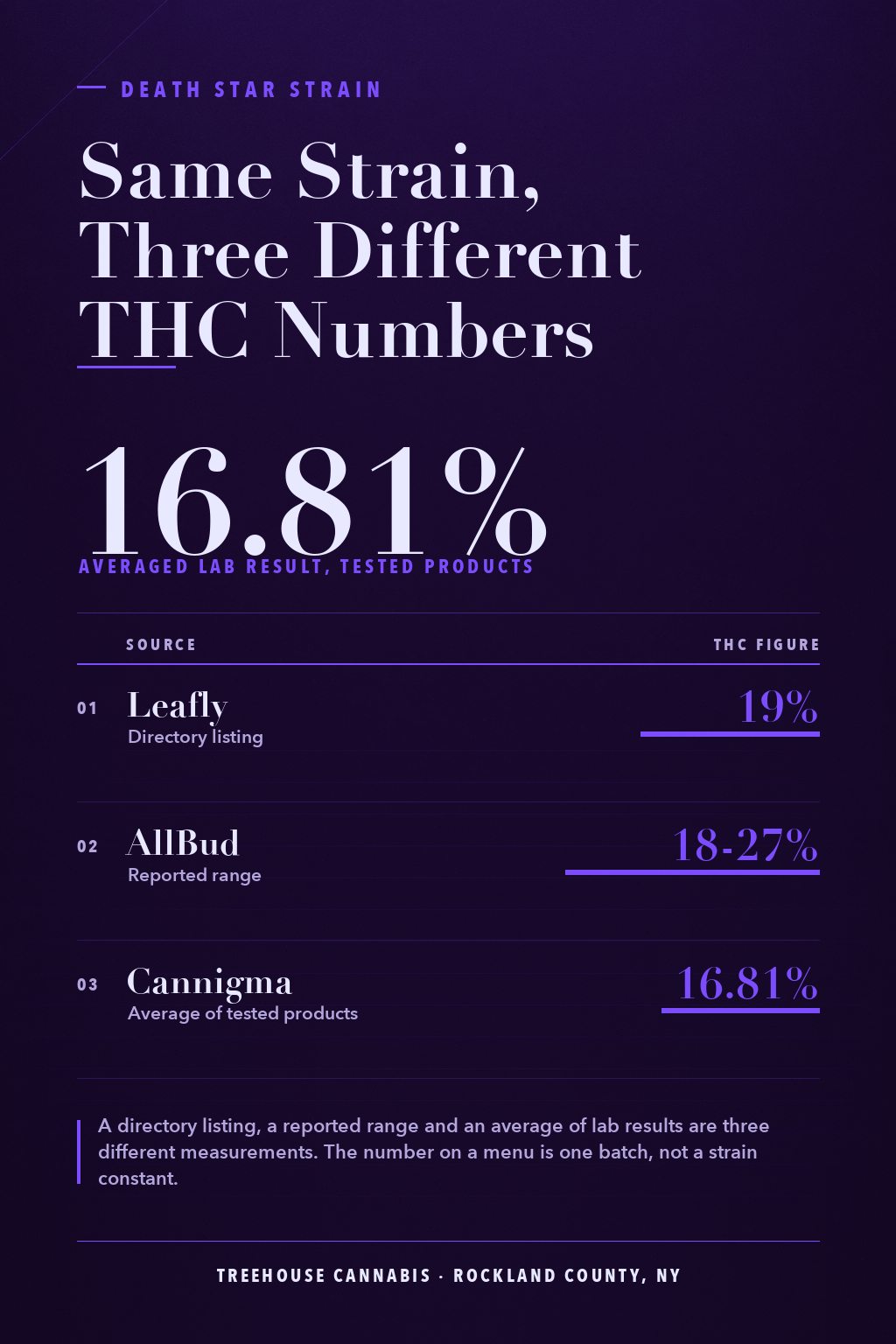
Reported THC runs from about 18 to 27 percent. Leafly lists 19 percent, AllBud gives the 18 to 27 percent range, and averaged lab results for products sold under the name land lower at roughly 16.81 percent.[1][2][3]
| Source | THC | What the figure actually is |
|---|---|---|
| Leafly | 19% | A directory listing |
| AllBud | 18-27% | A reported range across many grows |
| The Cannigma | 16.81% | An average of tested products |
- The spread: 19 percent from one directory, an 18 to 27 percent range from another, and 16.81 percent averaged across tested products
- Why they differ: a directory listing, a reported range, and an average of lab results are three different measurements wearing the same units
- Why Death Star drifts: a clone-only cut reproduced by different growers will vary in potency batch to batch, by definition
- The creeper warning: the full effect arrives minutes later, so topping up early is the classic mistake
- Why the number undersells it: the heavy Sensi Star finish reads stronger than the THC figure predicts
- What to do with the menu number: treat it as one lot's result, ask for the Certificate of Analysis, and compare it to what you normally buy
Three sources, three answers, and the discrepancy is the useful part rather than a problem to resolve. A directory listing is a composite compiled from submissions and historical data. A range is a spread across many grows. An averaged lab result reflects what actually tested out across products sold under the name. None of them measures the same thing, so treating them as rival estimates of one number is a category error.
Death Star's particular drift problem comes from its history. A clone-only cut reproduced in different rooms will vary batch to batch, and there is no seed-line stability to smooth that out. You are not buying a constant. You are buying one grower's run of a plant that has been passed around for two decades.
Then there is the part the numbers miss. Death Star is a creeper. The full effect arrives several minutes after smoking rather than immediately, so anyone who tops up because they do not feel it yet tends to end up far more sedated than they intended. That is a characteristic of the strain and the most common warning attached to it, not a reflection of a weak batch.
The mechanism is about absorption and time to peak, not about the strain being mild. Delayed onset means the effect is still climbing while the smoker is deciding whether it worked. And the body-heavy finish from the Sensi Star side reads stronger than the THC figures suggest, which is exactly why the number and the experience disagree.
So what should a customer do with a menu number? Treat it as one batch's test result rather than a property of the strain. Ask to see the Certificate of Analysis so the figure is tied to a specific tested lot. And compare it against what you normally buy rather than against the strain's reputation, because your own baseline is the only reference point calibrated to you.
If flower is not the format you want, the same genetics show up in rolled form, and the Gumball Diamond Infused | Pre-Rolls | 5 pack on the shelf carry the same lot-level labeling.
How Do You Judge a Good Cut of Death Star?
Judge it on four things a customer can actually check: bud structure, aroma intensity, trichome condition, and whether the package carries a Certificate of Analysis. The strain name alone proves nothing about the plant in the jar, especially for a cut reproduced by many growers over many years.
- Structure: dense and sticky with purple shading in the stems is the described norm, so loose and dry is a warning
- Aroma: diesel and skunk should hit immediately, and hay or weak tea means the volatile compounds are gone
- Trichomes: frosty and intact means fresh resin, dull and matte means oxidation has already started
- The label: a Certificate of Analysis ties the potency figure to a specific tested lot instead of to a reputation
- The terpene panel: a low caryophyllene figure on the COA predicts a batch that will not smell like Death Star
- The lineage question: because the original is clone-only, asking which Diesel cut and which Sensi Star cross made the batch is worth thirty seconds
Structure comes first because it is easiest to see. AllBud describes dense, sticky buds with purple shading in the stems, so a loose, dry, or pale sample is not showing the traits the strain is known for.[2] That is a condition indicator rather than a potency test, and it is worth treating it as exactly that.
Aroma is the most informative check. The diesel and skunk notes should be loud and immediate when a package is opened. A jar that smells like hay or weak tea has lost the volatile compounds, which is the clearest sign that handling or storage went wrong between harvest and shelf.[1][3]
Trichomes tell you about freshness rather than strength. Frosty and intact reads as fresh resin. Dull and matte reads as oxidized, which is the visible end of the same degradation process that eventually moves THC toward CBN.
The label is where a customer gets actual leverage. A Certificate of Analysis ties a specific lot to a specific test result, which is the only way to know whether the potency figure describes the product in your hand rather than the strain's general reputation. The terpene panel matters as much as the THC number, because a Death Star with a flat caryophyllene figure will not smell like Death Star no matter what the potency line says.[3]
Because the original is clone-only, lineage questions are fair questions. Asking which Diesel cut or which Sensi Star cross produced a batch is a better use of thirty seconds than comparing THC percentages across menus.
If you want to see what the current harvest looks like across the category, the Flower page lists what is in stock with the strain and potency for each item. A jar of Thai Sunrise Flower - 70g from a recent lot is the simplest way to check whether a batch still smells the way it should, and the Thai Sunrise Flower - 70g is one example of a single-lot listing with its figures attached.
Is Death Star the Same as Deathstar or Death Star OG?
Deathstar is only an alternate spelling of the same strain, and Leafly lists it as an alias. Death Star OG is a different name attached to different genetics and should be treated as an unrelated product.[1]
| Name on the label | What it is | How to treat it |
|---|---|---|
| Death Star | The Sensi Star and Sour Diesel cross | The strain this article describes |
| Deathstar | One word, same strain, listed as an alias | Same product, different spelling |
| Death Star OG | A separate name used for different genetics | Unrelated, ask for lineage |
| Sensi Star | A parent strain sold on its own | Not Death Star |
- Deathstar: an alternate spelling of the same strain, listed by Leafly as an alias, and harmless
- Death Star OG: a separate name applied to different genetics, so treat it as an unrelated product
- Sensi Star: a parent of Death Star but its own distinct strain, sold under its own name
- Sour Diesel: the other parent, and itself a family of cuts rather than one plant
- The rule: when a name is ambiguous, ask which genetics the batch came from instead of assuming
The spelling variation is genuinely harmless. A menu that writes Deathstar is describing the Sensi Star and Sour Diesel cross, and the name is legitimately spelled both ways across the industry.[1]
The OG suffix is not harmless in the same way. It gets applied to unrelated plants that may have no Sensi Star or Sour Diesel in them, and a customer searching for the fuel-and-skunk profile will not find it in a different genetic line carrying a familiar name. Names drift across the industry rather than being deployed with intent, but the practical effect on a shopper is the same.
The third confusion worth heading off is the parent. Sensi Star is one of the two strains that made Death Star and is also sold under its own name as its own product. A menu offering Sensi Star is not offering Death Star, even though the lineage overlaps.
The rule that resolves all of it is short. When a name is ambiguous, ask for the lineage rather than assuming, and treat any strain name as a description of where a plant came from rather than a guarantee of what it will do.
Where Can You Find Death Star and What Should You Ask?
Death Star is a strain worth buying on evidence rather than reputation. The lineage, the terpene panel, and the lot's own Certificate of Analysis tell you more than the number printed on the jar, and all three are things you can ask about before anything goes in the bag.
- The lineage: which Diesel cut and which Sensi Star cross produced this batch
- The paperwork: the Certificate of Analysis for the specific lot you are holding, not the strain in general
- The terpene panel: whether caryophyllene still leads, because a flat figure predicts a batch that will not smell right
- The package: whether it opens to fuel and skunk rather than hay, which tells you how it was stored
Treehouse Cannabis in Rockland County, NY lists the genetics and potency for every flower and pre-roll on the shelf, keeps terpene panels available on request, and will pull a package so you can read the label before it goes in the bag.
Browse the current menu or order online for pickup and delivery across Rockland, Orange, and Westchester Counties.
Frequently Asked Questions
Is the Death Star strain indica or sativa?
Death Star is an indica-dominant hybrid. AllBud rates it about 75 percent indica to 25 percent sativa, while Leafly files it under indica without a split. The Sour Diesel parent contributes a sharp fuel aroma and a brief lift, but the Sensi Star side dominates the finish with heavy body relaxation.
What are the parents of the Death Star strain?
Most sources give Death Star as Sensi Star crossed with Sour Diesel, specifically an East Coast Sour Diesel cut and a Paradise Seeds Sensi Star. Weedmaps credits a Columbus, Ohio crew called Team Death Star with the cross in the early 2000s. Some older grower accounts name different parents entirely.
How strong is the Death Star strain?
Reported THC runs from about 18 to 27 percent. Leafly lists 19 percent, AllBud gives the 18 to 27 percent range, and averaged lab results for products sold as Death Star land lower near 16.81 percent. The body effect reads heavier than those figures suggest, and onset is delayed.
What does Death Star smell and taste like?
Diesel and skunk lead. Leafly describes skunky, sweet jet-fuel aromas with diesel, pungent, and tea flavors, while AllBud adds earthy and rubber notes plus a sweet finish. Hints of citrus and hash appear depending on the cut, and the aroma is strong enough to carry across a room.
Which terpenes are dominant in Death Star?
Caryophyllene comes first at roughly 0.4 percent, then myrcene near 0.3 percent, limonene at 0.2 percent, and humulene at 0.14 percent in averaged lab results. Caryophyllene brings the peppery spice, myrcene the earthy body, and limonene a citrus lift that keeps the profile from reading flat.
Is Death Star a creeper strain?
Yes, and it is the most common warning attached to it. Death Star is widely described as a creeper, meaning the full effect arrives several minutes after smoking rather than at once. Anyone who tops up because they do not feel it yet tends to end up more sedated than they intended.
Is Death Star the same as Deathstar or Death Star OG?
Deathstar is just an alternate spelling of the same strain, and Leafly lists it as an alias. Death Star OG is a separate name attached to different genetics entirely, so treat it as unrelated. If a menu uses either spelling, ask for the lineage instead of assuming.
Why is the strain called Death Star?
The name is a Star Wars reference, but it was coined at a festival rather than in a lab. According to Team Death Star, a batch taken to Bonnaroo in Tennessee drew the comment that the weed was the death, and a friend replied that they should call it Death Star. The spelling stuck.
Sources
- Leafly — Leafly classifies Death Star as an indica crossed from Sensi Star and Sour Diese
- AllBud — AllBud rates Death Star an indica-dominant hybrid at 75% indica to 25% sativa wi
- The Cannigma — Cannigma reports averaged lab results for products sold as Death Star at roughly
- Weedmaps — Weedmaps documents the origin of Death Star with the breeders themselves: Team D
- Leafly — Leafly's terpene explainer finds no well-controlled human trials showing myrcene
- Frontiers in Pharmacology — This in vitro study found that alpha-pinene, beta-pinene, beta-caryophyllene, li
- Biomedicine & Pharmacotherapy (via PubMed) — This review confirms beta-caryophyllene, the sesquiterpene that leads the Death
- Pharmaceuticals (Basel) via PubMed Central — In a mouse model beta-myrcene shortened sleep latency, lengthened sleep duration
About Treehouse Cannabis
Treehouse Cannabis is a licensed adult-use dispensary in Rockland County, New York, serving customers across Rockland, Orange and Westchester Counties. This article is intended for adults 21 and older in New York State and covers the genetics, reported terpenes and lot-to-lot variation of one cannabis cultivar; it is not medical advice.
Cannabis is for adults 21 and older. Treehouse Cannabis is an adult-use dispensary; this article is educational and informational only and is not medical advice. Cannabis affects people differently, and potency, aroma and effect vary by cultivar, batch and storage. Please consume responsibly, keep all cannabis products out of reach of children and pets, and do not drive or operate machinery while impaired. Anyone with a health condition, anyone taking medication, and anyone who is pregnant or breastfeeding should speak with a licensed healthcare provider before using cannabis.

Shop our products

Shop All

Deals

Flower

Pre-rolls
Vaporizers

Edibles
Drinks

Concentrates
Tinctures

Topicals

CBD

Pet CBD

Accessories