Cannabis Vaporizers: Dry Herb vs Concentrate vs Disposable
Cannabis Vaporizers: Dry Herb vs Concentrate vs Disposable
How dry herb vaporizers, concentrate devices, and disposable vapes differ in format, temperature control, discretion, maintenance, and best fit.
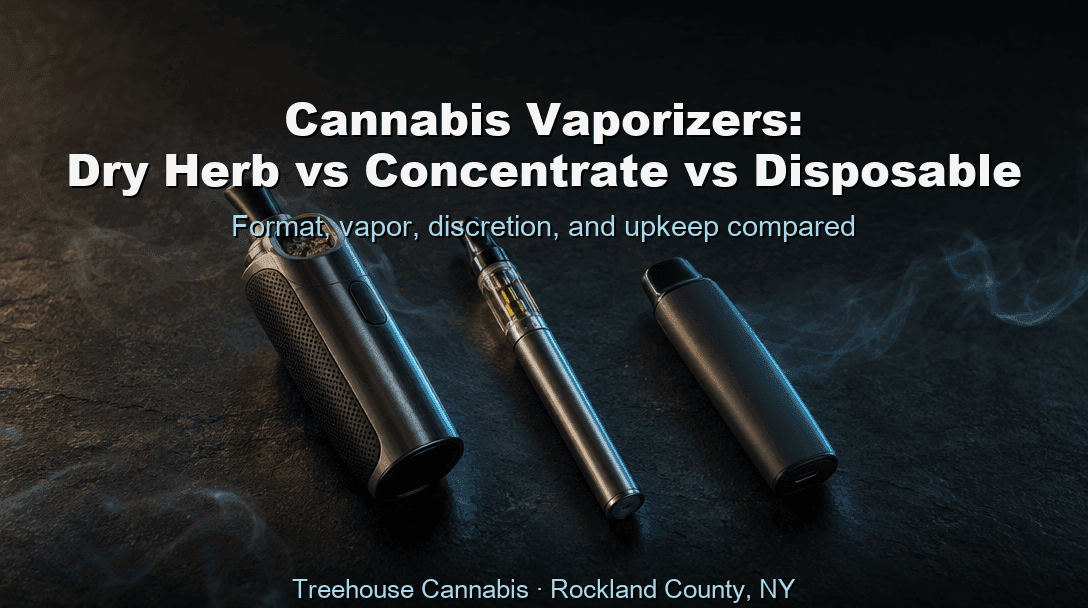
Cannabis vaporizers come in three formats, and the difference is the material each one heats. Dry herb devices vaporize ground flower in a chamber, concentrate vapes heat wax, rosin, or oil on a coil or atomizer, and disposables seal a prefilled cartridge, coil, and battery into one single-use unit. Matching the device to the material you plan to use settles most of the decision before you compare a single spec.
Vaporization itself is not combustion. A device that holds a controlled temperature releases cannabinoids as vapor instead of setting plant material on fire, which is why the temperature range a device can hold matters more than how large or expensive it looks.
What Are the Main Types of Cannabis Vaporizers?
There are three main types of cannabis vaporizers: dry herb devices that pass hot air over ground flower, concentrate devices that vaporize extract on a heated surface, and cartridge systems that use a resistively heated coil to vaporize cannabis oil [2]. Each format exists because a different material needs a different kind of heat.
- Dry herb vaporizers heat ground flower in a chamber, usually with a ceramic, stainless steel, or hybrid oven
- Concentrate devices heat extract directly on a coil, cup, or atomizer, and include refillable pens, prefilled carts, and portable dab rigs
- Disposables combine a prefilled cartridge, coil, and battery in one sealed unit that is discarded when it runs out
The practical difference shows up in control and upkeep. A dry herb device gives a customer direct control over temperature and load size, but it needs grinding, packing, and regular cleaning. A cartridge or disposable asks almost nothing of the user, yet offers limited control over how hot the coil runs.
Portability and discretion also separate the formats. Cartridge systems are compact, easy to conceal, and approachable for someone new to vaporizing, which is a large part of why they spread quickly [2].
If the format question is still open, Flower, Vapes, Edibles, or Concentrates: Which Format Fits You? compares flower, vapes, edibles, and concentrates on onset, duration, and effort.
How Does a Dry Herb Vaporizer Work?
A dry herb vaporizer pulls heated air through ground flower, releasing cannabinoids and terpenes as vapor without igniting the plant material. The chamber never reaches combustion temperature, so the flower is spent rather than burned.
Device design and temperature control decide how much of the plant actually reaches the user. Testing five commercial vaporizers at 210 C recovered between 54.6% and 82.7% of total THC in the vapor, depending on the unit, with THC decarboxylation efficiency of at least 97.3% in the four electric devices [1]. The gas-powered unit in that same test left ash and visible smoke, which is the opposite of what a vaporizer is supposed to do.
The chemistry behind that matters, because the boiling points repeated in most strain guides are misleading. The familiar figure of roughly 155 C to 157 C for THC comes from vacuum distillation near 0.05 torr, and corrected to normal atmospheric pressure the boiling points are closer to 425 C for THC and 463.9 C for CBD [3]. A device running at 180 C to 210 C is evaporating cannabinoids gradually, not boiling them.
What that looks like in practice:
- Grind the flower evenly so the chamber heats consistently
- Pack loosely enough that air can move through the material
- Start low, near 180 C, for flavor, then step up if the vapor thins
- Stir or repack mid-session if the device allows it
- Clean the chamber and mouthpiece regularly, since residue dulls flavor
The payoff is flavor range and control. The cost is time and maintenance, plus a session that runs longer than a couple of puffs on a cartridge. Freshness matters more here than with oil, so storage habits count, and How Long Does Weed Stay Fresh? covers how long flower holds up.
For customers who vape flower steadily, bulk formats such as B.A.M • Flower • 70g keep a rotation going without constant restocking. If you are weighing this format against smoking, Vapes vs Flower: What's the Difference? lays out the difference in byproducts and ritual.
How Does a Concentrate Vape Work?
A concentrate vape uses a coil or atomizer to heat cannabis extract, which can be wax, shatter, rosin, or a formulated oil. Because extract is concentrated, small amounts of heat produce a dense hit, and the device has far less material to work through than a flower chamber.
The formats within this category are not interchangeable:
- Refillable concentrate pens accept wax or thick oil that the user loads directly onto a coil
- Prefilled cartridges pair a cartridge with a 510-thread battery, and the oil formulation is fixed at purchase
- Portable dab rigs use a heated cup or nail and are built for larger, hotter doses
- Pod systems use proprietary cartridges that only fit the matching battery
Temperature control is the whole game here. Simulating real-world dabbing, researchers found that terpenes in cannabis extract degraded into methacrolein, benzene, and other products of health concern, and noted that users have real difficulty controlling nail temperature, which is exactly what exposes them to those degradation products [4]. A concentrate device that runs far hotter than a flower vaporizer sits closer to that problem.
That does not make every concentrate device risky. It makes variable voltage, low settings, and short draws worth paying attention to. A cartridge driven at the lowest setting that still produces vapor tends to taste better and lasts longer than one run wide open.
Extract type changes the flavor profile as much as the hardware does. Live Resin vs Live Rosin: What's the Difference and Which Is Better? breaks down the difference between live resin and live rosin, which is the distinction most customers ask about first. For customers who want to load their own material rather than buy carts, Animal Face | Rythm | Live Resin Concntrate lists what is currently on the shelf.
What Should You Know About a Disposable Cannabis Vape?
A disposable cannabis vape is a sealed system: battery, coil, and prefilled oil in one unit that is thrown away when it stops producing vapor. There is nothing to charge, load, or clean, which is the entire appeal.
That convenience comes with tradeoffs worth knowing before buying:
- The battery often dies before the oil is fully spent, so the last portion of the fill is wasted
- There is no adjustable temperature on most units, so the coil runs at whatever the factory set
- Fill weight and potency vary widely, and cost per milligram is usually higher than a cartridge and battery bought separately
- The device cannot be inspected, refilled, or repaired, so quality control happens entirely before purchase
Sourcing is the part that actually matters. In 2019 and early 2020, CDC received reports of 2,807 hospitalized EVALI cases or deaths across 50 states, DC, and two territories. Vitamin E acetate was found in lung fluid from 48 of 51 cases and in none of 99 comparison samples, and most cases involved THC products obtained from informal sources [6]. That outbreak describes unregulated supply, not the tested retail inventory sold at a licensed New York dispensary.
New York requires each lot of cannabis product to be tested for microorganisms, foreign material, metals, moisture content and water activity, mycotoxins, pesticides, residual solvents, and terpenoids before sale [7]. A disposable bought from a licensed retailer has cleared that panel. One bought from a friend or a bodega has cleared nothing.
Two practical notes. First, if a cart starts tasting burnt rather than clogged, Is Your Vape Cart Burnt or Just Clogged? How to Tell What to Do Next explains how to tell the two apart before you toss it. Second, extra batteries for cartridge systems are worth having on hand, and Batteries Accessories covers what is stocked for that.
Possession limits are separate from device choice. Adults 21 and older in New York may possess and share, but not sell, up to 3 ounces of flower and up to 24 grams of concentrated cannabis including vape oil [8].
How Do Dry Herb, Concentrate, and Disposable Vapes Compare?
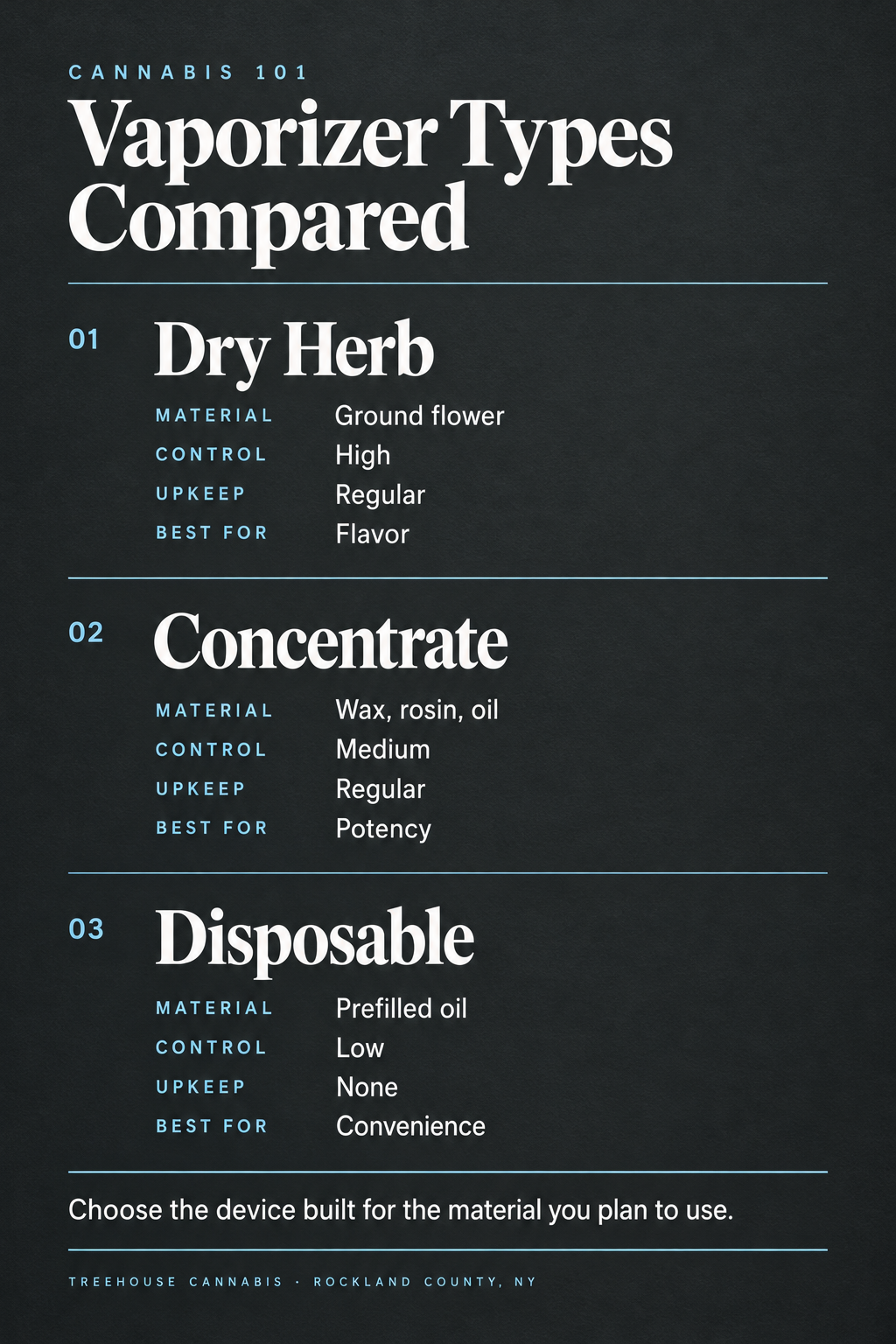
The three formats differ most in material, maintenance, control, portability, and the kind of session each is built to deliver. A side-by-side view makes the tradeoffs obvious.
| Format | Material | Temperature control | Maintenance | Portability | Best fit |
|---|---|---|---|---|---|
| Dry herb | Ground flower | High, often adjustable by degree | Regular cleaning, grinding, packing | Moderate, device plus tools | Flavor range and full-plant profile |
| Concentrate | Wax, shatter, rosin, oil | Medium, depends on battery or rig | Coil cleaning or cartridge swaps | High with carts, lower with rigs | Potency in a compact setup |
| Disposable | Prefilled oil | Low, usually fixed | None | Highest, one sealed unit | Convenience with no upkeep |
A few compatibility rules are worth stating plainly:
- A 510 battery does not make every cartridge interchangeable, since some pods and disposables use proprietary fittings
- A dry herb device should never be loaded with concentrate, because the chamber cannot reach or manage the temperatures extract needs
- A concentrate pen cannot vaporize ground flower, and will scorch it instead
- Some dry herb units sell concentrate pads as an add-on, but a dedicated device for each format performs better
Session length and discretion follow from the hardware. Flower sessions run longer and smell more. Cartridges are quick and low-odor. Disposables are the easiest to carry and the hardest to control.
Cost per session is the least universal metric in this comparison. Fill weight, battery capacity, voltage, and how hard a device is driven all change the math, so a cheaper device is not necessarily cheaper to run.
How Do You Choose the Right Cannabis Vaporizer?
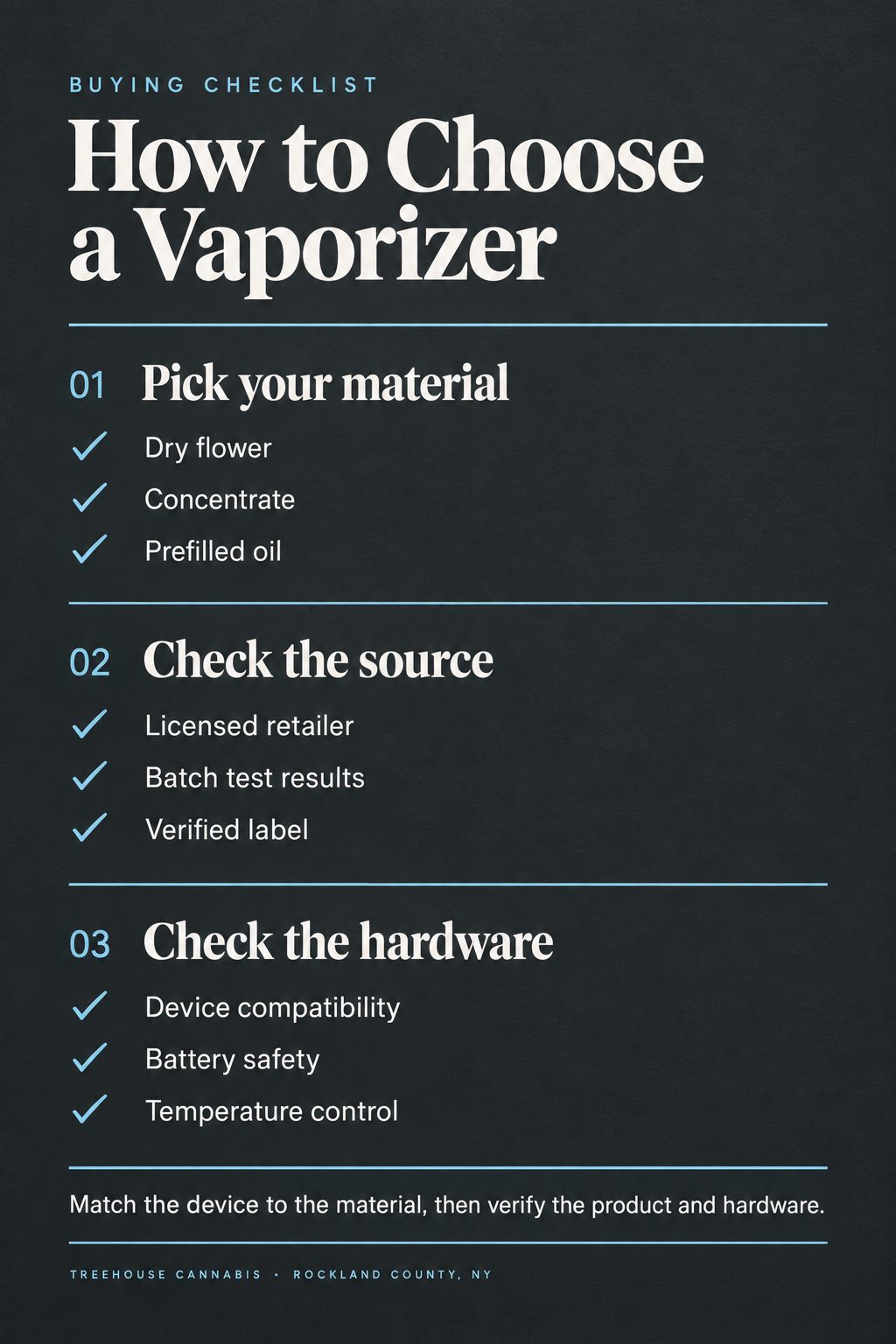
Choose the device built for the material you plan to use, then verify the product and the hardware. That order prevents most bad purchases.
A simple decision path:
- Choose a dry herb vaporizer for full-plant flavor, adjustable temperature, and a slower session
- Choose a concentrate vape for a compact, high-potency setup, and insist on variable voltage
- Choose a disposable for portability, zero maintenance, and short outings rather than daily use
Then run the buying checks:
- Buy from an OCM-licensed dispensary, and ask for the batch Certificate of Analysis
- Confirm the label potency matches the batch result
- Check device compatibility before buying a cartridge or pod
- Use reputable batteries and chargers, and never carry a loose cell in a pocket
- Set realistic expectations about session length and how long a fill actually lasts
That testing panel is not a formality. A licensed cartridge or disposable has cleared microbial, heavy metal, pesticide, residual solvent, and potency testing that an unlicensed product never sees [7].
If disposables fit your routine, Disposables Vaporizers shows the current sealed-unit lineup. For customers who want a battery and cartridge system instead, ZPK | Disposable Vape | 2g covers the hardware side.
One more expectation to set: a cartridge often delivers more THC per puff than flower, simply because the oil is far more concentrated. That makes it easier to overdo, particularly for customers with a lower tolerance. A dry herb device gives more room to pace a session.
What Else Should You Know About Cannabis Vaporizers?
The remaining decision points come down to sourcing, temperature control, and matching the device to the material, which is what customers ask about most at the counter.
- The format should match the material you plan to use, not the other way around
- Temperature settings, battery quality, and fill weight drive most of the difference between devices
- Licensed retail sourcing and batch testing matter more than any single spec on the box
What is the difference between a dry herb vaporizer, a concentrate vape, and a disposable?
A dry herb vaporizer heats ground flower in a chamber. A concentrate vape heats extract, either in a prefilled cartridge on a 510 battery or in a chamber loaded with wax or rosin. A disposable combines a sealed cartridge, coil, and battery in one single-use unit. Each format is built for a different material, so the choice of material comes first and the device follows.
Is vaping cannabis safer than smoking it?
Available research points to fewer combustion byproducts, not zero risk. In a large internet sample, vaporizer use predicted fewer self-reported respiratory symptoms such as cough, phlegm, wheeze, and chest tightness after controlling for age, sex, cigarette smoking, and amount of cannabis used [5]. Vapor still contains irritants, and long-term respiratory evidence for vaping is much thinner than for smoking, so treat it as lower exposure rather than harmless.
What temperature should a dry herb vaporizer run at?
Published device testing clustered between 180 C and 210 C, roughly 355 F to 410 F [1]. Lower settings favor flavor and lighter vapor, while higher settings extract more material and produce denser vapor. Above roughly 220 C the process moves close enough to combustion that the advantage of vaporizing starts to fade.
How long does a cartridge or disposable last?
It depends on fill weight, battery capacity, voltage, and how hard the device is driven. Higher voltage burns oil faster and flattens flavor, while short draws at lower voltage preserve both the fill and the taste. Some disposables quit while oil remains because the battery reaches end of life first.
Do cartridges deliver more THC per puff than dry herb vaporizers?
They often do. Concentrate cartridges typically carry far higher THC percentages than flower, so a single draw can deliver more cannabinoids than a draw from a packed flower chamber. That also makes cartridges easier to overconsume, especially for customers with lower tolerance.
Can a concentrate pen be used with dry flower?
No. Concentrate devices are designed for wax, shatter, rosin, or oil, and will scorch or under-extract ground flower. Some dry herb units include a concentrate pad, but a dedicated device for each format extracts more consistently and delivers the flavor the product was built for.
What should customers check before buying a cannabis vape in New York?
Buy from an OCM-licensed dispensary and ask for the batch Certificate of Analysis. New York requires testing for potency, pesticides, heavy metals, microbes, mycotoxins, residual solvents, and terpenoids. Confirm the label potency matches the batch result, check battery and cartridge compatibility, and avoid products from informal or unlicensed sources.
Why did vaping cause lung injuries in 2019?
The EVALI outbreak was linked to vitamin E acetate, a thickening agent found in THC cartridges sold outside licensed channels. CDC found it in lung fluid from 48 of 51 cases and in none of 99 comparison samples, and most cases involved THC products from informal sources [6]. It does not describe the regulated retail supply.
Sources
- PLOS ONE (Lanz et al., University of Bern) — Testing five commercial vaporizers at 210 C, total THC recovery in vapor ranged
- PubMed Central (NIH) - cannabis vaping toxicology review — Defines the three main cannabis vaping modalities - flower vaporizers that pass
- Cannabis and Cannabinoid Research (Meehan-Atrash et al.) — The widely repeated boiling points (THC about 155-157 C) are vacuum-distillation
- ACS Omega (Meehan-Atrash et al.) — Simulating real-world dabbing, terpenes in cannabis extract degraded into methac
- Harm Reduction Journal (Earleywine and Barnwell) — In a large internet sample, vaporizer use predicted fewer self-reported respirat
- US Centers for Disease Control and Prevention (CDC) — As of February 18, 2020, CDC had received reports of 2,807 hospitalized EVALI ca
- New York State Office of Cannabis Management (9 NYCRR 130.22, via Cornell LII) — New York requires each lot of cannabis product to be tested for microorganisms,
- New York City Department of Health and Mental Hygiene — Adults 21 and older in New York may possess and share (but not sell) up to 3 oun
About Treehouse Cannabis
Treehouse Cannabis publishes adult-use education for customers in Rockland County, New York. Vaporizer choice comes down to the material you want to use, the control you want over temperature, and the upkeep you are willing to do. Nothing here is medical advice.
- Licensed adult-use dispensary in Nanuet, Rockland County
- Cartridges, disposables, flower, and concentrates stocked side by side
- Staff available to compare formats before a purchase
Cannabis is for adults 21 and older. Keep all cannabis products away from children and pets. This article is educational and is not medical advice. Do not drive or operate machinery while impaired.

Shop our products

Shop All

Deals
Flower
Pre-rolls
Vaporizers

Edibles
Drinks

Concentrates
Tinctures

Topicals
CBD

Pet CBD
Accessories