
How to Choose a Cannabis Vape Without Buying on Flavor Alone
How to Choose a Cannabis Vape Without Buying on Flavor Alone
To choose a cannabis vape without buying on flavor alone, judge the cartridge on four things: the extract type inside it, the hardware heating it, the lab results behind its batch, and the dose you actually want. Flavor is the weakest of those four signals, because it is the easiest one to manufacture after extraction.
New York makes that check unusually practical. Every regulated adult-use product must carry the Universal Symbol and a QR code or link to that product's Certificate of Analysis, and everything sold at a licensed dispensary has passed lab testing before sale [1].
This guide is a practical cannabis cartridge guide rather than a menu tour. It covers what each extract family commits you to, how to read a label and a Certificate of Analysis, why hardware quietly decides whether the same oil tastes good or burnt, and the red flags worth walking away from.
What Should You Judge a Cannabis Vape On?
Judge a vape on four things, not one: the extract inside the cart, the hardware heating it, the lab results behind the batch, and the dose you actually want. Flavor is a real signal about terpenes and freshness, but it is the weakest of the four because it is the easiest to build in after the fact.
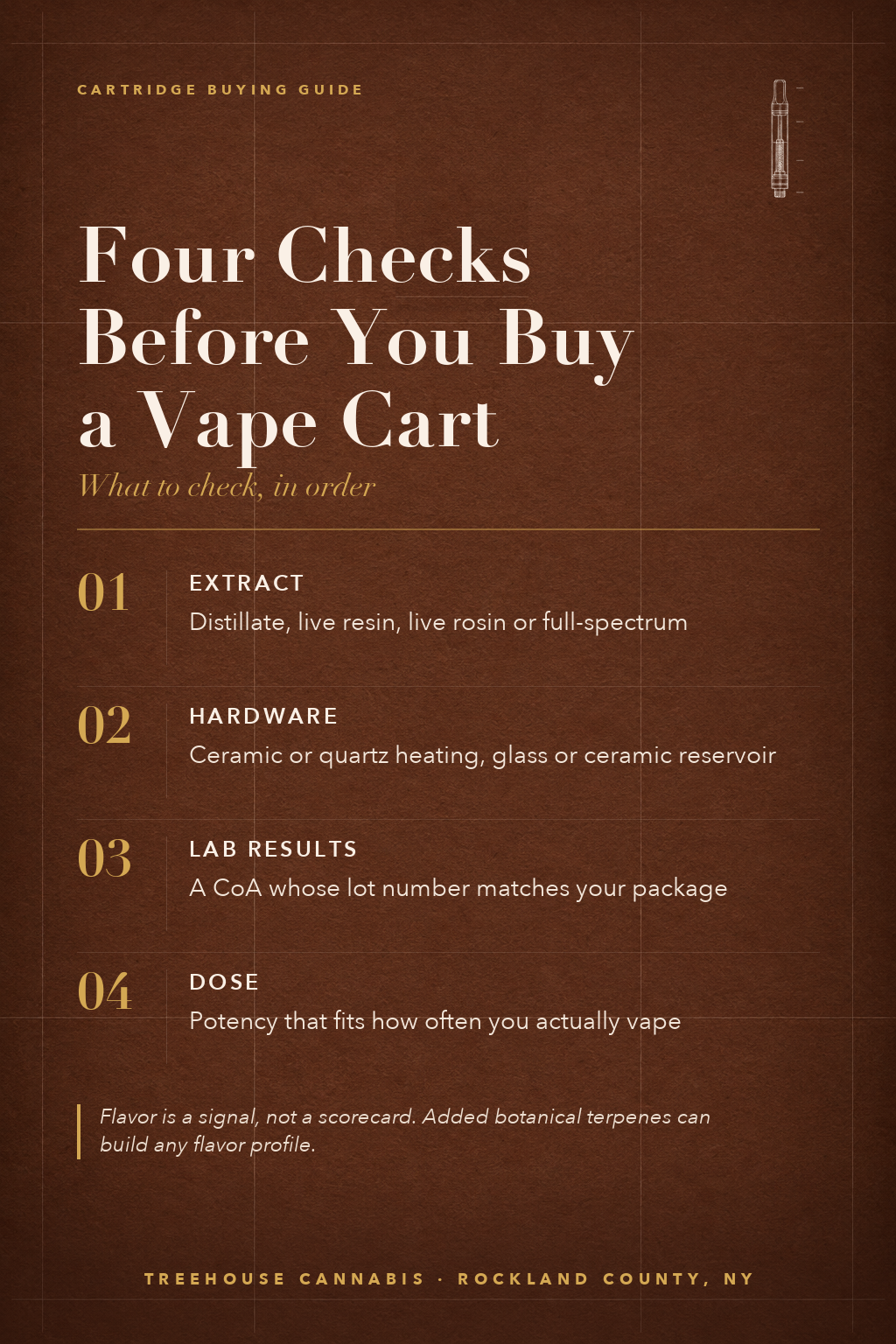
The four checks, in the order they are worth your attention:
- Extract type — what the oil actually is, from refined distillate to live resin and rosin
- Hardware — the heating element and reservoir, which decide flavor retention and clogging
- Lab results — the Certificate of Analysis for that specific lot, not for the brand in general
- Dose — the potency and serving size that fits how often you actually vape
- Flavor — a useful signal about terpenes and freshness, and the easiest of the five to fake
New York gives you a head start on all four. Part 128 labeling rules require potency, ingredients, warnings, the Universal Symbol and terpene profile disclosure, so the packaging answers most of the checklist before you open the box [4].
The work left for you is knowing which numbers matter and which ones are decoration.
Flavor tells you what someone wanted the cart to taste like. The other three tell you what is actually in it. That is the whole thesis of this article, and if you are comparing two carts at similar prices, it is also the fastest way to decide between them — our guide to How to Choose a Weed Pen Without Wasting Money covers the same tradeoffs from a hardware-shopping angle.
Why Does Flavor Alone Mislead You?
Flavor misleads because it comes from three different places, and only one of them tells you anything about the plant. A strong flavor is a statement about what was added, not proof of what survived the extraction.
Those three sources:
- Native terpenes — what came through the extraction from the plant itself
- Added terpenes — botanically derived terpenes blended back in after refinement
- Added flavoring — New York bans youth-attractive versions such as menthol or mint, cotton candy, bubble gum and candy, but permits other flavoring with disclosure
Most carts you taste are a blend of at least two of those. A cart that tastes like a specific cultivar may contain almost none of that cultivar's original terpene profile, and a great deal of a terpene blend built to imitate it.
New York's rules acknowledge this directly. Inhaled and vaporized cannabis products may not carry youth-attractive flavors such as menthol or mint, cotton candy, bubble gum and candy, and processors must keep records documenting the source of every botanically derived terpene [5].
That record-keeping requirement exists precisely because added terpenes are common and their origin is something a regulator wanted to be able to trace.
The research is worth stating honestly rather than overselling in either direction. A two-week study of 101 regular cannabis users found that cultivar classification and terpene content remain largely unsubstantiated as predictors of subjective effects, and the authors call for controlled lab work [10].
Separately, six common cannabis terpenoids tested alone and in combination did not change CB1 or CB2 receptor signaling or modify THC's effect at the human receptor level [11].
None of that proves terpenes are irrelevant. It establishes that the entourage effect is an active research question rather than a settled fact, so a loud flavor profile is not evidence of a better or more complete experience. It is evidence that someone built that flavor in.
That distinction gets sharper when you are buying for someone else. Gift-focused buying guides lean hard on flavor and presentation because those are the things a shopper can evaluate without opening the package, which is exactly why a buyer's guide like Cannabis Holiday Gifts 2026: The Complete Buyer's Guide is worth reading before you let a candy-forward flavor name make the decision for you.
What Does the Extract Type Tell You About a Vape Cart?
Extract type tells you what the processor had to do to the oil, and that single choice sets the price, the potency, the flavor ceiling and the temperature the cart wants. The families are not a quality ladder, they are different answers to different problems.
What each one commits you to:
- Distillate — refined to a narrow cannabinoid fraction, terpenes usually added back, which buys consistency and high potency and costs flavor complexity
- Live resin — fresh-frozen input, more native terpenes retained, which buys flavor depth at a higher price
- Live rosin — solventless, a similar flavor goal reached through a different process
- Cured resin and full-spectrum oil — the middle ground, closer to the plant than distillate and cheaper than fresh-frozen
The comparison most shoppers are actually making:
| Extract type | How it is made | Typical heat band |
|---|---|---|
| Distillate | Refined to a narrow cannabinoid fraction, terpenes usually added back | 400-450 F |
| Full-spectrum or cured resin oil | Whole-plant oil, less refinement than distillate | 350-420 F |
| Live resin | Fresh-frozen plant material, solvent extraction | 300-380 F |
| Live rosin | Fresh-frozen material, solventless heat and pressure | Not separately listed in the guidance cited here |
Live resin is extracted from fresh-frozen plant material and keeps more of the native terpene profile, which buys flavor depth at a higher price [9]. Live rosin gets to a similar place without solvents. Cured resin and full-spectrum oil sit between distillate and live resin, closer to the plant than distillate and cheaper than fresh-frozen.
Here is where buyers get burned: extract type decides the temperature, and the temperature decides whether you taste what you paid for. Published guidance puts distillate around 400 to 450 degrees Fahrenheit, live resin around 300 to 380, and full-spectrum oil around 350 to 420 [9]. A battery running hot enough for distillate will scorch the delicate terpenes that justified the live resin price.
The label should give you a number rather than a marketing word. Terpenes must be reported as a percentage by weight for vape cartridges and inhalable concentrates, and New York's adult-use rules restrict flavors that appeal to youth in inhaled products [6] [5].
If you are new to the category entirely, the broader logic of matching a product to your experience level is covered in How to Choose Your First Cannabis Product: A Complete Guide for Beginners. And if you would rather compare the raw material directly, the Oil Concentrates selection on our menu lists what is currently in stock.
Granddaddy Purple | Live Resin Badder | 1g
Beast Quake | Jeeter x Dodi | XL Disposable Vape | 2g
What Should You Check on a Vape Cartridge Label?
A vape label in New York should answer seven questions before you reach the register. Treat it as a physical checklist you can run while the budtender is pulling the box.
- The New York Universal Symbol, which marks a regulated adult-use product [1]
- Processor name and license number, so the seller is identifiable
- Cannabinoid percentages for each cannabinoid, plus the cultivar name [3]
- Potency within 90 to 110 percent of the tested value, so treat the printed number as a band rather than an exact figure [6]
- A lot or batch number, which you need to match against the Certificate of Analysis
- A QR code or link to the CoA, plus an expiration or use-by date
- Ingredients and warnings, including terpene profile disclosure under Part 128 [4]
Inhalable product labels specifically must show the percentage of each cannabinoid and typically name the cultivar [3]. That is the difference between "high potency" as a slogan and a number you can compare across three boxes on the same shelf.
The potency band is the item most customers misread. Because labeled potency must fall within 90 to 110 percent of the tested value, a 28 percent THC claim is a range in practice, not a precise measurement [6]. Two carts labeled 28 percent can differ by several points and both be compliant.
The use-by date is a quality signal, not a legal formality. The Certificate of Analysis is only reliable until the printed expiration or use-by date, which means an old cart can carry a clean CoA and still be past the point where that document describes what is in the tube [3].
If an element is missing, ask before you buy rather than walking out. A budtender can usually pull the batch record or the CoA on a phone in less time than it took you to read this section.
How Do You Read a Certificate of Analysis for a Vape Cart?
A Certificate of Analysis is the lab report for one specific batch, not a brand-level certificate. Read it as a match question first and a results question second.
The panels worth finding:
- What a CoA is — the lab report for one batch, produced after testing that lot
- Contaminant panels — pesticides, heavy metals, residual solvents and microbials, measured against OCM limits [2]
- Potency panel — cannabinoid percentages, which should line up with the package
- Terpene panel — reported as a percentage by weight for cartridges and inhalable concentrates [6]
- The matching step most buyers skip — the lot number on the CoA has to match the lot number on your package
- The expiration caveat — results are only reliable until the printed use-by date
OCM publishes per-analyte contaminant limits as a reference, and a Certificate of Analysis reports pass or fail results against those thresholds [2] [6]. The practical rule is blunt: a product sold in a regulated New York dispensary should never show any test as failed.
The matching move is the one that catches people. A beautiful CoA for a different batch tells you nothing about the cart in your hand, and lot numbers are the only way to tie a document to a physical package. Check the number on the box against the number on the report before you take the flavor claim seriously.
The terpene panel is where a flavor claim becomes verifiable. Because terpenes are reported as a percentage by weight for vape cartridges and inhalable concentrates, the report gives you the actual number behind the "live resin" or "cultivar-specific" language on the front of the box [6].
Treat none of this as a safety guarantee. A CoA says a batch passed the tests New York requires, not that a product is risk-free or appropriate in any amount.
Does Vape Cartridge Hardware Change the Quality?
Yes, substantially, and it is the check most buyers skip entirely. The same oil can perform well in one cartridge and poorly in another, because hardware choices drive clogging, degradation and leaching risk independent of what is inside [9].
The two components that matter:
- Heating element — ceramic and quartz heat more evenly than bare metal coils and are less likely to scorch oil
- Reservoir material — glass, quartz or ceramic are generally preferred over plastic for terpene-rich oil
- The matching principle — intake and wicking should suit the oil's viscosity and terpene load, which is why thin live resin oil and thick distillate do not want the same intake hole size
- Diagnostic one — a burnt taste is usually power or wicking, not flavor
- Diagnostic two — repeated clogging is a hardware mismatch, not bad luck
Ceramic and quartz are generally preferred for the heating side because they heat more evenly [9]. On the reservoir side, glass, quartz and ceramic are generally preferred over plastic, which can interact with a terpene-rich oil over the life of the cart.
The matching principle is what most shoppers never hear. A cartridge built for thick distillate will struggle to feed a thin live resin oil, and one built for thin oil can flood a thick distillate. That is a hardware problem that looks like an oil problem.
Two diagnostics are worth memorizing. A burnt taste is usually a power or wicking problem rather than a flavor problem, so turning the battery down is a better first move than blaming the extract. Repeated clogging is a hardware mismatch, not bad luck, and switching form factor often solves it permanently.
Form factor is the last decision, and it is a straight trade:
| Format | Heat control | Best for |
|---|---|---|
| 510-thread cartridge | Adjustable voltage or temperature on the battery | Matching heat to the extract you bought |
| Sealed disposable | Fixed output | Zero setup, single-piece convenience |
A sealed disposable like the Red Headed Stranger • T-pro Disposable Vape • 2G is a reasonable pick if you want zero setup. A 510 cart is the better pick if you intend to dial in temperature.
What Temperature Should You Vape Cannabis Oil At?
Match the temperature to the extract. Published guidance puts live resin lowest at roughly 300 to 380 degrees Fahrenheit, full-spectrum oil around 350 to 420, and distillate highest at roughly 400 to 450 [9].
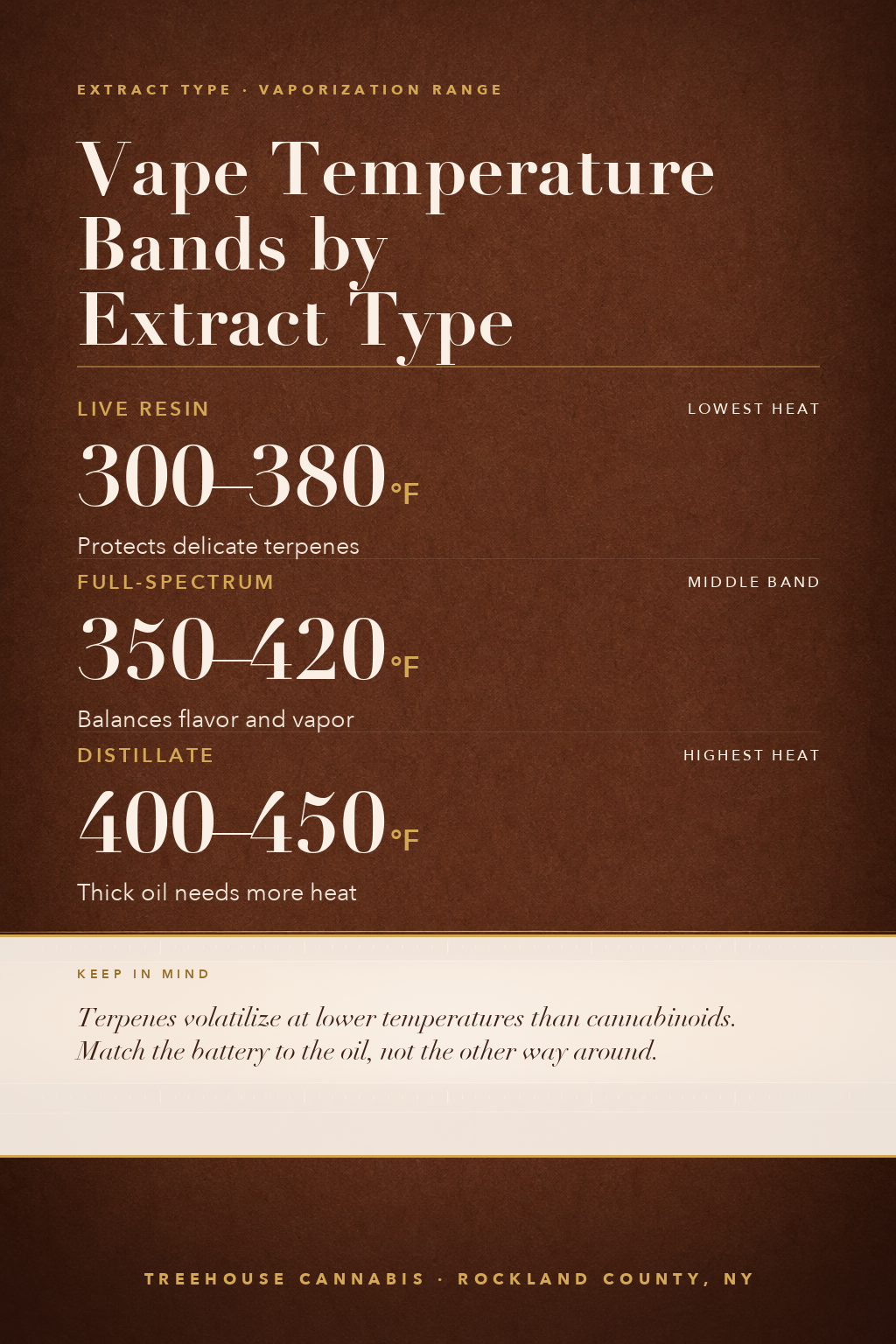
The bands side by side:
| Extract | Temperature band | Why it sits there |
|---|---|---|
| Live resin | 300-380 F | Delicate native terpenes burn off above this range |
| Full-spectrum oil | 350-420 F | Middle band that balances flavor and vapor |
| Distillate | 400-450 F | Thick, heavily refined oil needs more heat to vaporize |
What follows from those numbers:
- Match the battery to the oil, not the other way around, because the extract decides the ceiling
- Buy adjustable voltage or temperature control, since a fixed-output pen locks you into one heat for every cart you own
- Read a burnt taste as a power problem first, because scorched oil is usually too much heat rather than bad extract
- Treat vaporization efficiency as a portion-control question, not a strength upgrade
Terpenes volatilize at lower temperatures than cannabinoids, which is the whole mechanism [9]. Running a live resin cart at distillate power burns off exactly the compounds you paid extra for, and no amount of flavor on the front of the box survives that.
That makes adjustable voltage the single most useful feature on a battery. A fixed-output pen locks you into one temperature for every cart you own, and the Batteries Accessories selection on our menu is where to compare units that let you set it properly.
One pharmacokinetic finding deserves care rather than enthusiasm. In a double-blind study of 17 infrequent users, blood cannabinoid concentrations were higher after vaporization than after smoking the same THC dose, indicating vaporization is a more efficient delivery method [12].
That is a finding about how the body absorbs the dose, not an instruction about how much to use, and it means a vape rewards attention to portion control rather than substituting for it. If you are calibrating how long to wait between sessions, How Long Should You Wait Before Taking More Cannabis? covers that timing question in more detail.
What Are the Red Flags That Should Stop a Purchase?
Some signals are strong enough to end the conversation. The reason they matter is written into the 2019 EVALI outbreak, which is the clearest recent demonstration of what happens when nobody tests the batch.
In 2019, 86 percent of 867 EVALI patients reported using THC-containing products, and vitamin E acetate was detected in lung fluid from 48 of 51 patients tested, versus none of the comparison group [7]. CDC recorded 2,807 hospitalized EVALI cases or deaths as of February 18, 2020, and found that THC products from informal sources were linked to most cases [8].
Be precise about what that means. The outbreak was tied to illicit products and a specific diluent, not to regulated cartridges generally, and regulated New York products must pass contaminant testing and carry a CoA [1].
The red flags worth acting on:
- No CoA, or no lot number you can match to a lab report
- No processor name or license information on the package
- Packaging that imitates candy or snack brands
- A price far below the rest of the menu
- A loose cart with no box
Any one of those is a reason to ask a question. Two or more is a reason to put it back.
The simplest rule in this article: buy from a licensed dispensary. The entire difference between a tested batch and an unknown one is whether anyone ran the panels, and that is the check no flavor profile can substitute for.
What Should You Do Before You Check Out?
Flavor is the easiest thing to notice and the easiest thing to fake. Extract type, hardware, lab results and dose are harder to read, which is exactly why they are worth the two minutes it takes to look.
Run the checks in this order before you pay:
- Read the label for the Universal Symbol, cannabinoid percentages and the cultivar name
- Match the lot number on the package to the lot number on the Certificate of Analysis
- Confirm the hardware suits the oil's viscosity, and that the battery can hit the right temperature band
- Ask a budtender about anything that is missing rather than guessing
Whether you want a single 510 cartridge to try a new cultivar or a sealed disposable for convenience, the four checks in this guide are the same ones a budtender can walk you through in person. Stop in at our Rockland County dispensary serving Orange and Westchester County customers, ask for the Certificate of Analysis on the batch you are holding, and compare the lot number before you decide.
Frequently Asked Questions
How do I choose a cannabis vape without picking on flavor alone? Judge a vape on four things: the extract type inside the cart, the hardware heating it, the lab results behind the batch, and the dose you actually want. Flavor is a useful signal about terpenes and freshness, but it is the easiest quality marker to fake with added botanical terpenes.
What should I check on a vape cartridge label in New York? Look for the New York Universal Symbol, the processor name and license number, the cannabinoid percentages, the cultivar name, a lot or batch number, an expiration or use-by date, and a QR code that opens the product's Certificate of Analysis. Missing label elements are a reason to ask before buying.
What does a Certificate of Analysis tell me about a vape cart? A Certificate of Analysis is the lab report for that specific batch. It shows whether the product passed testing for pesticides, heavy metals, residual solvents, microbials and potency, and it lists the cannabinoid and terpene results as percentages. A regulated New York product should never show a failed panel.
Is live resin better than distillate for vape carts? Neither is objectively better, they solve different problems. Distillate is refined to a narrow cannabinoid fraction and usually has terpenes added back, which gives consistency and high potency. Live resin keeps more of the plant's native terpene profile, which gives more flavor depth at a higher price.
Does vape cartridge hardware actually affect quality? Yes, substantially. The heating element and reservoir material influence flavor, clogging and whether anything leaches into the oil. Ceramic and glass or quartz components are generally preferred over metal coils and plastic tanks, and hardware should be matched to the oil's viscosity and terpene load.
What temperature should I vape cannabis oil at? It depends on the extract. Published guidance puts distillate around 400 to 450 degrees Fahrenheit, full-spectrum oil around 350 to 420, and live resin lower at roughly 300 to 380 to protect delicate terpenes. A battery with adjustable voltage or temperature control lets you stay in the right band.
What about vitamin E acetate and vape safety? Vitamin E acetate is strongly linked to the 2019 EVALI outbreak and was found in lung fluid from 48 of 51 patients tested. Regulated products sold in licensed New York dispensaries must pass contaminant testing and carry a CoA, which is the practical reason to avoid carts of unknown origin.
Is a higher THC percentage always better? No. Higher THC means more potency per puff, not better quality, and it can make portion control harder for occasional customers. New York requires labeled potency to fall within 90 to 110 percent of the tested value, so a credible Certificate of Analysis matters more than chasing the largest number on the package.
Sources
- New York State Office of Cannabis Management — New York requires every regulated adult-use product to carry the Universal Symbo
- New York State Office of Cannabis Management — A Certificate of Analysis reports pass or fail results for contaminants against
- New York State Office of Cannabis Management — Inhalable product labels must show the percentage of each cannabinoid and typica
- New York State Office of Cannabis Management — New York's Part 128 labeling rules require potency, ingredients, warnings, the u
- New York State Office of Cannabis Management — New York prohibits inhaled and vaporized cannabis products from carrying youth-a
- New York State Office of Cannabis Management — OCM testing limits set per-analyte contaminant thresholds, require labeled poten
- Centers for Disease Control and Prevention (MMWR) — 86 percent of 867 EVALI patients reported using THC-containing products, and vit
- Centers for Disease Control and Prevention — CDC recorded 2,807 hospitalized EVALI cases or deaths as of February 18, 2020, a
- Cannabis Science and Technology — Different extract types need different vaporization temperatures, roughly 400 to
- National Library of Medicine (PubMed) / Cannabis and Cannabinoid Research — A two-week study of 101 regular cannabis users found that cultivar classificatio
- National Library of Medicine (PubMed) / Cannabis and Cannabinoid Research — Six common cannabis terpenoids tested alone and in combination did not change CB
- National Library of Medicine (PubMed) / Journal of Analytical Toxicology — In a double-blind study of 17 infrequent users, blood cannabinoid concentrations
About Treehouse Cannabis
Treehouse Cannabis is a New York State licensed adult-use dispensary serving customers across Rockland, Orange, and Westchester Counties. Our team helps adult customers work through the practical side of buying cannabis, from reading a Certificate of Analysis and matching a lot number to choosing hardware that suits a particular extract. Browse our full menu online or visit us to talk through a cartridge choice with a budtender.
This content is intended for adults 21 and older. Cannabis is for adults 21 and older only. The information here is educational and does not constitute medical, legal, or professional advice. Always follow the manufacturer's instructions for your specific device, and consult a qualified professional if you have questions about cannabis use and your health. Cannabis products may not be suitable for everyone; effects vary by individual.


Shop our products

Shop All

Deals

Flower

Pre-rolls
Vaporizers

Edibles
Drinks

Concentrates
Tinctures

Topicals

CBD

Pet CBD

Accessories