Cannabis and Migraines: What Headache Sufferers Should Know
Cannabis and Migraines: What Headache Sufferers Should Know
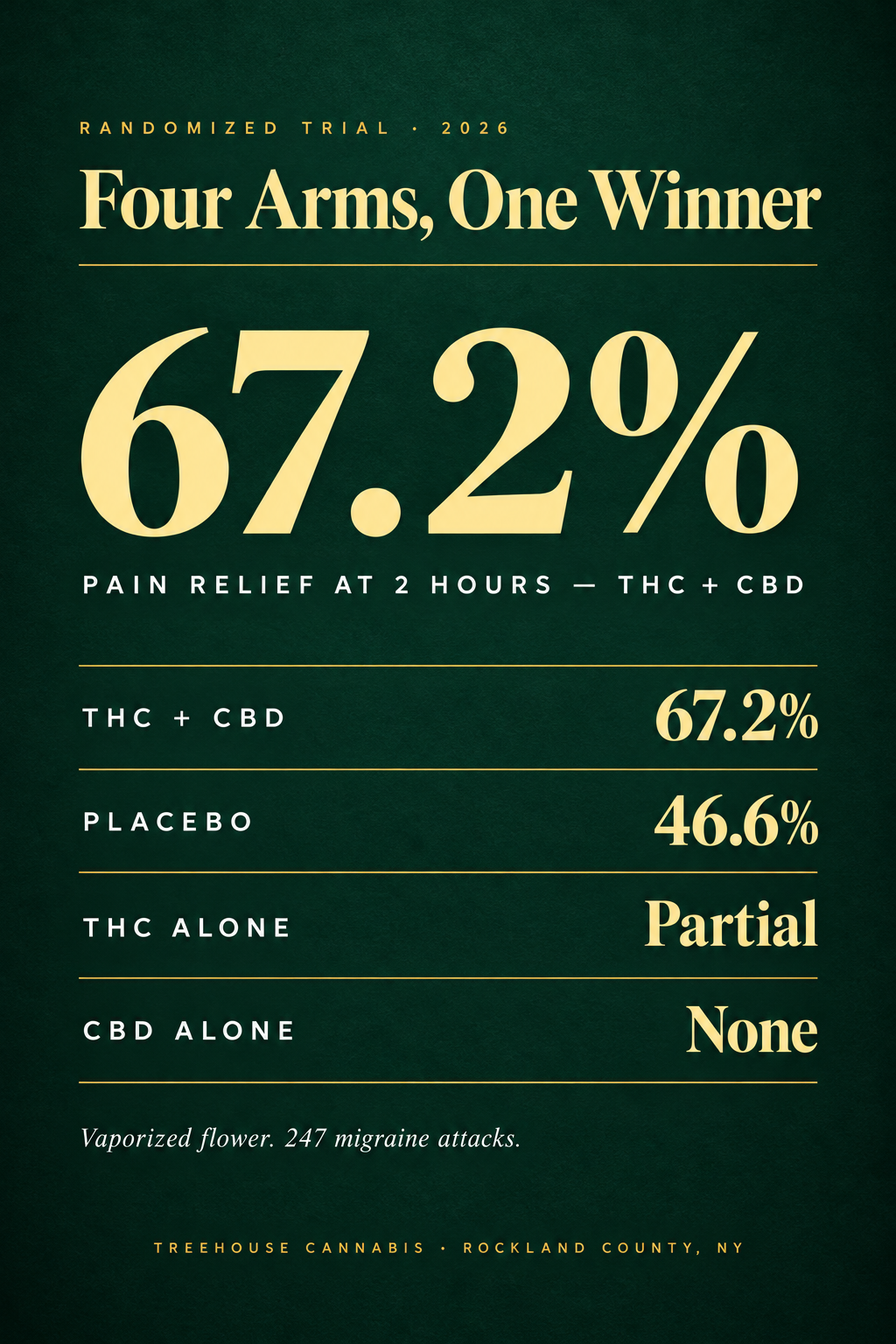
Cannabis and migraines: the evidence shows promise, not proof. In the first randomized trial, published in 2026, vaporized flower with 6% THC and 11% CBD relieved pain at two hours in 67.2% of attacks versus 46.6% with placebo, and CBD alone did not beat placebo. Talk to a clinician before changing anything.
That is more useful than either answer most people get. Cannabis content usually promises relief; neurology handouts say the evidence is thin. Both are partly right, and the details are what separate a reasonable decision from an expensive experiment.
This is not a list of reasons to try cannabis for migraine. It is a reading of what the research shows, including the parts that argue against frequent use.
Does Cannabis Help Migraines?
Yes, in one controlled trial, which is a narrower claim than it sounds. In 2026 a team at the UC San Diego Center for Medicinal Cannabis Research published the first randomized, double-blind, placebo-controlled crossover trial of cannabis for acute migraine. They randomized 92 adults and treated 247 attacks with one of four vaporized flower preparations: 6% THC, 11% CBD, a 6% THC plus 11% CBD combination, or placebo. [1]
The combination arm won. It beat placebo on pain relief at two hours, on complete pain freedom, and on freedom from the attack's most bothersome symptom. Benefits were still measurable at 24 and 48 hours, with no serious adverse events. [1]
- 92 adults were randomized and 247 migraine attacks were treated across four arms
- Pain relief at two hours: 67.2% with THC plus CBD versus 46.6% with placebo
- Complete pain freedom at two hours: 34.5% versus 15.5%
- Freedom from the most bothersome symptom: 60.3% versus 34.5%
- THC alone beat placebo on pain relief only, and CBD alone beat placebo on nothing
| Treatment arm | Pain relief at 2 hours | Complete pain freedom at 2 hours |
|---|---|---|
| 6% THC plus 11% CBD flower | 67.2% | 34.5% |
| Placebo flower | 46.6% | 15.5% |
| 6% THC flower only | Beat placebo | No significant difference |
| 11% CBD flower only | No difference | No difference |
Vaporized flower, 92 adults, 247 migraine attacks, 2026 randomized crossover trial. [1]
The limits matter as much as the numbers. This was one trial, in one lab, with a fixed flower composition. It tested cannabis during an attack, not as a way to keep attacks from arriving. The FDA has not approved the cannabis plant for any medical use, and approved cannabinoid medicines are limited to narrow indications such as rare epilepsy syndromes and chemotherapy-induced nausea. [9] Nothing is approved for migraine.
Everything published before that trial was survey and chart-review data, which is why a 2022 systematic review could report reduced monthly migraine frequency while still calling the underlying evidence mostly retrospective and low quality. [5] One positive trial does not erase that, but it gives the question a real test for the first time.
The cannabinoid at the center of it was delta-9 THC, the compound most people mean when they talk about feeling high, and it does not behave like a targeted headache drug. What Is THC? How the Main Cannabis Cannabinoid Works
Why Would Cannabis Affect Migraine at All?
Because migraine and the endocannabinoid system overlap in the same nervous-system real estate. Migraine affects roughly 16% of the population in Western countries and more than a billion people worldwide, and it is a leading cause of disability, which is why a plausible mechanism attracts so much self-experimentation. [6] [11]
The mechanism is specific. People with chronic migraine have lower levels of anandamide, an endocannabinoid the body makes on its own, in both cerebrospinal fluid and plasma. That reduction is associated with pain facilitation in the spinal cord, meaning the nervous system turns up the volume on pain signals rather than simply receiving more of them. [7]
- Migraine affects about 16% of people in Western countries and more than a billion worldwide
- Anandamide is reduced in chronic migraine, in both cerebrospinal fluid and plasma
- That reduction is associated with pain facilitation in the spinal cord
- Endocannabinoids modulate trigeminovascular nociception through CB1 receptors
- The research target that follows is enzyme inhibition, not the plant itself
That last point is the honest caveat. If low anandamide is part of the problem, the obvious pharmaceutical move is to block the enzyme that breaks anandamide down, fatty acid amide hydrolase, rather than inhale a plant that hits CB1 receptors all over the body. The review laying out this biology points at FAAH inhibition as the more promising target. [7]
Those same receptors sit throughout the gut, which is why cannabis shifts nausea and appetite, and why frequent use can irritate the stomach lining, a pattern covered in Cannabis and Gastritis: What the Research Says.
The populations overlap too. Migraine disproportionately affects middle-aged women, and so does the search for relief that does not come with a daily pill, a subject that comes up constantly in The Menopause-Cannabis Connection: How Women Are Finding Natural Relief.
CBD complicates the story, because it does not bind CB1 receptors the way THC does, so the mechanism above explains THC's effects far better than CBD's. CBD vs THC: The Science Behind the Two Most-Discussed Cannabinoids Minor cannabinoids are further out still, with much less research behind them than either main one. CBG vs CBD: How the Cannabinoids Compare
Strains do not solve this either. Names and indica or sativa labels are weak proxies for cannabinoid content, as covered in Indica vs Sativa: Why the Labels Are Mostly Meaningless, and cannabinoid content is what the trial actually controlled for.
Do THC and CBD Work Differently for Migraine?
Yes, and the trial separated them for exactly that reason. Only the combined THC plus CBD arm was superior to placebo across every endpoint. THC on its own produced pain relief but not complete pain freedom. Flower with 11% CBD and no THC was indistinguishable from placebo at two hours. [1]
- Only the combined THC plus CBD arm beat placebo on every endpoint
- THC on its own relieved pain but did not produce pain freedom
- CBD on its own was not distinguishable from placebo at two hours
- In survey data, concentrates outperformed flower for headache, which is a tolerance warning as much as a benefit
- No specific dose or ratio can be recommended from the published data
That runs against the way CBD is usually marketed. A high-CBD product with negligible THC has the weakest controlled support of any option here, not the strongest, at least for acute migraine.
Survey data add nuance without settling anything. Across 12,293 self-tracked sessions where cannabis was used for headache, and 7,441 for migraine, inhaled cannabis cut self-reported severity by roughly half. Concentrates outperformed flower for headache, and men reported larger reductions than women. Both are subgroup findings from self-report, not guidance. [3]
| What was tested | Result against placebo | Practical read |
|---|---|---|
| THC plus CBD flower | Superior for pain relief, pain freedom and symptom freedom | Closest match to the product that was actually tested |
| THC-dominant flower | Superior for pain relief only | May blunt pain without ending the attack |
| CBD-dominant flower | No better than placebo at two hours | Weakest controlled support as a stand-alone option |
| Concentrates | Outperformed flower for headache in survey data | Higher potency and a stronger tolerance signal |
Trial results from the randomized crossover trial; concentrate findings from self-tracked survey data. [1] [3]
There is no ratio to recommend. A clinical review from a neurology practice in Amherst, New York concluded that THC and CBD both appear to mediate the effects patients describe, while also concluding there is not enough data to make specific dose recommendations. [12] That is the state of the evidence: something is happening, and nobody can tell you what to aim for.
Price is not a proxy for suitability either. What makes a premium flower cost more is cultivation, hand trimming, testing and packaging, none of which predicts whether it will help a headache. What Makes Premium Cannabis Flower Cost More?
How Do People Use Cannabis During a Migraine Attack?
Mostly by inhaling it, because a migraine escalates in minutes and inhaled cannabis acts within minutes. In a retrospective chart review of 121 adults with a primary diagnosis of migraine, inhaled forms were the common choice for aborting an attack, and average monthly migraine frequency fell from 10.4 to 4.6 headaches per month. [2]
Edibles were the form that caused problems in that same review. The negative effects patients reported, somnolence and difficulty controlling dose timing and intensity, appeared only among edible users. [2] That is not a judgment about edibles. It is what happens when a product takes 30 to 120 minutes to peak while the window for interrupting an attack is closing.
| Format | Time to effect | What to know |
|---|---|---|
| Vaporized or smoked flower | Minutes | Most common in real-world use and the only format tested in a randomized trial |
| Concentrates | Minutes | Higher potency; survey data show effectiveness fading as doses climb |
| Edibles | 30 to 120 minutes to peak | Dose timing and intensity were the reported problems |
| Tinctures | Labeled in milligrams | Easier to portion than flower, but no migraine-specific data |
Onset figures describe how each format behaves generally. They are not migraine-specific dosing guidance.
Vaporized flower is the only format with randomized evidence behind it, and it is also the hardest to dose consistently, because a draw is not a measured unit. The trial controlled the flower's composition, not the volume any one person inhaled. [1]
- Inhaled forms act within minutes, matching how fast an attack escalates
- Vaporized flower is the only format tested in a randomized trial
- Edibles can take 30 to 120 minutes to peak, which is late for an acute attack
- The reported edible problems were somnolence and poor control of timing and intensity
- No specific dose, strain or product can be recommended from the published data
On a menu that looks unglamorous. A dry-herb vaporizer plus a flower option such as NY Diesel | Flower | 28g is the closest consumer-level match to the format the trial used, and both are stocked as Honeycrisp • T-pro Disposable Vape • 2G and NY Diesel | Flower | 28g. None of that is a recommendation for migraine, because the published data do not support one.
Can Cannabis Make Migraines Worse?
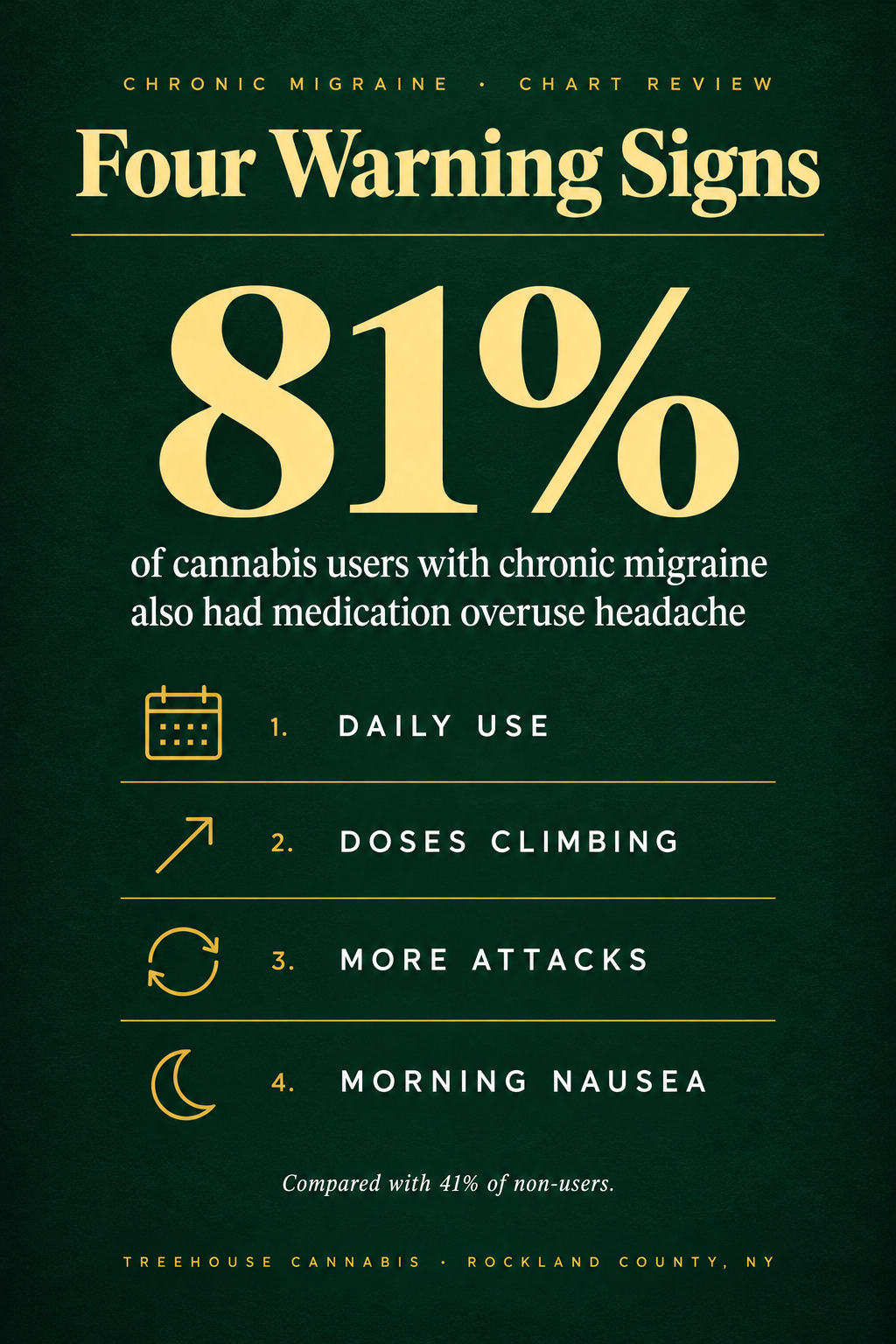
Yes, for some people, and this is the part most cannabis writing skips. A Stanford chart review of 368 adults with chronic migraine found medication overuse headache in 81% of current cannabis users, 122 of 150 patients, versus 41% of non-users, 90 of 218. The adjusted odds ratio was 6.3. [4]
Medication overuse headache is a daily or near-daily headache caused by taking acute relief too often. It is well documented with triptans, opioids and over-the-counter painkillers. The Stanford authors concluded that advising patients to reduce cannabis use may help treat it. [4]
A systematic review found the same association and added the caveat that matters: the underlying studies are mostly retrospective and low quality, so this is an association, not proof that cannabis causes the pattern. [5]
- Medication overuse headache appeared in 81% of cannabis users with chronic migraine versus 41% of non-users
- The association is strong, but the evidence is mostly retrospective, so causation is not established
- Tolerance shows up as the same amount doing less over time while use creeps upward
- Cannabis hyperemesis syndrome brings recurring nausea, vomiting and abdominal pain that improves when use stops
- Warning signs: more attacks rather than fewer, climbing doses, daily use, morning nausea
The tolerance signal is separate and better documented. In that same self-tracking dataset, the effect of inhaled cannabis weakened across repeated sessions while the doses people used grew, which is the shape tolerance takes. [3] Worth noting honestly: those authors did not detect medication overuse headache in their data, the opposite of what the Stanford review found. Two datasets, two answers. That contradiction is the real state of the field, and anyone who says it is settled is selling something.
Cannabis hyperemesis syndrome is a third mechanism, unrelated to rebound headache. Cannabis is anti-emetic at low doses and pro-emetic at high doses and with chronic use, producing recurring nausea, vomiting and abdominal pain that improves when use stops. It is a gut-brain axis disorder, and its prevalence is expected to rise as legal access widens. [10]
None of this means anyone should stop using cannabis on the strength of a blog post. It means that if attacks are getting more frequent rather than less, if the amount needed keeps climbing, if use has become daily, or if there is morning nausea, those are things to raise with a clinician rather than to solve by using more.
What Should You Ask a Clinician Before Using Cannabis for Migraine?
Start with the fact that no cannabis product is approved for migraine. The FDA has not approved the cannabis plant for any medical use, and approved cannabinoid drugs are limited to narrow indications such as rare epilepsy syndromes and chemotherapy-induced nausea. [9] A 2022 review confirmed that no cannabis-based drug is approved for migraine specifically. [6]
That gap is not theoretical. In a survey of 1,429 medical cannabis users, 35.5% reported using it for migraine, often without physician supervision. [6] In a 505-patient medicinal cannabis cohort, 445 of the 505 people using cannabis for headache screened positive for probable migraine, and opioids were the prescription most often substituted with cannabis. [8]
The clinical review from the New York neurology practice adds a fair-minded note: patients described improvement in their migraine profile and reduced prescription use, especially opioids, with mostly mild side effects. The same authors still could not recommend a dose. [12]
- No cannabis-based drug is approved for migraine, and the FDA has not approved the plant for any medical use
- 35.5% of surveyed medical cannabis users reported using it for migraine, often without supervision
- Patients in one New York neurology practice reported improvement without a dose recommendation
- Bring attack frequency, current prescriptions, how often you use cannabis, whether doses are rising, any morning nausea, and any change in aura
- Nothing here replaces prescribed acute or preventive treatment, and stopping a prescription abruptly can trigger rebound headaches
- In New York, adults 21 and older can buy at licensed dispensaries without a medical card, but legal access is not a medical recommendation
That last point deserves plain language. Legal access is not a diagnosis, and a dispensary is not a clinic. Migraine is a neurological condition with acute and preventive treatments that have survived far more testing than cannabis has. [11] The reasonable role for cannabis, if any, is alongside that care rather than in place of it.
If you are 21 or older, Treehouse Cannabis stocks High Dose "UP" | Tincture | 1000MG alongside flower, vaporizers and edibles for pickup or delivery across Rockland, Orange and Westchester counties. Take the format question to the team and the medical question to a clinician, in that order.
Frequently Asked Questions
Does cannabis actually help migraines? The first randomized trial of cannabis for acute migraine, published in 2026, found that vaporized flower containing 6% THC and 11% CBD relieved pain better than placebo at two hours. Almost all earlier evidence came from surveys and chart reviews rather than controlled trials, so the effect is promising but not yet confirmed across multiple studies.
Is CBD alone effective for migraine? Probably not on its own. In that randomized trial, the CBD-dominant flower at 11% CBD was not better than placebo for pain relief, pain freedom, or relief of the most bothersome symptom at two hours. CBD may still help some people, but controlled evidence does not support it as a stand-alone migraine treatment.
Can cannabis make headaches worse? Yes, for some people. A Stanford chart review of 368 chronic migraine patients found medication overuse headache in 81% of current cannabis users compared with 41% of non-users. Daily use, rising doses, and needing more to get the same relief are warning signs worth raising with a clinician.
What is medication overuse headache? Medication overuse headache is a daily or near-daily headache caused by taking acute pain relief too often. It is well documented with triptans, opioids, and over-the-counter painkillers, and recent research suggests frequent cannabis use may be associated with it as well. Treatment usually means reducing the overused product with medical guidance.
Does tolerance to cannabis build up? Observational data suggest it does. In a study of more than 19,000 tracked sessions, inhaled cannabis cut headache and migraine severity by roughly half, but the effect weakened across repeated sessions while the doses people used grew. That pattern is consistent with tolerance, which matters for anyone using cannabis frequently.
How do people use cannabis for a migraine attack? In the published studies, inhaled forms were commonly used for acute attacks because effects start within minutes and an attack can escalate quickly. Edibles can take 30 to 120 minutes to peak and are harder to titrate mid-attack. There is not enough data to recommend a specific dose or product for migraine.
Should I replace my migraine prescription with cannabis? No. Nothing in the evidence supports swapping proven acute or preventive migraine treatment for cannabis. The randomized trial tested vaporized flower as one option during an attack, not as a replacement for triptans, gepants, or preventive medication. Stopping prescribed treatment abruptly can trigger rebound headaches and worse attacks.
Is cannabis legal for migraine in New York? Adults 21 and older can buy cannabis at licensed New York dispensaries without a medical card, but that is adult-use legalization, not a medical recommendation. Migraine is a neurological condition that deserves a proper diagnosis, and a clinician should be involved before cannabis becomes part of how you manage attacks.
Sources
- Headache: The Journal of Head and Face Pain (Schuster, Wallace, Marcotte, Buse, Lee, Liu, Sexton; UC San Diego Center for Medicinal Cannabis Research) — First randomized controlled trial of cannabis for acute migraine: 92 adults trea
- Pharmacotherapy: The Journal of Human Pharmacology and Drug Therapy (Rhyne, Anderson, Gedde, Borgelt; University of Colorado Anschutz Medical Campus) — Retrospective chart review of 121 adults with a primary diagnosis of migraine at
- The Journal of Pain (Cuttler, Spradlin, Cleveland, Craft; Washington State University) — Analysis of 12,293 self-tracked sessions where cannabis was used for headache an
- Headache: The Journal of Head and Face Pain (Zhang and Woldeamanuel; Stanford University School of Medicine) — Chart review of 368 adults with chronic migraine at Stanford headache clinics fo
- Frontiers in Neurology (Okusanya, Lott, Ehiri, McClelland, Rosales; University of Arizona) — Systematic review of the pre-2022 medical cannabis literature for adult migraine
- Journal of Clinical Medicine (Lo Castro, Baraldi, Pellesi, Guerzoni; University of Modena and Reggio Emilia Headache Centre) — Narrative review establishing that migraine affects about 16% of the population
- Frontiers in Neuroscience (Greco, Demartini, Zanaboni, Piomelli, Tassorelli; IRCCS Mondino Foundation and University of California Irvine) — Reviews the biological rationale for a cannabis-migraine link: anandamide levels
- The Journal of Headache and Pain (Baron, Lucas, Eades, Hogue) — Cohort survey of 505 medicinal cannabis patients finding that 445 of 505 patient
- National Center for Complementary and Integrative Health (NIH) — Federal fact sheet confirming the FDA has not approved the cannabis plant for an
- Pharmaceuticals (Loganathan et al.), indexed in PubMed Central — Review documenting the biphasic dose response of cannabis, anti-emetic at low do
- American Migraine Foundation — Patient-education resource from the American Migraine Foundation stating that mo
- Current Pain and Headache Reports (Mechtler, Gengo, Bargnes; Dent Neurologic Institute, Amherst, New York) — Clinical review from a large New York neurology practice reporting that patients
About Treehouse Cannabis
Treehouse Cannabis is an adult-use dispensary serving Rockland, Orange, and Westchester Counties in New York. The menu spans flower, pre-rolls, vaporizers, edibles, tinctures, and concentrates from licensed New York producers. Order online for pickup or delivery, or visit the Rockland County location.
Cannabis is for adults 21 and older. Keep all cannabis products out of reach of children and pets. Do not drive or operate machinery after use. This article is for educational purposes only, is not medical advice, and does not replace guidance from a qualified healthcare professional. Product availability and regulations change; check current New York State adult-use rules before you buy.
Shop our products

Shop All

Deals

Flower

Pre-rolls
Vaporizers

Edibles
Drinks

Concentrates
Tinctures

Topicals

CBD

Pet CBD

Accessories