How to Portion Homemade Edibles Consistently
How to Portion Homemade Edibles Consistently
To portion homemade edibles consistently, work from one batch total. Convert the flower weight to milligrams, multiply by the labeled THC percentage and by 0.877, then divide by the number of identical pieces. After that, portion by weight or by count, never by eye. The arithmetic gives you a target; the process is what makes every piece land near it.
Most homemade edible problems are not baking problems. They are measurement problems wearing an apron. A tray of brownies cut into twelve squares looks uniform and is not, and the piece that lands on the corner of the pan is a different experience from the one in the middle.
The method below treats consistency as a system with fixed steps: calculate once, mix thoroughly, portion mechanically, and write down what you did. It will not make homemade edibles exact. It will make them repeatable.
How Do You Portion Homemade Edibles So Every Piece Matches?
You portion homemade edibles by fixing one total milligram figure for the whole batch, then splitting that figure into identical units. There are only two honest ways to split it: by count, using a mold or disher that holds the same volume every time, and by weight, using a scale for each piece. Cutting a pan by eye is neither.
- One batch equals one total milligram figure, calculated before anything goes in the oven
- Count-based portioning uses a mold, scoop or disher that produces the same volume every time
- Weight-based portioning uses a kitchen scale at 0.1 g resolution and beats any visual cue
- Cutting a pan by eye fails because the geometry is uneven, centers dome, and corner pieces run dry
- The regulated benchmark is 10 mg per serving and 100 mg per package in New York, with per-serving THC required to sit within 25% of the lot mean [10]
| Method | How it works | Where it fails |
|---|---|---|
| By count | Fixed-volume mold or disher, same number of pieces every batch | Volume is not weight, so a dense batter can hide more milligrams per piece |
| By weight | Scale each portion to the same gram figure | Slower, and requires weighing the whole batter before you start |
| By eye | Cut the pan into what looks like equal squares | Uneven geometry, domed centers, and no way to verify |
The weight method is the one worth learning, because it converts a vague instruction into a checkable number. Weigh the finished batter, divide by your portion count, and every portion gets that weight. If the total batter weight shifts between batches, you know before anyone eats anything. A kitchen scale at 0.1 g is the single tool that does the most work here.
The regulated benchmark is useful even if you never sell a thing. New York caps orally ingested products at 10 mg of total THC per serving and 100 mg per package, and treats a product as non-homogeneous when per-serving THC varies more than 25% from the lot mean. [10] Colorado takes the same 10 mg ceiling and defines a standardized serving as no more than 10 mg of active THC. [11] Those numbers describe what a large kitchen has to hit with lab testing behind it. A home cook aiming at the same 25% band is aiming at something real rather than arbitrary.
For the milligram side of the equation in more detail, How to Calculate THC in Homemade Edibles walks through the same arithmetic from a different angle. The measure of success here is boring: two pieces from the same batch should be close enough that the difference does not change your evening.
Peach x Oishii Live Resin Gummies | 10 pk
How Do You Calculate THC Per Serving Before You Bake?
Calculate THC per serving by turning the flower into a milligram figure, adjusting it for the fact that raw cannabis reports THCA rather than THC, and dividing by your portion count. Four steps, one calculator, and a hard number to portion against.
- Convert grams to milligrams. One gram of flower is 1,000 mg of material.
- Multiply by the labeled THC percentage. Use the number on the package, not a guess.
- Multiply by 0.877, the conversion factor regulators apply to THCA when they report total THC.
- Divide by the number of portions to get milligrams per piece.
Step three is the one people skip. Cannabis flower reports most of its potency as THCA, and the carboxyl group that makes it acidic is lost as heat is applied. Connecticut's labeling guidance states the relationship plainly: Total THC = (THCA x 0.877) + THC. [5] The 0.877 accounts for the mass that leaves with the carboxyl group. Skip it and your batch total runs high by roughly 12%. [6]
A worked example makes the arithmetic concrete. Assume 1 gram of flower labeled at 20% THC.
| Step | Calculation | Result |
|---|---|---|
| Flower weight to milligrams | 1 g x 1,000 | 1,000 mg of material |
| Labeled potency | 1,000 mg x 0.20 | 200 mg |
| THCA conversion | 200 mg x 0.877 | 175 mg total THC |
| Portion | 175 mg / 24 pieces | About 7 mg per piece |
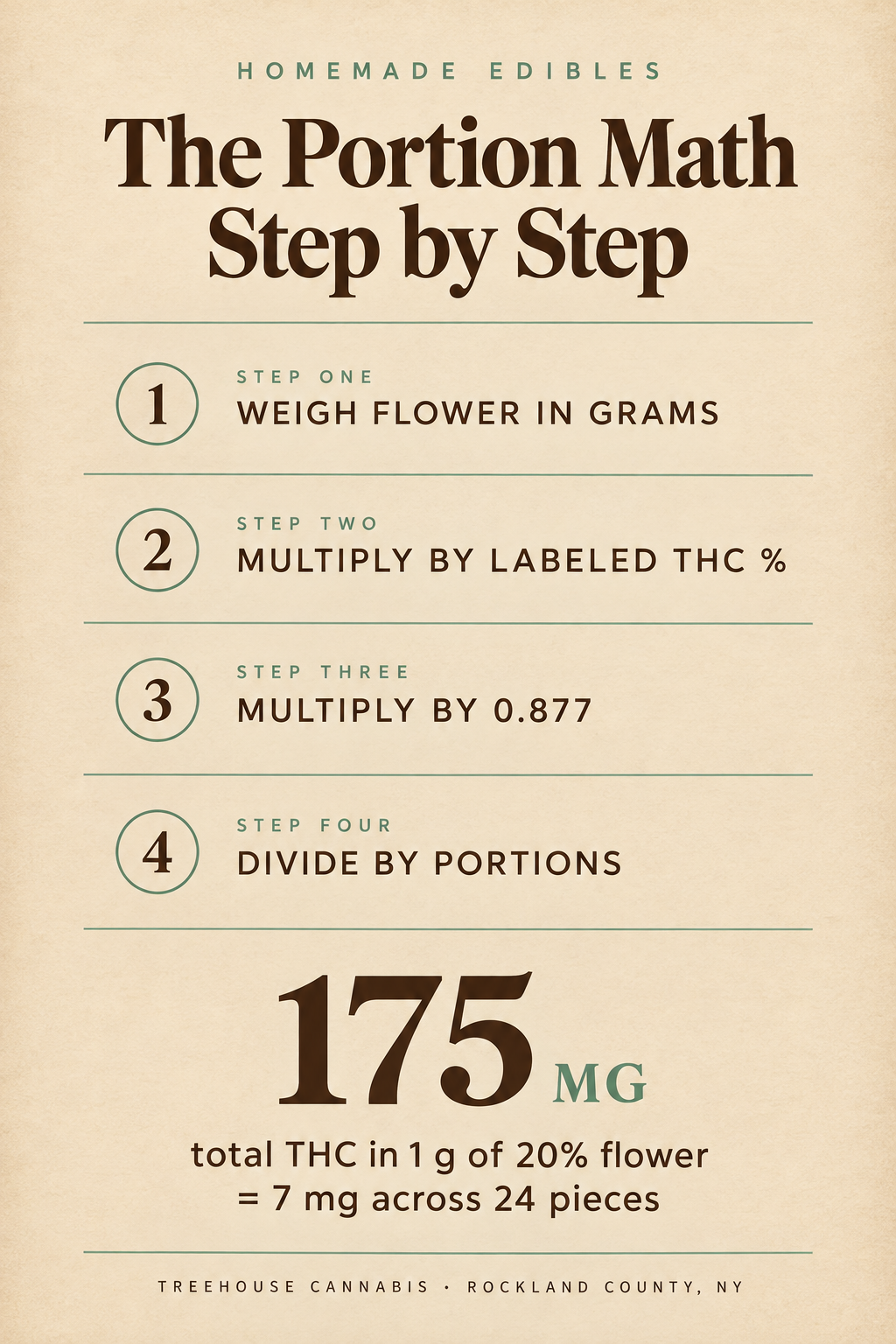
So a single gram of 20% flower lands near 175 mg across the batch, and cutting that into 24 identical pieces puts each piece in the neighborhood of 7 mg. Change any one input and the answer moves: 2 grams doubles it, 15% flower drops it to about 131 mg, and 18 pieces instead of 24 raises the per-piece figure by a third.
Two caveats keep this honest. First, decarboxylation is a chemical process with a completion curve, not a switch. A controlled study found conversion of THCA-A to THC was complete at 160 degrees Celsius under laboratory conditions, which is not a description of your oven. [7] Second, the percentage on the package is a claim about a lot, not a measurement of your gram. Independent testing has repeatedly found labeled potency running above measured potency. [3]
That is why the calculated figure is a ceiling rather than a guarantee. It tells you what the batch can contain if everything went right, which is enough information to portion against and not enough to promise anything. If you want a longer treatment of the label side, How to Compare Edible Labels: Dose, Serving Size, and Ingredients covers how to read dose, serving size and ingredients on a package before you buy.
If you are starting from butter rather than flower, How to Make Cannabutter: A Beginner-Safe Guide handles the infusion step and the potency accounting that goes with it.
Why Do the Same Recipe and the Same Dose Hit Differently?
Three variables move between batches, and only one of them is under your control. The starting flower varies, the decarboxylation varies, and the dispersion of cannabinoids through the batter varies. Standardizing the process reduces the last two, but nothing at home fixes the first.
- Variable one, the flower: the label is a claim about a lot, not a measurement of your gram
- Variable two, decarboxylation: heat and time decide how much THCA actually converts
- Variable three, dispersion: cannabinoids bind to fat and do not distribute themselves through a batter
- The evidence on labels: 74 Colorado samples showed a median labeled potency of 23.1% against a measured average of 18.1% [3]
- The evidence on edibles: 12 tested packages ranged from 288 mg under to 5,491 mg over the advertised amount [4]
- What it means at home: treat potency as an estimate and control everything else
The numbers are worth sitting with. In the Colorado testing, label values ran higher than observed values for both flower and edibles, and even the legally allowable variation between labeled and tested content was a generous plus or minus 15%. [3] The edible analysis found a spread that no home cook could plausibly reproduce by accident: an independent laboratory measuring 12 packages found some products hundreds of milligrams below the advertised total and others thousands of milligrams above it, with three products from a single brand disagreeing with each other. [4]
| What was tested | Labeled | Measured |
|---|---|---|
| Colorado flower, median of 74 samples | 23.1% THC | 18.1% THC |
| 12 edible packages, total THC | Advertised figure | 288 mg under to 5,491 mg over |
| New York label tolerance | Label value | Must fall within 85% to 115% of tested value |
Earlier testing of edible products bought in San Francisco, Los Angeles and Seattle reached the same conclusion about label accuracy, and noted that unregulated edibles failed basic standards that pharmaceuticals are held to. [2] None of this means the products were dangerous or that regulated edibles are unreliable. It means a number printed on a package is a best estimate produced by a sampling process, and a home cook working from that number inherits its uncertainty.
The practical consequence is a shift in attention. You cannot verify the flower, so stop trying to win that fight and spend the effort on the parts you can hold constant: the same starting weight, the same portion count, the same mixing sequence, the same recorded note about what you did. Three of those four are free.
One more variable sits outside the batter entirely, and it is the one most likely to make the same edible feel different on two different days: what else is in the stomach, and how long the last meal was. Absorption of orally ingested cannabinoids is slow and inconsistent, which is why onset varies so widely from person to person and from day to day. [1] A batch that is genuinely uniform can still land differently on an empty stomach than after a heavy meal, and that is not a portioning failure.
For a liquid format where the same dispersion question shows up in a different shape, How to Make Cannabis Tea Without Wasting THC covers extracting into tea without losing potency along the way.
How Do You Mix an Infusion So the THC Spreads Evenly?
Mix evenly by putting the infusion into the fat first, before any dry ingredient goes near the bowl, then scraping every surface the batter touched and folding the scrapings back in. Cannabinoids are fat-soluble, so they travel with the butter or oil and will not spread through a batter on their own.
- Cannabinoids are fat-soluble: they follow the butter, not the water
- Whisk the infusion completely into the fat or liquid component before dry ingredients go in
- Scrape the bowl, the beaters and the spatula, then fold the scrapings back into the batter
- Weigh batter per cavity or per portion rather than filling by eye
- Distribute mix-ins by weight so one piece does not collect all the chocolate chips
- The regulatory yardstick: more than 25% variation from the lot mean is officially non-homogeneous [10]
The order matters more than the effort. If melted infused butter goes into a bowl of flour, some of it coats the flour and some of it sits in pockets, and no amount of stirring afterward guarantees that the pockets are evenly distributed once the batter thickens. If the infusion is whisked into the fat or liquid first, it is already in solution before the structure of the batter forms. [6]
Scraping is the step that separates a good batch from a batch with one strong piece. Batter climbs the sides of the bowl, packs into the beaters, and collects under the blade. That material is not evenly dosed, it is whatever the mixing action pushed outward, and leaving it behind means the portions you weighed do not contain all of it. Scrape it down, fold it in, and weight per portion becomes meaningful again.
Weighing batter per cavity is where a digital scale earns its place. Two spoonfuls that look the same can differ by several grams, and if the batch total is 175 mg across 24 pieces, a 10% weight difference is a 10% potency difference. Filling a mold by eye reintroduces exactly the variance the arithmetic was meant to remove.
Mix-ins deserve the same suspicion. Chocolate chips, nuts and dried fruit do not carry cannabinoids, but they displace batter. A piece with a heavy cluster of chips holds less infused batter than a piece without them, which means the pieces are not identical even if the batter was perfect. Weighing the add-ins and folding them in evenly is a small habit with a visible payoff.
None of this produces a perfectly uniform piece. It narrows the spread. That is the honest goal, and the New York standard gives a sense of scale for how wide a spread can get before a commercial product would be considered non-homogeneous: per-serving THC varying more than 25% from the lot mean. [10] A sloppy mix can drift that far without any obvious sign in the batter.
What Counts as a Standard Dose of a Homemade Edible?
Regulated markets treat 10 mg of total THC as the standard ceiling for one serving, and sell products in 2.5 mg, 5 mg and 10 mg units. That figure is an upper limit set by regulators, not an entry point, and the units on the shelf exist because the ceiling and the useful portion are not the same number.
- Regulated unit sizes are commonly 2.5 mg, 5 mg and 10 mg [8]
- New York caps orally ingested products at 10 mg per serving and 100 mg per package [10]
- Colorado defines a standardized serving as no more than 10 mg of active THC [11]
- 10 mg is a ceiling, not a starting point, and many people orient around 2.5 to 5 mg per portion
- Onset commonly runs 45 to 90 minutes and effects can last around six hours [8]
- Liver metabolism converts THC to the more potent 11-hydroxy-THC, which is why a second portion should wait [8]
| Unit | Where it fits |
|---|---|
| 2.5 mg | Common low unit, and the smallest standard division of a 10 mg serving |
| 5 mg | Common mid unit, half of a regulated serving |
| 10 mg | Standard serving cap in New York and Colorado |
| 100 mg | Package cap for orally ingested products in New York |
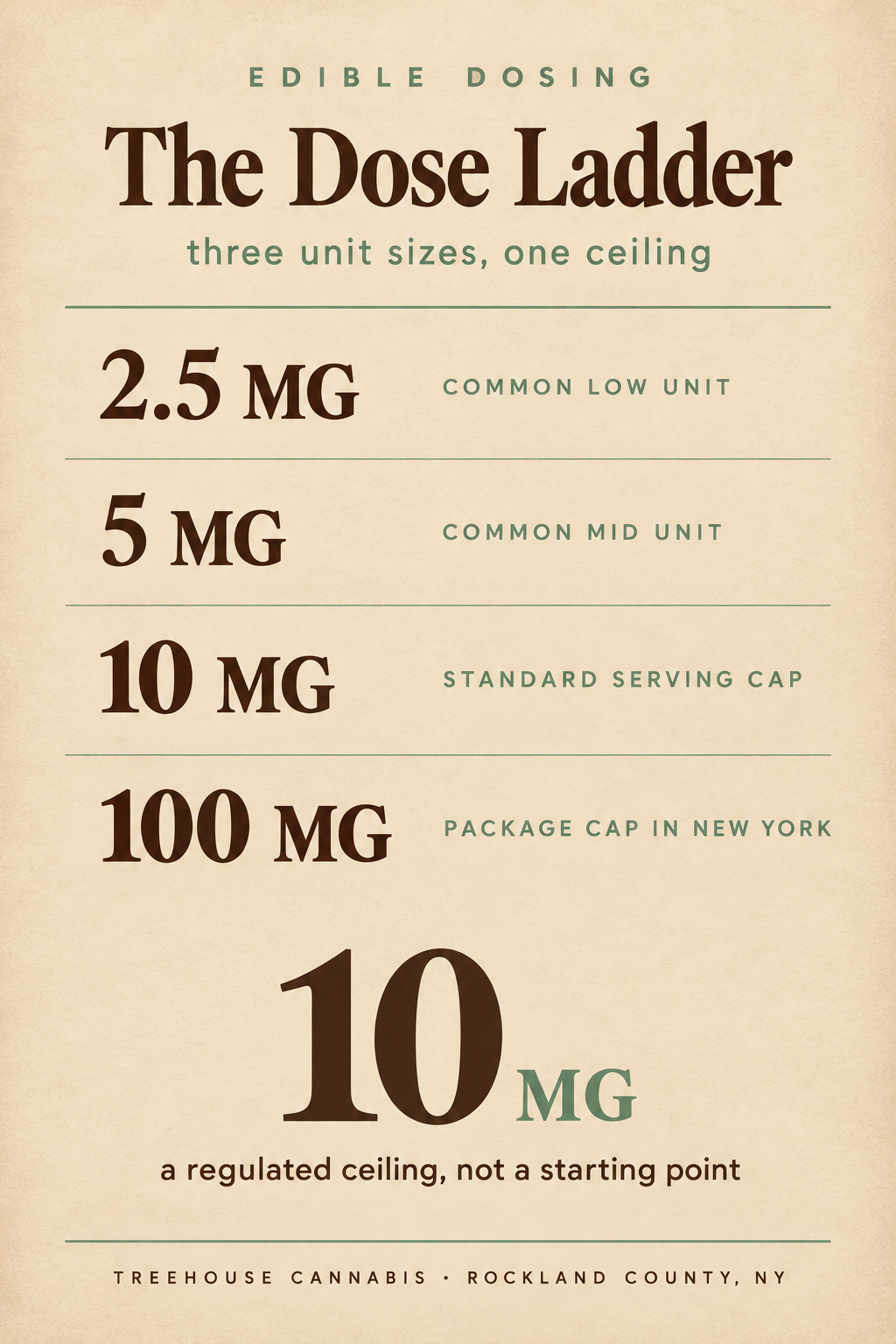
The gap between the ceiling and a sensible portion is the whole reason packaging comes in small divisions. A 10 mg serving is a legal maximum for one serving, and a 100 mg package is a legal maximum for a container, which means a package holding ten servings is expected to be consumed across ten occasions rather than one. A regulated gummy such as Peach x Oishii Live Resin Gummies | 10 pk prints both the per-piece milligram figure and the serving count for exactly that reason, and it is the reference a homemade batch is trying to imitate.
Timing is the part that catches people, and it has nothing to do with portioning discipline. Orally ingested THC is absorbed slowly and passes through the liver before reaching circulation, where it is converted to 11-hydroxy-THC, a metabolite with greater potency. [8] The visible effect is a delay: onset commonly runs 45 to 90 minutes and can stretch longer after a full meal, while effects can last around six hours. [8] Eating a second portion at the 30 minute mark because nothing has happened yet is the single most common way people end up far past the portion they intended. [1]
Cannabis also contains more than 400 compounds beyond THC, and the clinical literature on adverse effects is a reminder that individual response varies widely rather than tracking a milligram figure neatly. [9] Two people eating pieces from the same batch at the same milligram estimate can have very different evenings. Portioning controls what is in the piece. It does not control what the person brings to it.
The practical safety habits are unglamorous and they work: write the milligram estimate and the date on the container, keep edibles in a labeled container rather than a loose bag or a butter dish, and store them out of reach of children and pets. A homemade brownie looks exactly like a brownie.
How Do You Keep Portions Consistent From One Batch to the Next?
Keep portions consistent by fixing the batch size and the portion count, so the flower is the only variable that changes, and by writing down four numbers for every batch: starting weight, labeled potency, portion count, and milligrams per piece. A written log is the only way to notice that a new flower source moved everything.
- Fix the batch size and the portion count so the flower is the only variable in play
- Weigh the starting material every time, because a 10% difference in flower moves every portion by 10%
- Log weight, labeled potency, portion count and milligrams per piece for each batch
- The tools worth owning: a 0.1 g scale, a fixed-volume mold or disher, a marker and labels
- Label the finished container with the milligram estimate and the date
- Home test kits estimate rather than certify, and they cannot confirm even distribution [4]
Fixing the batch size sounds trivial and is not. If one week you make a 24 piece batch from 1 gram and the next week you use the same recipe with 2 grams and cut it into 18 pieces, you have changed two variables at once and learned nothing from the comparison. Hold the portion count, and the per-piece figure becomes a direct readout of what the flower did.
The log does the diagnosing. Four columns are enough: date, grams of flower, labeled potency, milligrams per piece. After six batches you can see whether a potency change came from a new flower source or from a change in how you made the batch, which is otherwise invisible. The 12 package analysis that found measured THC running from hundreds of milligrams under to thousands over the advertised amount is a reminder that labels carry real uncertainty. [4] Your log does not remove that uncertainty, but it makes your own batches comparable to each other, and that is the part you can act on.
Tools do the work that judgment cannot. A 0.1 g scale makes weight-based portioning practical, a fixed-volume disher or mold makes count-based portioning repeatable, and labels convert a container of unmarked edibles into something a household can reason about. The same instinct that keeps Dab Tools Accessories on hand for concentrates, grading material by weight instead of by eye, is what makes a ten dollar scale worth more than a decade of practice.
A dropper-dosed format removes the cutting step entirely, which is why are often the easiest place to see what consistent portioning looks like: a marked dropper holds a repeatable volume, and the bottle states the milligram content per milliliter. The same logic transfers back to solid food, where the fixed-volume mold plays the role of the dropper.
Home potency kits belong in this picture as a supplement, not a replacement. Consumer devices and test kits estimate rather than certify, and they will not tell you whether THC is evenly spread through the batch. [4] They can flag that a flower is weaker than the label claimed, which is useful. They cannot confirm that piece 7 matches piece 8, and that is the question portioning is answering.
Portioning is easier when the starting material is already labeled. Treehouse Cannabis in Rockland County stocks tested edibles with total THC printed on the package, so customers have a real number to work from before the flour comes out, plus a licensed team to ask when the math gets fuzzy. Adults 21 and older can shop in store or order for pickup and delivery across Rockland, Orange and Westchester counties.
Frequently Asked Questions
How do I calculate THC per serving in homemade edibles? Multiply the grams of decarbed flower by 1,000 to get milligrams, multiply by the labeled THC percentage, then multiply by 0.877 to convert THCA to THC. Divide that total by the number of portions. One gram of 20% flower works out to roughly 175 mg across the whole batch, or about 7 mg per piece across 24 pieces.
Why do my homemade edibles hit differently every batch? Three variables move: the actual potency of the flower, how completely it decarboxylated, and how evenly the infusion spread through the batter. Independent testing has found flower labels running well above measured THC, so even careful arithmetic starts from an estimate rather than a certainty.
What counts as one serving of a homemade edible? Regulated markets treat 10 mg of THC as a standard serving, but that figure is a ceiling rather than a starting point, and many people orient around 2.5 to 5 mg. Portion homemade edibles by weight or by count so each piece carries a known fraction of the batch total.
Does mixing infused butter into the whole batter make dosing even? It is the only way to get close. Cannabinoids bind to fat, so they do not distribute themselves. Whisk the infusion fully into the fat or liquid component first, then combine with the dry ingredients, and scrape the bowl. Unmixed pockets are the most common cause of one strong brownie and one dud.
How long should I wait before eating more of an edible? Two hours is the cautious answer. Onset commonly runs 45 to 90 minutes and can stretch longer after a full meal, and effects can last around six hours. Waiting less than that is how people end up far past their intended portion, because the first one has not finished arriving yet.
Can I test homemade edible potency at home? Only roughly. Consumer test kits and portable devices estimate rather than certify, and they will not tell you whether THC is evenly spread through a batch. For consistent portions, treat the calculation as an estimate and standardize the process instead of chasing an exact number.
What is the easiest way to portion edibles without a calculator? Build the portion into the recipe. Use a mold, scoop or scale so every piece is identical, keep the batch size fixed, and write the milligram estimate per piece on the container. If a batch always makes 24 identical pieces, the only number that changes between batches is the flower you started with.
Sources
- PubMed Central / NCBI — NIH-indexed review documents the delayed onset of orally ingested THC and explai
- JAMA / National Library of Medicine — Testing of edible products purchased in San Francisco, Los Angeles and Seattle f
- PLOS ONE / PubMed Central — Independent lab testing of 74 Colorado cannabis samples found median flower labe
- Clinical Toxicology / National Library of Medicine — Laboratory analysis of 12 edible packages found measured THC ranged from 288 mg
- Connecticut Office of Cannabis / State of Connecticut — State guidance defines the total THC calculation used for labeling as Total THC
- Project CBD — Explains that the carboxyl group on THCA is removed by a combination of heat and
- Cannabis and Cannabinoid Research / PubMed Central — Laboratory decarboxylation study found conversion of THCA-A to THC was complete
- Leafly — Reports that regulated edibles commonly sell in 2.5 mg, 5 mg and 10 mg units, th
- StatPearls / National Center for Biotechnology Information — Clinical overview of cannabis pharmacology and adverse effects, noting that cann
- New York State (9 NYCRR 123.6) via Cornell LII — New York rules cap orally ingested products at 10 mg total THC per serving and 1
- Colorado Marijuana Enforcement Division — Colorado rules define a standardized serving of marijuana as no more than 10 mg
About Treehouse Cannabis
Treehouse Cannabis is an adult-use dispensary serving Rockland, Orange, and Westchester Counties in New York. The menu spans flower, pre-rolls, vaporizers, edibles, tinctures, and concentrates from licensed New York producers. Order online for pickup or delivery, or visit the Rockland County location.
Cannabis is for adults 21 and older. Keep all cannabis products out of reach of children and pets. Do not drive or operate machinery after use. This article is for educational purposes only, is not medical advice, and does not replace guidance from a qualified healthcare professional. Product availability and regulations change; check current New York State adult-use rules before you buy.



Shop our products

Shop All

Deals

Flower

Pre-rolls
Vaporizers

Edibles
Drinks

Concentrates
Tinctures

Topicals

CBD

Pet CBD

Accessories