How to Make Cannabis Tea Without Wasting THC
How to Make Cannabis Tea Without Wasting THC
A practical cannabis tea guide: why most weed tea carries almost no THC, and the decarb plus fat steps that fix it.
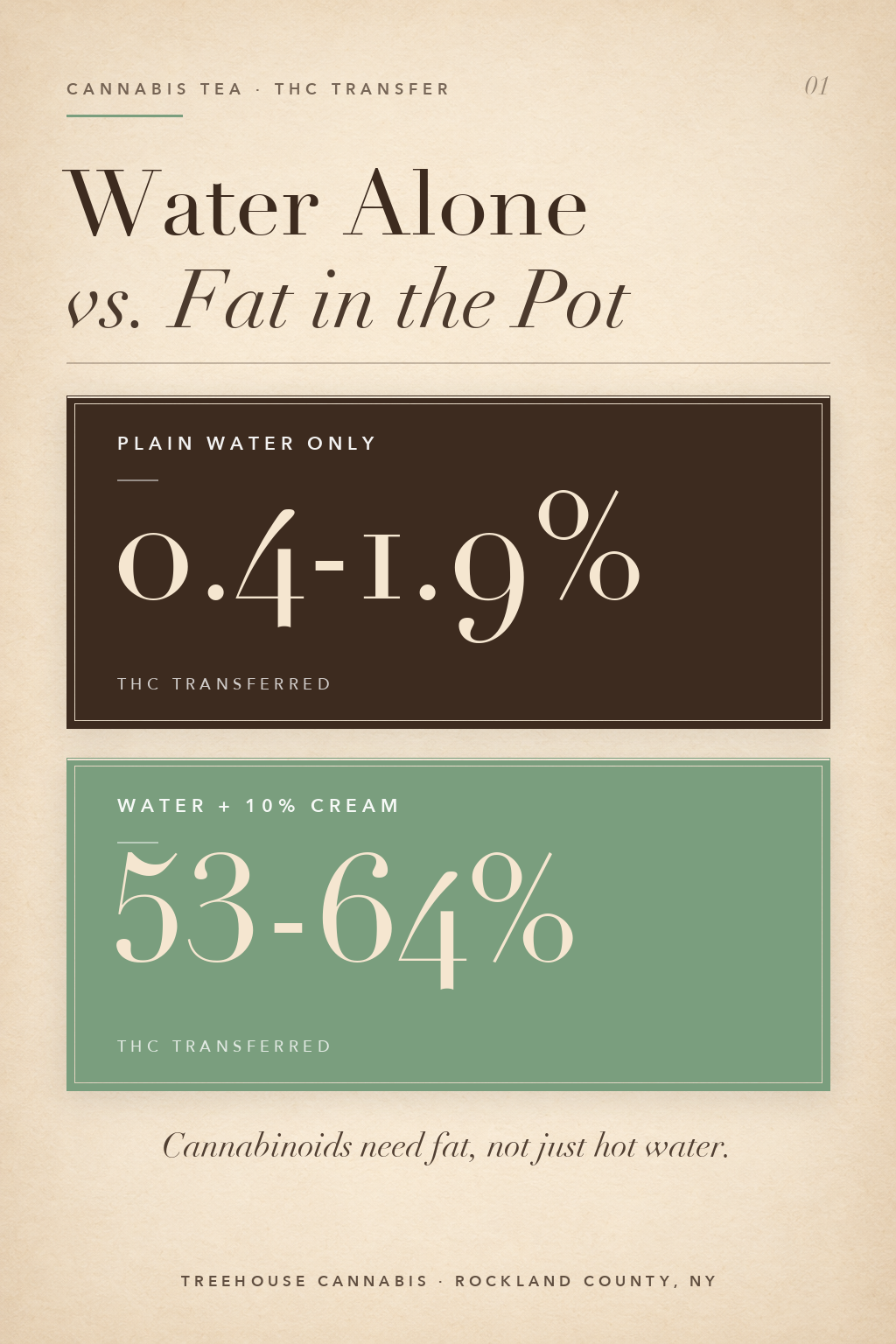
Cannabis tea delivers THC only when the flower is heated first and the brew contains fat. Miss either step and the cup carries almost none of it, however strongly it smells of cannabis. In published lab testing, a plain water infusion recovered just 0.4% to 1.9% of the THC in the plant material, while the same flower steeped with cream recovered 53% to 64% [1].
That gap is the entire article. Most homemade weed tea disappoints not because the flower was weak, but because the method threw the THC away before anyone took a sip. The plant matter goes in smelling strongly of cannabis, the kitchen fills with that smell, and the drink arrives with almost none of the intoxicating molecule in it.
A practical cannabis tea guide comes down to two fixes: a heat step before the flower meets the pot, and a fat that is present during the steep rather than stirred in afterward. Everything below explains why those two steps matter, how to run them, and how to keep a batch from landing far stronger than intended.
Does Cannabis Tea Actually Get You High?
Yes, but only when two conditions are met at the same time, and both are easy to miss. The flower has to be decarboxylated with heat before brewing, and the liquid has to contain fat while the flower steeps. Miss the heat and the THC stays locked as inactive THCA. Miss the fat and there is nothing for the cannabinoids to dissolve into.
The measured numbers are blunt about how much this matters:
- Two conditions must both be met: the flower is heated first, and the pot contains fat.
- Plain hot water pulls only 0.4% to 1.9% of the plant's THC into the cup.
- Adding 10% cream during steeping pushed transfer to 53% to 64% in the same published testing.
- Raw flower holds its THC mostly as THCA, which does not produce the usual intoxicating effect until heated.
THC is fat-soluble and only weakly water-soluble. Hot water swells the plant material and pulls out flavors, sugars, and a little chlorophyll, which is why water-only tea tastes and smells convincingly like cannabis while delivering almost nothing. The molecule people are actually after stays behind in the wet plant matter that gets strained into the trash.
This is also why a cup can feel like a placebo rather than a disappointment. The aroma promises one thing and the chemistry delivers another, and the gap is entirely a method problem rather than a flower problem. Fix the heat step and the fat, and the same gram behaves completely differently.
Home results vary with the potency of the flower, how finely it was ground, how long it steeped, and how much fat went into the pot. Two customers can follow the same weed tea recipe and land in very different places, which is why the dosing guidance below leans on labeled THC percentages rather than scoops or pinches. For a closer look at what the molecule itself does once it reaches the bloodstream, see What Is THC? How the Main Cannabis Cannabinoid Works.
Why Do You Have to Decarboxylate Cannabis Before Making Tea?
Because raw cannabis does not contain much THC. It contains THCA, the acidic form, which is not intoxicating on its own. Heat removes a carboxyl group and converts THCA into THC, and that reaction needs temperatures a kettle cannot reach.
Published lab work on the conversion is specific about the tradeoff between time and heat:
- THCA is the acidic form of THC stored in fresh plant material, and it is not intoxicating on its own.
- Complete conversion took about 30 minutes at 110 C, 9 minutes at 130 C, and 6 minutes at 145 C.
- Conversion did not finish within 60 minutes at temperatures below 100 C.
- Water boils at 100 C, so a steep alone cannot decarboxylate the flower.
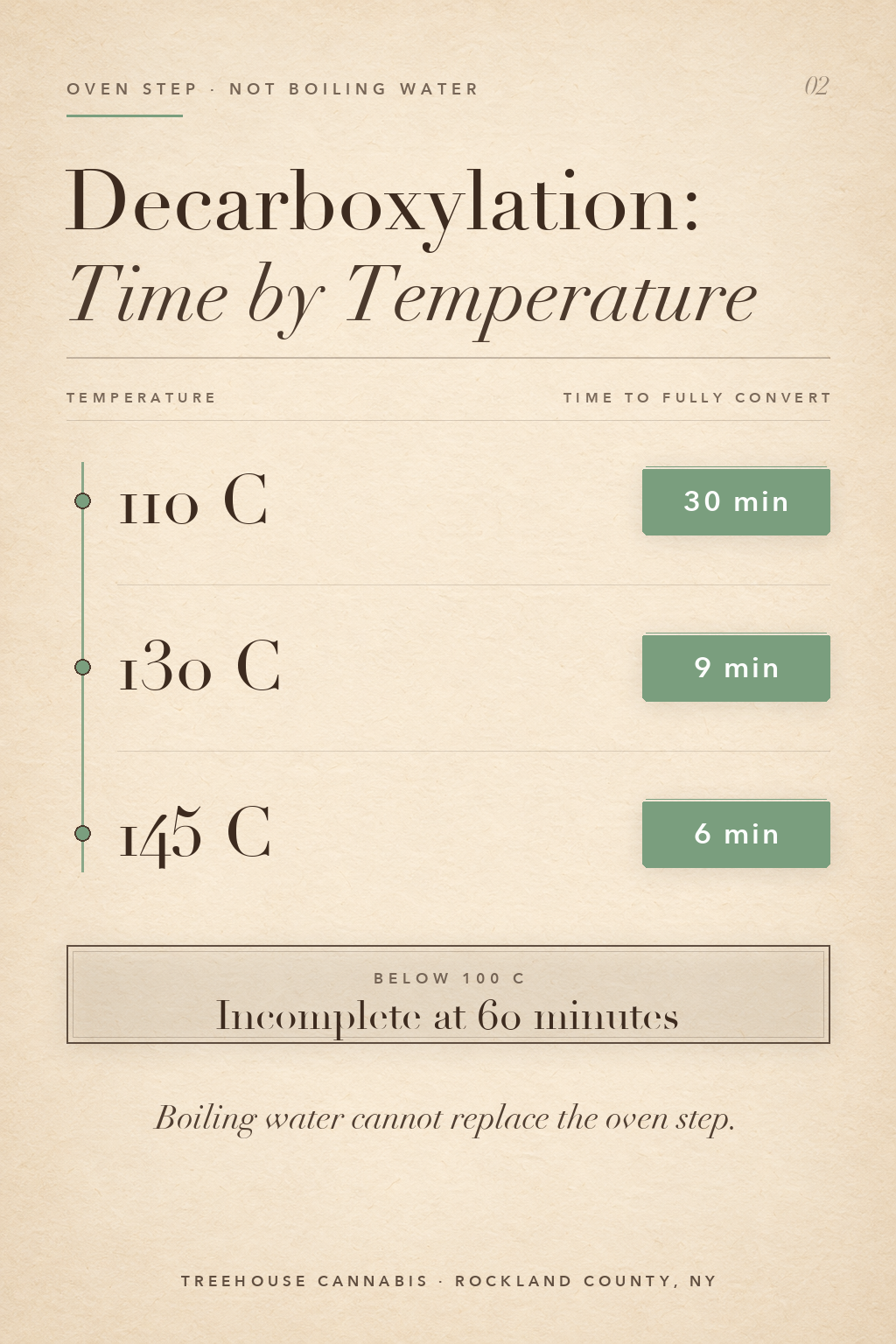
That last point is the one people miss. Boiling water sits right at the edge of a temperature where the reaction barely proceeds, and a five-minute steep at 100 C is nowhere near the published conversion curves. The oven step has to happen before the flower ever meets the pot. A home oven is not a laboratory instrument, so treat those figures as published conditions rather than a guaranteed result; the goal is thorough, even heating rather than precision chemistry.
Labels add to the confusion. New York calculates total THC as THC plus THCA multiplied by 0.877 [8], which means a jar of raw flower can read as potent while most of that advertised number is still inactive THCA.
The conversion factor exists precisely because regulators know the two forms are not interchangeable until heat has done its work. The difference between a budget gram and a premium one is largely resin quality and how carefully the flower was handled, which is covered in What Makes Premium Cannabis Flower Cost More?. If you would rather apply the same heat step to butter than to water, How to Make Cannabutter: A Beginner-Safe Guide walks through it at a beginner pace with identical logic.
Which Fat Carries THC Into Your Tea Best?
Any fat works, but it has to be in the pot before steeping, not stirred into the finished cup. That timing detail separates a drink that carries cannabinoids from one that merely looks creamy.
The evidence points the same way across two separate studies:
- Cannabinoids are fat-soluble, so the fat belongs in the pot with the flower rather than stirred in at the end.
- Creamer added before boiling raised THC concentration 2.3 to 4.4 fold.
- Creamer added to an already-brewed cup made no significant difference.
- One 200 mL cup of tested medicinal tea ranged from 0.46 mg to 11.3 mg THC depending on the product.
- Practical options run from whole milk and heavy cream to butter, ghee, coconut oil, and MCT oil.
| Fat option | Amount per 2 cups | Flavor note |
|---|---|---|
| Whole milk | 1 cup | Mild, classic tea texture, lower fat than cream |
| Heavy cream | 2 to 4 tablespoons | Richest transfer, thick mouthfeel, mutes bitterness |
| Butter or ghee | 1 to 2 tablespoons | Savory note, works well in chai-style spice blends |
| Coconut oil | 1 to 2 teaspoons | Strong flavor, separates unless whisked or emulsified |
| MCT oil | 1 teaspoon | Neutral and liquid at room temperature, no taste |
Start at the low end of those ranges. A quarter cup of cream per cup of tea is enough to do the job without turning the drink into dessert, and remember that fat is a carrier, not a potency switch. It moves more of what is already in the flower into the liquid; it cannot make a weak gram strong.
The 0.46 mg to 11.3 mg spread inside a single 200 mL cup of medicinal tea is the useful warning here [7]. Even products sold in the same category varied by more than twentyfold, so a homemade cup built on unknown flower is a genuine unknown. That uncertainty is why the waiting guidance in How Long Should You Wait Before Taking More Cannabis? matters as much as the ingredient list: onset is slow, and pouring a second cup too early is the most common way a good evening turns into a long one.
How Do You Make Weed Tea Step by Step?
This is the working weed tea recipe for two cups. It assumes decarboxylated flower, a fat, and a thermometer you trust, in that order.
- Decarboxylate 0.5 to 1 gram of flower at about 110 C for 30 minutes on a parchment-lined tray, breaking the buds up roughly so heat reaches the center of each piece.
- Grind coarse, not to powder. A coarse grind gives the fat surface area to work with and strains cleanly; powder turns the cup muddy and bitter.
- Combine with 2 cups of water plus 1 cup of whole milk, or 2 tablespoons of cream or butter. Add the fat now, not later.
- Hold a gentle simmer around 85 to 90 C for 30 to 45 minutes with the lid on, stirring occasionally and topping up with water if the level drops.
- Strain through fine mesh, press the solids with the back of a spoon, and sweeten to taste with honey, sugar, or a spice blend.
- Let the cup cool to a drinkable temperature before serving, and pour small portions rather than filling a mug.
A rolling boil is not an upgrade. It drives off liquid, concentrates the plant matter into a bitter stew, and can scorch the fat onto the bottom of the pot, which is exactly where the burnt, grassy aftertaste comes from. Keep the pot at a bare shiver of a simmer and the flavor stays clean.
Two smaller details change the finished cup more than people expect. First, keep the lid on for the whole steep; a covered pot holds both heat and the volatile aromatics that would otherwise escape with the steam. Second, do not let the liquid reduce much. If the level drops by more than a quarter, add hot water to bring it back, because a concentrated brew is harder to portion accurately and tastes harsher.
Consistency between batches comes from writing down what you did: the flower, its labeled percentage, the weight, the fat, and the steep time. Without those notes every batch is a fresh guess, and the second attempt is no more predictable than the first.
Potency math, labeled clearly as an estimate: 1 gram of flower testing at 20% THC holds roughly 200 mg of THC. Even at a 60% transfer rate, that is about 120 mg sitting in the pot. Split across a dozen small cups, it lands near the 10 mg per serving cap New York applies to commercial orally ingested products [8]. Split across two mugs, it is six times that per mug, which is how a reasonable-sounding recipe turns into an uncomfortable afternoon.
The starting point for any batch is tested, labeled flower, because the label is the only number you can actually do math with. Treehouse carries Martian Mints Flower - 70g for customers brewing in volume, Martian Mints Flower - 70g across the price tiers, and Limited Edition Sapphire Blue | Pivot Mobile Vaporizer such as fine mesh strainers and kitchen thermometers that make the simmer step controllable. Small buds are a sensible budget choice for infusion since they come from the same plant as the top colas at a lower price.
How Long Does Cannabis Tea Take to Kick In?
Expect 30 minutes to two hours before effects are noticeable, a peak around 1.5 to 3 hours, and a total duration of roughly 5 to 8 hours. That is dramatically slower than smoking, and it is the single biggest reason people over-drink their tea.
The timing comes from controlled dosing work rather than folklore:
- Onset is typically 30 to 120 minutes, not the minutes a smoked product takes.
- Peak effects land around 1.5 to 3 hours after drinking.
- Effects last roughly 5 to 8 hours.
- Oral bioavailability is about 4% to 20% and rises toward 25% with a high-fat meal.
- Wait a full two hours before deciding to drink more.
In one controlled study, 17 adults who had not used cannabis for at least 60 days showed no measurable effects until 30 to 60 minutes after ingestion, with effects peaking between 1.5 and 3 hours [3]. Separately, a systematic review of 26 studies found that oral THC absorption varied widely between formulations and that peak plasma concentrations were consistently delayed compared with other routes [4]. Bioavailability sits around 4% to 20% and climbs toward 25% when taken with a high-fat meal, with a duration of action of roughly 5 to 8 hours [5]. A fat-based tea is effectively a high-fat vehicle, one more reason the cream belongs in the pot.
The practical rule is a full two hours before a second cup. Because the drink peaks later than most people expect, a second cup at the 40-minute mark stacks a second slow dose on top of the first, and the two arrive together. Drinking the same brew on an empty stomach and after a meal is not the same experiment either, since absorption shifts with food. Never drive or operate machinery after drinking; impairment can outlast the pleasant part of the experience by hours.
If you are brewing on a budget, Small Buds Flower is where value flower usually sits, and the labeled percentage still tells you what the math looks like.
What Are the Most Common Ways People Waste THC in Tea?
Almost every disappointing cup traces back to one of six losses, and five of them happen before anyone tastes anything.
- Skipping decarboxylation leaves most of the THC locked as THCA, which is not intoxicating until heated.
- Steeping in water alone recovered only 0.4% to 1.9% of the plant's THC [1].
- Adding the fat after brewing instead of during steeping made no significant difference in measured THC [7].
- A five-minute steep is not long enough; 30 to 45 minutes at a gentle simmer is the working range.
- A hard boil drives off liquid and can scorch the fat, ruining the flavor along with the batch.
- Discarding the strained solids without pressing them leaves liquid and fat behind in the plant matter.
The conversion side of that list is worth restating plainly: below 100 C, the THCA to THC reaction did not finish within an hour in published testing [2]. A cup brewed from green, unheated flower smells like cannabis and carries almost none of the THC, which is exactly what the water-transfer measurements describe. Customers who follow that path usually conclude that tea does not work, when the real problem was that the flower was never activated.
One crude but useful signal: properly decarboxylated flower smells noticeably stronger and toastier than the green material that went into the oven. If the ground flower still smells like fresh trim, the heat step was likely short.
Stems and already-vaped bud are usable but far weaker than fresh decarboxylated flower. Stems carry far less resin, and vaped bud has already had much of its THC driven off by the heat of a previous session, so neither behaves like a fresh gram. Treat them as a way to use material you would otherwise discard, not as a way to stretch a batch that was already thin.
If measuring flower is the unreliable part of the process for you, a labeled tincture or edible removes the guessing: THC1000 Releaf Tincture | 30mL | 1000mg. For flower itself, Flower is the full menu, including the small-bud and premium tiers that change what a gram costs per milligram of THC.
How Does Homemade Cannabis Tea Compare to THC Drinks?
They behave like different products because they are absorbed differently. Nano-emulsified drinks are engineered into droplets that need little digestion, so they hit faster and fade sooner. Homemade tea behaves like a fat-based edible: slower onset, longer duration, wider margin for error.
| Factor | Homemade cannabis tea | Commercial THC drink |
|---|---|---|
| Onset | 30 to 120 minutes | Around 15 minutes |
| Duration | About 5 to 8 hours | 60 to 180 minutes |
| Dose labeling | None; estimate from flower percentage | Required per serving under New York rules |
| Dose control | Depends on the brewer's math | Fixed per container, but multi-serving cans invite over-pour |
What that means for dose control in practice:
- Homemade tea hits in 30 to 120 minutes and lasts 5 to 8 hours; nano-emulsified drinks hit in about 15 minutes and fade in 60 to 180 minutes.
- Multi-serving cans make it easy to over-serve, and homemade tea carries the same risk in a different form.
- Licensed New York oral products label every serving; homemade tea has no label at all.
Nano-emulsified THC beverages are absorbed faster than THC-infused foods because they need less digestion [6]. A can holding several servings is easy to finish in one sitting, the same failure mode as pouring an entire pot into a single mug.
Homemade gives you the inputs, not a label. Potency stays an estimate unless the flower's tested percentage is known, and the transfer rate sits on top of that estimate. Licensed New York oral products must identify each serving and cap it at 10 mg total THC [8].
If you would rather buy the predictable version, Drinks Edibles covers ready-made drinks, and Peach x Oishii Live Resin Gummies | 10 pk includes the broader lineup with per-serving labels. Brewing at home is cheaper per milligram when the process is right, and a worse deal when the flower was never decarboxylated.
Ready to brew a better cup? Visit Treehouse Cannabis in Rockland County, where the team can point you to tested flower with a labeled THC percentage so your first batch of cannabis tea starts from a known number. Customers in Rockland, Orange, and Westchester Counties can ask about the current flower menu before the kettle goes on. Start small, wait two hours, and enjoy responsibly.
Frequently Asked Questions
Does cannabis tea actually get you high?
It can, but only when the flower was decarboxylated with heat first and the brew contains fat while it steeps. A plain water infusion pulls just 0.4% to 1.9% of the available THC into the cup, while adding cream during steeping pushed transfer to 53% to 64% in the same published testing.
How long does cannabis tea take to kick in?
Expect 30 minutes to two hours before effects are noticeable, a peak around 1.5 to 3 hours, and a total duration of roughly 5 to 8 hours. That delay is why the working rule is to wait a full two hours before deciding the cup did nothing and pouring more.
Do you have to decarboxylate cannabis before making tea?
Yes. Raw flower holds most of its THC as THCA, which is not intoxicating on its own. Water boils at 100 C, and published lab work shows THCA conversion does not finish within an hour below that temperature, so the oven step has to happen before the flower meets the pot.
What kind of fat works best in cannabis tea?
Whole milk, cream, butter, coconut oil, and MCT oil all work because cannabinoids are fat-soluble. Cream added before boiling raised THC transfer in published testing, while creamer stirred into an already-brewed cup made no significant difference, so the fat belongs in the pot with the flower.
How much cannabis should go into one cup of tea?
Most published home recipes use 0.5 to 1 gram of decarboxylated flower for two cups. Because potency varies so widely, note the flower's labeled THC percentage, pour small servings, and treat the first cup as a test rather than a full dose.
Why did my cannabis tea do nothing?
The three usual causes are unheated flower, no fat in the pot, and too little steeping time. Green, unactivated plant material in hot water makes a drink that smells and tastes convincingly like cannabis while carrying almost none of the THC, which is what the water-transfer studies describe.
Can you make weed tea with stems or already-vaped bud?
You can, and it is a reasonable use for material you would otherwise discard, but expect a weaker result and dose cautiously. Stems carry far less resin than flower, and already-vaped bud has had much of its THC driven off, so neither behaves like a fresh gram.
Is homemade cannabis tea legal in New York?
Adults 21 and older may possess and consume cannabis legally in New York, and licensed dispensaries sell tested flower that customers can infuse at home. New York caps commercial orally ingested products at 10 mg total THC per serving, so keep homemade servings in that same cautious range.
Sources
- Journal of Agricultural and Food Chemistry (Maly et al., via NIH PubMed Central) — A plain water infusion carried only 0.4% to 1.9% of the THC in the plant materia
- Cannabis and Cannabinoid Research (Wang et al., via NIH PubMed Central) — THCA-A converted completely to THC in about 30 minutes at 110 C, 9 minutes at 13
- Drug and Alcohol Dependence (Schlienz et al., via NIH PubMed Central) — In 17 adults who had not used cannabis for at least 60 days, oral THC produced n
- Medicina (Poyatos et al., systematic review, via NIH PubMed Central) — Across 26 studies of capsules, oils, and baked goods, oral THC absorption was hi
- The Journal of Pediatric Pharmacology and Therapeutics (via NIH PubMed Central) — Oral delta-9-THC bioavailability is roughly 4% to 20% and rises toward 25% with
- Addiction (Abingdon, England) (via NIH PubMed Central) — Nano-emulsified THC beverages are absorbed faster than THC-infused foods because
- Basic and Clinical Pharmacology and Toxicology (Sonderskov et al., National Library of Medicine) — A 200 mL cup of standard medicinal cannabis tea contained 0.46 to 11.3 mg THC de
- New York State Office of Cannabis Management — New York requires orally ingested cannabis products to identify each serving, ca
About Treehouse Cannabis
Treehouse Cannabis is a licensed adult-use dispensary in Rockland County, New York, serving customers 21 and older across Rockland, Orange, and Westchester Counties. The team can point customers to tested flower with a labeled THC percentage, along with strainers, thermometers, and the other small tools that make a home infusion predictable.
Cannabis is for adults 21 and older. Keep all cannabis products securely stored and out of reach of children and pets. Do not drive or operate machinery while under the influence of cannabis. This article is intended for adult-use customers in New York State and is not medical advice; customers with questions about interactions with medications or underlying health conditions should consult a licensed clinician.

Shop our products

Shop All

Deals

Flower

Pre-rolls
Vaporizers

Edibles
Drinks

Concentrates
Tinctures

Topicals

CBD

Pet CBD

Accessories