Humulene: The Hoppy Terpene With an Appetite Angle
Humulene: The Hoppy Terpene With an Appetite Angle
What humulene actually is, where the appetite-suppressant reputation came from, and how to read it on a terpene panel without believing more than the research supports.
Humulene is a sesquiterpene with the formula C15H24, the compound behind the dry, woody, hoppy note found in cannabis flower, hops, black pepper and sage. It is also the terpene most often sold as an appetite suppressant, which is where the humulene cannabis reputation gets complicated. No human study has ever tested isolated humulene for appetite.
That gap matters more than it sounds. Humulene has real chemistry behind it, a real aroma signature, and a genuine body of animal research. What it does not have is a single clinical trial asking whether the isolated molecule changes how much a person eats. The appetite claim is a short walk through hop research, a naming mix-up and a lot of repetition, and it is worth taking that walk slowly.
Here is what humulene actually is, where it sits in a cannabis profile, what the studies on humulene effects do and do not show, and how to read a humulene figure on a certificate of analysis without turning a batch measurement into a promise.
What Is Humulene and Why Does It Smell Like Hops?
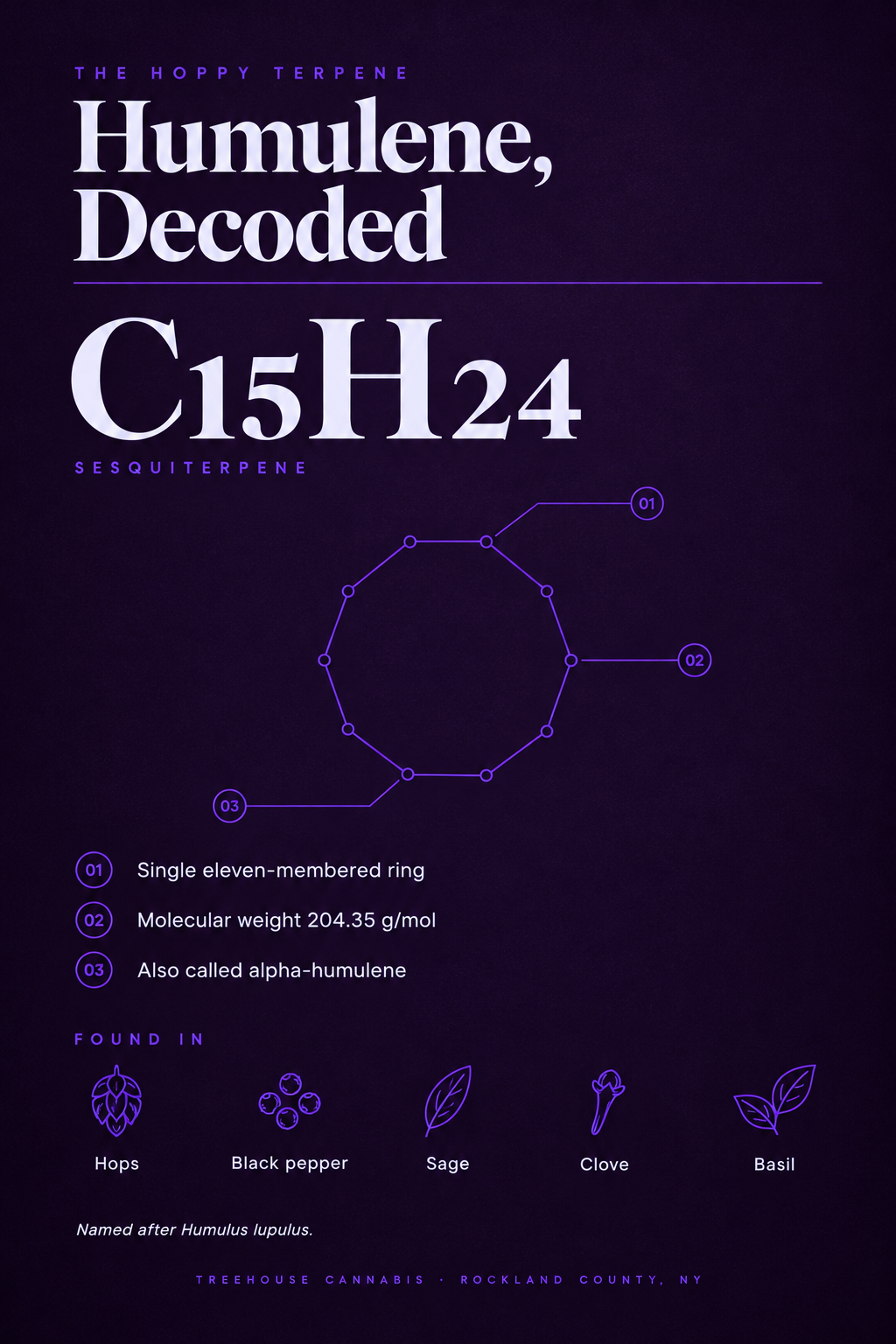
Humulene is a sesquiterpene assembled from three isoprene units, with a molecular weight of 204.35 g/mol and the CAS number 6753-98-6 [7]. It is also written alpha-humulene, and sometimes alpha-caryophyllene, which is where a good deal of the confusion in terpene coverage starts.
- Chemical identity: C15H24, 204.35 g/mol, a sesquiterpene built from three isoprene units [7]
- Aroma: dry, woody, earthy and faintly spicy, the note most people describe as hoppy
- Name origin: Humulus lupulus, the hops plant, which sits in the same botanical family as cannabis [8]
- Alternate names: alpha-humulene and alpha-caryophyllene, both in active use
- Not the same molecule as humulone, the hop bitter acid responsible for much of beer's bitterness [10]
The hops connection is botany rather than marketing. Hops and Cannabis sativa are both members of the Cannabaceae family, which is why a pale ale and a jar of flower can share an aroma note without either one borrowing from the other. The molecule was named for the plant it was first pulled out of, and cannabis happens to make it too.
Sensory expectation is where most shoppers go sideways. Humulene is rarely the loudest thing in a jar, so it tends to register as a background dryness underneath whatever leads the profile, rather than as a headline smell you can name on the first sniff. It also travels with beta-caryophyllene almost constantly, and the two together read as a peppery-woody base rather than as two separate notes.
One naming problem is worth flagging early, because it causes real errors online. Humulene is a terpene. Humulone is a hop bitter acid with its own separate chemical record, and studies of bitter acids or whole hop extracts are not studies of the terpene [10]. The names are one letter apart and the molecules are entirely different. If you want the plant-by-plant tour of where the molecule turns up outside cannabis, What Is Humulene and Why Does It Show Up in Herbs, Black Pepper, and Cannabis? covers herbs, pepper and flower side by side.
Where Does Humulene Come From in Cannabis and Hops?
Humulene is close to universal in cannabis and almost never abundant. A nine-cultivar commercial analysis found alpha-humulene in every sample tested, always below 0.2 percent of flower dry weight, while its co-produced isomer beta-caryophyllene ranged from 0.1 to 0.7 percent in the same material [5].
- In nine commercial cultivars, alpha-humulene was detectable in every sample but stayed under 0.2 percent of flower dry weight [5]
- Beta-caryophyllene, its co-produced isomer, ran from 0.1 to 0.7 percent in the same analysis [5]
- Cultivars where humulene reaches third most abundant include Death Star, Headband, Thin Mint GSC, Original Glue and Candyland [8]
- Other natural sources include hops, black pepper, sage, clove, basil and ginger
- Concentrates can show a higher percentage because the aromatic fraction is concentrated, not because the plant produced more of it
The reason the two isomers travel together is biosynthetic. Humulene and beta-caryophyllene come off the same branch of the terpenoid pathway, so a plant that builds one tends to build the other, and a flower with a strong caryophyllene reading usually carries measurable humulene alongside it. That is a chemistry fact, not a shopping heuristic, though it does explain why the two names keep appearing in the same sentences.
The cultivar list deserves a caveat. Being the third most abundant terpene in a plant where terpenes are measured in fractions of a percent still means a small absolute number [8]. A cultivar name is a starting point for a conversation, not a specification, because terpene content shifts with genetics, grow conditions, harvest timing and cure.
Humulene is also not a cannabis exclusive, which is why the aroma feels familiar to anyone who cooks. Hops carry it in quantity, and black pepper, sage, clove, basil and ginger all contribute it to the mix. The molecule is a normal part of the spice shelf, and treating it as a cannabis curiosity undersells how ordinary it is.
Concentrate panels need their own reading. A distillate or live resin figure reflects a fraction that has been concentrated on purpose, so comparing it directly to a flower percentage is comparing two different measurements [5]. Neither number is a dose, and a higher percentage does not mean a stronger or better product.
If you want to see how humulene sits against the rest of the aromatic family, The Cannabis Terpene Wheel: A Visual Guide to Every Common Terpene maps every common terpene in cannabis in one view, and A Guide to Terpenes and Their Effects walks through what each of them is generally associated with. The Flower section of the menu is where those figures turn into something you can compare by hand, batch by batch.
Is Humulene an Appetite Suppressant?
No. No human study has tested isolated humulene for appetite, which makes appetite suppression a reputation rather than a finding. The claim is repeated constantly, and the research behind it is about hops, not about the terpene.
- Direct answer: no human trial has tested isolated humulene for appetite, so the claim is untested in people
- The 2022 trial: 500 mg of bitter hop extract in 19 healthy-weight men lowered ad libitum energy intake to 4439 to 4473 kilojoules, against 5383 kilojoules on placebo [2]
- The same trial found no significant change on any subjective measure of appetite [2]
- The extract was whole hops, not isolated humulene, so the result does not transfer to the terpene [2]
- Humulone is a hop bitter acid and a different molecule, and hop-acid findings get relabeled as humulene findings in secondary coverage [10]
- The 2024 scoping review of 340 studies found no humulene research translated into clinical populations [1]
The 2022 crossover trial is the strongest human evidence anywhere near this question, and it is worth reading precisely. Nineteen healthy-weight men took 500 mg of bitter hop extract or a placebo, then ate freely, and energy intake came out lower after the extract. Gut peptide hormones shifted in a direction consistent with that change. But the participants did not report feeling less hungry, and appetite is a subjective experience before it is a calorie count [2].
Then the naming problem does the rest of the work. Bitter hop extract is dominated by alpha acids, humulone among them, and humulone is a different molecule from humulene with its own separate record [10]. A headline about hop extract becomes a paragraph about hops becomes a bullet about humulene, and by the fourth retelling the terpene is credited with a result produced by a plant extract it was a minor component of.
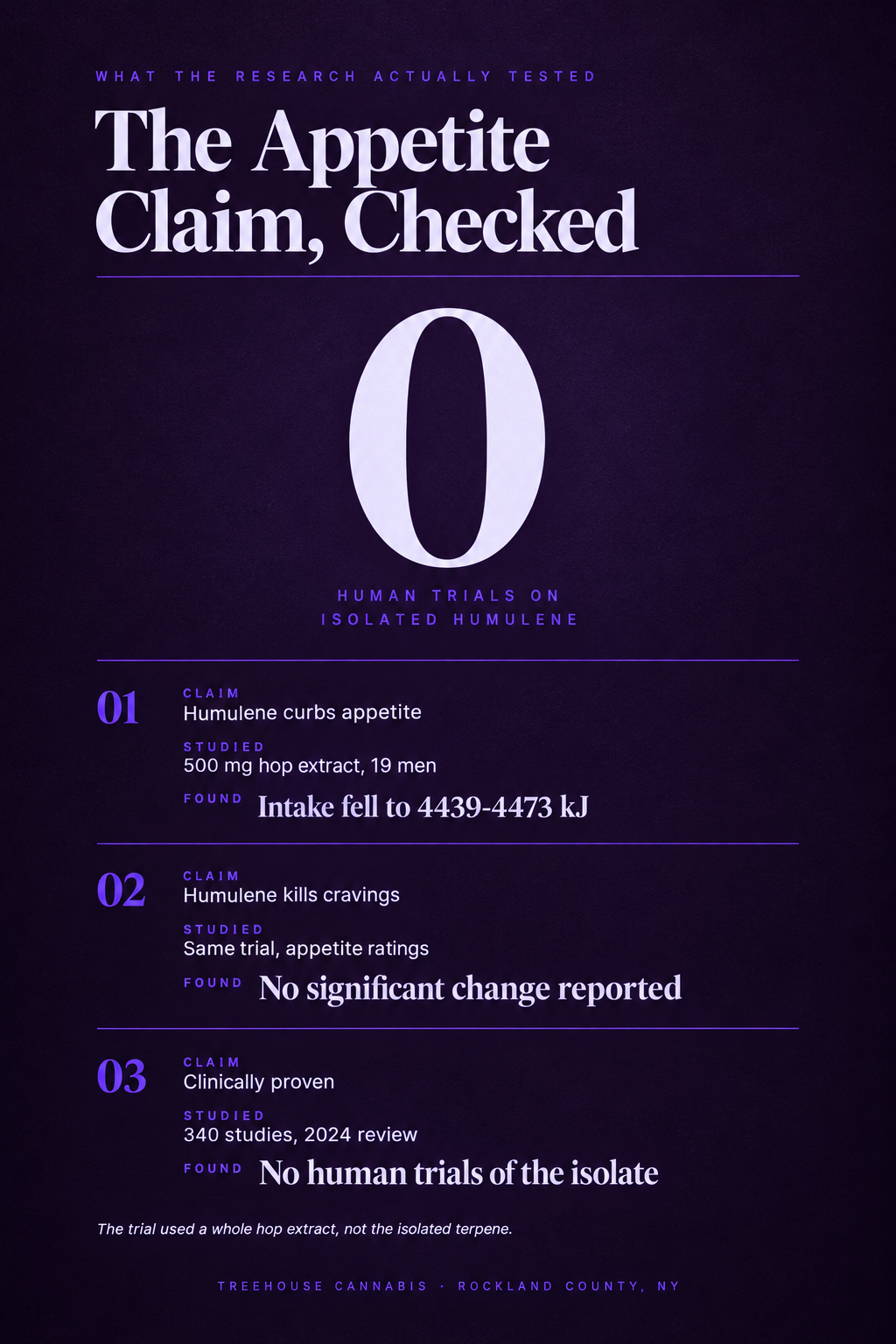
The wider literature check is blunt. A 2024 scoping review analyzed 340 peer-reviewed studies on alpha-humulene and found a paucity of work translating any of it into clinical populations, naming yield variability, limited isolation studies and terpene bioavailability as the barriers [1]. That is not a verdict that humulene fails at anything. It is a statement that the question has not been asked in people.
There is a real difference between "the research is thin" and "this is proven false," and the honest position sits in the first category. If a menu card or a brand calls humulene an appetite suppressant, that is a marketing shortcut rather than a study result. It may also be an honest mistake repeated from a source that confused a hop acid with a terpene. Either way, no trial supports it.
For the broader picture on how terpenes get discussed and where the language outruns the evidence, Understanding Terpenes in Cannabis is a useful primer.
What Do Studies Actually Show About Humulene Effects?
Almost all of it is preclinical. The 2024 scoping review analyzed 340 studies and found alpha-humulene showing anti-inflammatory, antimicrobial, antiproliferative and cannabimimetic activity in cell cultures and rodent models [1].
- 340 studies analyzed for the 2024 scoping review, covering anti-inflammatory, antimicrobial, antiproliferative and cannabimimetic activity [1]
- Doses that produced those findings: 50 mg/kg orally in rodents reduced paw edema and airway inflammation markers, and 50 to 200 mg/kg intraperitoneally produced cannabimimetic effects [1]
- 2021 receptor work found CB1 and adenosine A2a involvement, but only at relatively high concentrations, and the effect synergized with a synthetic cannabinoid agonist [3]
- A 2019 counterweight found six common cannabis terpenoids, alone or combined, did not activate CB1 or CB2 or alter THC signaling at those receptors [6]
- Why none of it has translated: variable yields, few isolation studies and poor terpene bioavailability [1]
The dose numbers need their context attached, because they are the most quotable and least transferable part of the literature. Fifty milligrams per kilogram given orally to a rodent is a laboratory dose in an animal model, not a serving size, and the injected range is a different route again [1]. Reported extraction yields across the species surveyed in that review ran from nil to 60.90 percent, which is another way of saying the starting material is wildly inconsistent before anyone gets to the dosing question.
The 2021 receptor study is the most interesting single paper in the set. In mice and in vitro assays, alpha-humulene produced antinociceptive and other cannabinoid tetrad effects through CB1 and adenosine A2a receptors, but it needed relatively high concentrations to activate CB1 and it synergized with the synthetic cannabinoid agonist WIN55,212-2 [3]. That is a genuine pharmacological signal, and it is also a long way from a jar of flower.
The counterweight matters just as much. A 2019 study in Cannabis and Cannabinoid Research tested six common cannabis terpenoids, alone and in combination, and found none of them directly activated CB1 or CB2 or altered THC signaling at those receptors [6]. If an entourage effect exists, that result says it is not explained by terpenes docking onto cannabinoid receptors directly.
None of this is a reason to read a terpene line on packaging as pharmacology. Terpene callouts on infused products, like the flavor notes on Rocket Razz Lemonade Effects Gummies - Energy - Uplift - 10pc - 100mg, describe a taste direction rather than a receptor event. Interesting science is not the same thing as a product claim, and the gap between a mouse at 50 mg/kg and a person opening a jar is the entire story.
Humulene vs Caryophyllene: What's the Difference?
Both are sesquiterpenes with the identical formula, C15H24, so the difference is shape rather than weight. Humulene is a single large eleven-membered ring, while beta-caryophyllene is bicyclic, and that geometry is why two molecules of the same mass behave differently in a lab dish.
| Property | Humulene | Beta-caryophyllene |
|---|---|---|
| Molecular formula | C15H24 | C15H24 |
| Ring structure | One eleven-membered ring | Bicyclic |
| Aroma | Dry, woody, earthy | Peppery, sharp, spicy |
| Level in nine-cultivar flower analysis | Under 0.2 percent dry weight | 0.1 to 0.7 percent |
| Effect in one fibroblast model | Minimal change in measured inflammatory markers | Lowered IL-6 |
| Response to UV light and heat | Degrades | Degrades at a similar rate |
- Same formula, different shape: C15H24 for both, with humulene as one eleven-membered ring and caryophyllene as a bicyclic structure [5]
- Aroma split: humulene reads dry and woody, caryophyllene reads peppery and sharp
- They co-occur in cannabis because they share a biosynthetic pathway, and caryophyllene usually outruns humulene in flower [5]
- In cultured pterygium fibroblasts, caryophyllene lowered IL-6 while alpha-humulene produced no significant cytotoxicity and minimal change in the markers measured [4]
- Both degrade under UV light and heat at similar rates, so storage matters more than the label [9]
The isomer distinction is not academic. In that fibroblast model, the two compounds did not behave the same way even though they were tested under the same conditions [4]. Caryophyllene moved an inflammatory marker; humulene did not, within the limits of what that assay measured. It is a single cell model and not a statement about anyone's health, but it does settle whether the two names can be used interchangeably. They cannot.
What they do share is fragility. A 2024 study in Phytochemical Analysis found alpha-humulene and beta-caryophyllene degrade along similar profiles and are strongly affected by UV light and heat [9]. Whatever a panel reports at harvest is not what survives a summer in a clear jar on a windowsill, and that applies to both isomers equally.
How Do You Read Humulene on a Terpene Panel?
A terpene panel reports percentages for one batch of one harvest, not for a cultivar in general. Humulene will usually appear as a small single-digit or sub-percent figure, or sit below the reporting threshold entirely, and its presence tells you about aroma direction rather than potency.
- A terpene panel reports percentages for a specific batch, and humulene is normally a small figure or absent from the headline three [5]
- Presence of humulene describes aroma direction, meaning dry, woody and hoppy, not strength or effect
- Flower and concentrate panels are not comparable: one measures plant material, the other a concentrated aromatic fraction [5]
- The 106 degrees Celsius figure most charts print is not an atmospheric boiling point; PubChem lists 99 to 100 degrees Celsius measured at 3 mm Hg, a reduced pressure [7]
- Terpenes volatilize well below their true boiling points, so an ordinary vaporizer setting releases humulene either way
- UV light and heat degrade humulene and caryophyllene at similar rates, so opaque, cool storage preserves the profile you paid for [9]
The boiling point correction is the most useful thing on this page, because the wrong number circulates everywhere. Terpene charts commonly print humulene at roughly 106 degrees Celsius, and the PubChem record shows 99 to 100 degrees Celsius taken at 3 mm Hg [7]. Reduced pressure lowers a boiling point, so that measurement is not a sea-level figure and the two numbers are not describing the same conditions.
The practical upshot is undramatic: terpenes evaporate far below their true boiling points, so humulene reaches you at any normal vaporizer setting whether or not a chart is accurate. That is a statement about physical chemistry, not a recommendation about devices.
Reading a percentage as a dose is the other common error. A flower figure describes the plant material in that batch, a concentrate figure describes a concentrated aromatic fraction, and neither one predicts how much of anything reaches you [5]. Two jars with the same cultivar name can carry genuinely different panels, because the plant is a crop and the certificate describes one harvest.
Storage is the part you control. Since UV light and heat degrade humulene and beta-caryophyllene at similar rates, an opaque container kept cool preserves more of the aroma profile than any label claim will [9]. Ask for the batch number when you buy, and check whether the panel lists terpenes as percentages or in milligrams per gram, because the two formats are not interchangeable.
If you want to go look at real panels rather than take a description's word for it, the pre-roll and concentrate sections of the menu list what each batch tested, and the terpene lines there are the same figures a certificate of analysis would show you.
Halftime Haze • Glass Tip Infused 5 pack Pre-Roll • 2.5g
Donut Trip | Tier 2 Live Rosin Concentrate | 4g
Frequently Asked Questions
What is humulene and what does it smell like?
Humulene, also called alpha-humulene or alpha-caryophyllene, is a sesquiterpene with the formula C15H24 and a molecular weight of 204.35 g/mol. It smells woody, earthy and faintly spicy, and it is the compound largely responsible for the hoppy aroma of beer because hops and cannabis share it. [7] [8]
Does humulene suppress appetite?
No human study has tested isolated humulene for appetite. The claim traces to research on bitter hop extracts, not the terpene. A 2022 trial found hop extract lowered energy intake in 19 men without changing reported appetite, and a 2024 scoping review found no humulene research translated into clinical populations. [1] [2]
What is the difference between humulene and caryophyllene?
They are structural isomers sharing the formula C15H24, but humulene is a single large eleven-membered ring while beta-caryophyllene is bicyclic. They usually occur together in cannabis and hops and smell similar, though caryophyllene reads peppery and humulene reads dry and woody. [4] [5]
Which cannabis strains are highest in humulene?
Humulene is almost never a dominant terpene. Leafly lists it as the third most abundant terpene in Death Star, Headband, Thin Mint GSC, Original Glue and Candyland. Because it is co-produced with beta-caryophyllene, flower with high caryophyllene usually carries measurable humulene too. [5] [8]
What temperature does humulene vaporize at?
Charts commonly list humulene at about 106 degrees Celsius, but that figure derives from a measurement taken at reduced pressure, not at sea level. Terpenes evaporate well below their true boiling points, so a normal vaporizer setting releases humulene regardless of which number a chart prints. [7]
How much humulene is actually in cannabis flower?
Very little. In a nine-cultivar analysis, alpha-humulene was detectable in every sample but stayed under 0.2 percent of flower dry weight, while beta-caryophyllene reached 0.1 to 0.7 percent. Concentrates can carry higher percentages, but a flower figure is a batch measurement, not a dose. [5]
Does humulene get you high?
No. Humulene is not intoxicating and no human study shows it produces a high. Animal work found cannabimimetic effects only at injected doses of 50 to 200 mg/kg, far above what burning or vaping flower delivers, and it required relatively high concentrations to activate CB1 receptors in the lab. [1] [3]
Is humulene the same thing as humulone?
No, and the names cause real confusion. Humulone is a bitter acid in hops, one of the alpha acids behind beer bitterness. Humulene is the aromatic terpene. Studies on hop bitter acids or whole hop extracts are not studies of the terpene, so their results do not transfer to humulene. [2] [10]
Sources
- Planta Medica — Across 340 analysed studies, alpha-humulene showed anti-inflammatory, antimicrob
- The American Journal of Clinical Nutrition — In 19 healthy-weight men, 500 mg of bitter hop extract lowered ad libitum energy
- Scientific Reports — In mice and in vitro assays, alpha-humulene produced antinociceptive and other c
- International Journal of Ophthalmology — In cultured pterygium fibroblasts, alpha-humulene alone produced no significant
- Plant Physiology — In nine commercial cannabis cultivars, alpha-humulene was detectable in every st
- Cannabis and Cannabinoid Research — None of six common cannabis terpenoids, tested alone or combined, directly activ
- PubChem (National Library of Medicine) — Humulene is C15H24 with a molecular weight of 204.35 g/mol and CAS number 6753-9
- Leafly — Humulene is a minor terpene in most cannabis cultivars, appearing as the third m
- Phytochemical Analysis — The isomers alpha-humulene and beta-caryophyllene showed similar degradation pro
- PubChem (National Library of Medicine) — Humulone is a separate hop bitter acid with its own PubChem record, distinct fro
About Treehouse Cannabis
Treehouse Cannabis is a New York State licensed adult-use dispensary serving customers across Rockland, Orange and Westchester Counties. The team can walk you through a certificate of analysis for any cultivar on the menu, from the terpene percentages to the batch number, so you can compare panels before you buy instead of guessing from a strain name.
Cannabis is for adults 21 and older. Keep all cannabis products locked and out of reach of children and pets. Do not drive or operate machinery while under the influence of cannabis. This article is intended for educational purposes only and is not medical advice; consult a qualified clinician with questions about cannabis and your health. Always purchase cannabis from a licensed New York adult-use dispensary.


Shop our products

Shop All

Deals

Flower

Pre-rolls
Vaporizers

Edibles

Drinks

Concentrates
Tinctures

Topicals

CBD

Pet CBD

Accessories