Women Who Changed Cannabis History
Women Who Changed Cannabis History
Eight women in cannabis history changed how the plant is studied, cooked, sold and legalized. They run from a twelfth-century abbess who wrote hemp into a medical text and a 1954 cookbook recipe that reached American kitchens, to a neuroscientist who identified the brain's cannabinoid receptor in 1988.
The through-line is the same for all of them: they built the parts of cannabis culture that outlasted them, and none of them waited for permission.
What follows is who they were, what each one actually changed, and where their work meets the legal market a customer walks into today in Rockland, Orange or Westchester County.
Who Are the Women in Cannabis History Everyone Should Know?
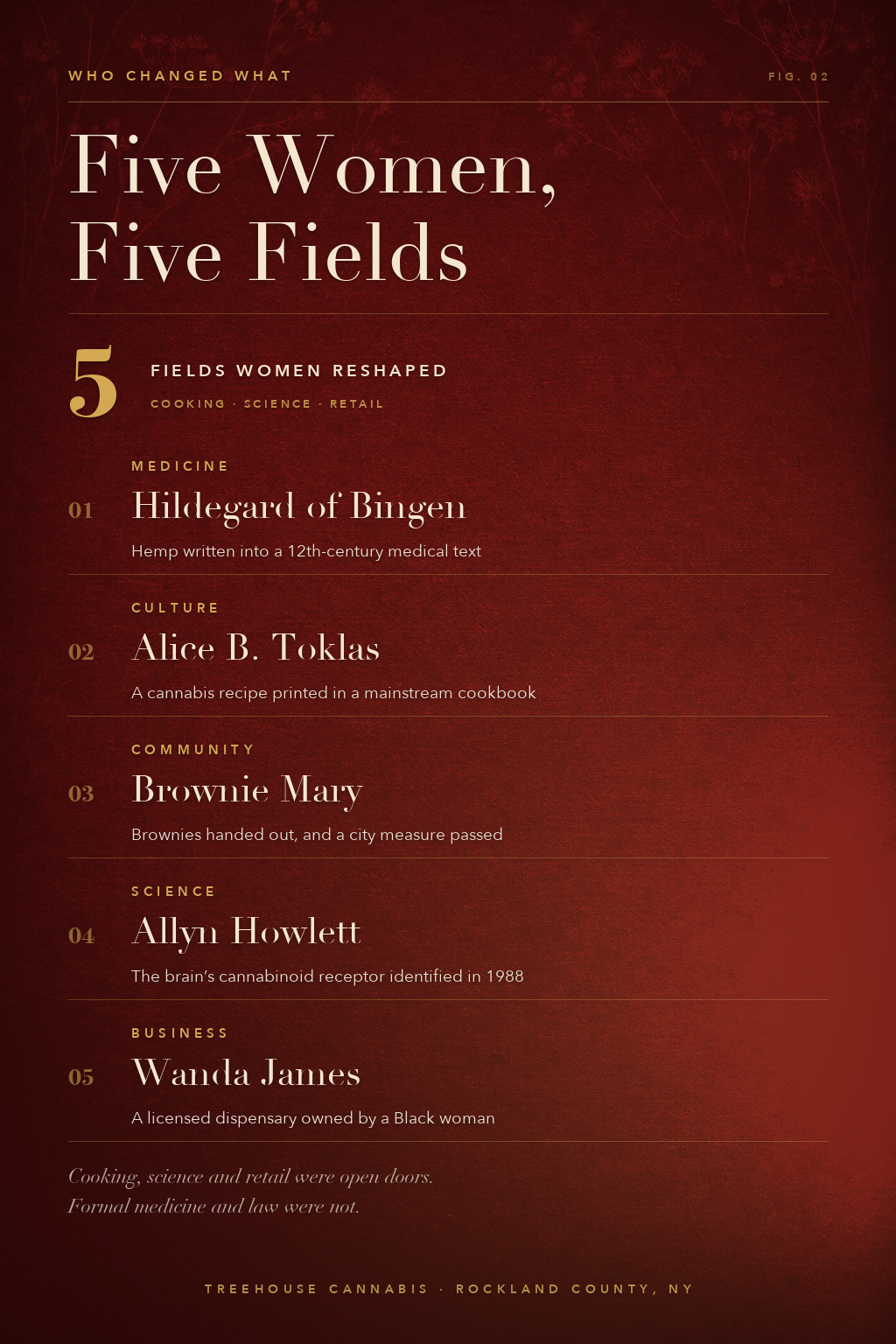
Eight names carry most of this story, and each one did something concrete rather than symbolic:
- Hildegard of Bingen (1098-1179) gave hemp its own chapter in her medical text Physica, which historians of medicine describe as the first book in which a woman discusses plants and their medicinal properties [1]
- Alice B. Toklas printed a "Haschich Fudge" recipe in her 1954 cookbook, and the recipe outlived the scandal it caused [3]
- Mary Jane Rathbun (1922-1999), known as Brownie Mary, baked cannabis brownies in San Francisco and was arrested for it repeatedly [5]
- Allyn Howlett led the laboratory whose 1988 paper established a cannabinoid receptor in brain tissue [10]
- Melanie Dreher ran a 1994 ethnographic study of Jamaican mothers that took users' own lives seriously as evidence [8]
- Sue Sisley was principal investigator on the FDA-approved randomized, triple-blind, placebo-controlled trial of four cannabis potencies in veterans with treatment-resistant PTSD [9]
- Wanda James is described as the first African-American woman in Colorado to own a cannabis dispensary [12]
- Jane West founded Women Grow and held its first networking meeting in 2014 [14]
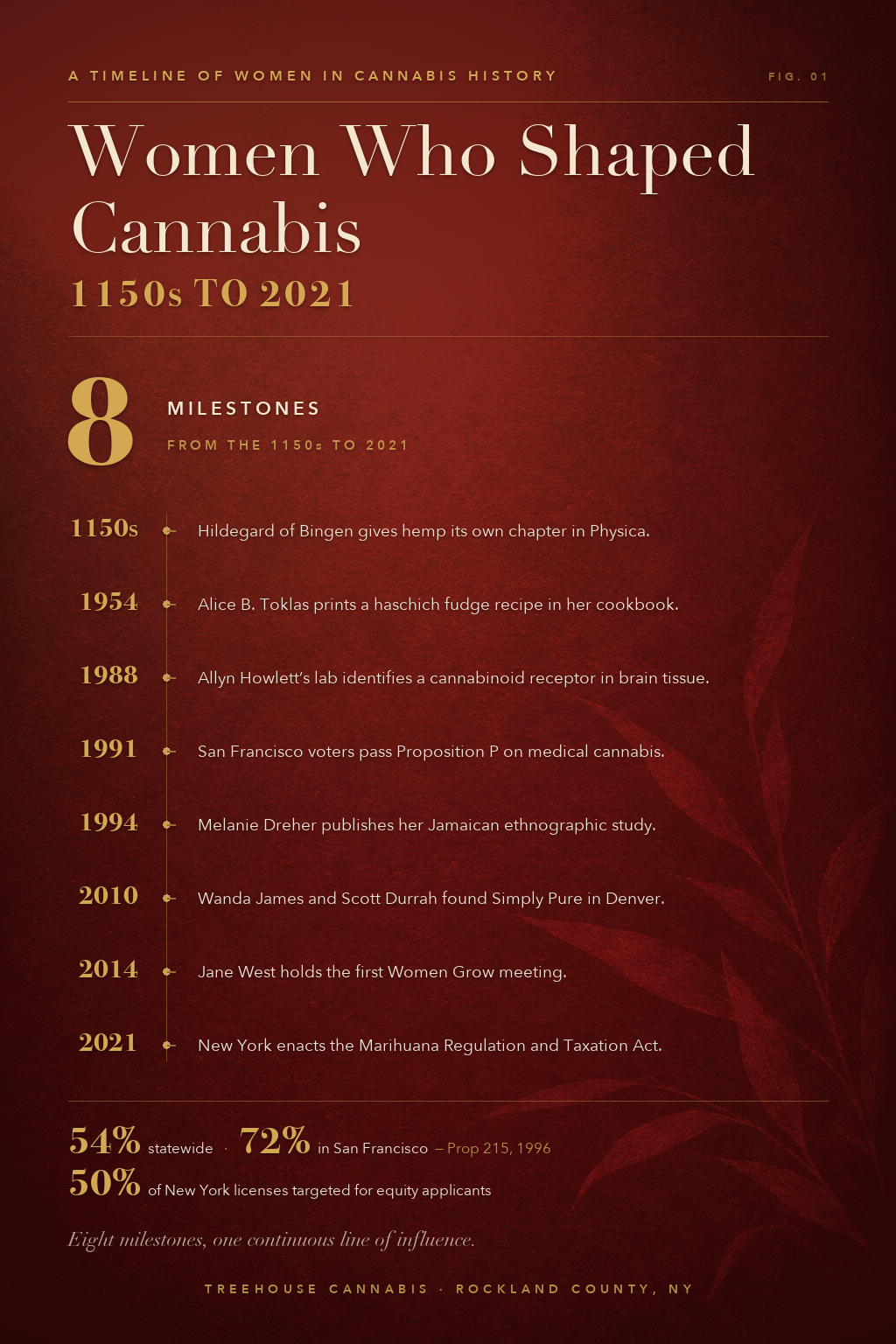
The reason this list is more than trivia is where these women worked. Cooking, science and retail were doors that opened. Formal medicine and law were the ones that stayed shut longest, and the women who pushed on those doors are why the others eventually gave.
The rest of this article takes them roughly in order. It starts with a twelfth-century abbess writing outside the medicine of her century, moves through a cookbook and a brownie, then the laboratory work that named the receptor system a modern label refers to, and ends with the licensing fight that is still going on.
How Did a Twelfth-Century Abbess Become the First Woman to Write About Cannabis?
Hildegard of Bingen (1098-1179) was a Benedictine abbess in the Rhineland, and her medical text Physica gives hemp a chapter of its own. Historians of medicine describe Physica as the first book in which a woman discusses plants and their medicinal properties [1].
What she wrote is modest, and it is worth keeping modest. Cannabis, she recorded, eased headache and other complaints [1]. That is a twelfth-century observer setting down what she had seen and been told. It is not a trial, it is not a dose, and it is not evidence for anything printed on a package today.
The details that survive are these:
- She lived from 1098 to 1179 and led a Benedictine community in the Rhineland [1]
- Physica assigns hemp its own chapter rather than a passing mention [1]
- Her entry records that cannabis eased headache and other complaints [1]
- Historians of medicine treat the book as the first in which a woman discusses plants and their medicinal properties [1]
That placement matters because of what surrounded it. European medicine in her century was largely a male, university-trained enterprise, and she worked outside it, assembling what she knew about plants into a reference a monastic community could actually use. She was not a scientist in any modern sense, and calling her one flatters the wrong century.
Cannabis did not stay exotic. It remained ordinary European medicine for centuries afterward, common enough that by 1878 J. Russell Reynolds, appointed that year as physician-in-ordinary to Queen Victoria's household, could summarize thirty years of practice in a widely cited 1890 Lancet paper [2]. By then the plant had a literature, a dosing convention and a professional audience.
Attribution is the part worth noticing. A woman wrote about this plant in the 1150s. The names that survived in the nineteenth-century record belong to the men who formalized it.
That is not a reason to diminish Reynolds; it is a reason to be accurate about how history assigns credit, and to say plainly that the record kept the men's names. How the law caught up with the plant afterward is a separate story, and The History and Evolution of Cannabis Laws in the U.S. follows it from prohibition forward.
How Did Alice B. Toklas Put Cannabis in the American Kitchen?
The Alice B. Toklas Cookbook appeared in 1954 with a recipe called "Haschich Fudge," supplied by the artist Brion Gysin [3]. Her American publisher cut it from the first US edition.
It returned in the 1960s anyway, and by 1968 the phrase had traveled far enough to title a film, I Love You, Alice B. Toklas [3].
The sequence, in order:
- Toklas published the cookbook in 1954 with Gysin's "Haschich Fudge" recipe [3]
- Her American publisher omitted the recipe from the first US edition [3]
- It came back in the 1960s and inspired the 1968 film [3]
- The reproduced 1954 text calls for pulverized Cannabis sativa - dried plant material, not hashish [4]
- The recipe stated that two walnut-sized pieces were sufficient [4]
That fourth fact is the most interesting thing in this section, because almost everyone gets it wrong. The recipe is remembered as a hashish recipe and it was not one. It called for dried, pulverized plant material, which is to say the same thing a home baker would plausibly have had on hand.
It is also a terrible instrument for measuring anything today. A 1950s kitchen recipe cannot tell you the potency of the plant in front of you, and potency is the number that matters. That is the difference between a historical document and a procedure, and the two are worth keeping apart.
Toklas was not a cannabis advocate in any modern sense. She was a writer and a host, and the recipe reached her through a circle of artists rather than through a campaign. That is exactly why her influence is easy to underrate.
Because the recipe sat in a mainstream cookbook, it made cannabis legible as an ingredient years before any state allowed a store to sell one. The vocabulary around the plant was shifting in the same years, and The History of the Word “Marijuana” traces where the word "marijuana" came from and what it was made to do.
Why Did Brownie Mary's Brownies Change Medical Cannabis Law?
Mary Jane Rathbun (1922-1999), known as Brownie Mary, baked cannabis brownies in San Francisco and gave them to AIDS patients at San Francisco General Hospital through the 1980s and 1990s. She was arrested repeatedly, campaigned for Proposition P, and co-founded the San Francisco Cannabis Buyers Club, widely credited as the first medical cannabis dispensary in the United States [5].
The brownies mattered politically, not just personally. The GLBT Historical Society's exhibition on AIDS treatment activism records that AIDS buyers' clubs paved the way for medical marijuana clubs, that advocates first framed legalization as an AIDS issue, and that Brownie Mary volunteered on the AIDS ward [7]. That is the mechanism in one line: a criminalized plant became a sympathetic cause at the moment the people using it were visibly dying and visibly being helped.
The record she left behind:
- She lived from 1922 to 1999 and baked cannabis brownies in San Francisco [5]
- She distributed them at San Francisco General Hospital through the 1980s and 1990s [5]
- She was arrested repeatedly rather than once [5]
- She campaigned for Proposition P, which San Francisco voters passed in 1991 [6]
- She co-founded the San Francisco Cannabis Buyers Club, widely credited as the first medical cannabis dispensary in the country [5]
- AIDS buyers' clubs paved the way for medical cannabis clubs, and advocates framed legalization as an AIDS issue [7]
- Proposition 215 passed in 1996 with 54 percent statewide and 72 percent in San Francisco [17]
- She appeared on a 1993 Newsweek cover, served as Pride Grand Marshal with Dennis Peron in 1997, and was honored with Brownie Mary Day on May 2, 1999 [6]
Two numbers in that list are the argument. San Francisco voters passed Proposition P in 1991 [6]. Five years later, California's Proposition 215 carried 54 percent of the statewide vote and 72 percent in San Francisco, the city where she and the buyers' club operated [17]. A city that had already voted on the question voted harder.
Home baking never went away, and it does not need to. What changed is that a customer can now buy tested flower for it, including smaller-format options like Small Buds Flower, or skip the oven entirely with something already measured, like Peach x Oishii Live Resin Gummies | 10 pk.
The honest limit of her legacy is that she was never a legislator or a scientist. She baked, she showed up, and she was willing to be arrested in public, repeatedly. The law moved because that was enough.
Which Women Built the Science of the Endocannabinoid System?
Three women did the work: Allyn Howlett identified the receptor, Melanie Dreher studied users' own lives as evidence, and Sue Sisley ran the federal trial. Their contributions were different in kind, and they should not be lumped together.
Allyn Howlett's laboratory published the 1988 paper in Molecular Pharmacology that provided the high-affinity, stereoselective binding evidence establishing a specific cannabinoid receptor in brain tissue, the finding that opened the endocannabinoid field [10]. Her own institution's faculty profile credits her with the discovery of the CB1 receptor and with developing the radioligand binding assay that made the identification possible [11]. Every potency conversation a customer has today runs through a receptor system that laboratory helped find.
Melanie Dreher's 1994 ethnographic study of Jamaican mothers who used cannabis was unusual for taking users' own lives seriously as evidence rather than treating them as a sample to be corrected [8]. The study reported that neonates of heavy cannabis-using mothers scored better on measures including autonomic stability and alertness - and the authors themselves framed those results as specific to that population and explicitly not a recommendation for use in pregnancy [8]. Nobody should read that as permission to use cannabis while pregnant. It is not one, no study is, and the authors said so themselves.
Sue Sisley was principal investigator on the FDA-approved randomized, triple-blind, placebo-controlled crossover trial testing four cannabis potencies in veterans with treatment-resistant PTSD, with 76 veterans enrolled [9]. What that trial represents is worth naming: the bureaucratic fight to run a controlled study on a Schedule I plant at all. The registry record does not report efficacy results, and this article will not invent them.
The three contributions, side by side:
| Scientist | Contribution | Record |
|---|---|---|
| Allyn Howlett | Binding evidence for a specific cannabinoid receptor in brain tissue, 1988 | Molecular Pharmacology |
| Allyn Howlett | Discovery of the CB1 receptor and the radioligand binding assay behind it | Institutional faculty profile |
| Melanie Dreher | Ethnographic study of Jamaican mothers, with authors' own population-specific caveat | PubMed, 1994 |
| Sue Sisley | Principal investigator, FDA-approved randomized, triple-blind trial, 76 veterans | ClinicalTrials.gov |
What the three have in common:
- Howlett's 1988 paper supplied the binding evidence for a cannabinoid receptor in brain tissue [10]
- Her institution credits her with the CB1 receptor discovery and the radioligand binding assay behind it [11]
- Dreher's 1994 study treated cannabis users' own lives as evidence rather than as a problem to be corrected [8]
- Its neonatal findings were framed by the authors as population-specific and not a recommendation for use in pregnancy [8]
- Sisley led the FDA-approved randomized, triple-blind, placebo-controlled trial of four potencies in 76 veterans with treatment-resistant PTSD [9]
- None of it is dosing guidance or a health claim - it is the research record [10]
The pattern is the same one that runs through the rest of this article. The science exists because these women pushed into institutions that were not set up for them, and the labels customers read now are downstream of arguments they won. The label conversation itself now runs from whole flower through pre-ground formats like Pre Ground Flower to concentrates, and each one states a number rather than a guess.
Who Broke the Glass Ceiling for Women in the Cannabis Industry?
Wanda James and her husband Scott Durrah are described as the first Black, veteran marijuana license holders in the nation, legally licensed to own a dispensary, a cultivation facility and an edible company, with Simply Pure founded in Denver on July 1, 2010 [12]. James is identified as the first African-American woman in Colorado to own a cannabis dispensary [13].
Her route into the industry was not a business plan. She traces it to her brother's imprisonment at 17 for possessing four and a half ounces of cannabis [13]. That is the equity argument in its plainest form: some families paid for prohibition first and were then invited to compete in the market that replaced it, and she has spent years pressing an industry that markets social equity to say out loud who was criminalized.
Jane West came at the same wall from a different angle. She founded Women Grow and held its first networking meeting in 2014, and says more than 100,000 people have attended its events since [14]. What an organization like that actually does is unglamorous and useful: capital introductions, licensing know-how, and a room where being the only woman in it is not the default.
Two leaders, two different barriers:
| Leader | Route into the industry | What it changed |
|---|---|---|
| Wanda James | Licensed dispensary, cultivation facility and edible company from 2010 | Who owns the store |
| Jane West | Women Grow, first networking meeting in 2014 | Who gets to learn how |
The modern industry, in the details that matter:
- James and Durrah are described as the first Black, veteran marijuana license holders in the nation [12]
- That licensing covered a dispensary, a cultivation facility and an edible company [12]
- Simply Pure was founded in Denver on July 1, 2010 [12]
- James is identified as the first African-American woman in Colorado to own a cannabis dispensary [13]
- Her brother was imprisoned at 17 for possessing four and a half ounces of cannabis [13]
- Jane West founded Women Grow and held its first meeting in 2014 [14]
- West says more than 100,000 people have attended Women Grow events [14]
Put the two together and the split is clear. One changed who owns the store. The other changed who gets to learn how to. Both describe an industry that is legal on paper and still uneven in who holds the licenses, and neither story is finished.
The shelf they argued for carries formats nobody in 1954 could have bought, from plain flower to Infused Bud Flower and everything between.
Where Does Women's Cannabis History Meet New York Cannabis Law Today?
New York's Marihuana Regulation and Taxation Act, the state's Cannabis Law, was enacted on March 31, 2021, and it makes social equity central rather than incidental. The Office of Cannabis Management states a goal of delivering 50 percent of licenses to equity applicants from communities most impacted by prohibition enforcement [16], and describes the program as repairing decades of disproportionate enforcement for adults 21 and older [15].
That is the same argument James has been making in Colorado for over a decade, written into a statute. The equity provisions exist because the people who paid for prohibition were identified, counted and named in the text.
The practical version for someone standing in Rockland, Orange or Westchester County:
- The Marihuana Regulation and Taxation Act was enacted on March 31, 2021 [16]
- The Office of Cannabis Management states a goal of 50 percent of licenses to equity applicants [16]
- The law is framed as repairing decades of disproportionate enforcement, for adults 21 and older [15]
- Buying from a licensed dispensary is how a customer participates in the market this history produced
- A licensed label states potency and testing in a way a home recipe or an unregulated bag never can
One limitation belongs in the same breath: a 50 percent licensing goal is a target, not an outcome. The industry these women built is still uneven.
The shelf is broader than the measures that created it, and the state's history is longer than a single statute. The History of Cannabis in New York covers how the plant moved through New York before legalization, and the retail end of that argument now includes the whole-flower side of the menu, like Whole Flower Flower. A single product listing, such as Animal Scout | Flower | 28g, states the potency a 1954 recipe could never have told you.
Treehouse Cannabis in Rockland County keeps that shelf in one place for adults 21 and older: flower like Animal Scout | Flower | 28g, tinctures such as High Dose "UP" | Tincture | 1000MG, and edibles alongside both, every one of them labeled with potency and testing. That is not the culmination of anyone's activism. It is just what the argument finally produced - a licensed, tested, legal shelf in Rockland, Orange and Westchester Counties.
Frequently Asked Questions
Who was the first woman to write about cannabis as medicine?
Hildegard of Bingen, a Benedictine abbess who lived from 1098 to 1179, gave hemp its own chapter in her medical text Physica. Historians of medicine describe Physica as the first book in which a woman discusses plants and their medicinal properties, and she recorded that cannabis relieved headache and other complaints [1].
Who was Brownie Mary?
Mary Jane Rathbun, known as Brownie Mary, baked cannabis brownies in San Francisco and gave them to AIDS patients at San Francisco General Hospital through the 1980s and 1990s. She was arrested repeatedly, campaigned for Proposition P in 1991, and co-founded the San Francisco Cannabis Buyers Club, widely credited as the first medical cannabis dispensary in the country [5] [6].
What did Alice B. Toklas contribute to cannabis culture?
Toklas included a haschich fudge recipe in her 1954 cookbook, supplied by the artist Brion Gysin. Her American publisher cut it from the first US edition; it returned in the 1960s and inspired the 1968 film I Love You, Alice B. Toklas. The printed recipe actually called for pulverized Cannabis sativa, not hashish [3] [4].
Which women shaped modern cannabis science?
Allyn Howlett's laboratory produced the 1988 binding evidence that established a cannabinoid receptor in brain tissue, opening the endocannabinoid field. Melanie Dreher pioneered ethnographic research on cannabis use in Jamaican communities. Sue Sisley was principal investigator on the FDA-approved randomized, triple-blind, placebo-controlled trial of four cannabis potencies in 76 veterans with treatment-resistant PTSD [10] [8] [9].
Who was the first Black woman to legally own a US cannabis dispensary?
Wanda James and her husband Scott Durrah are described as the first Black, veteran marijuana license holders in the nation, licensed for a dispensary, a cultivation facility and an edible company. Simply Pure was founded in Denver on July 1, 2010, and James is identified as the first African-American woman in Colorado to own a cannabis dispensary [12] [13].
What is Women Grow?
Women Grow is a professional networking organization that Jane West founded and launched with its first meeting in 2014. Its chapter meetings give women in the cannabis industry access to capital introductions, licensing know-how and peers. West says more than 100,000 people have attended Women Grow networking events since that first meeting [14].
How did women shape cannabis law reform in the United States?
Women were central to the medical cannabis movement of the 1980s and 1990s. Brownie Mary's repeated arrests drew sympathetic coverage to AIDS patients, and her work alongside Dennis Peron produced San Francisco's Proposition P in 1991 and the Cannabis Buyers Club, the model that preceded California's Proposition 215 in 1996 [5] [6] [17].
Is cannabis legal for adults in New York?
Yes. New York's Marihuana Regulation and Taxation Act was enacted on March 31, 2021, and allows adults 21 and older to buy cannabis from licensed dispensaries regulated by the Office of Cannabis Management. Treehouse Cannabis serves customers across Rockland, Orange and Westchester Counties [15] [16].
Sources
- The History of Dermatology Society — Hildegard of Bingen wrote Physica, the first book in which a woman discusses pla
- Dialogues in Clinical Neuroscience (PMC / NIH) — J. Russell Reynolds, appointed in 1878 as physician-in-ordinary to Queen Victori
- Scientific American — Alice B. Toklas published The Alice B. Toklas Cookbook in 1954 containing a hash
- Hash Marihuana & Hemp Museum — The museum reproduces the original 1954 recipe text, which calls for pulverized
- Grinnell College, History of Medicine — Mary Jane Rathbun (1922-1999) distributed cannabis brownies to AIDS patients at
- Online Archive of California / San Francisco Public Library — Archival finding aid documents Rathbun's biography, her arrests and community se
- GLBT Historical Society — The exhibition establishes that AIDS buyers' clubs paved the way for medical mar
- PubMed / National Library of Medicine (Dreher et al.) — Dreher's ethnographic study of Jamaican mothers found that neonates of heavy can
- ClinicalTrials.gov / National Library of Medicine — Registry record for the FDA-approved randomized, triple-blind, placebo-controlle
- PubMed / Molecular Pharmacology (Devane, Dysarz, Johnson, Melvin & Howlett) — The 1988 paper from Allyn Howlett's laboratory at St. Louis University provided
- Wake Forest University School of Medicine — Her institutional faculty biography states she is noted for the discovery of the
- Simply Pure — Wanda James and Scott Durrah are described as the first Black, veteran marijuana
- Democracy Now! — Interview identifying Wanda James as the first African-American woman in Colorad
- Jane West — Jane West states she founded Women Grow and held its first networking meeting in
- New York State Office of Cannabis Management — New York's Cannabis Law makes social equity central to the regulated adult-use m
- New York State Office of Cannabis Management — OCM states that the Marihuana Regulation and Taxation Act, New York's Cannabis L
- Los Angeles Times — Reports that California's Proposition 215 passed with 54 percent of the statewid
About Treehouse Cannabis
Treehouse Cannabis is a New York State licensed adult-use dispensary serving customers across Rockland, Orange and Westchester Counties. The flower, edibles and tinctures on the menu carry their potency and testing information on the label, so the team can walk you through what a package actually contains before you buy rather than leaving you to guess from a 1950s recipe.
Cannabis is for adults 21 and older. Keep all cannabis products out of reach of children and pets. This article is educational and is not medical advice; it does not diagnose, treat or cure any condition. Cannabis affects people differently, and anyone with a health condition, anyone taking medication, and anyone who is pregnant or breastfeeding should speak with a licensed healthcare provider before using cannabis. Do not drive or operate machinery while impaired. Buy only from licensed New York dispensaries and follow local possession and consumption laws.
Shop our products

Shop All

Deals
Flower
Pre-rolls
Vaporizers

Edibles
Drinks

Concentrates
Tinctures

Topicals
CBD

Pet CBD
Accessories