What Is RSO? Rick Simpson Oil Explained for Adult-Use Consumers
What Is RSO? Rick Simpson Oil Explained for Adult-Use Consumers
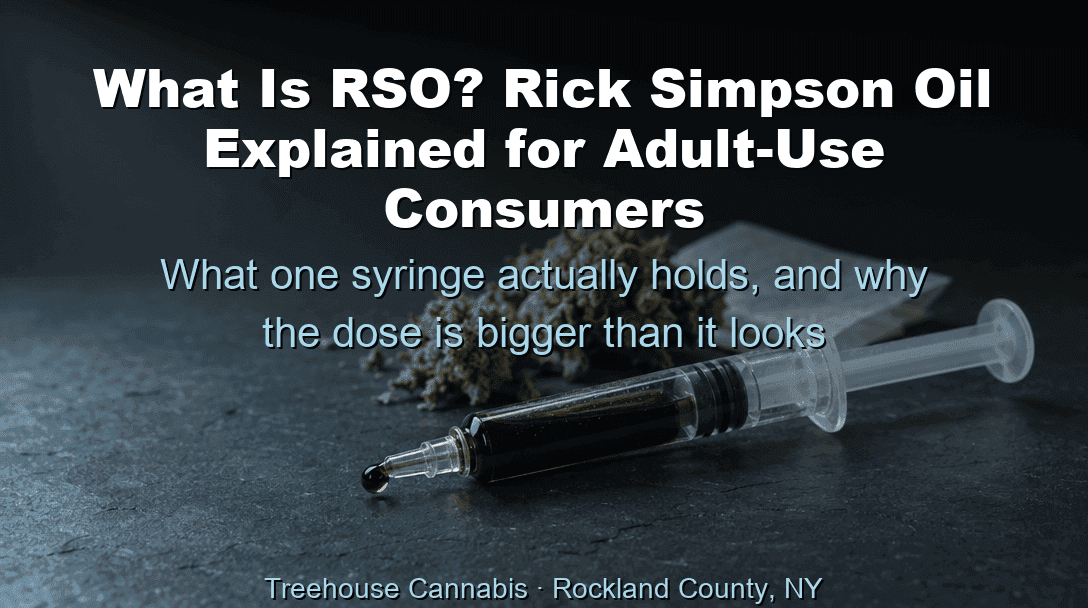
RSO cannabis is a dark, thick, decarboxylated oil sold in an oral syringe and swallowed in very small amounts rather than inhaled. It is usually high in THC, and a single gram can carry several hundred milligrams of it. The dose looks tiny, measures large, and arrives an hour or more after you take it.
This guide covers what RSO actually is, how it differs from distillate and tinctures, why its dosing is unforgiving, and what the evidence says about the claims that travel with it.
What Is RSO Cannabis and Where Does the Name Come From?
RSO stands for Rick Simpson Oil: a dark, thick, whole-plant cannabis oil sold in an oral syringe and swallowed rather than inhaled. It is decarboxylated, meaning it has been heated so the plant's THCA converts into active THC [1].
The make happens in three broad steps:
- Cannabis flower is washed in a solvent that pulls cannabinoids and plant compounds out of the plant material
- The solvent is evaporated off, leaving a thick crude oil behind
- Gentle heat is applied so THCA converts into active THC [1]
The name is where the confusion starts. "RSO" is a popularized, generic label rather than a regulated product category, and there is no formal definition behind it [2]. Two syringes with the same word on the box can differ in potency, in how refined the oil is, and in which solvent was used to make it.
The term comes from Rick Simpson, whose self-published material popularized the method and the name [1]. That origin is worth knowing. It is not a specification, and it does not guarantee anything about the syringe in front of you.
Potency is the part shoppers get wrong most often. Simpson claims his own method reaches 90-95% THC, while extraction above 80-90% is difficult outside professional equipment [2]. Retail strength therefore varies widely, and the label is the only reliable number. For a longer history of the format, The Comprehensive Guide to Rick Simpson Oil (RSO) goes deeper than this guide needs to.
One framing note before anything else: this article treats RSO as a legal retail concentrate in New York, sold to adults 21 and older. It is not a treatment for any condition, and nothing here is medical advice.
How Is Rick Simpson Oil Different From Distillate, a Tincture, and FECO?
The short answer is refinement. Rick Simpson oil is crude and unrefined, so it keeps cannabinoids, waxes, chlorophyll and plant pigments, which is why it looks near-black, tastes bitter and moves like tar [1].
Distillate is refined toward isolated THC. A tincture is a diluted liquid. FECO is the same crude full-extract idea as RSO, distinguished mainly by using ethanol as the solvent [2].
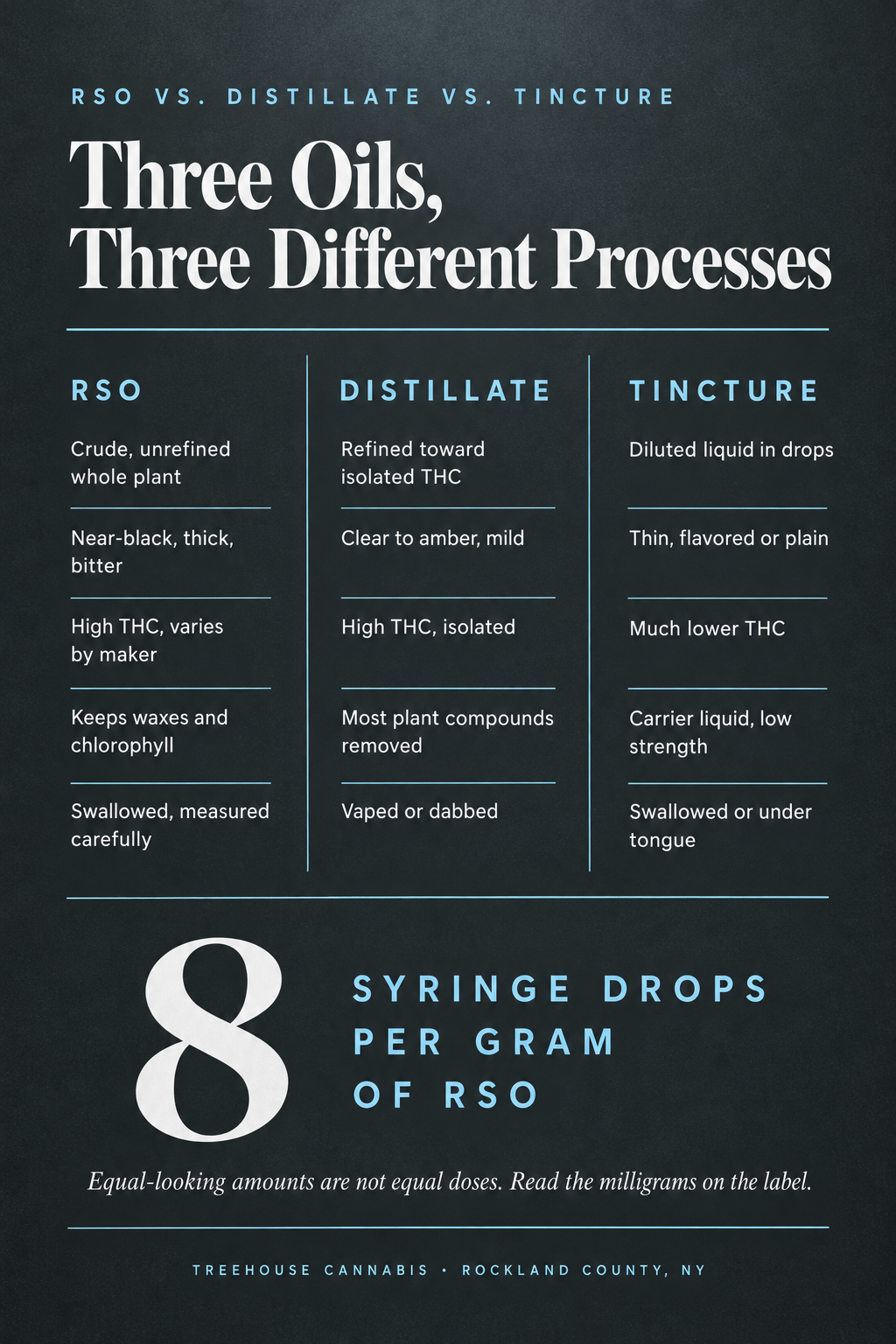
Here is the same comparison laid out for scanning:
| RSO | Distillate | Tincture | |
|---|---|---|---|
| Refinement | Crude, unrefined whole plant | Refined toward isolated THC | Diluted liquid |
| Look and taste | Near-black, thick, bitter | Clear to amber, nearly tasteless | Thin, flavored or plain |
| Potency | High THC, varies by maker | High THC, isolated | Much lower THC |
| Plant compounds | Keeps waxes and chlorophyll | Most plant compounds removed | Carrier liquid, low strength |
| Intended route | Swallowed, measured carefully | Vaped or dabbed | Swallowed or under the tongue |
The practical differences, in plain terms:
- RSO keeps the widest spread of plant material, which is also why it is the harshest to taste
- Distillate strips most other compounds, so the effect is narrower and the flavor is close to nothing
- Tinctures are diluted, so they are dosed in drops and land far below either oil in strength
- FECO mirrors RSO closely and is usually distinguished by ethanol rather than by any structural difference
One detail surprises people who assume "full spectrum" means loud: RSO typically carries low terpene content [2]. It is full of plant material, not necessarily full of aroma.
These formats are not interchangeable by volume. An amount that works for a tincture is nowhere near an equivalent dose of RSO, and the label rather than the look of the oil is what tells you which is which.
If you are still deciding which category suits you at all, Flower, Vapes, Edibles, or Concentrates: Which Format Fits You? compares them from the top. One useful contrast sits at the refined, solventless end of the shelf: What is Live Rosin explains live rosin, and Live Resin vs Live Rosin: What's the Difference and Which Is Better? handles the resin-versus-rosin question readers ask most. If drops suit you better than oil, Cannabis Tinctures: A Complete Guide to Sublingual Dosing covers sublingual dosing. Rules and product ranges vary by state, and Comparing All Legal Cannabis Markets in the US maps the legal markets.
Why Is RSO Dosing So Much Harder Than It Looks?
Because the amount you can see and the amount you are actually taking disagree with each other. A gram of RSO is a small dark ribbon, and that same gram can hold several hundred milligrams of THC, so a portion the size of a grain of rice is a meaningful dose rather than a nibble.
Four facts do most of the work:
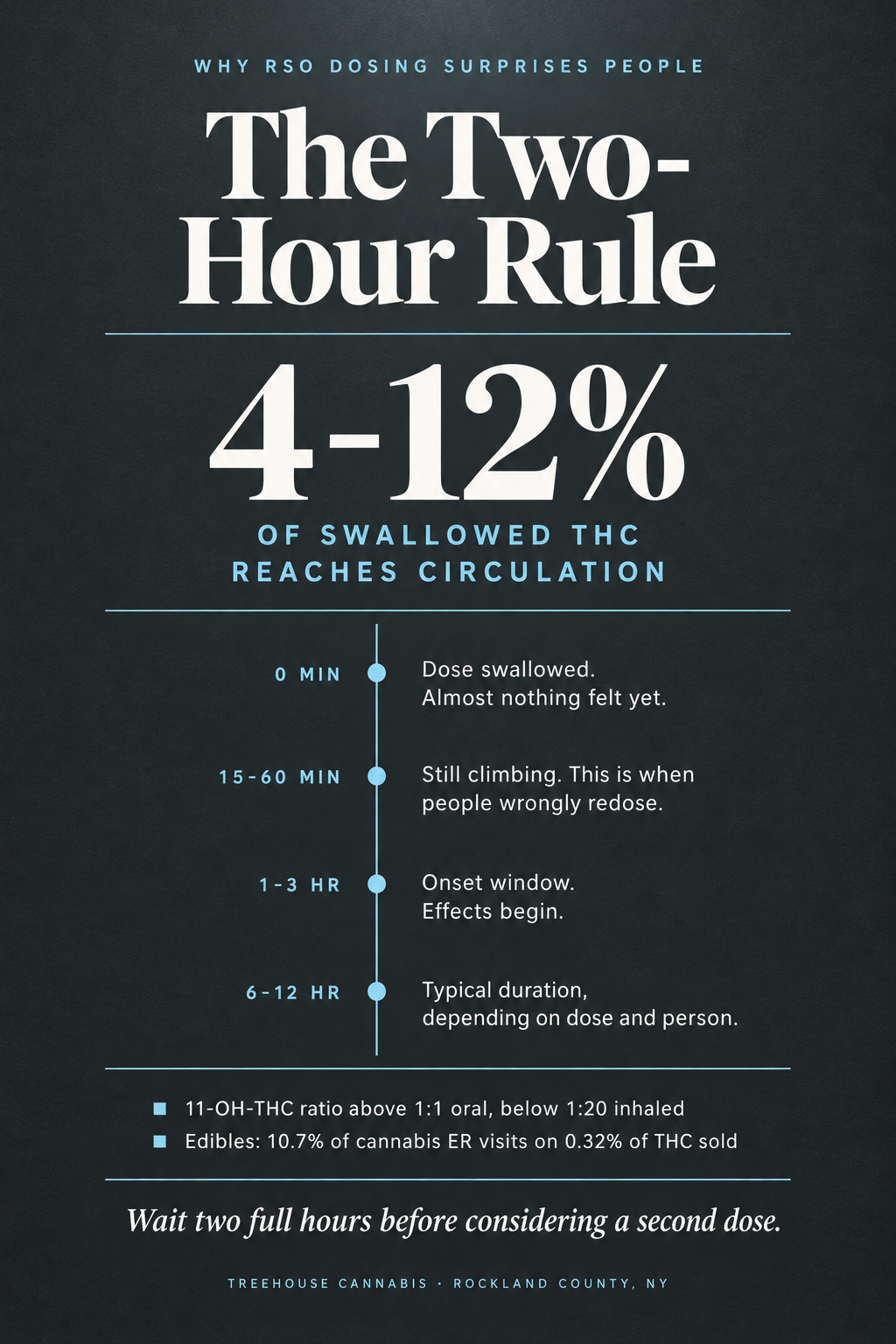
- Bioavailability: only about 4-12% of swallowed THC reaches systemic circulation, against far higher absorption from inhalation, so a swallowed milligram is not an inhaled milligram [5]
- Timing: onset runs roughly one to three hours and effects last six to twelve hours, which means the window where you conclude "nothing happened" is the window where the dose is still climbing [5]
- Metabolites: oral dosing pushes the 11-OH-THC to THC ratio above 1:1, versus below 1:20 after inhalation, and 11-OH-THC is roughly 10 times more potent than THC [5]
- Variability: a systematic review of 26 human studies drawn from 363 records concluded that oral absorption is slow, irregular and highly variable between people and between products [6]
That last point is the one no label can solve. Two customers can take the same measured amount of the same product and have noticeably different experiences.
The population-level consequence is measurable. In a Colorado review of 2,567 cannabis-attributable emergency visits, edible cannabis accounted for 10.7% of them while representing just 0.32% of THC sold by weight, roughly 33 times its expected share. Acute psychiatric symptoms appeared in 18.0% of edible-linked visits versus 10.9% for inhaled cannabis, and intoxication in 48% versus 28% [4]. That study measured edible cannabis, not RSO specifically, but the mechanism it describes is the same one RSO runs on: swallowed THC, delayed feedback, and a customer who redoses before the first dose finishes arriving.
Federal health authorities document the other side of high-THC exposure too, including anxiety, psychosis risk, impaired memory and attention, and elevated heart rate [3]. Knowing where you are allowed to consume matters as well, given the duration involved; Where Can You Legally Use Cannabis in New York? covers the legal settings in New York.
None of this makes RSO unreasonable. It makes it a product that rewards patience and punishes guessing.
How Should a First-Time Customer Approach RSO Dosing?
There is no standard RSO dose, and any source that hands out one number for every person is guessing. The widely repeated starting point is a portion of a single rice grain, often described as roughly 2.5-5 mg of THC, followed by a minimum two-hour wait before considering any more.
The conversion that makes this concrete: about 1 gram of RSO equals roughly eight syringe drops [1]. A rice-grain portion is a small fraction of one of those drops, which is exactly why a marked surface or a measured serving beats squeezing the plunger blind.
A workable routine looks like this:
- Warm the syringe briefly in your hand so the oil flows, rather than forcing a cold plunger
- Dispense onto something you can actually see, such as a marked cracker, a spoon, or into a small amount of food
- Write down the amount and the time, because memory is the first thing to go
- Reseal the syringe and store it upright, cool and dark, since the oil is sticky and degrades with heat
- Wait the full two hours before adding anything, and treat that wait as part of the dose rather than dead time
That last rule prevents most bad nights. Redosing at 45 minutes lands squarely inside the window where the first dose is still arriving [5], so the decision gets made on the least information you will have all evening.
In New York, RSO is commonly sold labeled sativa, hybrid or indica, and those are strain descriptors rather than a potency scale. The milligram figure on the package is what turns a guess into a measurement, so read it instead of assuming a standard strength [9].
Two more boundaries worth stating plainly. First, the 60 gram over 90 day protocol that circulates online was written for cancer patients under medical supervision, not for a recreational routine, and it does not belong in one [10]. Second, anyone managing a health condition, or taking antidepressants, opioids or sedatives, should be talking to a clinician rather than to a blog [10].
Can You Smoke or Dab RSO Cannabis?
No, and clinicians generally advise against smoking or vaporizing it [10]. The reasons are specific rather than ceremonial.
- RSO is built for swallowing, so it retains plant waxes and chlorophyll that irritate airways when heated and inhaled
- It may carry residual solvent if it was poorly purged: in a lab analysis of 279 crude cannabis extract samples that explicitly included RSO and FECO, 37% exceeded USP 467 residual solvent limits [8]
- Inhaling a product designed to be weighed and swallowed delivers an unmeasured dose instantly, which removes the only safety feature oral RSO has
The residue point deserves a second sentence. Testing is what makes solvent residue detectable, not what makes a product residue-free, so a lab-tested retail oil tells you what is and is not in the syringe. A trace you swallow in a grain-sized serving is still not something you want to combust and pull deep into your lungs, and dabbing it off a hot nail runs into the same problem from a different direction.
The intended route is straightforward: lab-tested oil, taken orally, in an amount you chose deliberately [1].
Does Rick Simpson Oil Cure Cancer, and What Does the Evidence Actually Show?
No. No evidence supports the claim that RSO cures cancer, and the article would be dishonest if it softened that.
What the evidence actually consists of:
- A 2022 review in Cannabis and Cannabinoid Research examined every peer-reviewed case report alleging anticancer activity from cannabis, graded the overall evidence weak, and found only one published report involving RSO [7]
- The widely circulated 60 gram over 90 day protocol does not come from a clinical trial; it traces to a non-peer-reviewed book [7]
- That same protocol was written for cancer patients under medical supervision, not for general adult-use consumers [10]
- No regulatory body has approved RSO as a cancer treatment
- High-THC exposure carries documented risks, including anxiety and psychosis [3]
The real harm in this conversation is delay. RSO is not a substitute for oncology care, and postponing treatment for a treatable cancer while trying an unproven oil is the outcome worth preventing.
There is an honest version of what draws people to RSO, and it is a much smaller claim: it is a legal, potent concentrate that some adults use for effects they personally experience. That is a different statement from a cure, and the difference is not a technicality.
Why Buy Lab-Tested RSO Cannabis From a Licensed New York Dispensary?
Because potency and solvent residue are precisely the two things a customer cannot check at home. A licensed label states total THC in milligrams, and that single number is what turns RSO from a guess into a measured dose [9].
The legal frame in New York is simple: adults 21 and older may possess up to 3 ounces of cannabis and 24 grams of concentrated cannabis, a category that includes oils like RSO. Licensed retail carries a 13% excise tax and mandatory METRC traceability, which is what makes a tested batch traceable back to its source [9].
Why that matters for this product in particular:
- Potency varies by maker because "RSO" has no regulated definition [2]
- Solvent residue is invisible, tasteless and only detectable through testing; 37% of unregulated crude extract samples exceeded USP 467 limits [8]
- A milligram figure on the package is the difference between a measurement and an eyeballed squeeze
- Traceability means a batch problem can actually be identified rather than guessed at
Testing does not make a product contamination-free. It makes problems detectable, which is the most any label can honestly offer.
The shelf has more variety than the syringe alone. RSO syringes are commonly sold by strain type, and RSO also turns up in edibles such as tablets and gummies at a far lower per-piece potency, which is a reasonable on-ramp for anyone who does not want to handle a syringe yet. If a lower-dose format sounds like the better first step, Peach x Oishii Live Resin Gummies | 10 pk is one example of what that looks like.
Donut Trip | Tier 2 Live Rosin Concentrate | 4g
Peach x Oishii Live Resin Gummies | 10 pk
Want to compare RSO syringes and lower-dose RSO edibles side by side before you choose? Treehouse Cannabis in Rockland County, NY lists potency and strain details across its concentrate and edible menus, so you can read the milligrams on the package before you buy instead of guessing from the color of the oil.
Frequently Asked Questions
What is RSO cannabis?
RSO stands for Rick Simpson Oil, a dark, thick, full-spectrum cannabis extract sold in an oral syringe. It is made by washing cannabis flower in a solvent, evaporating the solvent, and heating the oil so THCA converts into active THC. It is usually very high in THC and is swallowed rather than inhaled. [1] [2]
How is RSO different from distillate or a tincture?
Distillate is refined toward isolated THC, stripping most other plant compounds. A tincture is a diluted liquid, usually 5-30% THC. RSO is crude and unrefined, so it keeps cannabinoids, waxes, chlorophyll and plant pigments, which is why it is near-black, bitter, and far more concentrated than a tincture. [1] [2]
How much RSO should a first-time consumer take?
There is no standard dose. Most guidance starts with a portion of a rice grain, often described as 2.5-5 mg of THC, then waits at least two hours before considering more. Because oral THC can take one to three hours to peak, taking a second dose early is the most common way people overdo it. [1] [5]
How long does RSO take to kick in and how long does it last?
Swallowed RSO typically begins working in about one to three hours, peaks around two to three hours, and can last six to twelve hours depending on the dose and the person. Holding it under the tongue may start effects sooner, but the oil is still largely swallowed and absorbed slowly. [5]
Does RSO cure cancer?
No evidence supports that claim. A 2022 review of every peer-reviewed case report alleging anticancer activity from cannabis graded the evidence weak, found only one published report involving RSO, and noted the popular 60 gram protocol comes from a non-peer-reviewed book. RSO is not a substitute for oncology care. [7] [10]
Can you smoke or dab RSO?
Clinicians generally advise against it. RSO is made for swallowing, retains plant waxes and chlorophyll, and may carry residual solvent if it was poorly purged. Inhaling it irritates the lungs and delivers an unmeasured dose. Lab-tested oil taken orally is the intended and safer route. [10] [8]
Why is RSO considered riskier than other cannabis products?
Potency and delayed feedback. A single gram can hold several hundred milligrams of THC, yet the oil looks like a tiny ribbon, and the effect arrives an hour or more after dosing. That gap invites repeat dosing, which is how edible-related emergency visits for intoxication and acute psychiatric symptoms happen. [4] [5]
How should RSO be stored and measured?
Keep the syringe sealed, upright and away from heat and light, since the oil is sticky and degrades with warmth. Warm it briefly in your hand to make it flow, dispense onto a marked surface or into food, and record the amount and time. Never guess a dose by eyeballing a partial plunger. [1]
Sources
- Leafly — Defines RSO as a dark, whole-plant, decarboxylated cannabis oil that keeps the f
- Cannigma — Explains that RSO is a generic, popularized name for any crude decarboxylated ca
- National Institute on Drug Abuse (NIDA) — Federal reference on cannabis pharmacology and risks, covering THC impairment of
- Annals of Internal Medicine (Monte et al.) — Colorado emergency department chart review of 2,567 cannabis-attributable visits
- The Permanente Journal — Clinical review reporting oral THC bioavailability of about 4-12%, delayed onset
- Medicina (Poyatos et al.) — Systematic review of 26 human pharmacokinetic studies (from 363 records) conclud
- Cannabis and Cannabinoid Research — Appraises every peer-reviewed case report claiming anticancer activity from cann
- Journal of Cannabis Research — Laboratory analysis of 279 crude cannabis extract samples, explicitly including
- Dutchie Compliance — Summarizes New York adult-use rules enforced by the Office of Cannabis Managemen
- Leafwell — Clinical-facing guide stating that RSO should not be smoked or vaporized, that i
About Treehouse Cannabis
Treehouse Cannabis is a New York State licensed adult-use dispensary serving customers across Rockland, Orange and Westchester Counties. Concentrates and edibles on the menu carry their potency per package and per serving, so the team can walk you through what a syringe or a piece actually contains before you buy rather than leaving you to guess from the color of the oil.
Cannabis is for adults 21 and older. Keep all cannabis products out of reach of children and pets. This article is educational and is not medical advice; it does not diagnose, treat or cure any condition. Cannabis affects people differently, and anyone with a health condition, anyone taking medication, and anyone who is pregnant or breastfeeding should speak with a licensed healthcare provider before using cannabis. Do not drive or operate machinery while impaired. Buy only from licensed New York dispensaries and follow local possession and consumption laws.

Shop our products

Shop All

Deals

Flower

Pre-rolls
Vaporizers

Edibles
Drinks

Concentrates
Tinctures

Topicals

CBD

Pet CBD

Accessories