Cannabis Storage Safety: Keep Flower Fresh, Edibles Potent, Kids Safe
Cannabis Storage Safety: Keep Flower Fresh, Edibles Potent, Kids Safe
Cannabis storage comes down to four variables you can actually control: light, heat, oxygen and moisture. Get all four right and flower keeps its terpenes longer, edibles hold their potency, and the whole household stays safer. Get them wrong and potency drops even when the product still looks fine.
Why Does Cannabis Storage Actually Matter?
Cannabis storage matters because cannabis is a perishable plant product. Potency loss starts the day a product is packaged, and no container reverses it. A good setup slows the decline. Nothing stops it.
The scale of that decline is measurable. In a controlled 90-day test, total potential THC fell an average of 11.83% by day 30 and more than 12.5% by day 60 across every temperature and container tested, with degradation fastest at 30C [1]. Amber glass slowed it slightly. Nothing halted it.
Four factors do most of the damage, and they compound:
- Light breaks down cannabinoids, which is why a clear jar on a windowsill is the worst case in the house
- Heat accelerates the process, and terpene degradation roughly doubles for every 10C rise in temperature [2]
- Oxygen drives oxidation, the main route from THC toward CBN, which is why airtight matters more than anything else
- Moisture decides whether the product merely declines or actually becomes unsafe to use
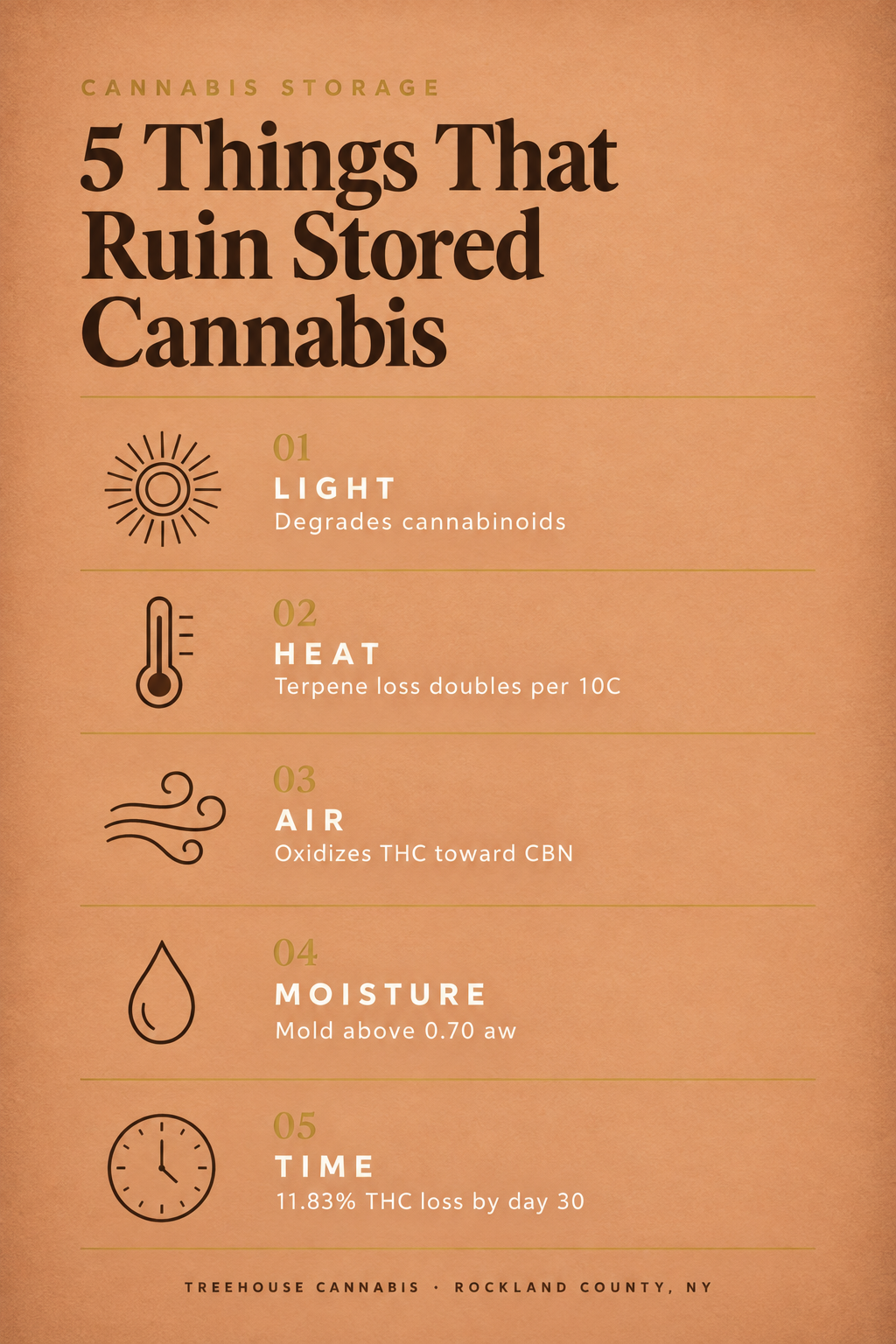
Temperature and light work on the same curve. A peer-reviewed review of postharvest research found that dark storage near 4C slowed decarboxylation, while light and warmth pushed it along faster [2]. Long-term stability testing reached a similar conclusion from a different angle: room temperature accelerated the conversion of THC into CBN in most products, while storage at -20C best preserved cannabinoid integrity [3].
That is the framing for everything below. Cannabis storage is not one trick with one right answer. It is a set of tradeoffs between convenience, cost, and how long you actually plan to keep the product.
If you want the long version of the timeline, How Long Does Weed Stay Fresh? breaks down how freshness drifts week by week, and How to Store Cannabis: Keep Flower Fresh for 6+ Months covers a six-month storage plan in detail.
What Is the Best Container for Storing Cannabis?
An airtight, opaque glass jar with a tight-fitting lid is the practical standard for cannabis storage. It hits three requirements at once: it keeps oxygen out, blocks light, and contains odor.
Amber glass has a small edge. In that same 90-day degradation test, amber glass marginally outperformed clear glass because it filters the wavelengths that drive cannabinoid loss [1]. The difference is real but modest, and an amber jar in a hot car is still worse than a clear jar in a cool closet.
What fails is more useful to know than what wins:
- Plastic bags and sandwich wrap are not airtight, and they do nothing about light or smell
- Non-airtight tins let air exchange freely, which is the oxidation problem running in slow motion
- A decorative jar with a dried-out rubber gasket is airtight in name only
- A clear jar on a kitchen counter is a light-exposure experiment with a predictable result
Side by side, the container question resolves quickly:
| Container | Keeps oxygen out | Blocks light | Verdict |
|---|---|---|---|
| Airtight opaque glass jar with a tight lid | Yes | Yes | The practical standard |
| Amber glass jar | Yes | Mostly | Marginally better than clear in degradation testing |
| Clear glass jar on a counter | Yes | No | Worst case in the house |
| Plastic bag or sandwich wrap | No | No | Fails on oxygen, light and odor |
| Non-airtight tin | No | Yes | Air exchange in slow motion |
| Decorative jar with a dried gasket | In name only | Maybe | Fails once the seal dries out |
One decent opaque jar is enough to start, and Limited Edition Sapphire Blue | Pivot Mobile Vaporizer is a reasonable place to begin if you would rather not shop around.
New York's rules already do part of this work for you. Part 128 requires retail cannabis packages to be child-resistant for the product's useful life, resealable when the package holds more than one serving, and fully enclosed to minimize oxygen exposure and block light-driven degradation [7]. In practice, the package your flower came in was designed as a storage container.
That is worth sitting with. A regulated child-resistant package that still seals properly beats a kitchen jar on the variable that matters most in a house with kids. The jar is a quality upgrade. It is not a safety upgrade.
So keep the original package as the primary container, and if you transfer flower for convenience, transfer it back before it goes into a cupboard. The regulator's guidance is consistent on this point: original packaging, locked, out of sight, out of reach [6].
Two related reads if you are working through the container question: How to Store Pre-Rolls So They Stay Fresh covers the narrower case of pre-rolled product, and the Flower menu is the place to start if you are buying to store. A bulk format like NY Diesel | Flower | 28g makes the whole question concrete, since 28 grams will be around for weeks rather than days.
How Do Temperature and Humidity Affect Stored Cannabis?
Temperature and humidity decide how fast stored cannabis declines, and the two interact. Cold slows the chemistry. Moisture decides whether the plant material stays stable or turns into a mold risk.
On temperature, the research is fairly consistent:
- Room temperature accelerated conversion of THC into CBN in most products [3]
- Storage at -20C best preserved cannabinoid integrity in long-term stability testing [3]
- Refrigeration slowed degradation compared with room temperature [3]
- CBD-dominant products tolerated room temperature noticeably better than THC-dominant ones [3]
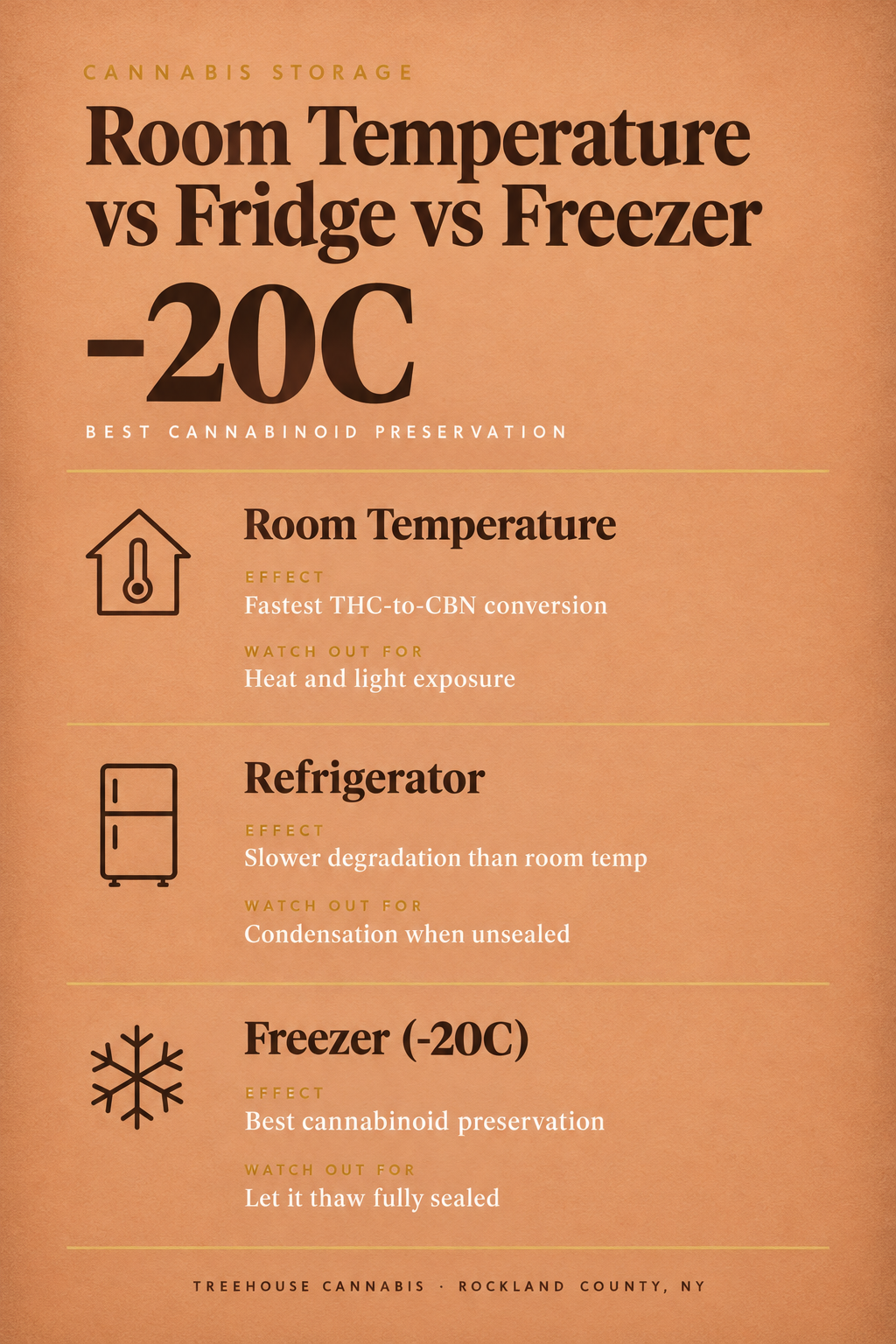
The practical read: if a product will be gone in two weeks, a cool dark cupboard is fine. If you are holding a bulk purchase for months, the freezer is the better answer, with one rule attached.
In text form, the three common answers trade off like this:
| Storage method | Effect on cannabinoids | What it costs you |
|---|---|---|
| Room temperature | Fastest conversion of THC into CBN in most products | Potency, sooner |
| Refrigerator | Slower degradation than room temperature | Condensation if you open it cold |
| Freezer at -20C | Best cannabinoid preservation in long-term testing | You have to thaw it sealed, every time |
Let frozen cannabis come back to room temperature while it is still sealed. Opening a cold jar in a warm room pulls condensation straight onto the flower, and that is exactly the moisture that invites mold. Repeated freeze-thaw cycles are worse than either extreme, so portion out what you need before freezing rather than pulling the whole jar out each time.
A larger format like NY Diesel | Flower | 28g is precisely where this matters, because 28 grams will outlast a two-week window by a wide margin.
Humidity is where quality and safety stop being the same question. Dried cannabis typically sits between 0.60 and 0.70 water activity, mold and yeast growth is inhibited below 0.70, and dropping below 0.55 causes trichome structure loss along with terpene and cannabinoid loss [8]. Industry practice targets roughly 58% to 62% relative humidity to stay inside that window [8].
Too wet and you are running a mold culture. Too dry and the trichomes crumble off the flower you paid for. Humidity packs are a tool for holding the range on product that is already sound. They are not a fix for flower that has gone musty, and they are not mold prevention.
How Do You Store Edibles So They Stay Potent and Safe?
Store edibles by the rule that governs the food they are made of. An edible's shelf life is the food's shelf life, and cannabis storage advice that ignores the cookie underneath the THC is not much use.
Potency runs on its own timeline. Edibles generally hold potency for three to six months with proper storage and then decline slowly, and oxygen exposure is the main driver of THC degradation [10]. That is a wider window than most people assume and a shorter one than the package date sometimes implies.
What it looks like in practice, by product type:
| Edible type | Realistic shelf life | What to watch |
|---|---|---|
| Gummies and hard candies | Months, if the package is resealed every time | Clumping and sticking once the seal fails |
| Chocolate | Months, with a fast quality decline | Bloom, plus it picks up fridge and freezer odors |
| Baked goods with dairy or egg | About a week | Stale long before the THC is the problem |
| Anything past the package date | Treat as expired | Not a challenge to salvage |
Oxygen is the variable you control most directly. Reseal the original package every single time, whether that is Peach x Oishii Live Resin Gummies | 10 pk or a single chocolate bar, and press the air out of anything flexible before closing it.
Cool and dark is the rest of it. The cupboard above the stove is the worst spot in the kitchen for both heat and humidity. A high shelf in a cool closet is better on every count, and it has the secondary benefit of sitting outside a child's sightline.
Two things not to do:
- Do not move edibles into a snack container, a candy dish, or a piece of Tupperware that lives with regular food. That is how a gummy becomes indistinguishable from a gummy.
- Do not repackage them into an unlabeled bag either. The labeling is what makes an accidental ingestion identifiable to a responder.
If you are trying to work out whether a package is still worth keeping, Do Edibles Expire? Potency & Safety Guide goes through potency and safety by product type.
How Should You Store Cannabis Around Kids and Pets?
Store cannabis locked, out of sight and out of reach, in the original child-resistant packaging. That is the short answer, and the data behind it is not subtle.
The FDA counted 10,448 single-substance THC edible exposure cases reported to U.S. poison centers between January 2021 and May 2022, with 77% of them involving people 19 or younger [4]. A National Poison Data System analysis found pediatric edible cannabis exposures in children under six rose from 207 cases in 2017 to 3,054 in 2021, a 1,375% increase [5]. Of those pediatric exposures, 97.7% happened in a residential setting [5].
That last number is the whole argument. This is not a dispensary problem or a packaging problem. It is a kitchen cabinet problem.
New York and Colorado regulators hand out essentially the same playbook, which is a good sign that these are the load-bearing steps:
- Keep products in the original child-resistant packaging rather than a bag or a loose jar
- Store them locked and out of sight, not just up high
- Keep them separate from regular food and drinks so they cannot be mistaken for a snack
- Keep labels intact and legible so a product can be identified in an emergency
- Dispose of cannabis waste in a closed-lid container, out of reach [6]
Colorado's guidance adds the same points, plus a direct pointer to the free Poison Help line for anyone worried about an exposure [9].
Two honest caveats. Child-resistant is not child-proof, and it is not meant to be. It buys time, which is the most a package can do. And the "we do not have young kids" reasoning is how a lot of these numbers got where they are: a visiting nephew, a neighbor's kid, a dog with a good jump. A locked container is the only version of this that holds up.
Pets deserve the same treatment with less explanation. A dog will get into a bag on a low shelf, and edibles are the usual route. Same rule, higher shelf, actual lock.
What Do You Do If a Child Eats a Cannabis Edible?
Call the Poison Help line at 1-800-222-1222 immediately. Do not wait for symptoms, because edible effects can take hours to appear and a child who seems fine right now is not evidence of a small exposure.
Then work through the rest in order:
- Call 911 if the child is not breathing, has collapsed, is having a seizure, or is difficult to rouse
- Tell responders and clinicians that you suspect cannabis, and say what form it was
- Bring the package with you so the product, serving size and THC content are known
- Do not wait to see how it goes before making either call
Both New York and Colorado regulators point to the same free Poison Help line, which is staffed around the clock [6] [9]. Nothing about that call requires you to be certain. "I think my kid ate a gummy" is a complete sentence and a good enough reason to dial.
The FDA's exposure data is a reminder of how these calls start: an edible that looked like candy, a package that was not locked, a few minutes of not watching [4]. None of that is a character flaw, but all of it is preventable with a lock.
Which is the argument for handling this part now rather than later. Save 1-800-222-1222 in your phone under Poison, and put it somewhere a babysitter can find it. The value of the number is entirely in not having to look it up while something is going wrong.
When Should You Throw Cannabis Away?
Throw cannabis away when it shows mold, when it smells wrong, or when it crumbles to dust. Do not try to salvage it.
Mold is the line that matters. Cannabis held above roughly 0.70 water activity can support mold and yeast growth, and inhaling mold spores or mycotoxins is a real respiratory concern [8]. That is not a quality issue you can taste your way around.
The signals worth acting on:
- Visible fuzz, white or gray, especially near the stem or deep inside a dense bud
- A musty, ammonia, or basement smell rather than a plant smell
- Flower that crumbles to dust between your fingers instead of holding together
- Vapor or smoke that tastes harsh or acrid in a way it did not before
Spoiled and merely aged are different problems, and they call for different responses:
| What you notice | Spoiled or just aged | What to do |
|---|---|---|
| Visible white or gray fuzz | Spoiled | Discard |
| Musty, ammonia or basement smell | Spoiled | Discard |
| Crumbles to dust between your fingers | Spoiled | Discard |
| Harsh or acrid vapor that was not there before | Spoiled | Discard |
| Browned or dulled flower | Aged | Use it sooner and expect a flatter profile |
| Hay or cardboard smell | Aged | Usable, but the terpenes are gone |
| A calmer, more sedating effect | Aged, not spoiled | THC has partly converted to CBN |
The quality signals are milder. Browned or dulled flower, a hay or cardboard smell, and a flat terpene profile all mean the product has aged rather than spoiled. THC converting to CBN over time is the same story: not spoilage, but a different experience, and one reason a long-stored batch can feel more sedating than the same strain did fresh [3]. If sleep is the goal, Cannabis and Sleep Quality: What Actually Works (and What Doesn't) gets into what the research actually supports and what it does not.
If you want to know what a sound batch looks like on paper before you buy it, Understanding Cannabis COAs: Your Guide to Lab Testing and Safety explains how to read a Certificate of Analysis, including the moisture and water activity figures that predict most storage problems.
Disposal has rules too. Put waste in a closed-lid container, keep it out of reach, and do not send it down a drain or into an open compost bin where a child or a pet can get to it. Regulators are consistent on the closed-lid point for exactly that reason [6].
Ready to put this into practice? Whether you are stocking up on flower or picking up edibles for the weekend, the team at Treehouse Cannabis can walk you through what keeps best and how to store it once you get home. Stop by the dispensary serving Rockland, Orange and Westchester Counties, and ask for the child-resistant packaging on anything you plan to keep around the house.
Frequently Asked Questions
How long does cannabis stay potent in storage? Potency declines on a curve, not a cliff. A controlled study found total potential THC dropped about 11.8% by day 30 and more than 12.5% by day 60 in every container tested. Cool, dark, sealed storage slows that decline considerably, and frozen storage preserves cannabinoids best over the long term.
What is the best container for storing cannabis? An airtight, opaque glass jar with a tight-fitting lid is the practical standard. Amber glass marginally outperformed clear glass in degradation testing because it blocks light. Avoid plastic bags and sandwich wrap, which are not airtight and do nothing to stop light or oxygen from reaching the flower.
Should cannabis be stored in the refrigerator or freezer? Freezing at -20C preserved cannabinoid integrity best in long-term stability testing, and refrigeration slows degradation compared with room temperature. The catch is moisture and condensation: let frozen product come to room temperature sealed before opening it, or condensation will introduce the humidity that invites mold.
What humidity should cannabis be stored at? Industry practice targets roughly 58% to 62% relative humidity, which corresponds to a water activity near 0.62. Mold and yeast growth is inhibited below 0.70 water activity, while dropping below 0.55 causes trichome structure loss and takes terpenes and cannabinoids with it.
How do you keep cannabis edibles potent? Treat an edible like the food it is, because that is what governs its shelf life. Keep it airtight, cool, dark and away from heat, and follow the package expiration date. Gummies and hard candies hold up for months, baked goods with dairy or egg go stale in about a week, and potency declines slowly once past peak freshness.
How should cannabis be stored around children and pets? Locked, out of sight, and out of reach, in the original child-resistant packaging. Store edibles separately from regular food and drinks so they cannot be mistaken for snacks. Pediatric edible exposures in children under six rose 1,375% between 2017 and 2021, and 97.7% happened in a home.
What should you do if a child eats a cannabis edible? Call the Poison Help line at 1-800-222-1222 immediately, without waiting for symptoms, because edible effects can take hours to appear. Call 911 if the child is not breathing, has collapsed, is having a seizure, or is difficult to rouse. Tell responders you suspect cannabis.
Does cannabis go bad or grow mold? Yes. Cannabis stored above roughly 0.70 water activity can support mold and yeast growth, and inhaling mold spores or mycotoxins is a real respiratory concern. Visible fuzz, a musty or ammonia smell, or flower that crumbles to dust are all reasons to discard rather than salvage.
Sources
- Anresco Laboratories — A controlled 90-day study found total potential THC fell an average of 11.83% by
- Frontiers in Plant Science — A peer-reviewed review of postharvest storage research reports that light and hi
- Cannabis and Cannabinoid Research (National Library of Medicine) — Long-term stability testing across room temperature, refrigeration and freezing
- U.S. Food and Drug Administration — FDA reports 10,448 single-substance THC edible exposure cases to U.S. poison cen
- Pediatrics (American Academy of Pediatrics) — National Poison Data System analysis found pediatric edible cannabis exposures i
- New York State Office of Cannabis Management — New York's cannabis regulator recommends storing products locked, out of sight a
- New York State Office of Cannabis Management — New York's Part 128 rules require retail packages to be child-resistant for the
- Neutec Group — Water activity analysis shows dried cannabis typically sits between 0.60 and 0.7
- Colorado Department of Revenue, Cannabis — Colorado's cannabis regulators advise keeping products in store child-resistant
- Leafly — Edibles generally hold potency for three to six months with proper storage and t
About Treehouse Cannabis
Treehouse Cannabis is a New York State licensed adult-use dispensary serving customers across Rockland, Orange, and Westchester Counties. Our team helps adult customers work through the practical side of buying and keeping cannabis, from choosing a container that actually seals to reading the water activity figure on a Certificate of Analysis and storing edibles so they stay identifiable in a house with kids and pets. Browse the menu online or visit us to talk through storage and packaging questions with a budtender.
Cannabis is for adults 21 and older. Keep all cannabis products locked and out of reach of children and pets. Do not drive or operate machinery while under the influence of cannabis. This article is intended for educational purposes only and is not medical advice; consult a qualified clinician with questions about cannabis and your health. Always purchase cannabis from a licensed New York adult-use dispensary.


Shop our products

Shop All

Deals

Flower

Pre-rolls
Vaporizers

Edibles

Drinks

Concentrates
Tinctures

Topicals

CBD

Pet CBD

Accessories