
Limonene: The Citrus Terpene Behind Uplifting Effects
Limonene: The Citrus Terpene Behind Uplifting Effects
What limonene does in cannabis, the 2024 clinical evidence behind the entourage effect, and how to find limonene-rich flower at the dispensary.
Limonene is a cannabis terpene responsible for the bright citrus peel, lemon zest, and orange rind aroma found in popular strains like Wedding Cake, Super Lemon Haze, and Durban Poison. Limonene is not intoxicating on its own — it shapes the qualitative character of the cannabis experience alongside THC.
What is limonene and why does it matter in cannabis?
Limonene is one of the most abundant terpenes found in the cannabis flower, and the molecule most responsible for the bright citrus peel, lemon zest, and orange rind aroma that defines popular strains like Wedding Cake, Super Lemon Haze, and Durban Poison. The same terpene dominates the essential oils of lemons, oranges, and grapefruits, and d-limonene is generally recognized as safe by the FDA for use in food and cosmetics [7].
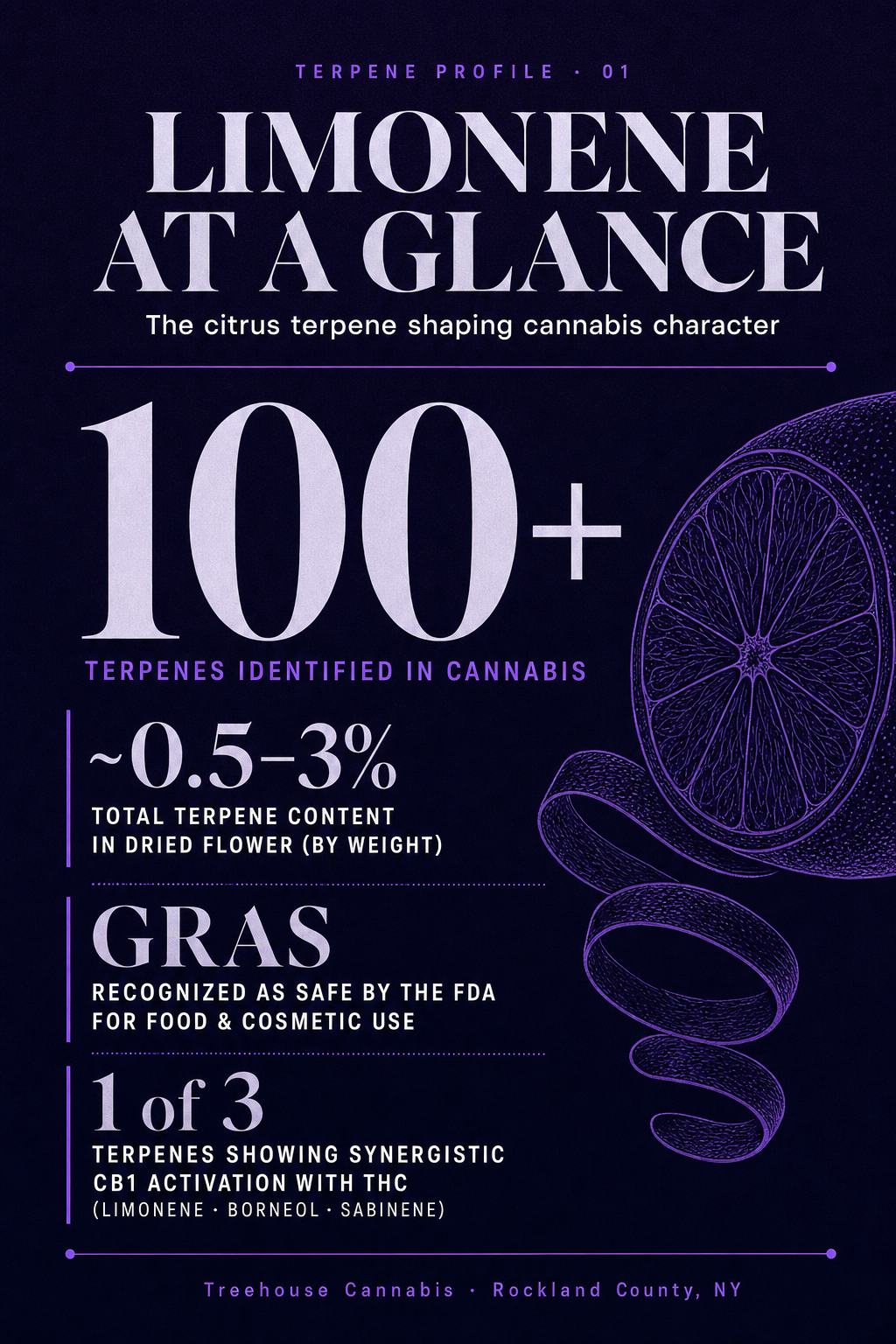
Cannabis flowers produce more than 100 different terpenes and terpenoids, but only a handful dominate any single cultivar's aroma profile. Surveys of chemovar terpene composition place limonene in the top tier of recurring terpenes across commercial flower, alongside myrcene, caryophyllene, and pinene [7].
Limonene does not produce intoxication on its own. It contributes to aroma and to the qualitative character of the experience, which is why it shows up on dispensary menus and lab certificates of analysis alongside cannabinoids like THC and CBD. For adult-use shoppers in Rockland, Orange, and Westchester Counties, it is the first terpene name worth learning to read on a COA.
Limonene at a glance:
- Aroma profile: bright citrus peel, lemon zest, and orange rind
- Plant occurrence: among the most abundant terpenes in commercial cannabis flower
- FDA status: d-limonene is GRAS for use in food and cosmetics
- Experience role: shapes but does not produce the cannabis high
For a broader tour of the terpene family, the Treehouse guide A Guide to Terpenes and Their Effects covers the other molecules in the same aroma profile. Two related pieces focus on adjacent terpenes in the cannabis flower: What Is Ocimene? The Sweet, Uplifting Terpene in Cannabis and What Is Limonene? A Citrus-Scented Guide to One of Cannabis’s Most Recognizable Terpenes.
What does limonene do to your mood and your high?
Limonene is most often associated with a clear-headed, uplifting mood profile — an energized, stress-light feeling rather than a heavy or sedative one. The reputation is built on consumer experience, dispensary menus, and a small but growing research base.
A 2024 controlled laboratory study published in Drug and Alcohol Dependence found that vaporized d-limonene combined with THC significantly reduced self-reported ratings of feeling anxious, nervous, and paranoid compared with THC alone, without dulling other THC effects [1]. The Drexel University Center for Cannabis Research framed this as one of the first clinical studies to demonstrate the cannabis entourage effect between a single terpene and THC [2].
Mechanistically, preclinical research points to adenosine A2A receptor modulation as one plausible pathway for limonene's mood-related activity in animal models [5]. Broader reviews of whole-plant cannabis and isolated terpenes note that d-limonene can influence GABAergic, serotonergic, and dopaminergic pathways relevant to mood and stress responses [4].
The headline point for adult customers: limonene shapes the qualitative character of the experience rather than producing the cannabis high itself.
What the research shows:
- 2024 crossover trial (Drug and Alcohol Dependence): vaporized d-limonene + THC reduced anxious and paranoid ratings vs. THC alone, without dulling other THC effects [1]
- Drexel summary: described as one of the first clinical demonstrations of a terpene-driven entourage effect with THC [2]
- Adenosine A2A pathway: preclinical mechanism for limonene's anxiolytic-like activity in animal models [5]
- Whole-plant reviews: d-limonene modulates GABAergic, serotonergic, and dopaminergic pathways tied to mood [4]
How does limonene work with THC and other cannabinoids?
The cannabis entourage effect is the idea that cannabinoids, terpenes, and other plant compounds modulate one another in the body — producing effects that are not predicted by THC content alone. Limonene has become one of the most-cited terpenes in that conversation.
The modern framing traces to a 2011 review by Ethan Russo in the British Journal of Pharmacology, which proposed that common cannabis terpenes including limonene contribute synergistically to the activity of cannabinoids. Russo cited limonene specifically for uplifting mood, anti-anxiety, and gastroesophageal-reflux claims that have since shaped how dispensaries describe strains [3].
Published CB1 receptor binding data takes the argument further. Of 16 terpenes tested alongside THC at the CB1 receptor, only three — limonene, borneol, and sabinene — produced synergistic activation rather than additive or neutral effects [8]. Reviews of whole-plant extracts and isolated terpenes continue to support the idea that d-limonene modulates GABAergic, serotonergic, and dopaminergic pathways relevant to mood [4].
For a longer read focused on this specific terpene, see A Guide to Limonene in Cannabis.
Evidence for the limonene + THC synergy:
- Russo 2011 review: limonene contributes synergistically to cannabinoid activity, as proposed in the British Journal of Pharmacology [3]
- CB1 binding data: only limonene, borneol, and sabinene produced synergistic CB1 activation with THC out of 16 terpenes tested [8]
- Whole-plant reviews: d-limonene modulates GABAergic, serotonergic, and dopaminergic pathways alongside THC [4]
Which cannabis strains and products are highest in limonene?
Several popular cultivars repeatedly test in the upper range for limonene by percentage of weight, and they appear consistently on dispensary menus across Rockland, Orange, and Westchester Counties.
Across product categories, limonene-dominant flower is the most accessible starting point for customers who want to evaluate the terpene's character. Many of those same genetics also appear in Pre_rolls, giving customers a convenient format for sampling without buying a full eighth of flower.
Vaporizer cartridges filled with limonene-forward cultivars are also common, though the lab-tested terpene content of carts varies widely by extractor and fill batch. Flower and pre-roll COAs are typically the most reliable source of terpene data.
Strain name is a useful starting hint, but it is not a guarantee. The same cultivar can test very differently depending on the grower, the cure, and the harvest lot. Two batches of Wedding Cake from different producers can carry materially different limonene percentages, which is why the menu alone does not tell the full story.
Common limonene-dominant cultivars:
- Wedding Cake
- Super Lemon Haze
- Durban Poison
- OG Kush
- Jack Herer
How can you tell if a cannabis product is limonene-dominant?
The reliable signal is the certificate of analysis (COA) published by the licensed testing lab that handled the product. In New York's regulated market, most flower, pre-roll, and vaporizer listings include a COA link from the product page.
Most terpene panels list the top three to five terpenes by percentage of weight. Limonene-dominant chemovars will show limonene at the top of that list, usually followed by myrcene, caryophyllene, or pinene in smaller amounts. Products without a published terpene panel have either not been tested for terpenes or carry very low total terpene content.
Mature dried flower typically carries 0.5 to 3 percent total terpenes by weight, with limonene alone able to exceed 1 percent in limonene-dominant chemovars [7]. Aroma is a useful cross-check — bright citrus peel, lemon zest, and orange rind notes generally indicate a limonene-forward flower — but aroma is qualitative, not quantitative. A specific flower currently on the Treehouse menu that illustrates the kind of limonene-rich profile to look for is MAC Stomper - Premium - 3.5g.
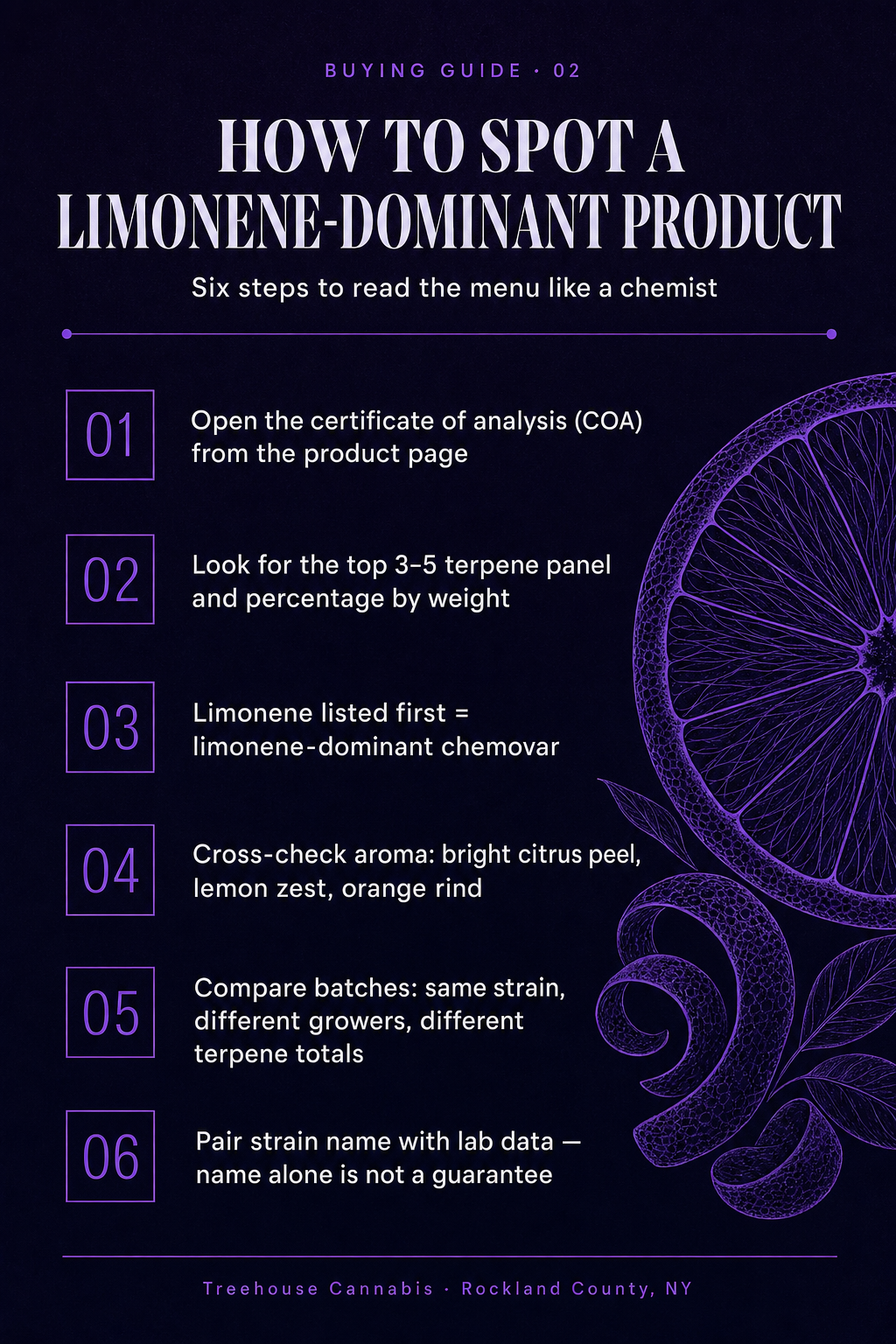
How to read a COA terpene panel:
- Open the certificate of analysis (COA) from the product page
- Look for the top 3 to 5 terpenes listed by percentage of weight
- Limonene listed first = limonene-dominant chemovar
- Cross-check aroma (citrus peel, lemon zest, orange rind) as a qualitative signal
- Compare batches: same strain, different growers, different terpene totals
Is limonene safe to consume, and what should adults know?
Limonene, in the form of d-limonene, is generally recognized as safe by the FDA for use as a food additive and flavoring agent. It is also common in cosmetics, cleaning products, and essential oils at much higher concentrations than cannabis flower delivers [6].
A 2025 review cataloged limonene's broader pharmacological activities — antioxidant, anti-inflammatory, wound-healing, antidiabetic, anticancer, and immunomodulatory — across preclinical and clinical studies, though most of that work has been done outside the cannabis context [6].
For adult-use cannabis customers, the practical framing is straightforward. Limonene shapes but does not produce the cannabis high. When inhaled as part of cannabis flower or concentrate, d-limonene has been studied in adults without serious adverse events, though research on long-term high-dose inhalation is still limited [1].
Adults shopping for limonene-rich flower can browse Whole Flower Flower on the Treehouse Cannabis menu — locally curated for adult customers across Rockland, Orange, and Westchester Counties in New York.
What adults should know about limonene safety:
- FDA GRAS status: d-limonene is approved for use as a food additive and flavoring agent [6]
- Broader use: common in cosmetics, cleaning products, and essential oils at higher concentrations than cannabis delivers [6]
- 2025 review: cataloged antioxidant, anti-inflammatory, wound-healing, antidiabetic, anticancer, and immunomodulatory activities in preclinical and clinical work [6]
- Cannabis-context research: studied in adults without serious adverse events, though long-term high-dose inhalation data is still limited [1]
Cannabis is for adults 21 and older. Keep all cannabis products out of the reach of children and pets. This article is intended for educational purposes for adult customers in New York's regulated cannabis program and is not medical advice.
Do not drive or operate heavy machinery after consuming cannabis. Effects may be delayed when cannabis is eaten or swallowed. If you are pregnant, breastfeeding, or taking medication, consult a licensed healthcare provider before use.
Sources
- Drug and Alcohol Dependence (via PMC / NIH) — Controlled human laboratory study showing 15 mg vaporized d-limonene combined wi
- Drexel University Center for Cannabis Research — Institutional summary of the Johns Hopkins / University of Colorado crossover tr
- British Journal of Pharmacology (via PMC / NIH) — Foundational review by Ethan Russo proposing that common cannabis terpenes inclu
- Current Neuropharmacology (via PMC / NIH) — Peer-reviewed review covering evidence that whole-plant cannabis extracts and is
- PubMed / Korean Society for Applied Pharmacology — Preclinical pharmacology paper identifying adenosine A2A receptor modulation as
- Frontiers / PMC — Recent review cataloging limonene's documented pharmacological activities — anti
- Plants (MDPI) / PMC — Survey of cannabis chemovar terpene composition documenting that more than 100 t
- Project CBD — Nonprofit explainer summarizing published CB1 receptor binding data showing that
About Treehouse Cannabis
Treehouse Cannabis is an adult-use dispensary serving customers 21 and older across Rockland County, Orange County, and Westchester County, NY. The store carries terpene-forward flower, concentrates, vapes, and pre-rolls, with every product tied to a verifiable Certificate of Analysis. Browse the current menu at treehousecannabis.com or stop in to review COAs in person.

Shop our products

Shop All

Flower

Pre-rolls

Vaporizers

Edibles

Drinks

Concentrates

Tinctures

Topicals

CBD

Pet CBD

Accessories