
Live Resin Vape vs Distillate: What Is the Difference?
Live Resin Vape vs Distillate: What Is the Difference?
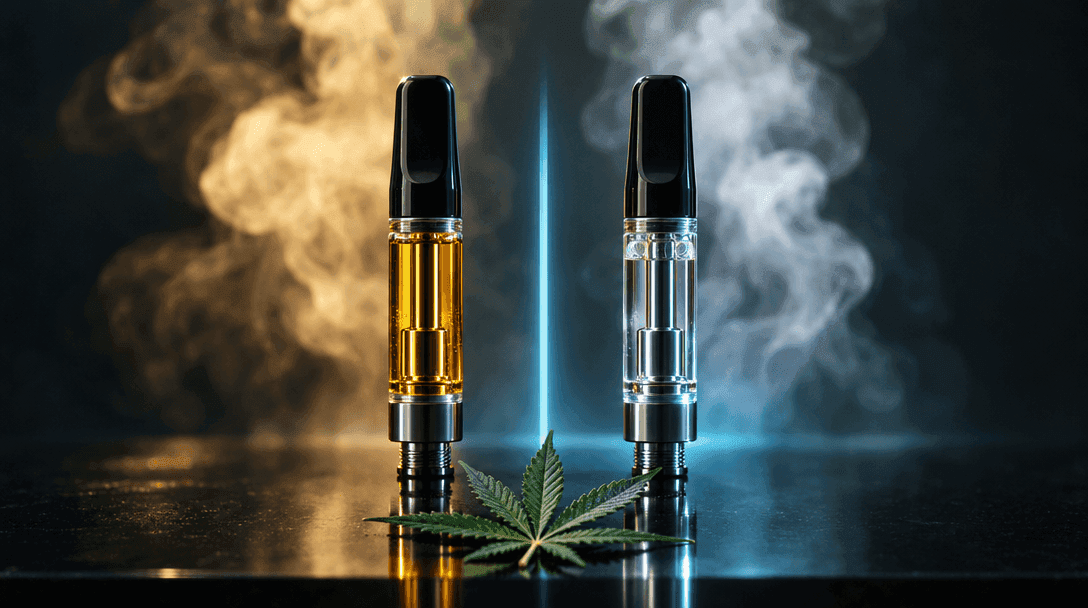
A live resin vape and a distillate vape both deliver cannabis oil through a 510-thread cartridge, but the two extracts come from opposite ends of the production spectrum. Live resin is a full-spectrum extract made from flash-frozen cannabis flower that keeps most of the plant's original cannabinoids, terpenes, and flavonoids. Distillate is a single-cannabinoid extract, usually 90 percent or more THC, that has been stripped of nearly everything else and is often re-flavored with terpenes after the fact [1].
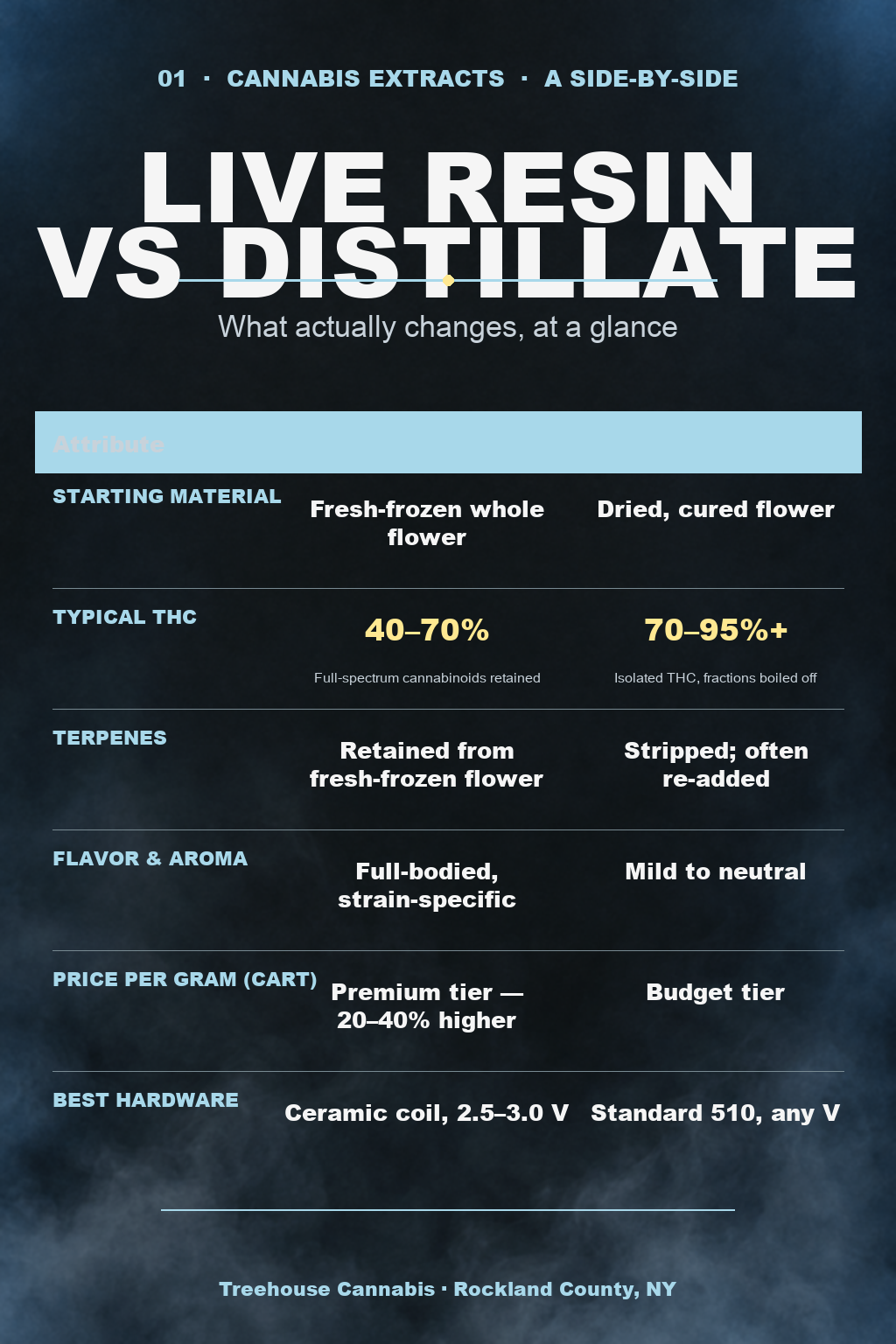
The two formats also land at very different points on the THC meter. Live resin cartridges typically test at 40 to 70 percent THC with a richer profile of minor cannabinoids and retained terpenes, while distillate cartridges typically test at 70 to 95 percent or higher after fractional distillation strips the other compounds away [2]. That headline number is part of the story, but it is not the whole story, because how the rest of the plant's chemistry is preserved changes how the experience actually feels.
Flower, Vapes, Edibles, or Concentrates: Which Format Fits You? walks through how vapes fit alongside flower, edibles, and concentrates, and Live Resin vs Distillate Carts looks at the same live resin vs distillate comparison from a cart-specific angle. Both pair naturally with this side-by-side breakdown.
How Is Live Resin Made From Fresh-Frozen Cannabis?
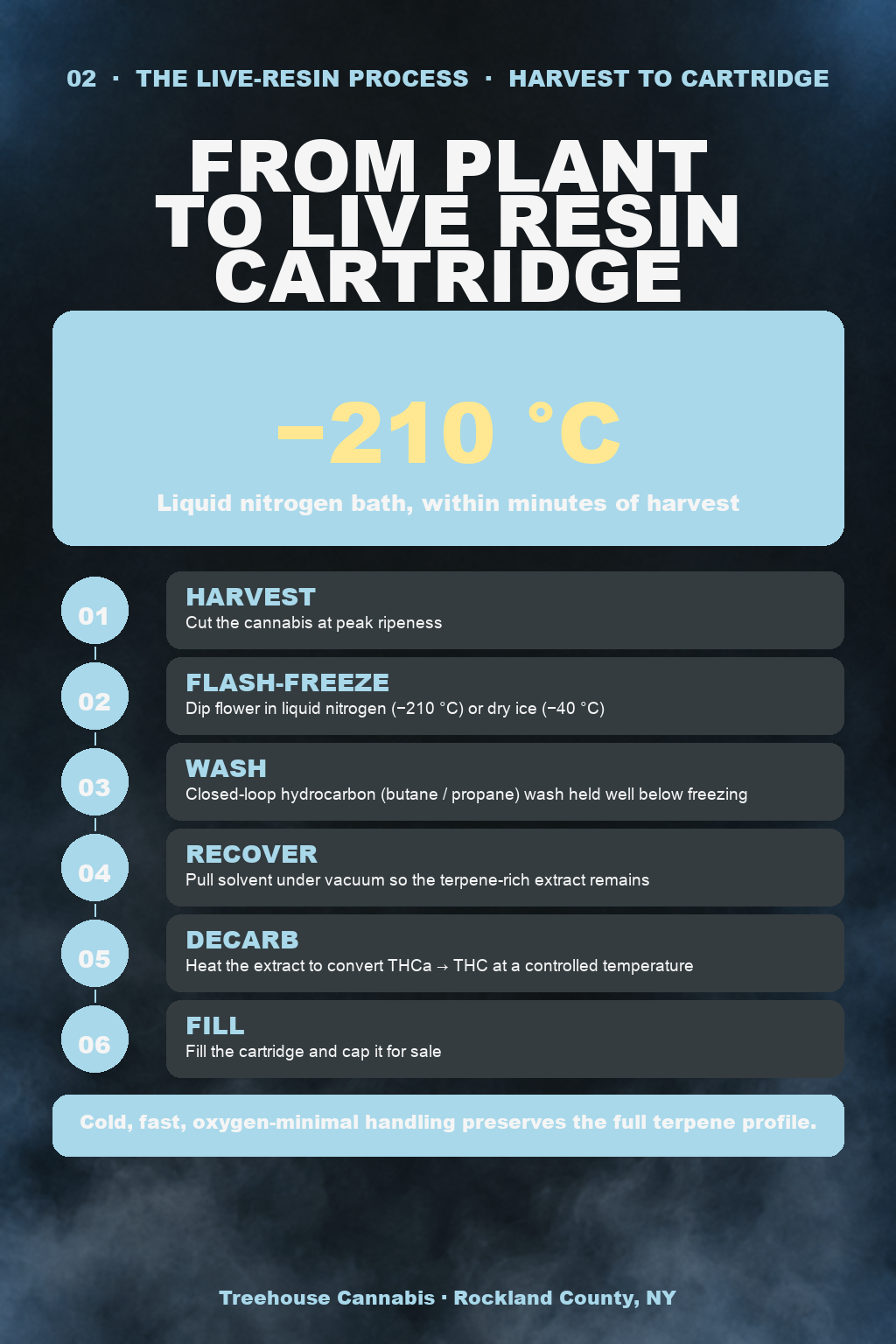
The defining choice in live resin production is what happens to the flower in the first few minutes after harvest. Instead of being dried and cured like flower headed for a jar, live resin flower is flash-frozen within minutes of being cut, typically dipped in liquid nitrogen at around negative 210 degrees Celsius or sealed in dry ice at around negative 40 degrees Celsius [5].
That cold, fast workflow preserves the plant's natural terpene profile from the moment of harvest because terpenes and flavonoids are volatile compounds that begin to evaporate the moment fresh cannabis is exposed to room-temperature air. Locking the flower in place at the moment of harvest means a greater share of the plant's original chemistry survives into the final extract than is possible with any heat-driven method.
The frozen starting material is then washed with a hydrocarbon solvent, typically butane or propane, inside a closed-loop extraction system held well below freezing. The cold solvent pulls cannabinoids, terpenes, and flavonoids out of the flower without cooking them off, and the solvent is recovered under vacuum so the terpene-rich extract remains [5]. The result is a concentrate that smells and tastes closer to the living plant than any extract that has been dried, cured, and heated.
For a deeper look at how this cryogenic step compares with solventless production, Live Resin vs Live Rosin: What's the Difference and Which Is Better? covers the live resin vs live rosin distinction in detail.
Live resin production, step by step:
- Harvest cannabis at peak ripeness (no drying or curing).
- Flash-freeze the flower with liquid nitrogen at around negative 210 degrees Celsius, or pack it in dry ice at around negative 40 degrees Celsius, within minutes of harvest.
- Wash the frozen flower with a hydrocarbon solvent such as butane or propane in a closed-loop system held well below freezing.
- Recover the solvent under vacuum so the terpene-rich extract remains.
- Decarb the extract at a controlled temperature to convert THCa into active THC.
- Fill the cartridge and cap it for sale.
How Is Cannabis Distillate Made and Why Is It So Potent?
Distillate is a near-pure cannabinoid extract (usually 90 percent or more THC) produced by a deliberate heat- and time-driven workflow that strips the cannabis plant down to one target compound. Distillate starts in a much more ordinary place: dried, cured cannabis flower is washed with a solvent such as ethanol, butane, or CO2 to produce a crude cannabis oil, which is then winterized to remove fats and waxes and decarboxylated to activate the cannabinoids [1].
That crude oil is then run through short-path or fractional distillation, a process that separates compounds by boiling point inside a vacuum chamber. Each pass isolates a tighter band of the target compound, and the final product is a near-pure cannabinoid, often 90 percent or more THC, with most of the natural terpene and minor-cannabinoid content stripped away by the heat [1].
Because that high-heat distillation step removes nearly everything aromatic, unflavored distillate has almost no flavor or smell. To make it taste like cannabis again, producers typically re-add terpenes afterward, either cannabis-derived or botanical, which is why two distillate carts at the same THC percentage can taste completely different [1]. For more background on how distillate fits alongside the rest of the cannabis concentrate family, What is The Difference Between Resin, Live Resin, and Rosin? breaks down resin, live resin, and rosin in plain language.
Distillate production, step by step:
- Extract cannabinoids from dried, cured cannabis with a solvent such as ethanol, butane, or CO2.
- Winterize the crude oil to remove fats and waxes.
- Decarboxylate the oil to activate THC (and other cannabinoids).
- Run the oil through short-path or fractional distillation, separating compounds by boiling point inside a vacuum chamber.
- Recover a near-pure cannabinoid fraction, often 90 percent or more THC.
- Optionally re-add terpenes (cannabis-derived or botanical) to restore flavor.
Live Resin vs Distillate THC Percentage: How Do They Compare?
The THC numbers are the easiest place to start when comparing a live resin vape vs distillate, and they paint a clear picture on paper. The table below shows the headline ranges reported across current third-party testing for the two cartridge formats:
| Attribute | Live resin cartridge | Distillate cartridge |
|---|---|---|
| Typical THC range | 40 to 70 percent | 70 to 95 percent or higher |
| Minor cannabinoids | Retained alongside THC | Stripped by distillation |
| Terpenes | Retained from fresh-frozen flower | Stripped, often re-added afterward |
| Starting material | Fresh-frozen whole flower | Dried, cured flower |
|Source comparisons: live resin carts typically test at 40 to 70 percent THC with a richer profile of minor cannabinoids and retained terpenes [2], while distillate carts typically test at 70 to 95 percent or higher THC with most other compounds removed by distillation [1]. The starting-material difference is fresh-frozen whole flower for live resin vs dried, cured flower for distillate [5], and terpene retention is high in live resin because the cold extraction preserves them, low in distillate unless terpenes are added back after distillation [1].
A higher THC number does not automatically mean a stronger-feeling session. Retained terpenes and minor cannabinoids shape how THC is experienced, not just how much of it is in the cartridge, which is why many adult consumers describe a 60 percent THC live resin cart as feeling more layered than a 90 percent THC distillate cart [8].
Key takeaways when comparing THC numbers:
- Higher THC percentage does not automatically mean a stronger-feeling session.
- Retained terpenes and minor cannabinoids shape how THC is experienced, not just potency.
- Two distillate carts at the same THC percentage can taste completely different depending on whether (and which) terpenes were re-added.
For shoppers browsing the current menu, Cartridges Vaporizers shows the live cartridge vaporizers currently in stock at Treehouse Cannabis.
Does the Entourage Effect Make Live Resin Feel Different From Distillate?
The entourage effect is the theory that cannabinoids, terpenes, and flavonoids in whole-plant cannabis work together to produce effects that none of those compounds produce in isolation [8]. It is the working explanation for why two cartridges with the same THC percentage can feel like very different experiences.
Preclinical evidence for that idea has been building. A 2021 University of Arizona study published in Scientific Reports found that four common cannabis terpenes, alpha-humulene, geraniol, linalool, and beta-pinene, each activate the CB1 cannabinoid receptor on their own. When those terpenes were combined with a synthetic cannabinoid agonist, they produced greater pain relief than either the terpene or the cannabinoid alone, suggesting that the compounds genuinely interact rather than just adding up [7]. A 2024 peer-reviewed review in Pharmaceuticals synthesized the broader evidence for the entourage effect, including the role of terpenes in modulating blood-brain barrier permeability and shaping cannabinoid activity [6].
That preclinical research is not the same as a clinical prescription, but it lines up with what many adult consumers report: a full-spectrum live resin cart tends to feel more layered and longer-lasting, while an isolated distillate cart can feel intense but shorter [8].
Points to remember when weighing the entourage effect for vape choice:
- It is a working theory supported by preclinical research, not yet a clinical prescription.
- Terpenes and minor cannabinoids modulate how THC feels, not just how much is on the label.
- A full-spectrum extract (live resin) preserves the compounds that the entourage theory is built on; an isolated extract (distillate) does not, unless terpenes are re-added.
For anyone who prefers a full-spectrum edible as a baseline, the same entourage logic shows up in products like Sour Watermelon RSO Gummies • 100mg, which combines a solventless RSO extract with a fruit-forward profile rather than relying on isolated THC.
Which Vape Format Is Right for You: Live Resin, Distillate, or Both?
The honest answer is that the two formats serve different moments, and most regular vape shoppers end up keeping both on hand.
When you are deciding between the two, focus on four practical factors: flavor, price, hardware, and use case.
- Flavor and aroma. Live resin wins on natural, strain-specific flavor because the terpenes are preserved from fresh-frozen flower. Distillate is mild or flavorless until terpenes are re-added [2].
- Price. Live resin cartridges typically cost 20 to 40 percent more per gram than distillate cartridges, because the fresh-frozen starting material and lower extraction yields drive production cost up [2].
- Hardware. Both formats use standard 510-thread cartridges, but live resin is thicker and performs best with ceramic coils and a lower-voltage battery around 2.5 to 3.0 V to avoid burning the delicate terpenes. Distillate flows more easily and tolerates a wider range of coils and voltages [2].
- Use case. Distillate suits budget shoppers and anyone who wants a flavorless, high-THC option. Live resin suits flavor chasers and anyone who wants a more nuanced, full-spectrum experience [1].
For a concrete starting point, Hash Burger Live Resin Vape Pen | .5G is one of the live resin vape pens currently available at Treehouse Cannabis and is a good place to see how the full-spectrum flavor profile lands in a cart format.
Frequently Asked Questions
What is the main difference between a live resin vape and a distillate vape?
A live resin vape is filled with a full-spectrum extract made from fresh-frozen cannabis, so it keeps most of the plant's original cannabinoids, terpenes, and flavonoids. A distillate vape is filled with an isolated cannabinoid, usually 90 percent or more THC, that has been stripped of almost everything else and is often re-flavored with added terpenes [1].
Which gets you higher, live resin or distillate?
On paper, distillate usually wins because it tests at 70 to 95 percent THC or higher versus roughly 40 to 70 percent THC for most live resin [2]. In practice, many adult consumers report that live resin feels stronger or more layered because the retained terpenes and minor cannabinoids shape how THC is experienced, not just how much is present in the cartridge [8].
Why does live resin taste and smell different from distillate?
Live resin keeps the cannabis plant's natural terpene and flavonoid content because the flower is flash-frozen at harvest and extracted cold [5]. Distillate is filtered, winterized, and distilled at high heat, which removes nearly all of those aromatic compounds, so it has little to no flavor until terpenes are added back in [1].
How is live resin made?
Live resin starts with cannabis that is flash-frozen with liquid nitrogen or dry ice within minutes of harvest [5]. The frozen material is then washed with a hydrocarbon solvent such as butane or propane inside a closed-loop system held well below freezing, and the solvent is recovered so the terpene-rich extract remains [5].
How is distillate made?
Distillate is made by first extracting cannabinoids from dried, cured cannabis with a solvent like ethanol, butane, or CO2, then winterizing the crude oil to remove fats and waxes, decarboxylating it, and running it through short-path distillation to isolate a single target cannabinoid at very high purity [1].
Do live resin vapes need a different battery or cartridge than distillate vapes?
Both formats use the same standard 510-thread hardware, but live resin is thicker and more viscous, so it performs best in cartridges with ceramic coils and lower-voltage batteries around 2.5 to 3.0 V to avoid burning the delicate terpenes. Distillate flows more easily and tolerates a wider range of coils and voltages [2].
Is the entourage effect real, and does it matter for vape choice?
Preclinical research, including a 2021 University of Arizona study and a 2024 NIH review, supports the idea that cannabis terpenes and minor cannabinoids modulate THC's effects at the CB1 receptor [7] [6]. That growing evidence is the main reason many adults prefer full-spectrum live resin over isolated distillate for a more nuanced experience [8].
Are live resin vapes more expensive than distillate vapes?
Yes, in most legal markets live resin carts cost noticeably more per gram because the fresh-frozen starting material, cold extraction, and lower yields drive up production cost. Distillate is cheaper to produce at scale, so distillate carts are usually the budget option while live resin sits at the premium tier [2].
Sources
- Leafwell — Defines live resin as a full-spectrum cannabis extract made from flash-frozen fr
- Triangle Hemp Wellness — Side-by-side comparison showing distillate carts typically test at 70-95%+ THC w
- Cloud Cannabis — Walks through the full distillate workflow — solvent extraction, decarboxylation
- Story Cannabis — Defines live resin as a cannabis concentrate made from fresh-frozen plant materi
- Sensi Seeds — Explains the cryogenic fresh-freezing step at the heart of live resin — the whol
- Pharmaceuticals (via PubMed Central / NCBI) — Peer-reviewed review in Pharmaceuticals that synthesizes the evidence for the en
- University of Arizona Health Sciences — Press release for LaVigne, Hecksel, Keresztes and Streicher (Scientific Reports,
- Medical News Today — Plain-language overview of the entourage effect theory — that cannabinoids, terp
About Treehouse Cannabis
Treehouse Cannabis is a licensed adult-use dispensary serving Rockland County, Orange County, and Westchester County, New York. Our budtenders help adult customers compare live resin and distillate cartridges in person and online at treehousecannabis.com.
Cannabis is for adults 21 and older. Keep all cannabis products out of the reach of children and pets. The content on this page is for informational and educational purposes only and is not a substitute for professional medical advice. Effects of cannabis vary by individual; consume responsibly and in accordance with local laws.

Shop our products

Shop All

Deals

Flower

Pre-rolls
Vaporizers

Edibles
Drinks
Concentrates
Tinctures

Topicals

CBD

Pet CBD
Accessories