
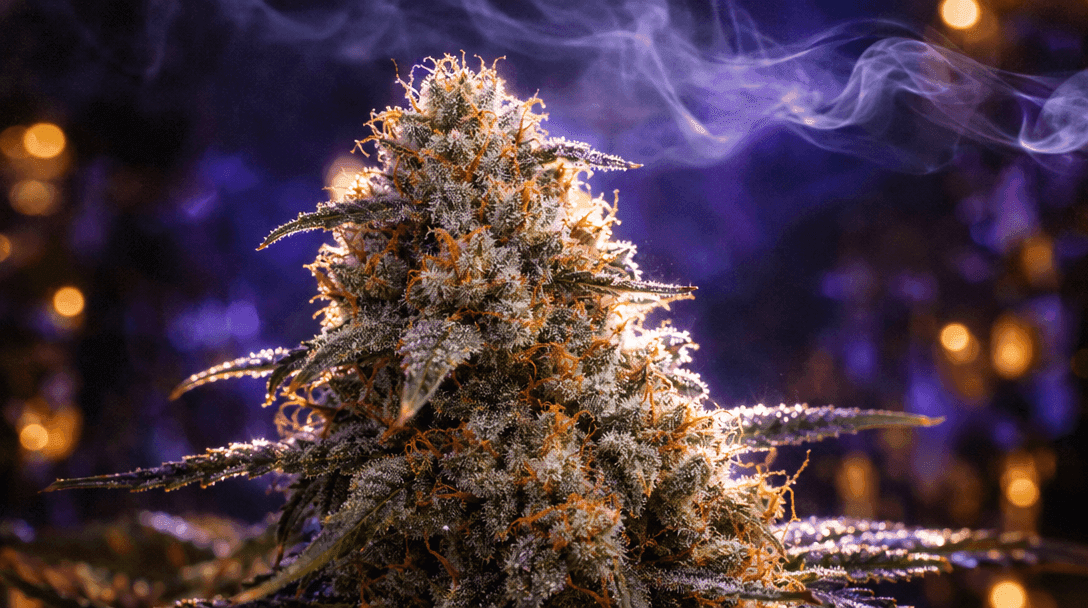
Super Silver Haze Strain: History and Terpene Profile
title: "Super Silver Haze Strain: History and Terpene Profile" slug: super-silver-haze-strain-history-and-terpene-profile
Super Silver Haze Strain: History and Terpene Profile
Super Silver Haze is a sativa-dominant cannabis hybrid bred in the Netherlands in the 1990s by Green House Seed Company from a three-way cross of Haze, Northern Lights, and Skunk. The Super Silver Haze strain is best known for winning the High Times Cannabis Cup three years in a row (1997–1999) and for a certified-labs terpene profile led by myrcene, caryophyllene, and limonene.
How a 1990s Dutch cross of Skunk, Northern Lights, and Haze became one of the most decorated sativas ever grown — and why growers and consumers still chase it.
What Is Super Silver Haze?
Super Silver Haze is a sativa-dominant cannabis hybrid bred in the Netherlands in the 1990s by Green House Seed Company, made by crossing three foundation strains — Skunk, Northern Lights, and Haze — into a single stable cultivar [1]. It is widely recognized as one of the most decorated competition strains in cannabis history and remains a reference point for what a refined Haze-family hybrid can be [2].
The Haze family itself is a long-flowering sativa lineage that first took root in Santa Cruz, California during the 1960s, and modern Haze hybrids including Super Silver Haze, Jack Herer, and Blue Dream all trace back to that original genetic well [3][4].
The "Super" prefix is not marketing fluff — it signals a specific three-way cross that adds Skunk to the Haze x Northern Lights backbone, producing a plant that is taller, longer-flowering, and more cerebral than its parents. Modern cultivated Super Silver Haze typically tests between 18% and 23% THC, with an average around 21%. Leafly's certified-labs terpene profile shows myrcene as the dominant terpene, followed by caryophyllene and limonene [1].
For readers mapping the wider terpene landscape, the visual reference at The Cannabis Terpene Wheel: A Visual Guide to Every Common Terpene shows where myrcene, caryophyllene, and limonene sit among the other common cannabis terpenes.
Key defining traits of the Super Silver Haze strain:
- Classification: sativa-dominant hybrid
- Parent strains: Haze, Northern Lights, and Skunk
- Average THC: around 21% (typical range 18%–23%)
- Top three user-reported effects: energetic, uplifted, focused
- Top three user-reported flavors: citrus, skunk, earthy
- Average user rating: 4.4 out of 5 across more than 2,400 Leafly reviews [1]
One of the parent strains, Acapulco Gold, is itself a landmark Mexican sativa that helped shape the Haze family's spicy, earthy character — the strain profile in Acapulco Gold Strain: History, Genetics, and Terpene Profile covers its history, genetics, and terpene profile in more detail.
Who Created Super Silver Haze and Why Does the Lineage Matter?
Super Silver Haze was created in the Netherlands during the mid-to-late 1990s by Green House Seed Company, with Scott Blakey, widely known as Shantibaba, serving as the principal breeder alongside Green House founder Arjan Roskam [2]. Shantibaba later left Green House and co-founded Mr. Nice Seedbank, where Super Silver Haze remains a flagship cultivar and the original breeder lineage is still maintained [5].
The strain emerged out of Amsterdam's late-1990s seed scene, when breeders were refining the long-flowering Haze line into something that could be grown commercially without sacrificing the cerebral character that made Haze famous [2].
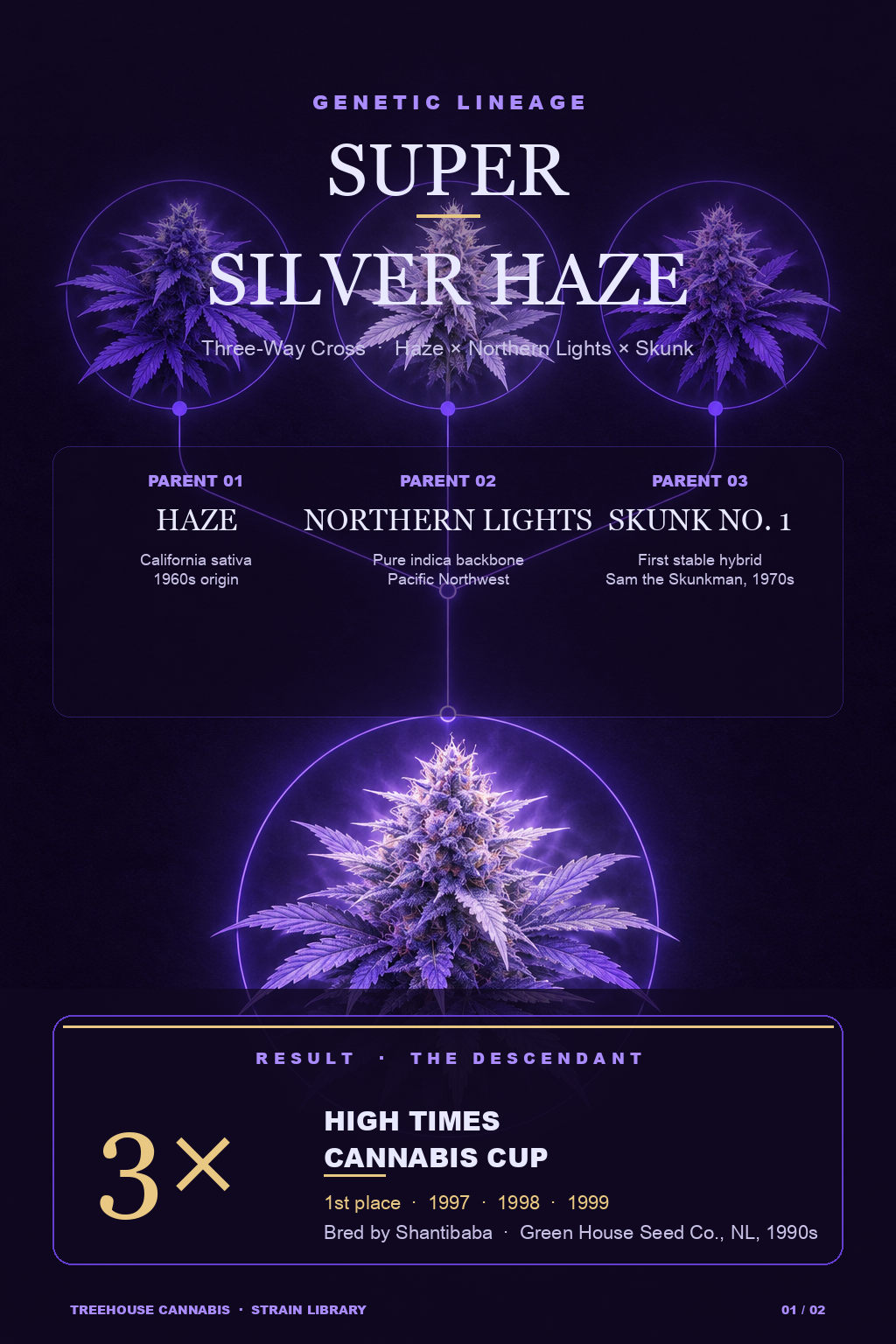
The three-parent cross is not arbitrary — each parent contributes a specific trait, and understanding the cross explains why Super Silver Haze looks, smells, and feels the way it does. Haze is the long-flowering California sativa responsible for the uplifting, cerebral character and the spicy-citrus undertone that defines the family [4]. Northern Lights is a pure indica from the U.S. Pacific Northwest, later stabilized in the Netherlands, and it contributes the structural density, resin production, and earthy base note. In SSH the Northern Lights side is most commonly traced through a Northern Lights #5 x Haze mother [6]. Skunk No. 1 — the first stable hybrid created by David Watson (Sam the Skunkman) in the late 1970s from Afghani, Acapulco Gold, and Colombian Gold — adds vigor, shortened flowering time relative to pure Haze, and the pungent, musky sweetness on the front end of the aroma [7].
What each parent contributes to the SSH cross:
- Haze: long flowering cycle, spicy-citrus undertone, cerebral effects
- Northern Lights: structural density, resin production, earthy base note
- Skunk No. 1: vigor, shorter flowering, pungent musky sweetness
For a related example of how a 1990s cross reshaped the modern menu, the Sour Diesel Strain Family: History, Genetics, and Terpenes profile walks through the Sour Diesel family and how its Chemdog x Super Skunk backbone produced a different take on the same Haze-era genetics.
How Did Super Silver Haze Win the Cannabis Cup Three Years in a Row?
Super Silver Haze won first place at the High Times Cannabis Cup three consecutive years: 1997, 1998, and 1999 [1]. The run was widely reported as unprecedented and helped define the late-1990s peak of international cannabis competition culture, when Amsterdam-based breeders dominated the global stage and competition entries were dominated by a handful of well-executed Haze-family hybrids [2].
What made the streak unusual was not a single exceptional entry but sustained performance across three separate harvests, judged by three different panels, against a rapidly evolving international field. The cultivar proved that refinement of established Haze, Northern Lights, and Skunk lines could outperform constant novelty — a point that Beard Bros Pharms explicitly highlights as part of SSH's lasting reputation as a benchmark sativa-dominant hybrid [2].
The 1997–1999 run also coincided with a period when average THC across legal and underground markets was still in the 10%–15% range, so the cup-winning cuts were visibly stronger than what most consumers had access to at the time.
Why the three-year run mattered for the cannabis world:
- It set a new bar for what a refined Haze hybrid could deliver in competition
- It validated the three-way Haze x Northern Lights x Skunk cross as a stable breeding template
- It cemented Green House Seed Company's international reputation during the late 1990s
- It established a benchmark that later competition strains are still measured against [2]
For readers interested in the chemistry that drives the cup-winning profile, the A Guide to Terpenes and Their Effects guide covers how terpene composition shapes the aroma and reported effects of modern flower.
What Is the Terpene Profile of Super Silver Haze?
According to Leafly's certified-labs data, the dominant terpene in Super Silver Haze is myrcene, followed by caryophyllene and limonene [1]. The combined profile produces a sharp citrus-and-skunk aroma on the front end with earthy, spicy incense on the exhale, which is the signature Haze-family bouquet that the parent lineage predicts.
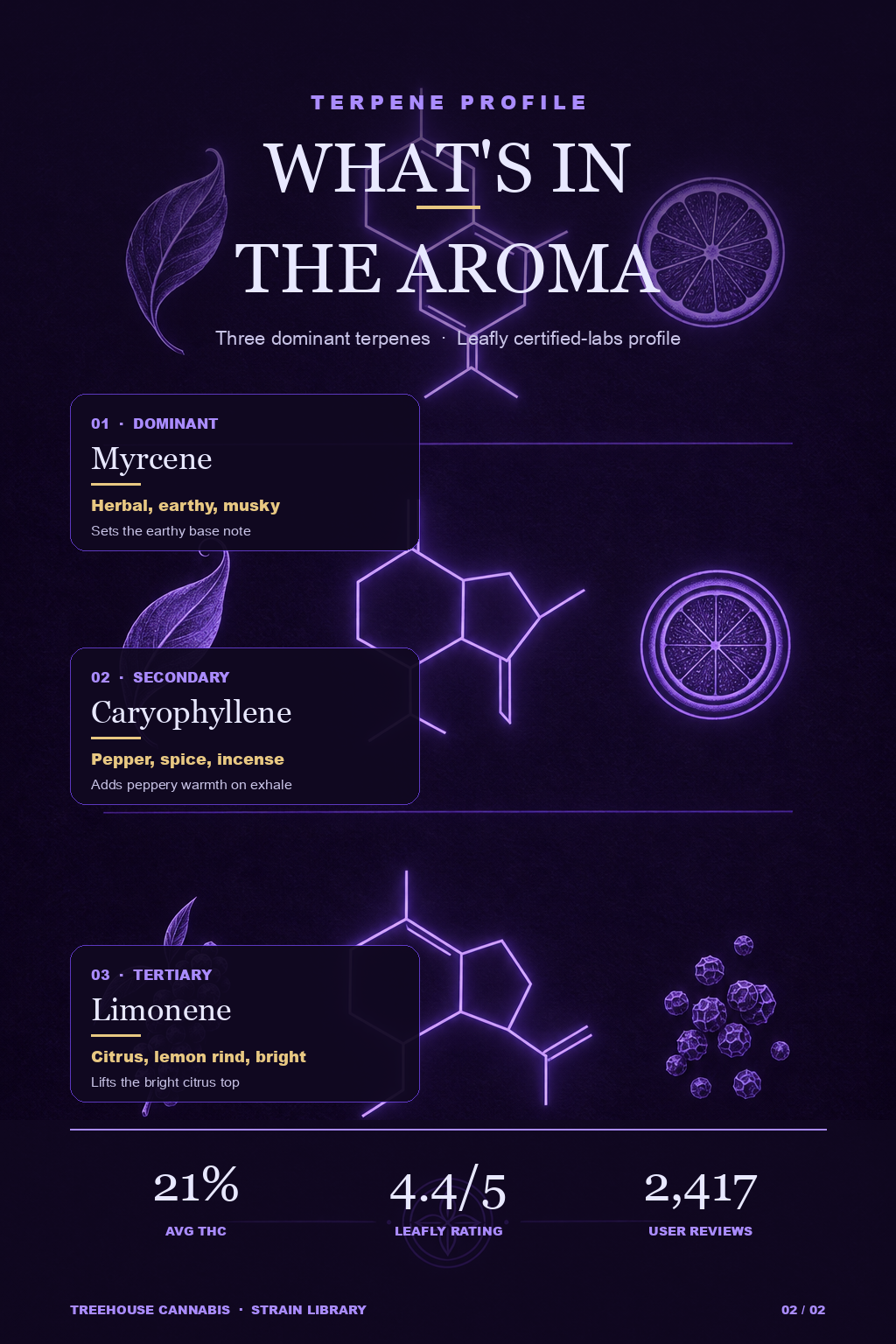
The three dominant terpenes in Super Silver Haze:
- Myrcene (dominant): herbal, earthy, musky — the base note that gives SSH its grounded, resinous character; myrcene is also the dominant terpene in the Haze parent, where it pairs with pinene and caryophyllene [4]
- Caryophyllene (secondary): pepper, spice, incense — contributes the warm, slightly sharp edge on the back end of the aroma and is the terpene most associated with the Skunk side of the cross [7]
- Limonene (tertiary): citrus, lemon rind, bright — gives SSH its bright citrus opening and ties it visually and aromatically to the Haze family's spicy-citrus lineage [4]
The profile reflects the genetic mix almost line-by-line. The myrcene base and citrus character come from Haze [4], the pungent musky sweetness on the front end comes from Skunk No. 1 [7], and the resin density and earthy base note come from Northern Lights [6].
For consumers evaluating SSH on a dispensary shelf, the practical takeaway is that aroma is a reliable proxy for the underlying chemotype — a sharp citrus-and-skunk nose with an earthy, spicy finish predicts the certified-labs profile closely [1].
How Strong Is Super Silver Haze and What Effects Does It Produce?
Modern cultivated Super Silver Haze typically tests between 18% and 23% THC, with Leafly reporting an average of 21% and an average CBG content around 1% [1]. Original late-1990s competition cuts were celebrated for potency well above the average cannabis of that era, which more commonly ran in the 10% to 15% THC range [2].
The modern cup-winning average is a clear step up from late-1990s norms, but it is also unremarkable against current dispensary-shelf averages for top-tier flower, which routinely clear 20%.
Leafly user reports rank the top three effects of Super Silver Haze as energetic, uplifted, and focused, with dominant flavors of citrus, skunk, and earthy [1]. Consumers commonly describe a long-lasting, cerebral, creative high that is functional during the day. The most-cited negatives are dry mouth, dry eyes, and occasional dizziness.
The effect profile is consistent with the Haze family — cerebral, talkative, and creative rather than heavy or sedating. The Skunk and Northern Lights contributions show up more in the aroma and the resin production than in the effect curve itself.
What modern consumers can expect from Super Silver Haze:
- Average THC: around 21% (range 18%–23%)
- Top effects: energetic, uplifted, focused
- Top flavors: citrus, skunk, earthy
- Average CBG: around 1%
- Best fit: daytime, creative, or social use rather than late-evening wind-down
Readers who want to compare SSH against an in-stock version of the cultivar can look at the current Super Silver Haze Classic Cuts | Flower | 3.5g listing for a Super Silver Haze Classic Cuts flower option; the article on category covers the broader range of current sativa-leaning cuts on the Treehouse menu.
Is Super Silver Haze the Same as Silver Haze?
No — Super Silver Haze and Silver Haze are two distinct cultivars. Silver Haze is the earlier strain bred by Sensi Seeds from a two-way Haze x Northern Lights cross. Super Silver Haze is the later, more sativa-forward three-way cross (Haze x Northern Lights x Skunk) released by Green House Seeds in the 1990s. The "Super" prefix reflects the addition of Skunk and the higher-energy, longer-flowering profile that the third parent brings [1].
The two cultivars are commonly confused because they share the Haze x Northern Lights backbone and a similar silver-tinted bud structure, but they are genetically distinct releases from different Amsterdam seed banks, with different breeders and different effect curves. Silver Haze is generally described as a more compact, slightly faster-flowering plant, while Super Silver Haze is taller, longer in flower, and more cerebral in effect.
The Skunk parent is the practical differentiator: it added the pungent front-end aroma, the vigor, and the breeding template that Green House used to dominate the late-1990s competition circuit [2].
| Trait | Silver Haze (Sensi Seeds) | Super Silver Haze (Green House Seeds) |
|---|---|---|
| Cross | Haze × Northern Lights (two-way) | Haze × Northern Lights × Skunk (three-way) |
| Release era | Earlier 1990s | Mid-to-late 1990s |
| Plant structure | More compact, slightly faster flowering | Taller, longer-flowering |
| Effect curve | Classic Haze x NL balance | More cerebral, higher energy |
| Aroma | Haze citrus with NL earthiness | Sharp citrus + pungent skunk front, earthy/spice back |
| Competition record | Multiple cup wins | High Times Cannabis Cup 1st place 1997, 1998, 1999 |
| Distinguishing parent | — | Skunk No. 1 adds vigor and pungent sweetness [2] |
Key points:
- Silver Haze is the earlier two-way Haze x Northern Lights cross released by Sensi Seeds [1].
- Super Silver Haze is the later three-way Haze x Northern Lights x Skunk cross released by Green House Seeds.
- Both share the Haze x Northern Lights backbone and a similar silver-tinted bud structure.
- The "Super" prefix signals the Skunk addition — more vigor, longer flowering, more cerebral effects.
- Skunk No. 1 is the practical differentiator that adds pungent front-end aroma and competition pedigree [2].
What Are the Most Common Questions About Super Silver Haze?
Quick answers:
- Super Silver Haze (SSH) is a 1990s sativa-dominant Dutch hybrid bred by Green House Seed Company from Skunk, Northern Lights, and Haze.
- The principal breeder was Scott Blakey (Shantibaba), working alongside Green House founder Arjan Roskam.
- The lineage is a three-way Haze x Northern Lights x Skunk cross, often traced through a Northern Lights #5 x Haze mother.
- SSH won first place at the High Times Cannabis Cup three consecutive years — 1997, 1998, and 1999.
- Leafly certified-labs terpene data shows myrcene as dominant, followed by caryophyllene and limonene.
What is the Super Silver Haze strain? Super Silver Haze, often shortened to SSH, is a sativa-dominant cannabis hybrid bred in the Netherlands in the 1990s by Green House Seed Company. It was created by crossing three foundation strains — Skunk, Northern Lights, and Haze — and it remains one of the most decorated competition strains in cannabis history [1][2].
Who created Super Silver Haze? Super Silver Haze was created by Green House Seed Company in Amsterdam, with Scott Blakey, widely known as Shantibaba, serving as the principal breeder during the 1990s alongside Green House founder Arjan Roskam. Shantibaba later co-founded Mr. Nice Seedbank, where SSH remains a flagship offering [2][5].
What is the genetic lineage of Super Silver Haze? Super Silver Haze is a three-way cross of Haze, Northern Lights, and Skunk, with the Haze side most commonly traced through a Northern Lights #5 x Haze mother [1][6][7].
How many times did Super Silver Haze win the High Times Cannabis Cup? Super Silver Haze won first place at the High Times Cannabis Cup three consecutive years: 1997, 1998, and 1999 [1][2].
Is Super Silver Haze a sativa or an indica? Super Silver Haze is classified as a sativa-dominant strain. It grows tall with long internodes, flowers longer than typical indica-leaning hybrids, and produces the energetic, uplifting, focused effects associated with Haze-family sativas [1][4].
What is the terpene profile of Super Silver Haze? According to Leafly's certified-labs data, the dominant terpene in Super Silver Haze is myrcene (herbal, earthy), followed by caryophyllene (pepper, spice) and limonene (citrus) [1].
How strong is Super Silver Haze in THC? Modern cultivated Super Silver Haze typically tests between 18% and 23% THC, with Leafly reporting an average of 21%. Original late-1990s competition cuts were celebrated for potency well above the average cannabis of that era, which more commonly ran in the 10% to 15% THC range [1][2].
What effects does Super Silver Haze produce? Leafly user reports rank the top three effects of Super Silver Haze as energetic, uplifted, and focused, with dominant flavors of citrus, skunk, and earthy. The most-cited negatives are dry mouth, dry eyes, and occasional dizziness [1].
Is Super Silver Haze the same as Silver Haze? No. Silver Haze is the earlier strain bred by Sensi Seeds from a Haze x Northern Lights cross. Super Silver Haze is the later three-way cross (Haze x Northern Lights x Skunk) released by Green House Seeds in the 1990s [1].
Sources
- Leafly — Leafly documents Super Silver Haze as a sativa strain bred by Green House Seeds,
- Beard Bros Pharms — Beard Bros Pharms reports that Super Silver Haze was created by Green House Seed
- Wikipedia — Wikipedia's Cannabis strain article covers the Haze lineage family and the major
- Leafly — Leafly documents Haze (Original Haze, Haze Brothers) as a sativa that first took
- Mr. Nice Seedbank — Mr. Nice Seedbank, founded by Shantibaba (Scott Blakey) after his tenure at Gree
- Leafly — Leafly documents Northern Lights as a pure indica and one of the most influentia
- Leafly — Leafly documents Skunk No. 1 as the first stable hybrid (Afghani x Acapulco Gold
About Treehouse Cannabis
Treehouse Cannabis is an adult-use dispensary serving Rockland County, Orange County, and Westchester County in New York. The team curates current sativa, indica, and hybrid cuts and publishes educational content on strain history, terpene profiles, and consumer guidance for adult customers 21 and older.
Cannabis is for adults 21 and older. Keep all cannabis products securely stored and out of reach of children and pets. Do not drive or operate machinery while under the influence of cannabis. If you are pregnant, breastfeeding, or have a medical condition, consult a qualified professional before use. This article is intended for adult-use customers in New York and is for educational purposes only — it is not medical advice.


Shop our products

Shop All

Deals

Flower

Pre-rolls
Vaporizers

Edibles
Drinks

Concentrates

Tinctures

Topicals

CBD

Pet CBD

Accessories