What Is Pinene? The Pine-Scented Terpene That May Sharpen Focus
What Is Pinene? The Pine-Scented Terpene That May Sharpen Focus
Pinene cannabis refers to cannabis containing pinene, a terpene associated with a fresh pine aroma. Its scent is a useful sensory cue, but claims that it sharpens focus or protects memory are not established. A controlled human study found that alpha-pinene did not counter THC-related memory impairment.
That distinction matters when reading descriptions of a pine-scented flower. Terpenes belong to cannabis aroma chemistry; they are not interchangeable with THC, the cannabinoid associated with intoxication. A pleasant, fresh scent does not establish that a product will improve concentration or leave attention unaffected. [1] [3]
The title's suggestion that pinene may sharpen focus is a question to examine, not a demonstrated benefit. The useful approach is to separate three things: what the plant smells like, what a batch report measures, and what direct human research actually shows. Those are different kinds of information, and none can stand in for the others.
What is pinene in cannabis, and why does it smell like pine?
Pinene is a terpene associated with the fresh, pine-like side of cannabis aroma. Its presence describes part of a plant's aromatic profile, not a proven focus benefit or a measure of THC impairment.
Cannabis produces terpene-rich resin in glandular trichomes, the plant's small resin-producing structures. Researchers studying cannabis terpene synthases, the enzymes involved in making these compounds, identified alpha-pinene among their products. This helps explain pinene's place in plant chemistry without making a claim about how customers will feel. [3]
A flower's overall aroma is a mixture rather than a single-compound signature. Research has documented terpene variation both within and between plants carrying the same cultivar label, so a familiar name does not ensure an identical aromatic profile each time. [4]
Keep these distinctions in mind when exploring pine-forward aromas:
- Pinene belongs to the plant's terpene chemistry.
- A pine-like scent is a sensory description, not a concentration measurement.
- Other aromatic compounds contribute to the overall impression.
- Smelling fresh or bright does not establish improved attention.
- Aroma alone cannot show whether THC impairment is absent.
For a visual introduction to aroma categories, start with The Cannabis Terpene Wheel: A Visual Guide to Every Common Terpene. If the terminology is unfamiliar, Understanding Terpenes in Cannabis provides broader background before narrowing the discussion to one compound.
Other terpene profiles offer useful points of comparison without turning scent into an effects chart. Explore A Guide to Limonene in Cannabis and Understanding Myrcene: The Aromatic Terpene Found Across Nature and Cannabis to place pinene alongside other commonly discussed cannabis terpenes.
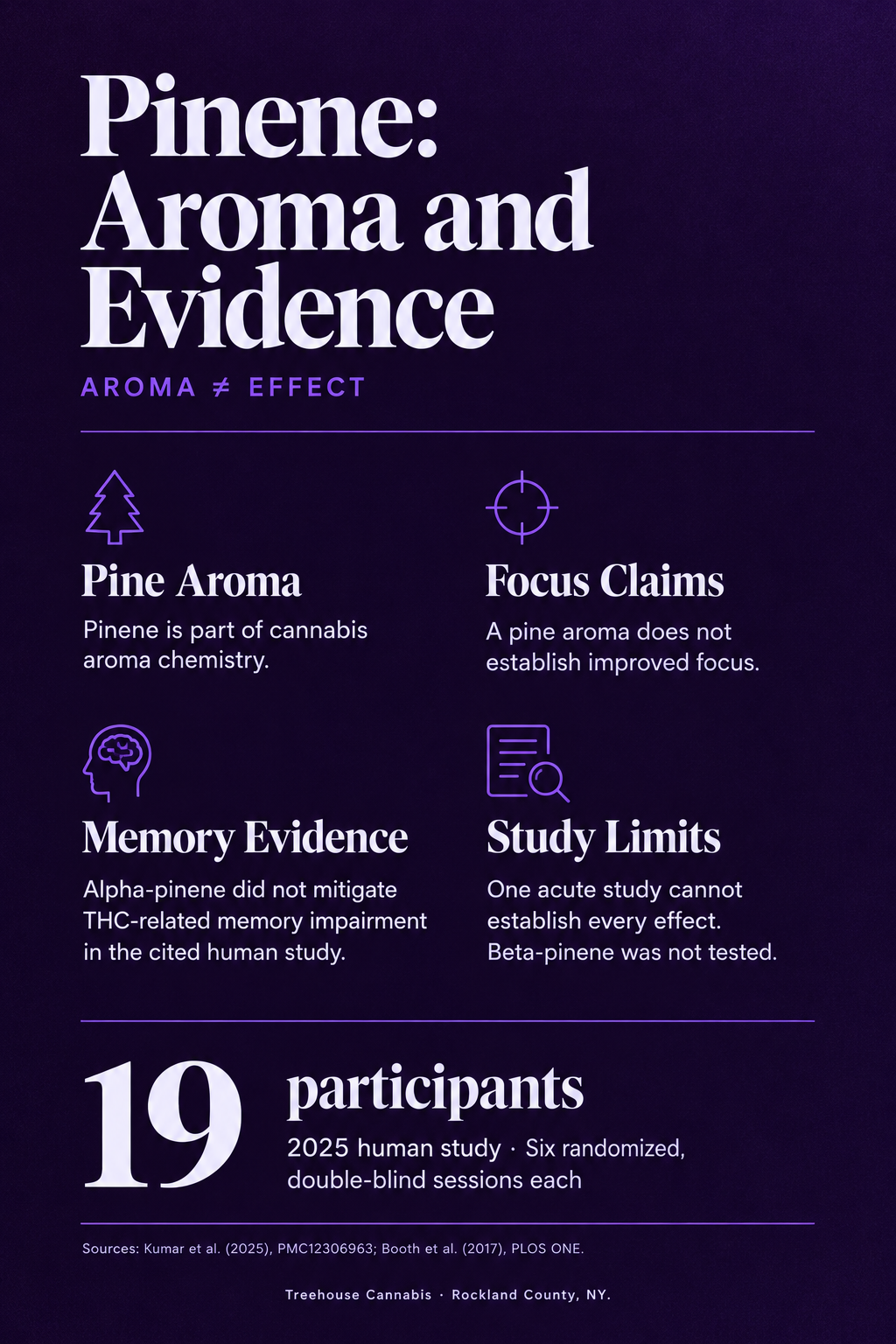
The evidence distinction also belongs in any visual summary of pinene. Pine aroma is part of its sensory story, but a focus benefit is not established; the cited human experiment did not find protection against THC-related memory impairment. That acute alpha-pinene experiment cannot settle every possible effect or establish beta-pinene's effects. [1]
For more context on the difference between plant chemistry and claims about experience, read The Science of Cannabis Terpenes: Beyond THC.
How does alpha-pinene vs beta-pinene differ in cannabis information?
Alpha-pinene and beta-pinene are distinct forms of pinene, not interchangeable research subjects. A report may list them separately, and findings from the cited alpha-pinene experiment do not establish beta-pinene's effects.
The distinction is especially important when a product description uses only the word "pinene." That shorthand leaves out which form was measured, whether both were included, and what evidence supports any accompanying effects claim. Read the specific compound name rather than assuming that research on one form applies to both. [1]
| Question | Alpha-pinene | Beta-pinene |
|---|---|---|
| What entry should a report show? | An alpha-pinene entry, if tested and reported. | A beta-pinene entry, if tested and reported. |
| Was it tested in the cited 2025 human experiment? | Yes; it did not mitigate THC-related memory impairment under the tested conditions. | No; that experiment does not establish beta-pinene's effects. |
| Does its name establish a focus benefit? | No established focus benefit from the retained evidence. | No established focus benefit from the retained evidence. |
| What is the practical takeaway? | Read the measurement and its research context separately. | Do not substitute alpha-pinene findings for beta-pinene evidence. |
When comparing alpha-pinene vs beta-pinene information:
- Look for the full compound name on the report.
- Check whether both forms were included in the reported panel.
- Do not turn a missing entry into an assumed measurement.
- Match a research claim to the compound actually studied.
For a wider overview, A Guide to Terpenes and Their Effects introduces terpene-related effects discussions; the direct human evidence below sets the limits for this article's pinene claims.
Does pinene cannabis improve focus or protect memory?
Improved focus and protection from THC-related memory impairment are not established benefits of pinene cannabis. The cited controlled human study did not find that alpha-pinene prevented THC-induced memory impairment under its tested conditions.
In the 2025 randomized, double-blind study, Kumar and colleagues examined alpha-pinene and THC in 19 healthy adults. Alpha-pinene did not mitigate THC-induced memory impairment or significantly change the other measured acute effects. Alpha-pinene alone also produced no significant measured pharmacodynamic effects compared with placebo. [1]
That is more directly relevant to a focus claim than knowing that cannabis can produce pinene. Plant-biochemistry research explains how aromatic compounds are made; a controlled human experiment addresses what happened to people under defined conditions. Evidence for the first question does not automatically answer the second.
The study still has limits. It was a small, acute experiment involving alpha-pinene under specific conditions, not a test of every cannabis product or every possible use pattern. A nonsignificant result is not proof of an exact zero effect in all circumstances, but it also cannot be presented as evidence that pinene improves concentration. [1]
A useful evidence checklist is:
- Separate a scent description from a cognitive-benefit claim.
- Ask whether the evidence comes from people, plant chemistry or a proposed mechanism.
- Check which pinene form the experiment tested.
- Describe nonsignificant findings without turning them into a benefit or a universal negative.
- Do not assume a terpene cancels the effects of THC.
CDC guidance notes that recent cannabis use can affect attention, memory, thinking, coordination and reaction time. A pine-like aroma does not override that guidance or establish suitability for driving, machinery or concentration-dependent work. [5]
Readers exploring Cannabis for Focus & Productivity should carry that distinction with them: interest in focus does not make pinene-containing cannabis a demonstrated productivity tool.
Which cannabis strains with pinene can a batch report actually identify?
A current batch terpene report can identify measured pinene more reliably than a strain name alone. Research documents chemical variation within cultivar labels, so an untested cultivar or retail product cannot be promised as consistently high in pinene.
A familiar name can help customers find products they want to investigate. It does not supply a chemical analysis. Smith and colleagues found that commercial cannabis labels do not consistently represent measured cannabinoid and terpene composition, while Booth and colleagues documented terpene variation within and between cultivar labels. [2] [4]
This is why a fixed list of "high-pinene strains" can be misleading without current batch evidence. Even a name associated with a particular aroma in past testing does not establish the composition of the package available now.
Use names as a starting point, then ask:
- Is terpene information available for this specific batch?
- Does the report identify the same product and batch as the package?
- Was alpha-pinene, beta-pinene or both measured and reported?
- Does the description distinguish chemistry from predicted effects?
- Is an indica or sativa label being used in place of actual terpene information?
For an example of a flower listing to investigate, Panama Red | Flower | 3.5g provides a product-page starting point. The link is not evidence of pinene content, a particular terpene concentration or a focus-enhancing effect; those claims would require matching batch information and, for benefits, appropriate human evidence.
A sativa label is not a pinene measurement. Neither a name nor a product category establishes that a flower will sharpen attention. [2]
How do you read a pinene terpene lab report before shopping?
Start with a terpene report that matches the product's batch, then locate the specific pinene entries and reported units. Read cannabinoid information alongside terpenes; a composition report is not a guarantee of focus or an impairment test.
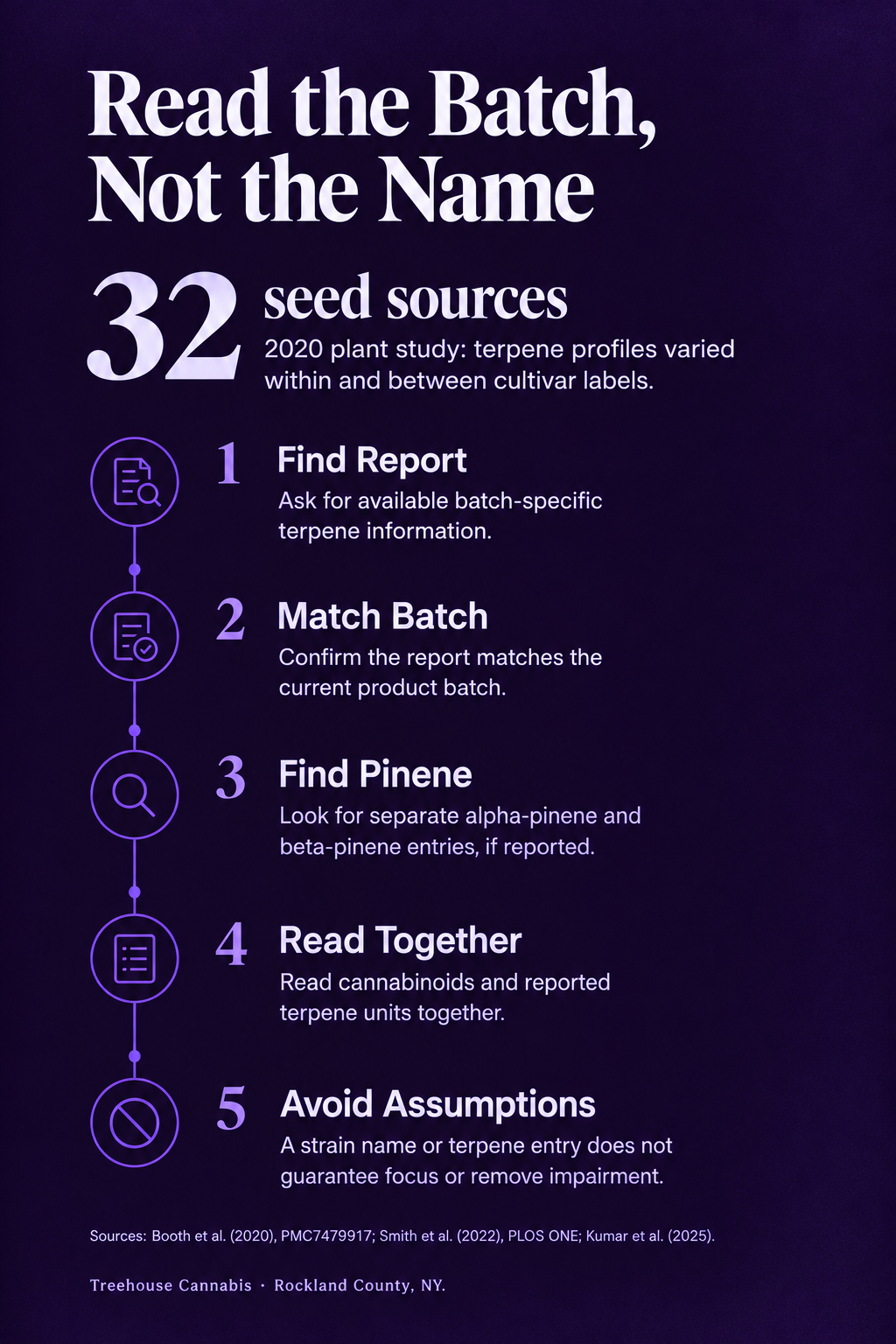
The practical principle is to read the batch, not just the name. Research showing variation across commercial labels and within cultivars supports looking for information tied to the actual product rather than relying on reputation alone. [2] [4]
Follow this report-reading sequence:
- Ask whether current, batch-specific terpene information is available. Do not assume every listing includes a terpene panel.
- Match the identifiers. Confirm that the report belongs to the product and batch being considered, not another release with the same name.
- Find the pinene entries. Look for alpha-pinene and beta-pinene separately if the report includes them.
- Read the stated units. Do not assume every number is a percentage or compare unlike units as though they were equivalent.
- Read cannabinoids alongside terpenes. A pinene entry does not replace the product's cannabinoid information.
- Keep interpretation separate from measurement. Reported composition does not guarantee concentration, memory protection or freedom from impairment.
There is no evidence-based "ideal pinene number for focus" established by the retained research. A report may help describe composition, but the human alpha-pinene experiment did not demonstrate the memory-protection benefit often attached to this terpene. [1]
If a listing offers only a strain name and an aroma description, treat those as limited information. Ask what supporting batch documentation is available rather than filling the gap with an assumed terpene percentage or predicted experience.
What else should customers know about pinene cannabis?
Pinene is useful to understand as part of cannabis aroma and batch composition. The key questions are what was measured, which pinene form was involved, and whether a claimed effect has direct human support.
Keep these answers in perspective:
- Aroma can describe a preference without promising a benefit.
- A cultivar name does not replace batch-specific information.
- Alpha-pinene research does not automatically establish beta-pinene effects.
What is pinene in cannabis?
Pinene is a terpene associated with the fresh, pine-like side of cannabis aroma. Cannabis produces terpene-rich resin in glandular trichomes, and terpene profiles can vary across plants. Pinene's presence describes part of the plant's aromatic chemistry, not a proven improvement in customers' focus or memory. [3] [4]
Does pinene cannabis improve focus?
Improved focus is not an established benefit of pinene-containing cannabis. In the cited 2025 controlled human experiment, alpha-pinene alone produced no significant measured acute pharmacodynamic effects compared with placebo. Its addition also did not mitigate THC-related memory impairment, so a pine aroma is not a reliable productivity claim. [1]
Can pinene prevent THC-related memory problems?
Pinene should not be relied on to protect memory during THC use. The randomized, double-blind human study found that adding alpha-pinene did not mitigate THC-induced memory impairment under the tested conditions. Its small, acute design leaves research questions open, but it does not support a memory-protection promise. [1]
What is the difference between alpha-pinene and beta-pinene?
Alpha-pinene and beta-pinene are distinct forms that may appear separately in terpene reporting. They should not be treated as interchangeable research subjects. The cited human experiment tested alpha-pinene, not beta-pinene, so it cannot establish beta-pinene's effects or justify a claim that either form reliably sharpens focus. [1]
Do strain names reliably identify high-pinene cannabis?
A strain name is a starting point, not a guarantee of pinene content. Research documents variation in measured chemistry and imperfect agreement between commercial labels and chemical profiles. Current batch-specific terpene information, when available, is more informative than a familiar name or an indica/sativa label. [2] [4]
Does pinene make cannabis safe for work or driving?
No. A pine-scented profile does not establish that THC impairment is absent. Cannabis can affect attention, memory, coordination and reaction time, and the cited alpha-pinene experiment did not show protection against THC-related memory impairment. Pinene-containing cannabis should not be framed as suitable for driving, machinery or concentration-dependent work. [1] [5]
Sources
- Kumar et al.; Medical Cannabis and Cannabinoids — In a randomized, double-blind study of 19 healthy adults, inhaled alpha-pinene d
- Smith et al.; PLOS ONE — Commercial cannabis labels do not consistently represent measured cannabinoid an
- Booth, Page and Bohlmann; PLOS ONE / University of British Columbia — Cannabis accumulates terpene-rich resin in glandular trichomes, and functional e
- Booth et al.; Plant Physiology / University of British Columbia — Measured terpene profiles varied both within and between plants labeled as the s
- Centers for Disease Control and Prevention — Recent cannabis use can affect attention, memory, thinking, coordination and rea
About Treehouse Cannabis
Treehouse Cannabis serves adult-use customers in Rockland County, NY.
- Explore the current flower selection and ask what batch-specific terpene information is available.
- Choose an aroma profile you enjoy without treating pinene as a promise of focus or memory protection.
Cannabis is for adults 21 and older. This article is for educational purposes only and is not medical advice.
Cannabis can impair attention, memory, coordination and reaction time. Do not drive or operate machinery after using cannabis. Keep cannabis products away from children and pets.


Shop our products

Shop All

Deals

Flower

Pre-rolls
Vaporizers

Edibles

Drinks

Concentrates
Tinctures

Topicals

CBD

Pet CBD

Accessories