
White Durban Strain: Genetics and Terpene Profile
White Durban Strain: Genetics and Terpene Profile
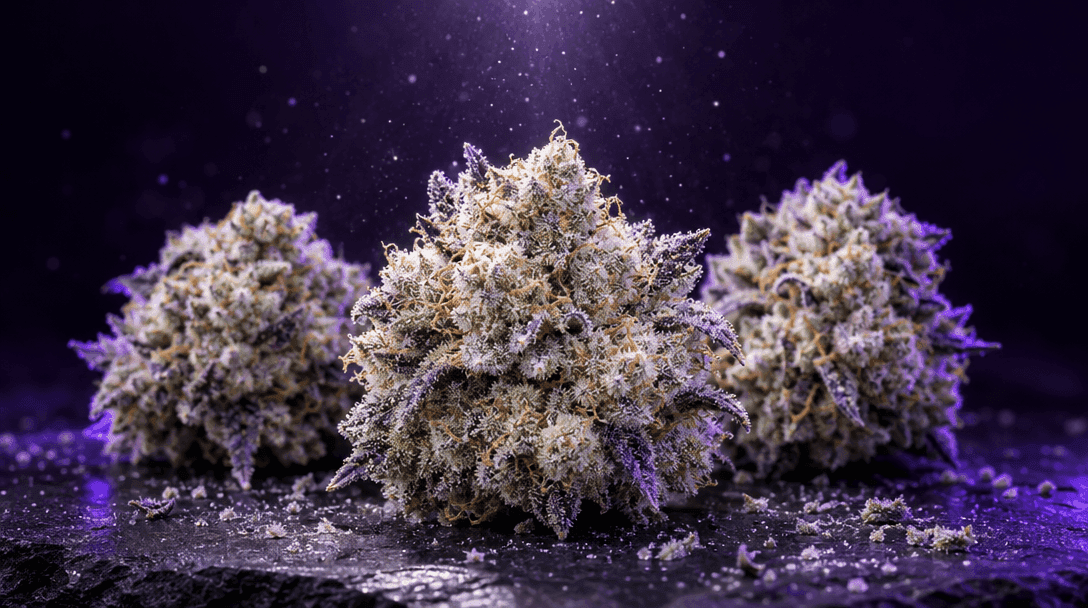
The White Durban strain is a sativa-dominant cannabis variety bred by Fireline Genetics from White Fire OG (WiFi OG) and the South African landrace Durban Poison, with a terpinolene-led terpene profile measured at roughly 1.50 percent of the total terpene content ([1][4][5]). The terpinolene backbone drives its citrus-and-pine aroma, with a secondary fuel note from the White Fire OG parent shaping the overall character.
This article walks through White Durban's genetics, lineage, breeder, terpene profile, aroma, and effects — the practical facts an adult-use customer needs to decide whether the strain fits their day. For a broader primer on how terpenes shape cannabis aroma and effects, The Cannabis Terpene Wheel: A Visual Guide to Every Common Terpene gives a visual reference, and Sour Diesel Strain Family: History, Genetics, and Terpenes compares the same diesel-forward terpene family across a related lineage.
What Is the White Durban Strain?
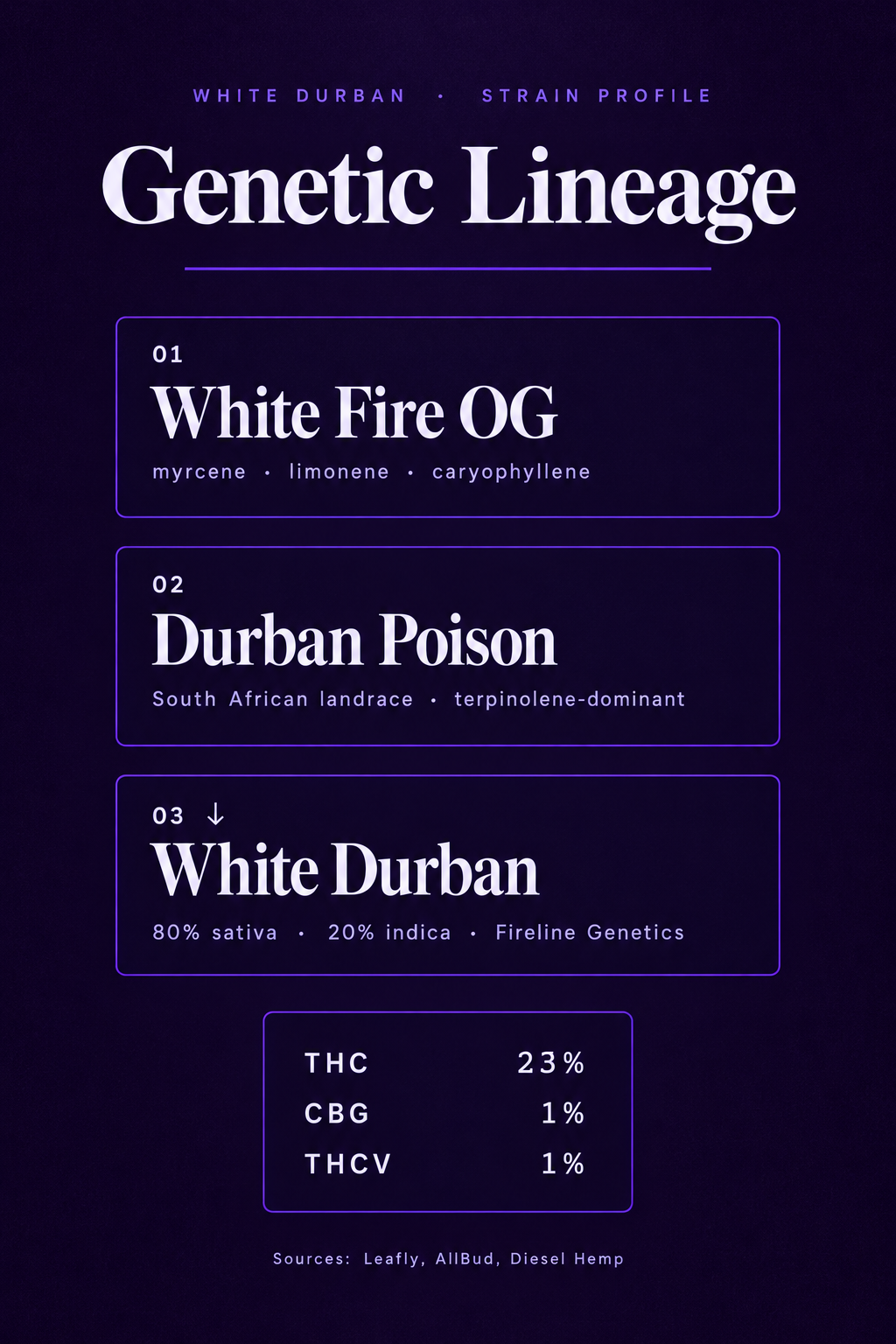
White Durban is a sativa-dominant hybrid cross of White Fire OG and Durban Poison, bred by Fireline Genetics and listed as 80 percent sativa / 20 percent indica ([1][5]). Leafly reports a 23 percent THC average, with about 1 percent CBG and 1 percent THCV — a small but unusual cannabinoid tail that drives its reputation as a daytime sativa ([1]).
Two facts frame the rest of this article:
- White Durban inherits Durban Poison's terpinolene-dominant backbone, which drives its citrus-and-pine aroma.
- White Durban inherits White Fire OG's resin, OG fuel, and limonene accent, which softens the South African landrace into a more layered, slightly fuel-tinged flavor.
The strain shows up under a single name across dispensary menus, but the reported THC and minor-cannabinoid numbers vary between sources — a reminder that cannabis chemovars shift between growers and batches, not just between strain names.
What Are the Parent Strains Behind White Durban?
Key points:
- White Durban's two parents pull in opposite directions, which is why the resulting strain reads as both bright and fuel leaning.
- The cross combines a resin heavy OG hybrid with a pure South African landrace, producing a profile that lands somewhere between the two.
- White Fire OG, also called WiFi OG, is a hybrid cross of Fire OG and The White ().
White Durban's two parents pull in opposite directions, which is why the resulting strain reads as both bright and fuel-leaning. The cross combines a resin-heavy OG hybrid with a pure South African landrace, producing a profile that lands somewhere between the two.
White Fire OG, also called WiFi OG, is a hybrid cross of Fire OG and The White ([3]). Leafly lists its dominant terpene profile as myrcene, limonene, and beta-caryophyllene — a combination that delivers the heavy resin production, OG gas note, and citrus peel accent that show up in White Durban's flavor.
Durban Poison is a pure sativa landrace from the South African port city of Durban ([2]). It is terpinolene-dominant, with myrcene and ocimene as secondary terpenes, and is known for energizing, focused effects. White Durban borrows Durban Poison's terpinolene backbone almost intact.
Comparing the two parents side by side:
| Trait | White Fire OG (WiFi OG) | Durban Poison |
|---|---|---|
| Type | Hybrid (Fire OG x The White) | Pure sativa landrace |
| Origin | California OG line | South African port of Durban |
| Dominant terpenes | Myrcene, limonene, beta-caryophyllene | Terpinolene, myrcene, ocimene |
| Signature aroma | Resin, OG gas, citrus peel | Citrus, pine, sweet anise |
| Effect character | Heavy resin and OG backbone | Energizing, focused, uplifting |
Because the Durban Poison parent supplies most of the terpinolene and the White Fire OG parent supplies most of the resin and OG character, the offspring reads as a slightly tamed, sweeter version of Durban Poison with extra fuel. RYTHM's brand page confirms this lineage and credits White Fire OG x Durban Poison as the parentage ([6]). For another perspective on classic landrace sativas, Acapulco Gold Strain: History, Genetics, and Terpene Profile traces a similar history with Acapulco Gold.
Who Bred White Durban and How Strong Is It?
Fireline Genetics is credited as the breeder across both Leafly and Diesel Hemp's strain encyclopedia ([1][7]). The brand has stayed in the background of most retail listings — dispensary menus tend to advertise the strain name rather than the breeder — but Fireline's fingerprints are on the cross itself.
Reported THC numbers for White Durban do not agree across sources. The published figures cluster in three ranges, and the spread is worth knowing before you buy:
- Leafly lists a 23 percent THC average ([1]).
- AllBud lists a 16 to 19 percent THC range, which is closer to what a typical commercial batch might test at ([5]).
- Diesel Hemp cites a Good Green retail batch that measured 23.98 percent THC, suggesting well-grown flower can hit the high end ([7]).
The minor-cannabinoid profile adds to its character. About 1 percent CBG and 1 percent THCV show up in Leafly's data ([1]) — small percentages, but enough to be worth noting for customers tracking cannabinoids beyond THC. None of these numbers should be read as a fixed potency; they describe the spread of tested batches across the market. For a contrast on how potency is reported across classic sativa strains, Super Silver Haze Strain: History and Terpene Profile walks through Super Silver Haze's THC history.
What Is White Durban's Dominant Terpene Profile?
Key points:
- Terpinolene is White Durban's dominant terpene.
- CannMenus's certificate of analysis aggregates put terpinolene at about 1.50 percent of the total terpene weight, with the rest of the profile stacked undern…
- The full CannMenus distribution looks like this:
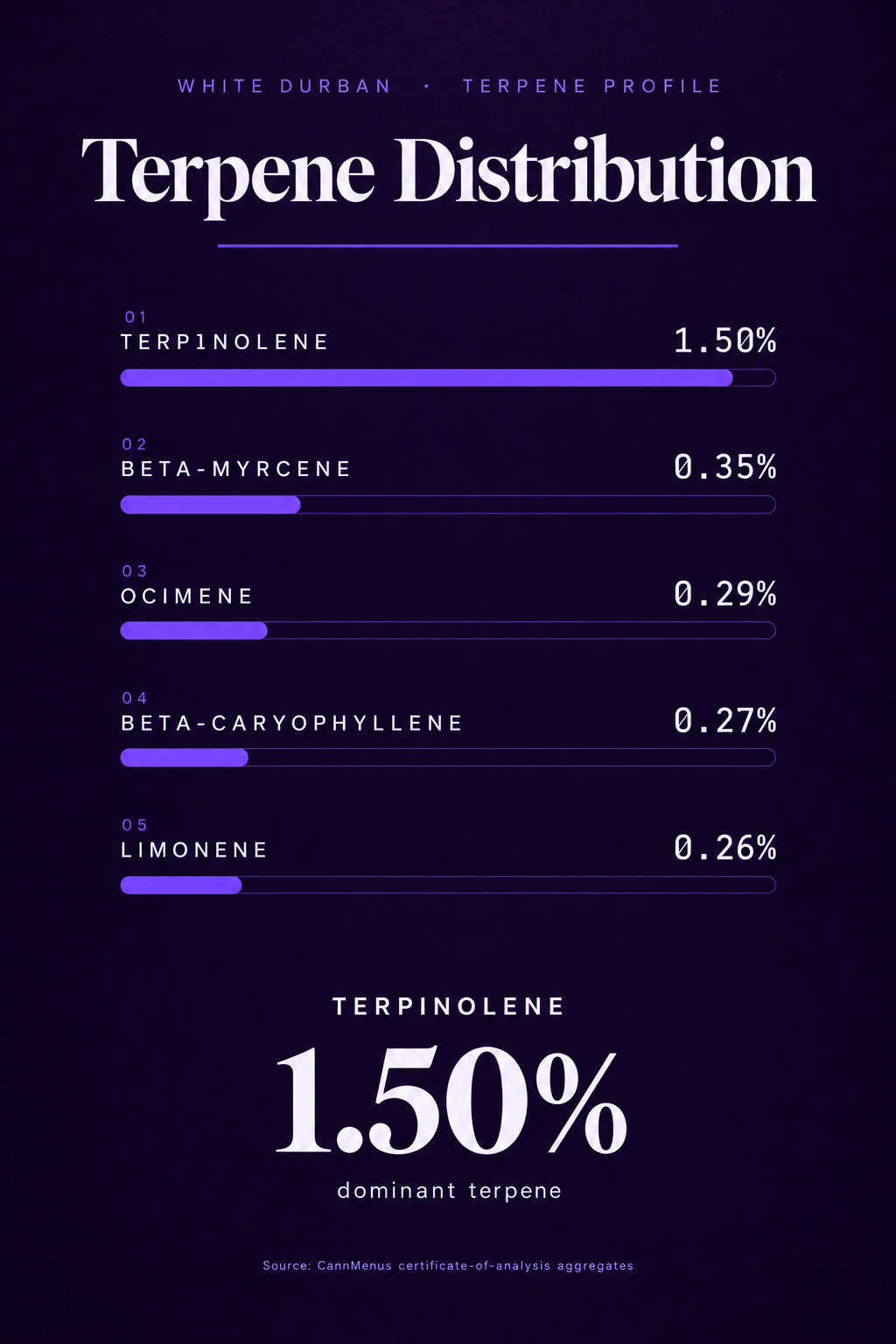
Terpinolene is White Durban's dominant terpene. CannMenus's certificate-of-analysis aggregates put terpinolene at about 1.50 percent of the total terpene weight, with the rest of the profile stacked underneath it ([4]).
The full CannMenus distribution looks like this:
| Terpene | Concentration (% of total terpenes) |
|---|---|
| Terpinolene | 1.50% |
| Beta-myrcene | 0.35% |
| Ocimene | 0.29% |
| Beta-caryophyllene | 0.27% |
| Limonene | 0.26% |
Source: CannMenus certificate-of-analysis aggregates ([4]).
Comparing the two framing sources against each other:
| Source | Top three terpenes | How the profile is ranked |
|---|---|---|
| CannMenus lab aggregates ([4]) | Terpinolene 1.50%, beta-myrcene 0.35%, ocimene 0.29% | Quantitative, weighted by percent of total terpenes |
| Leafly strain profile ([1]) | Terpinolene, pinene, caryophyllene | Qualitative, ranked by prominence in user-reported aroma |
Leafly takes a different cut of the same profile and lists terpinolene, pinene, and caryophyllene as the leading three terpenes ([1]). Both framings agree on terpinolene at the top, which is the most useful single fact for an adult-use customer trying to predict the aroma and effects before opening the jar.
The terpinolene dominance is also a fingerprint of Durban Poison, which Leafly lists with the same top terpene ([2]). The smaller percentages of myrcene, ocimene, caryophyllene, and limonene underneath come from White Fire OG's myrcene-limonene-caryophyllene profile layered on top ([3]). The combined effect is a layered citrus-and-fuel character that neither parent fully delivers on its own.
What Does White Durban Smell and Taste Like?
In the jar, White Durban reads as a layered citrus-and-fuel strain built on a terpinolene backbone ([4]). Top aroma notes are grapefruit, citrus, pine, diesel, and sweet earth ([7]), with secondary spice, pepper, and herbs ([5]).
How the descriptors break down across sources:
- AllBud ([5]): sweet, sugary, spicy, dank, with peppery, woody accents on the tongue after exhale.
- CannMenus ([4]): secondary notes of smoky, woody, piney, floral, and earthy alongside the top citrus-and-fuel layer.
- RYTHM ([6]): earthy, fruity, fuel, and spice — a four-note framing from front-palate citrus to a clean sweet-earth diesel exhale.
AllBud describes the flavor as sweet and sugary yet spicy and dank, with the sweetness lingering on the tongue after exhale ([5]). CannMenus adds secondary descriptors — smoky, woody, piney, floral, and earthy — that explain why the same strain can smell slightly different from batch to batch ([4]).
What the customer actually smells on opening a jar usually includes:
- A bright top note of grapefruit or sweet citrus
- A pine mid-palate that reads slightly resinous
- A fuel or diesel bottom note from the White Fire OG parent
- A clean, slightly spicy exhale that lingers
The flavor shifts as the flower breaks apart — the terpinolene-dominant top note is sharpest in the intact bud, while the fuel and earth notes deepen as the flower is ground or broken up. This is consistent with how terpinolene volatilizes faster than the heavier myrcene and caryophyllene underneath it.
How Does the Entourage Effect Shape White Durban's Effects?
The entourage effect covers how cannabinoids and terpenes interact to produce effects no single compound delivers alone. A 2024 NIH review identifies eight predominant cannabis terpene super-classes — myrcene, terpinolene, ocimene, limonene, alpha-pinene, humulene, linalool, and beta-caryophyllene — and summarizes experimental support for synergistic terpene-cannabinoid interactions, including terpinolene's anxiolytic activity in zebrafish models ([8]).
White Durban's terpinolene-led profile fits squarely inside that framework:
- Its dominant terpene (terpinolene) is one of the eight listed in the NIH review.
- Its secondary terpenes — myrcene, ocimene, beta-caryophyllene, limonene — are all in the same super-class list ([4][8]).
- Pinene and caryophyllene contribute modulating activity alongside the 23 percent THC average ([1][8]), which is one reason two batches with similar THC can feel noticeably different on the same day.
What this means in practice for an adult-use customer: the strain's effects are unlikely to come from terpinolene alone, or from THC alone. The combined profile is therefore a textbook example of the kind of multi-terpene mixture the entourage literature describes. For customers who want to explore how a Durban-derived flower expresses its terpene profile in a finished retail product, Durban Kush Kief Infused | Pre-ground Flower | 14g is a pre-ground flower option in the same lineage family.
What Effects and Best Timing Does White Durban Have?
White Durban's most reported effects are energizing, focused, and uplifting, with top user-reported notes including creativity, euphoria, and a light cerebral lift ([1]). AllBud's effect profile lists euphoric, uplifting, focused, and tingly as the leading descriptors ([5]).
What the user-reported pattern looks like:
- Energizing, focused, and uplifting as the dominant effects ([1]).
- Creativity, euphoria, and a light cerebral lift as the top secondary notes ([1]).
- Euphoric, uplifting, focused, and tingly per AllBud's descriptors ([5]).
The strain is widely recommended for morning and daytime use, which tracks with its Durban Poison heritage ([2]). Leafly's strain data also includes a useful caution: higher doses can overstimulate even seasoned consumers, and common negatives include anxiety, paranoia, and dizziness for some users ([1]). This is worth paying attention to with any high-terpinolene, high-THC sativa — the same energizing profile that reads as a productive lift at a small amount can tip into overstimulation at a larger one.
For an adult-use customer trying to plan a session, the practical pattern looks like this:
- Best timing: morning through mid-afternoon
- Best setting: active, creative, or social — not late evening
- Start low: a single small inhalation is enough to gauge the response, given the 23 percent THC average ([1])
- Avoid stacking: combining with other high-THC sativas amplifies the overstimulation risk noted above
For customers who want the Durban Poison side of the family in a portable format, Durban Poison X White Thorn Rose • Live Rosin Jelly Infused Pre-Roll • 1g is a live-rosin-jelly-infused pre-roll that uses Durban Poison crossed with White Thorn Rose. To browse the broader menu of flower options in this lineage family, Flower lists the full current Flower selection.
Frequently Asked Questions
What are the genetics of the White Durban strain? White Durban is a sativa-dominant cross of White Fire OG (WiFi OG) and the South African landrace Durban Poison, bred by Fireline Genetics. Both Leafly and RYTHM confirm the White Fire OG x Durban Poison parentage, and AllBud classifies it as 80 percent sativa and 20 percent indica.
What does White Durban smell and taste like? White Durban has a layered citrus-and-fuel profile. Top reported aromas are grapefruit, citrus, pine, diesel, and sweet earth, with secondary notes of spice, pepper, and herbs. AllBud describes the flavor as sweet and sugary yet spicy and dank, lingering on the tongue after exhale.
What is the dominant terpene in White Durban? Terpinolene is White Durban's dominant terpene. CannMenus lab aggregates show terpinolene at about 1.50 percent of the total terpene profile, followed by beta-myrcene (0.35 percent), ocimene (0.29 percent), beta-caryophyllene (0.27 percent), and limonene (0.26 percent). Leafly lists terpinolene, pinene, and caryophyllene as the leading terpenes.
How strong is White Durban in THC content? Reported THC levels for White Durban vary by source. Leafly lists 23 percent THC average, AllBud lists 16 to 19 percent, and one tested Good Green retail batch measured 23.98 percent. Minor cannabinoids include about 1 percent CBG and 1 percent THCV, per Leafly.
What effects does White Durban produce? White Durban is reported as energizing, focused, and uplifting, with top user-reported effects including creativity, euphoria, and a light cerebral lift. Leafly notes that higher doses can overstimulate even seasoned consumers, and common negatives are anxiety, paranoia, and dizziness for some users. Best timing is morning and daytime use.
Why is White Durban's terpene profile similar to Durban Poison? Terpinolene dominance is inherited from Durban Poison, which Leafly also lists as terpinolene-dominant. White Durban's secondary terpenes (pinene, caryophyllene, myrcene, ocimene) reflect the White Fire OG parent's myrcene-limonene-caryophyllene profile layered onto the Durban Poison backbone, producing a combined citrus, pine, and fuel character.
How does the entourage effect relate to White Durban's terpenes? A 2024 NIH review identifies terpinolene, myrcene, ocimene, pinene, caryophyllene, and limonene among the eight predominant cannabis terpene super-classes linked to synergistic effects with cannabinoids. White Durban's terpinolene-led profile fits this entourage framework, with pinene and caryophyllene contributing counterbalancing and modulating activity alongside THC.
Sources
- Leafly — Leafly documents White Durban as a sativa strain bred by Fireline from White Fir
- Leafly — Leafly describes Durban Poison as a pure sativa landrace originating from the So
- Leafly — Leafly documents White Fire OG (also known as WiFi OG) as a hybrid cross of Fire
- CannMenus — CannMenus aggregates certificate-of-analysis data showing White Durban's full te
- AllBud — AllBud categorizes White Durban as an 80% sativa / 20% indica hybrid crossed fro
- RYTHM — RYTHM's brand page confirms the White Durban lineage as White Fire OG crossed wi
- Diesel Hemp — Diesel Hemp's strain encyclopedia credits Fireline Genetics as the breeder and c
- National Center for Biotechnology Information (NCBI/NIH) — A peer-reviewed NIH review covering the pharmacological role of terpenoids in ca
About Treehouse Cannabis
Browse Treehouse Cannabis' current Flower and Pre-rolls menus to find sativa-dominant options inspired by the same Durban Poison and OG lineages covered above. Our Rockland County team is happy to walk you through terpene and THC ranges in-store.
Cannabis is for adults 21 and older. Keep all cannabis products out of the reach of children and pets. The effects described above are commonly reported but not guaranteed — chemovars vary between growers and batches, and individual responses to THC, terpinolene, and other cannabinoids differ. Nothing in this article is medical advice; consult a qualified clinician for health-related questions. Always purchase cannabis from a licensed New York adult-use dispensary.

Shop our products

Shop All

Deals

Flower

Pre-rolls
Vaporizers

Edibles
Drinks

Concentrates
Tinctures

Topicals

CBD

Pet CBD

Accessories