THCV vs THC: Similar Names, Different Effects
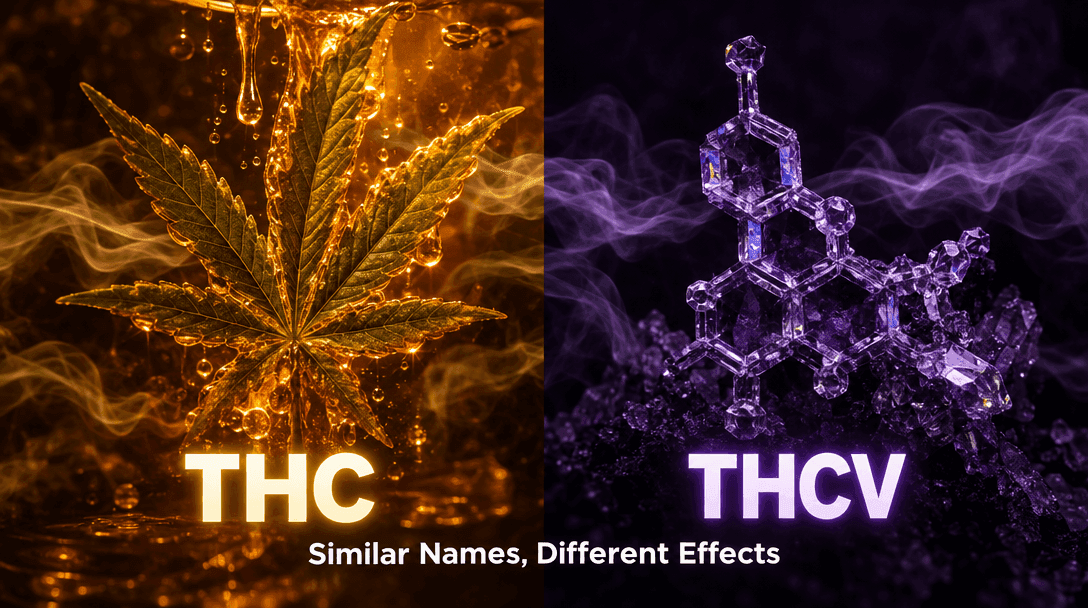
THCV vs THC: Similar Names, Different Effects
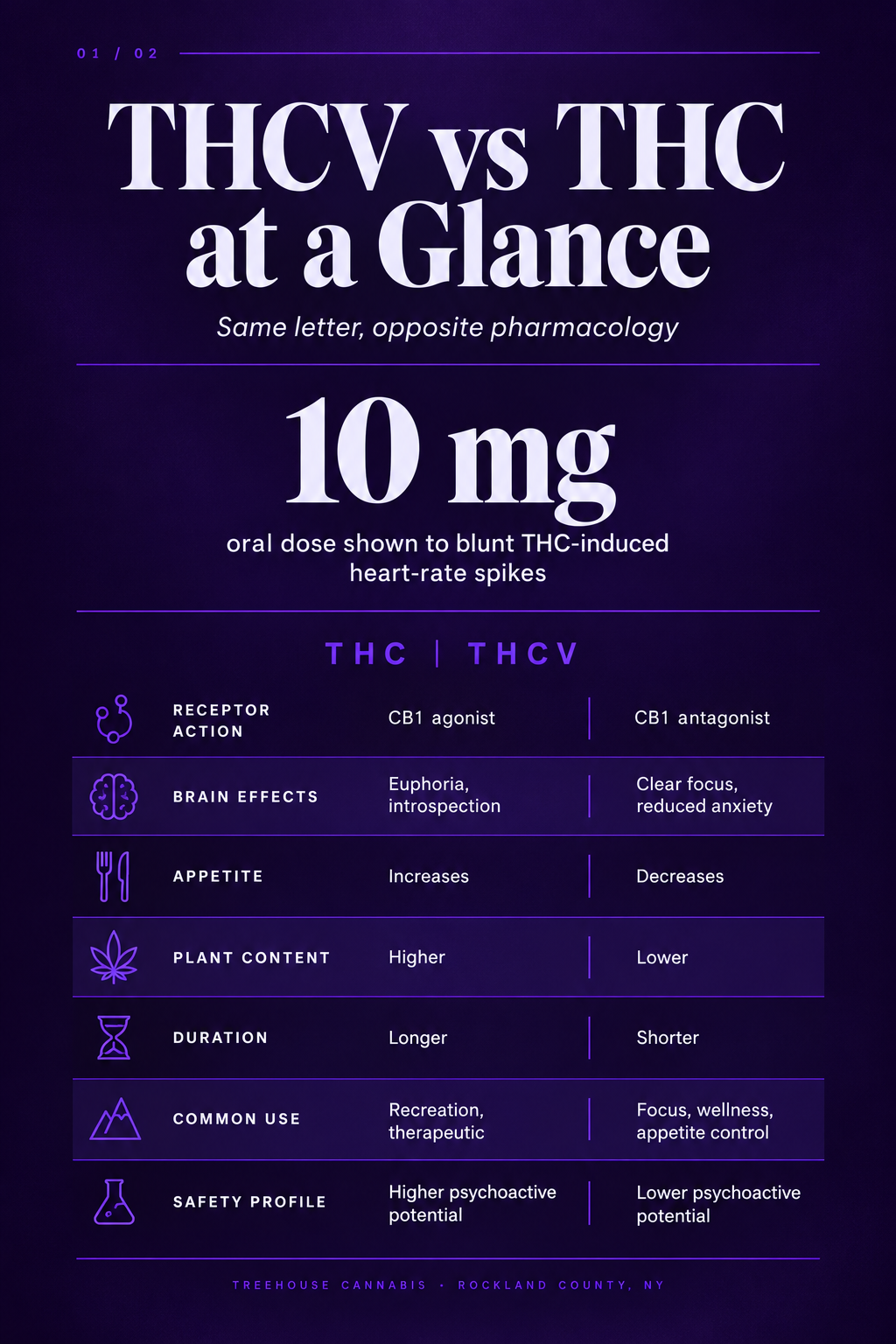
THCV vs THC comes down to a single receptor flip: THC activates the CB1 receptor and is intoxicating and appetite-stimulating, while THCV, at low doses, blocks CB1 and is non-intoxicating and appetite-suppressing. Despite sharing most of their molecular skeleton, the two cannabinoids send the body in opposite directions.
What Are THCV and THC, and Why Do They Have Similar Names?
THCV vs THC comes down to two related molecules built from different precursors. THC (Δ9-tetrahydrocannabinol) is the dominant psychoactive compound in most modern cannabis cultivars. THCV (tetrahydrocannabivarin) shares part of THC's chemical backbone but has a shorter side chain, which changes how it sits inside the body's cannabinoid receptors [4].
The two compounds look enough alike that early researchers assumed they would behave alike. Modern pharmacology has shown otherwise. A 2025 NIH-indexed editorial commentary makes the distinction explicit: THCV is not a low-dose THC, and at comparable oral doses the two cannabinoids produce opposite effects on appetite and intoxication [1].
Key structural and behavioral differences to keep in mind:
- Molecular skeleton. THC and THCV share a core ring structure but differ in side-chain length, which changes how each molecule fits into the CB1 and CB2 receptors.
- Source in the plant. THC builds from olivetolic acid and is dominant in most modern cultivars. THCV builds from a shorter precursor (varinolic acid) and concentrates in certain African landrace sativas.
- Receptor behavior. THC activates CB1 to produce a high. THCV, at typical adult-use doses, blocks CB1 instead of turning it on.
- Naming. The "varin" suffix in tetrahydrocannabivarin signals that the molecule carries a three-carbon propyl tail rather than THC's five-carbon pentyl tail.
For a quick visual on how cannabis molecules map onto the broader terpene and cannabinoid family, the Cannabis Terpene Wheel: A Visual Guide to Every Common Terpene is a useful reference. For a deeper dive on the THCV side of the family tree, the What Is THCV? The Minor Cannabinoid With Big Effects guide walks through the basics of where it comes from and why it stands out.
How Does THCV Work Differently From THC in the Body?
The short answer comes down to one receptor. THC is a CB1 agonist — it turns CB1 on. THCV, at the doses most adult-use customers encounter, is a neutral CB1 antagonist — it stops other molecules from turning CB1 on. Both compounds engage the CB2 receptor, but in different ways and to different effect [2].
That single flip in receptor behavior changes almost every downstream signal:
- Appetite. CB1 activation by THC drives the classic munchies. CB1 blockade by THCV suppresses food intake in animal models and is the mechanism behind its "diet weed" reputation.
- Inflammation. THCV's partial agonism at CB2 contributes to early anti-inflammatory and neuroprotective signals without producing THC-style intoxication.
- Metabolism. CB1 antagonism is the same lever several metabolic research programs have pointed at for restoring insulin sensitivity and improving glucose control in diet-induced models [3].
| Receptor action | THC | THCV (at typical doses) |
|---|---|---|
| CB1 | Agonist (activates) | Neutral antagonist (blocks) |
| CB2 | Partial agonist | Partial agonist |
| Net psychoactive effect | Intoxicating | Non-intoxicating |
| Appetite effect | Increases (munchies) | Suppresses |
For a side-by-side on how THCV compares with another well-known cannabinoid, the CBD vs THC: The Science Behind the Two Most-Discussed Cannabinoids piece covers the receptor and effect differences in plain language.
Does THCV Get You High Like THC Does?
Key points:
- At the doses most customers meet on a dispensary shelf, THCV is not intoxicating.
- Harm reduction resources describe THCV as non psychoactive unless it is taken in high amounts, in contrast to THC, which produces a clear high at standard do…
- That tracks with the pharmacology: blocking CB1 is the opposite of what THC does to create intoxication.
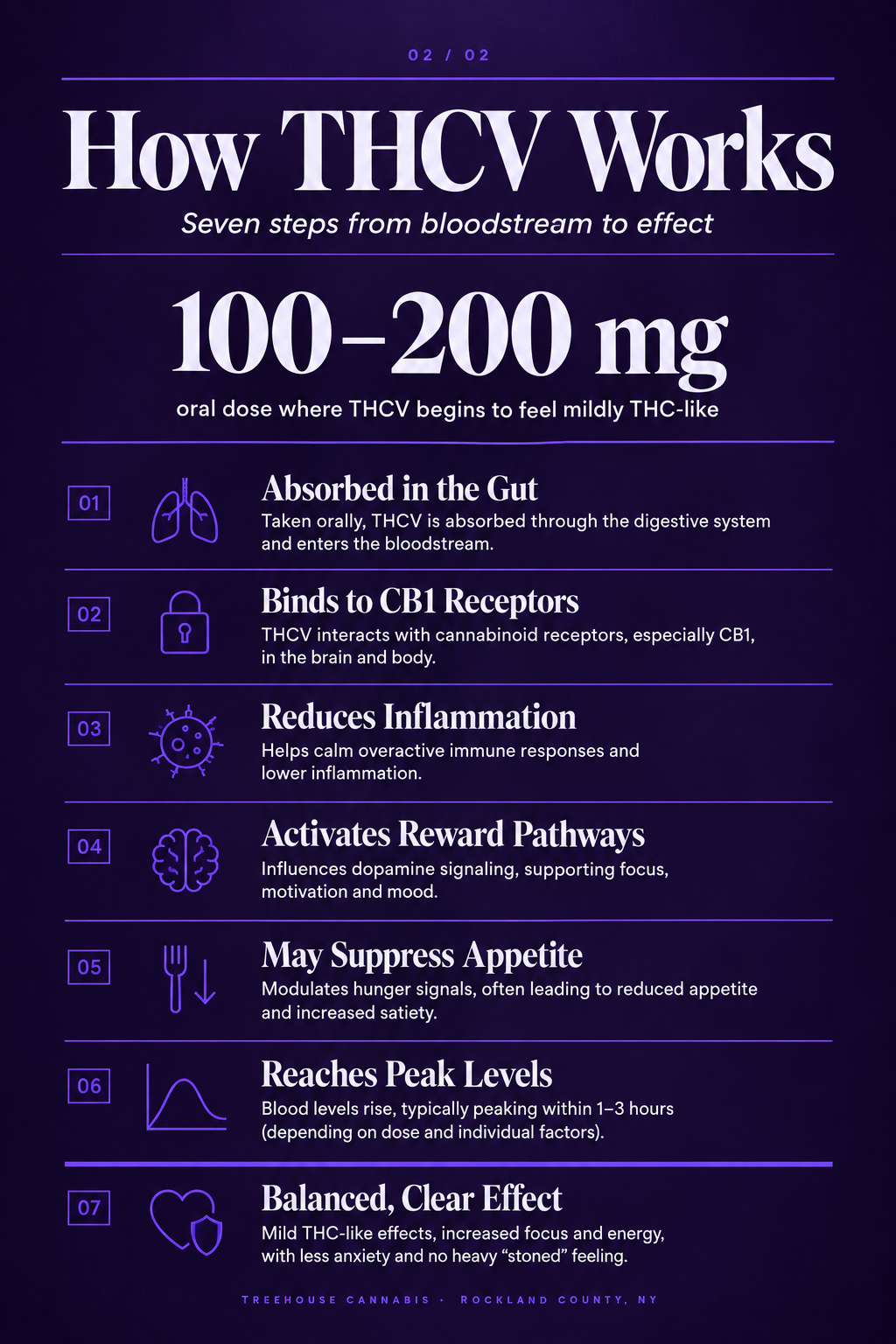
At the doses most customers meet on a dispensary shelf, THCV is not intoxicating. Harm-reduction resources describe THCV as non-psychoactive unless it is taken in high amounts, in contrast to THC, which produces a clear high at standard doses [8]. That tracks with the pharmacology: blocking CB1 is the opposite of what THC does to create intoxication.
At much higher oral doses, the picture shifts. A dose-finding human trial reported that 100–200 mg of oral THCV produced mild THC-like subjective effects, but without psychotic symptoms, paranoia, or short-term memory impairment [5]. A physician-authored explainer on the same study noted that lower doses felt energizing and clear, and that adding THC to the daily dose produced sensations of being high without the cognitive impairment usually associated with THC alone [7].
| Dose range | THCV psychoactive effect | THC comparison |
|---|---|---|
| Low (≤10 mg oral) | None reported; clear, focused | THC at comparable dose: mild intoxication |
| Moderate (25–100 mg oral) | Energizing, no impairment | THC at comparable dose: clear high, possible memory effects |
| High (100–200 mg oral) | Mild THC-like effects, no paranoia or memory impairment | THC at comparable dose: full high with cognitive effects |
| Co-dosed with THC | Tempers heart-rate spike and cognitive impairment | n/a |
For comparison, the THC Beverages: A Buyer's Guide to Dosing, Onset, and Effects piece shows how standard THC dosing curves look in adult-use products — useful context for customers trying to gauge where a THCV-forward option might fit.
How Do THCV and THC Affect Appetite Differently?
The appetite question is where THCV vs THC draws its sharpest line. THC's CB1 activation drives the well-documented increase in hunger and food intake. THCV's CB1 blockade does the opposite in animal and early human studies [2].
A few signals stand out from the published research:
- A peer-reviewed mini-review reports that THCV reduced food intake and weight gain in free-feeding mice at 3 mg·kg⁻¹ and improved glucose regulation, in direct contrast to THC's effects [2].
- A commentary in the Journal of Cannabis Research summarized that THCV restored insulin sensitivity in diet-induced obese mice and modulated metabolic processes, framing it as a research candidate for metabolic disorders [3].
- A cannabis-nurse consumer resource describes a 90-day THCV/CBD oral-strip pilot trial in which every participant reportedly lost weight — up to 22 pounds in some cases — though the trial was small and not placebo-controlled [6].
| Effect | THC | THCV |
|---|---|---|
| Appetite (short-term) | Increases hunger ("munchies") | Suppresses appetite |
| Food intake in animal models | Increases | Decreases at 3 mg·kg⁻¹ |
| Insulin sensitivity | Mixed / neutral | Restored in diet-induced obese mice |
| Reward response to high-calorie food | Heightened | Blunted |
That body of work is why THCV has earned its "diet weed" nickname, and why customers looking for a less appetite-stimulating option often gravitate toward THCV-forward cultivars or balanced products.
Which Cannabis Strains and Products Are Highest in THCV?
Most modern cultivars test below 0.5% THCV. The cultivars that stand out fall into two camps: natural African landrace sativas and selectively bred descendants.
- Durban Poison is the most-cited natural source. The cultivar routinely tests around 1% THCV and is widely available at adult-use dispensaries in sativa-leaning form.
- Doug's Varin was developed specifically for THCV content and routinely tests at 3–6% THCV, making it the most reliable cultivar for noticeable THCV effects when it appears on a menu.
| Strain or product | Typical THCV % | Type |
|---|---|---|
| Durban Poison | ~1% | Natural African landrace sativa |
| Doug's Varin | 3–6% | Selectively bred for THCV |
| Most modern cultivars | <0.5% | Standard breeding |
| Balanced THCV/THC vapes and edibles | Varies | Designed for combined effects |
Customers in the Treehouse Cannabis Flower category can look for sativa cultivars with reported THCV percentages on the label. The lineup rotates, but a current example of the kind of energizing sativa profile associated with THCV-forward chemovars is East Coast Sour Diesel - Premium - 3.5g, which carries the kind of sharp, uplifting character THCV-rich cultivars are known for.
Because THCV-forward flower is not always on the shelf, balanced products that combine THCV with THC or CBD are often the easiest on-ramp — and they let customers titrate the dose more precisely than smoking flower alone.
How Do THCV and THC Compare on Anxiety, Energy, and Other Effects?
Beyond intoxication and appetite, the two cannabinoids diverge on a handful of subjective effects that customers notice first:
- Energy. Low-dose THCV is widely described as clear, focused, and energizing rather than sedating, while THC's effects range from uplifting to heavy depending on dose and cultivar [7].
- Anxiety. THC's effects on anxiety are dose-dependent and mixed, with some customers reporting relief and others reporting spikes. THCV, at low doses, is reported as anxiolytic in harm-reduction summaries, which lines up with its CB1-blocking profile [8].
- Cognitive effects. Human dosing studies found that 100–200 mg oral THCV produced mild THC-like subjective effects but no short-term memory impairment, and that co-dosing 10 mg THCV over five days reduced THC-induced heart-rate increase in healthy volunteers — evidence of a partial tempering effect rather than full blockade [5].
| Effect | THC (typical dose) | THCV (typical low dose) |
|---|---|---|
| Energy | Uplifting to heavy | Clear, focused, energizing |
| Anxiety | Dose-dependent; mixed | Reported anxiolytic |
| Short-term memory | Often impaired | No impairment at low doses |
| Heart rate during THC co-dose | Increased | Reduced by 10 mg THCV co-dose |
A common adult-use pattern: a customer who finds straight THC racy or anxiety-prone may prefer a balanced THCV/THC product that smooths the experience without flattening it.
Is THCV Legal to Buy in New York, and How Should You Try It?
THCV derived from cannabis is legal for adult-use customers of legal age in New York and is sold at licensed dispensaries, including Treehouse Cannabis in Rockland County, NY. Hemp-derived THCV falls under the same state and federal framework that governs other minor cannabinoids, and reference sources confirm THCV is not a scheduled compound in the U.S. legal cannabis context [4].
For a first try, a few practical notes from budtenders and harm-reduction resources:
- Start low. THCV's effects stack with THC in products that contain both, so a balanced edible or vape is easier to titrate than a high-THCV flower on its own.
- Mind the dose curve. Low oral doses feel clear and energizing; higher doses (100–200 mg) tip toward mild THC-like effects without the cognitive hit [5].
- Pair with the right category. Edibles and vapes labeled as balanced or THCV-forward are a good entry point. A current balanced edible example carried at Treehouse Cannabis is New Morning Highs | 20 Pack | Gummies | THC: 100mg, CBD: 100mg, which uses a balanced cannabinoid profile designed for a smoother daytime effect.
Stop into Treehouse Cannabis in Rockland County, NY and ask the budtender for a current THCV-forward option that fits the effect you're after — whether that's a Durban Poison-leaning sativa, a Doug's Varin descendant when available, or a balanced edible that lets you dial in the dose.
Frequently Asked Questions
Quick answers to the most common THCV vs THC questions adult-use customers ask at the counter:
- What is THCV and how is it different from THC? — THCV (tetrahydrocannabivarin) is a naturally occurring minor cannabinoid found in some cannabis cultivars, especially African landrace sativas. It shares part of THC's molecular structure but acts as a neutral CB1 antagonist and CB2 partial agonist rather than a CB1 agonist, which is the source of its different effects.
- Does THCV get you high? — At typical supplement doses, THCV is not intoxicating. Human dosing studies show that low oral doses of THCV do not produce THC-like intoxication, while higher oral doses (100–200 mg) can produce mild, faster-acting, more focused THC-like effects without paranoia or short-term memory impairment.
- Does THCV suppress appetite while THC increases it? — Yes. THC activates the CB1 receptor and is associated with increased appetite, while THCV blocks CB1 and has been shown in animal and preliminary human studies to reduce food intake and blunt the reward response to high-calorie foods — the effect behind its reputation as "diet weed."
- Which cannabis strains are highest in THCV? — South African landrace sativas such as Durban Poison are the most widely cited natural source of THCV, typically around 1% THCV. The cultivar Doug's Varin was specifically bred for THCV and routinely tests at 3–6% THCV, making it the most reliable cultivar for noticeable THCV effects.
- Is THCV legal to buy in New York? — Adult-use customers of legal age in New York can purchase cannabis products containing THCV at licensed dispensaries, and Treehouse Cannabis carries options that highlight THCV content on the label. THCV derived from hemp also falls under the same state and federal rules that govern other minor cannabinoids.
- Can THCV counteract the psychoactive effects of THC? — At low doses THCV acts as a CB1 antagonist, and a placebo-controlled crossover study found that 10 mg oral THCV over five days reduced THC-induced increases in heart rate and cognitive impairment in healthy volunteers, supporting a partial tempering effect rather than full blockade.
Sources
- Cannabis and Cannabinoid Research (NIH/PMC) — NIH-indexed editorial commentary confirming that THCV and THC are pharmacologica
- AIMS Neuroscience (NIH/PMC) — Peer-reviewed mini-review documenting that THCV acts as a CB1 antagonist and CB2
- Journal of Cannabis Research (NIH/PMC) — Commentary summarizing that THCV restores insulin sensitivity in diet-induced ob
- Wikipedia — Reference overview confirming THCV's molecular formula (C19H26O2), its status as
- Biomolecules (NIH/PMC) — MDPI-indexed primary research showing THCV acts as a dose-dependent modulator of
- Leaf411 — Cannabis-nurse consumer resource noting the 90-day THCV/CBD oral-strip trial rep
- CannaMD — Physician-authored explainer citing the human dosing trial (25–200 mg oral THCV)
- Recovered.org — Harm-reduction-oriented overview noting that, unlike THC, THCV does not typicall
About Treehouse Cannabis
Treehouse Cannabis is an adult-use dispensary serving Rockland County, Orange County, and Westchester County, NY. The store carries a rotating selection designed to surface minor-cannabinoid content on labels so customers can choose products by effect rather than by THC percentage alone:
- Flower — rotating menu of cultivars, including sativa-leaning chemovars with reported THCV percentages when available.
- Pre-rolls — single-strain and infused options for customers who want a ready-to-use format.
- Vaporizers — balanced and THCV-forward cartridge and disposable options where state regulations allow.
- Concentrates — rosin, live resin, and solventless extracts labeled with full cannabinoid breakdowns.
- Edibles — gummies, chocolates, and beverages, including balanced THC/CBD and minor-cannabinoid-forward formulations.
Cannabis is for adults 21 and older. Keep all cannabis products out of reach of children and pets. This article is educational and is not medical advice — talk to a qualified clinician before using cannabis for any health-related goal.

Shop our products

Shop All

Deals
Flower
Pre-rolls
Vaporizers

Edibles
Drinks

Concentrates
Tinctures

Topicals
CBD

Pet CBD
Accessories