
What to Do If You Feel Too High
What to Do If You Feel Too High
If you are wondering what to do if you feel too high right now, the first move is simple: get somewhere calm, sit down, sip water, and remind yourself the feeling is temporary and will pass without lasting harm. Slow your breathing, stay with a trusted person, and skip more cannabis, alcohol, or other substances while the episode runs its course. Most cannabis overconsumption episodes peak quickly and ease within a few hours.
What should you do first if you feel too high?
The very first step is to change your environment: move to a quiet, well-lit, familiar room and sit or lie down somewhere you can breathe comfortably. Sip water slowly rather than gulping, and tell yourself out loud that the feeling will pass, because that clear reminder often short-circuits the spiral of "what if it does not" [7][8].
Call or text a trusted friend and ask them to stay with you, even on the phone, because having another calm adult nearby lowers the anxiety that makes the high feel worse [8]. Avoid driving, operating machinery, or making any big decisions until you feel fully clear-headed again [7].
The good news is the clock is on your side. Inhaled cannabis usually tapers off within two to four hours, and even an edible overconsumption episode almost always resolves within a day. Run through these first-response steps in order rather than trying to do everything at once:
- Change your environment: move to a quiet, familiar room and dim the lights.
- Sip water slowly and skip alcohol, caffeine, and any more cannabis entirely.
- Remind yourself out loud that the feeling is temporary and will pass.
- Call or text a trusted person to sit with you, in person or on the phone.
- Avoid driving, operating machinery, or making any big decisions.
If you want a deeper framework for matching dose to your experience level going forward, the Cannabis Dosing: How to Find Your Right Amount by Consumption Method guide walks through the same start-low-go-slow principles this article is built on.
For readers who already know this was too much and want to make sure it does not happen again, the related piece How to Avoid Taking Too Much Cannabis covers the same ground from a prevention-first angle, including format-by-format dose ladders and a checklist for new or returning consumers.
Why does cannabis sometimes feel overwhelming?
Cannabis feels overwhelming at high doses because THC binds to CB1 receptors in the brain and shifts perception, mood, and time sense in ways that can read as anxiety or paranoia when the dose outruns your tolerance [2]. The same receptor activity that produces the relaxing effect also raises heart rate and can blur short-term memory and motor control, which is why too much can feel like a storm in slow motion [1].
Today's flower is meaningfully stronger than what most older harm-reduction advice was written for. Selective breeding has pushed average THC content into the twenty to thirty percent range, up from roughly twelve percent a decade ago, so a single modern bowl can carry two to three times the THC of the same serving ten years ago [4]. The National Institute on Drug Abuse also flags high-potency products as a driver of more severe psychological effects, including anxiety and panic, especially in newer or occasional users [2].
A few predictable drivers push most overconsumption episodes:
- Doubling up on edibles because the first dose did not feel like it worked
- Mixing cannabis with alcohol or other substances
- Using a concentrate or high-potency cartridge on an empty stomach
- Returning to cannabis after a tolerance break at the same old dose
If you want a more tactical walkthrough of the timing trap that catches most people, How Long Should You Wait Before Taking More Cannabis? breaks down the dose-to-onset math by format and explains why waiting matters more than people expect.
How long does a 'too high' feeling usually last?
A typical timeline looks like:
- 5-30 minutes — peak effects right after inhaled forms hit the bloodstream
- 30 minutes to 2 hours — strongest high after edibles or tinctures ingest
- 2 to 4 hours — gradual decline for inhaled forms
- 4 to 12 hours — slow decline for edible or high-dose ingestible forms
- 12 to 24 hours — residual sleepiness, brain fog, or low mood can linger
These windows reflect the pharmacokinetics of inhaled vs. ingestible THC [6] and the variability in personal tolerance, body composition, and what you ate that day.
How long a too-high feeling lasts depends almost entirely on whether you inhaled or ate it. Inhaled cannabis typically starts within five to fifteen minutes, peaks inside thirty minutes to two hours, and fades enough that most adults feel close to baseline within roughly six hours of the last puff [1].
Edibles tell a different story. They take thirty minutes to two hours to kick in, peak around three to four hours, and the tail can run eight to twelve hours with some next-day grogginess, which is why so many people mistake the slow ramp-up for "it did not work" and re-dose [3]. The CDC also notes edibles carry a greater risk of poisoning precisely because their effects are delayed and last far longer than inhaled forms [1].
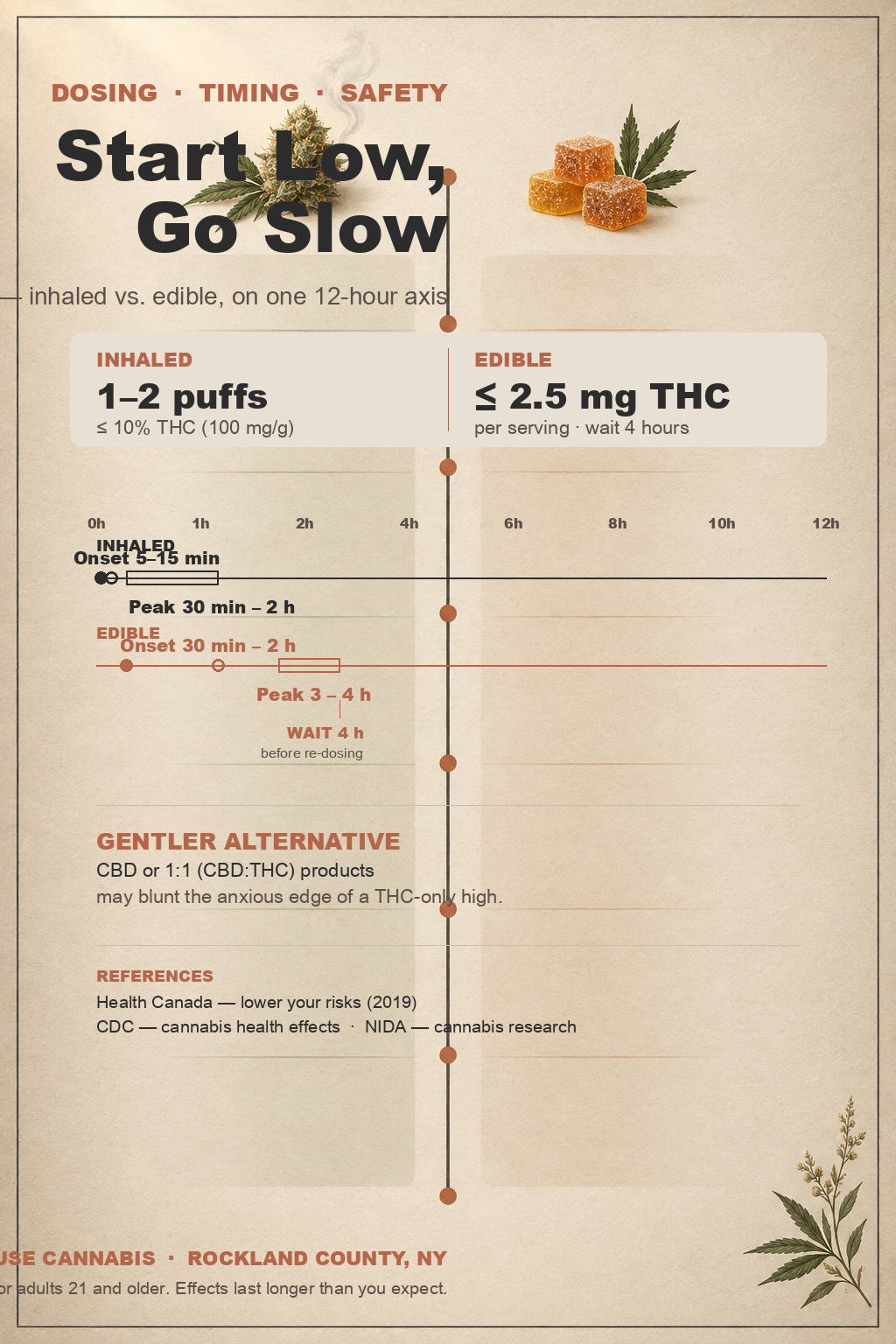
That long edible tail happens because the liver converts THC into 11-hydroxy-THC, a metabolite that crosses the blood-brain barrier more efficiently than inhaled THC and produces a heavier, longer arc of effect. The side-by-side timeline below shows the two formats plotted on the same clock:
| Phase | Inhaled (flower, vape) | Edible (gummy, capsule, drink) |
|---|---|---|
| Onset | 5 to 15 minutes | 30 minutes to 2 hours |
| Peak | 30 minutes to 2 hours | 3 to 4 hours |
| Time to feel close to baseline | 2 to 4 hours | 8 to 12 hours |
| Risk of accidental overconsumption | Moderate (easy to take another puff) | High (delayed onset triggers re-dose) |
| Starting dose for new or returning users | 1 to 2 puffs of 10 percent (100 mg/g) THC or less [3] | 2.5 mg THC or less per serving [3] |
For anyone aiming to avoid a repeat, the deeper dive on How to Start Low and Go Slow With Cannabis walks through the same numbers and explains how to anchor your starting dose to your tolerance, not the package.
What helps in the first 10 minutes of a too-high episode?
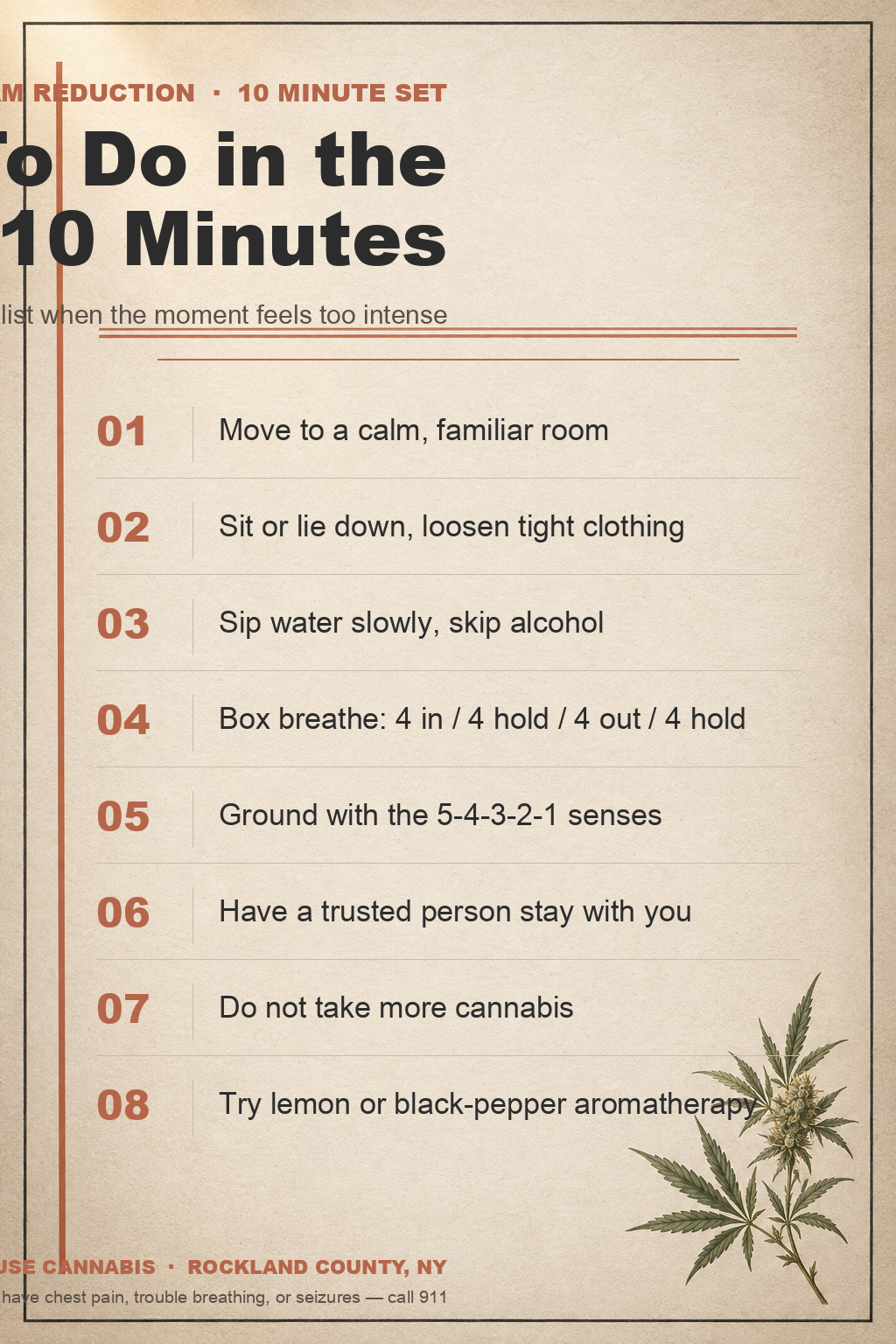
The first ten minutes are the loudest part of the experience, which is also when a short, concrete plan does the most good. Move through these steps in order rather than trying to do everything at once, and check in with yourself after each one.
- Move to a calm, familiar room and turn down loud music or bright lights.
- Sit or lie down, loosen tight clothing, and let your shoulders drop.
- Sip water slowly, and skip alcohol and any more cannabis entirely.
- Try box breathing: four seconds in, four seconds hold, four seconds out, four seconds hold [8].
- Ground yourself with the 5-4-3-2-1 senses technique (five things you can see, four you can hear, three you can touch, two you can smell, one you can taste).
- Have a trusted person stay with you, in person or on the phone.
- Try sniffing a cracked black peppercorn or a slice of lemon, since d-limonene and beta-caryophyllene have shown early promise at softening THC-induced anxiety [4].
If you want a quick pocket reference for the next time, the steps above are also captured in the visual checklist below.
For readers who currently inhale and want to back down to a more controllable serving, picking up a measured Pre Ground Flower option lets you portion out a single bowl's worth instead of relying on guesswork from a whole bud [7].
Can CBD or terpenes counteract a THC high?
CBD and certain cannabis terpenes can blunt the anxious edge of a THC high when they are present in the product you consume, but they are not a reliable mid-episode rescue. Peer-reviewed research, including the Zuardi line of work and a more recent review, has found that CBD taken alongside THC reduces THC-induced anxiety compared with THC on its own [5].
A 2024 Johns Hopkins randomized crossover trial added a second lever. Twenty healthy adults inhaled vaporized d-limonene, a citrus-forward terpene, alongside THC, and reported significantly lower "anxious/nervous" and "paranoid" ratings than when they took THC alone, without dulling THC's other effects [4].
The current peer-reviewed evidence for CBD and terpene-based anxiety relief includes:
- CBD taken alongside THC reduces THC-induced anxiety compared with THC alone [5].
- Vaporized d-limonene co-administered with THC significantly lowered "anxious/nervous" and "paranoid" ratings in 20 healthy adults [4].
- Beta-caryophyllene shows early promise at softening THC-induced anxiety, mostly from preclinical models.
- Choosing a product with a 1:1 THC:CBD ratio is the practical field version of the agent's research.
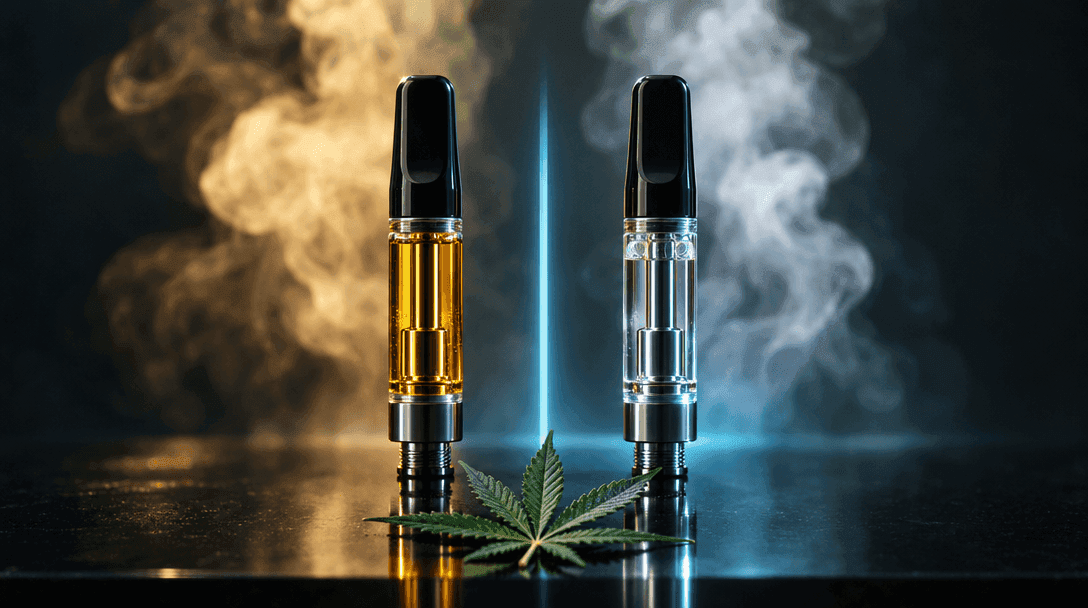
The catch is timing. Reaching for a high-CBD or limonene-forward product after the THC has already peaked rarely works, because the onset of an edible or a swallowed tincture cannot catch the spike from inhaled THC. The practical play is to choose the gentler product before you dose rather than after, which is one reason harm-reduction-minded readers often start with a Vaporizers category product that clearly states both its THC percentage and any terpene profile on the label.
If you already keep a CBD-forward or 1:1 ratio product on hand, that is the more useful teammate for next time, and the following section covers the full dosing ladder.
When is feeling too high a medical emergency?
A bad high is uncomfortable, but it is almost never a medical emergency. There is a clear short list of red-flag symptoms that warrant calling 911 or Poison Control at 1-800-222-1222 right away [8].
- Chest pain, pressure, or trouble breathing
- Seizures or seizure-like shaking
- Severe vomiting that prevents keeping fluids down
- Loss of consciousness or extreme confusion
- Suicidal thoughts or self-harm urges
A second category worth knowing is cannabinoid hyperemesis syndrome (CHS), which shows up in chronic heavy users as intense cyclic vomiting paired with temporary relief from hot showers [6]. CHS is not a "wait it out" situation; it needs emergency-room care with IV fluids, haloperidol, lorazepam, or topical capsaicin cream, and the long-term treatment is stopping cannabis use [6][7].
If none of those red flags apply, the supportive care in the sections above is the standard approach even in clinical settings [7]. Most adults ride out an overconsumption episode at home without ever needing an ER visit [8].
How can you avoid getting too high next time?
The clearest path to avoiding the next episode is to operationalize Health Canada's start-low-go-slow rule, which sets real numeric anchors instead of vague warnings [3].
- Edible serving: 2.5 mg THC or less for a first dose or after a tolerance break.
- Wait before re-dosing: at least four full hours for edibles, since they can take that long to peak.
- Inhaled starting dose: one to two puffs of a joint or vape with ten percent (100 mg/g) THC or less [3].
- New or returning users: favor CBD-forward or 1:1 THC:CBD ratios over pure THC products [5].
- Avoid mixing: cannabis plus alcohol reliably pushes people past their intended dose.
Format matters too. Edibles convert THC to 11-hydroxy-THC in the liver and produce a longer, heavier arc than inhaled THC, while modern concentrates and high-percentage cartridges carry a much higher THC-per-puff load than flower [1][2]. The simplest move for inhaled dose control is to load Pre_rolls sized for one short session, take a puff, set a timer for fifteen minutes before deciding whether to take another, and put it down if anything feels off.
The CDC also notes that roughly three in ten people who use cannabis will develop cannabis use disorder, which is a clinical pattern of continued use despite harm rather than a single bad night [1]. If overconsumption keeps happening or you find you need cannabis to feel normal, that is the threshold to talk with a clinician rather than another self-guided adjustment.
Where can Rockland County adults find lower-dose options?
Adults 21 and older in Rockland, Orange, and Westchester Counties can stop by Treehouse Cannabis for clearly labeled, low-dose edible and flower options, plus knowledgeable budtenders who will walk through THC percentages, CBD ratios, and start-low-go-slow dosing in plain language. Our shelves carry measured, repeatable formats so the next serving is the same as the last one, not a guess [1][3].
For anyone leaning toward a gentler THC-to-CBD balance, our Ratio Tinctures are an easy on-ramp: a measured dropper, a clearly labeled ratio, and the ability to step up or step down by a milligram at a time without guessing. Bring this article or the infographic above, and our team will match the dose ladder to the product rather than the other way around.
When you visit, here is what to look for on the shelf and on the menu:
- Clearly labeled THC percentage per serving, not per package.
- 1:1 or CBD-forward ratio options for new or returning consumers.
- Pre-ground flower or single-size pre-rolls sized for one short session.
- Measured tincture droppers labeled in milligrams per milliliter.
- Budtenders who can translate a dose ladder from this article into a specific product.
Cannabis is for adults 21 and older. Keep all cannabis products out of the reach of children and pets. This article is for educational purposes and is not medical advice; if you have underlying health conditions or take other medications, talk with a clinician before using cannabis. Do not drive or operate machinery while impaired.
What do most people ask about feeling too high?
Skip to a question:
- Is feeling too high dangerous?
- How long until the peak fades?
- What helps fastest in the moment?
- Will CBD or black pepper really help?
- When should someone seek medical help?
How long does being too high from cannabis usually last?
Inhaled cannabis usually peaks within 30 minutes and fades over 2-4 hours, with most adults back to baseline within 6 hours. Edibles take 30 minutes to 2 hours to start, peak around 3-4 hours, and linger 8-12 hours, with residual grogginess possible the next day. The duration is dose-, product-, and tolerance-dependent.
What should you do in the first 10 minutes of feeling too high?
Move to a calm, quiet, familiar place, sit or lie down, sip water slowly, and remind yourself the feeling is temporary. Have a trusted person stay with you, avoid more cannabis, and skip alcohol or other substances. Slow box breathing and grounding techniques like naming five things you can see help most adults settle within minutes.
Can CBD counteract a THC high?
Peer-reviewed evidence shows CBD taken alongside THC reduces THC-induced anxiety, and a 2024 Johns Hopkins clinical trial found d-limonene, a common cannabis terpene, lowered anxious and paranoid feelings from THC. Reaching for a high-CBD or limonene-forward product mid-episode is not a reliable rescue, however, because the onset rarely matches the THC spike.
Should you eat or drink something to sober up faster?
No food or drink speeds THC clearance from your bloodstream, but light snacks and water can ease racing heart, dry mouth, and low blood sugar that amplify the uncomfortable feeling. Black peppercorn sniffing and lemon or pinene-rich aromatherapy are folk remedies with anecdotal support, and a 2024 Hopkins trial suggests citrus d-limonene may genuinely soften anxiety.
When is feeling too high a medical emergency?
Call 911 or Poison Control at 1-800-222-1222 if the person has chest pain, trouble breathing, seizures, severe vomiting that prevents keeping fluids down, loss of consciousness, extreme confusion, or signs of cannabinoid hyperemesis syndrome (intense cyclic vomiting and compulsive hot showers in a chronic user). CHS needs ER care with IV fluids and specific antiemetics.
Why do edibles make people feel 'too high' more often than smoking?
Edibles take 30 minutes to 2 hours to start and up to 4 hours to peak, so users often re-dose thinking the first serving did not work. The CDC and Health Canada both warn this delayed onset is the leading cause of accidental overconsumption. Edibles also convert THC to 11-hydroxy-THC in the liver, which crosses the blood-brain barrier more efficiently and produces a longer, more intense effect.
How can you avoid getting too high next time?
Follow Health Canada's start-low-go-slow rule: 2.5 mg THC or less per edible serving, wait at least 4 hours before re-dosing, and 1-2 puffs of a joint or vape with 10 percent (100 mg/g) THC or less if inhaling. Choose CBD-forward or 1:1 ratio products, avoid high-potency concentrates if you are a new or occasional user, and never mix cannabis with alcohol.
What is the difference between a bad high and cannabis use disorder?
A bad high is an acute overconsumption episode that resolves in hours with supportive care. Cannabis use disorder, by contrast, is a clinical pattern of continued use despite harm, estimated to affect about 3 in 10 users (CDC). If a single bad high keeps prompting heavier use, or if you need cannabis to feel normal, that is the threshold to talk with a clinician.
Sources
- Centers for Disease Control and Prevention (CDC) — Authoritative federal overview of cannabis's short- and long-term health effects
- National Institute on Drug Abuse (NIDA) — NIH resource confirming that THC can change mood, thoughts, and perception of re
- Health Canada — Government of Canada harm-reduction guidance formalizing the 'start low, go slow
- Johns Hopkins Medicine — Hopkins-led randomized crossover trial (Spindle, Vandrey et al., J Drug Alcohol
- National Center for Biotechnology Information (PMC) / NIH — Peer-reviewed review summarizing evidence that CBD administered alongside THC ca
- Wikipedia (sourced to medical literature) — Reference summary of cannabinoid hyperemesis syndrome (CHS): cyclic vomiting in
- University of Florida Health (UF Health) — Academic medical center treatment guidance for cannabis intoxication: supportive
- PreventEd — Practical harm-reduction overview of 'greening out' symptoms (panic, rapid heart
About Treehouse Cannabis
Treehouse Cannabis is an adult-use cannabis dispensary serving Rockland County, Orange County, and Westchester County, NY. We focus on clearly labeled, low-dose and 1:1 ratio options, transparent THC and CBD percentages, and one-on-one budtender conversations so adult customers leave with a product that matches their experience level, not a guess.
Shop our products

Shop All

Deals

Flower

Pre-rolls
Vaporizers

Edibles
Drinks

Concentrates
Tinctures

Topicals

CBD

Pet CBD

Accessories