
What “Solventless” Means on a Cannabis Menu
What "Solventless" Means on a Cannabis Menu
Solventless cannabis meaning comes down to how the concentrate was made, not what is in the jar. A solventless product is built by physically separating the resin glands — called trichomes — from the cannabis plant using only ice, water, heat, pressure, and mesh screens. No butane, propane, ethanol, or CO2 is used at any stage of production.
Every jar labelled kief, dry sift, bubble hash, hash rosin, or live rosin on a dispensary shelf shares that mechanical-only thread [1]. Solventless has also become a popular gift category because the process tends to preserve the plant's native terpene profile cleanly [2]. If you've been hunting for a curated intro, our Valentine's Day roundup Valentine’s Day Cannabis Gifts: Thoughtful Ideas for Every Cannabis Lover leans heavily on flower-forward, full-spectrum picks that fit the same mindset.
What Does "Solventless" Mean on a Cannabis Menu?
Solventless is a production label. It tells the customer that no butane, propane, ethanol, or CO2 ever touched the cannabis during extraction. Instead, the concentrate is built from trichome heads that were knocked loose, sifted, washed, or pressed out of the plant using only physical tools [1]. The active compounds customers care about — cannabinoids like THCA and CBDA, plus the monoterpenes and sesquiterpenes that shape aroma and flavor — are all synthesized inside those trichome heads [2], so isolating the heads mechanically captures a complete extract without chemical help.
That biology is also why a good solventless product tastes like the cultivar it came from. The trichome heads hold the plant's full terpene profile, and a gentle mechanical process keeps those volatiles intact rather than driving them off with heat or stripping them with a solvent [3]. For a deeper look at how those aroma compounds translate to felt experience, our terpene primer A Guide to Terpenes and Their Effects maps the major terpenes to the qualities they tend to express.
What touches the plant in solventless processing:
- No chemical solvents. No butane, propane, ethanol, or CO2 at any stage.
- Ice and water. Used to harden trichome heads so they snap off cleanly during washing.
- Heat and pressure. Applied with a rosin press to release the resinous sap from hash or flower.
- Mesh screens. Graded by micron size to filter out plant material and isolate intact trichome heads.
If you want a quick reference for a single cultivar that anchors the experience, our 28g flower listing NY Diesel | Flower | 28g is a useful benchmark — the jar shows the trichome density that solventless processing is designed to harvest.
How Are Solventless Concentrates Actually Made?
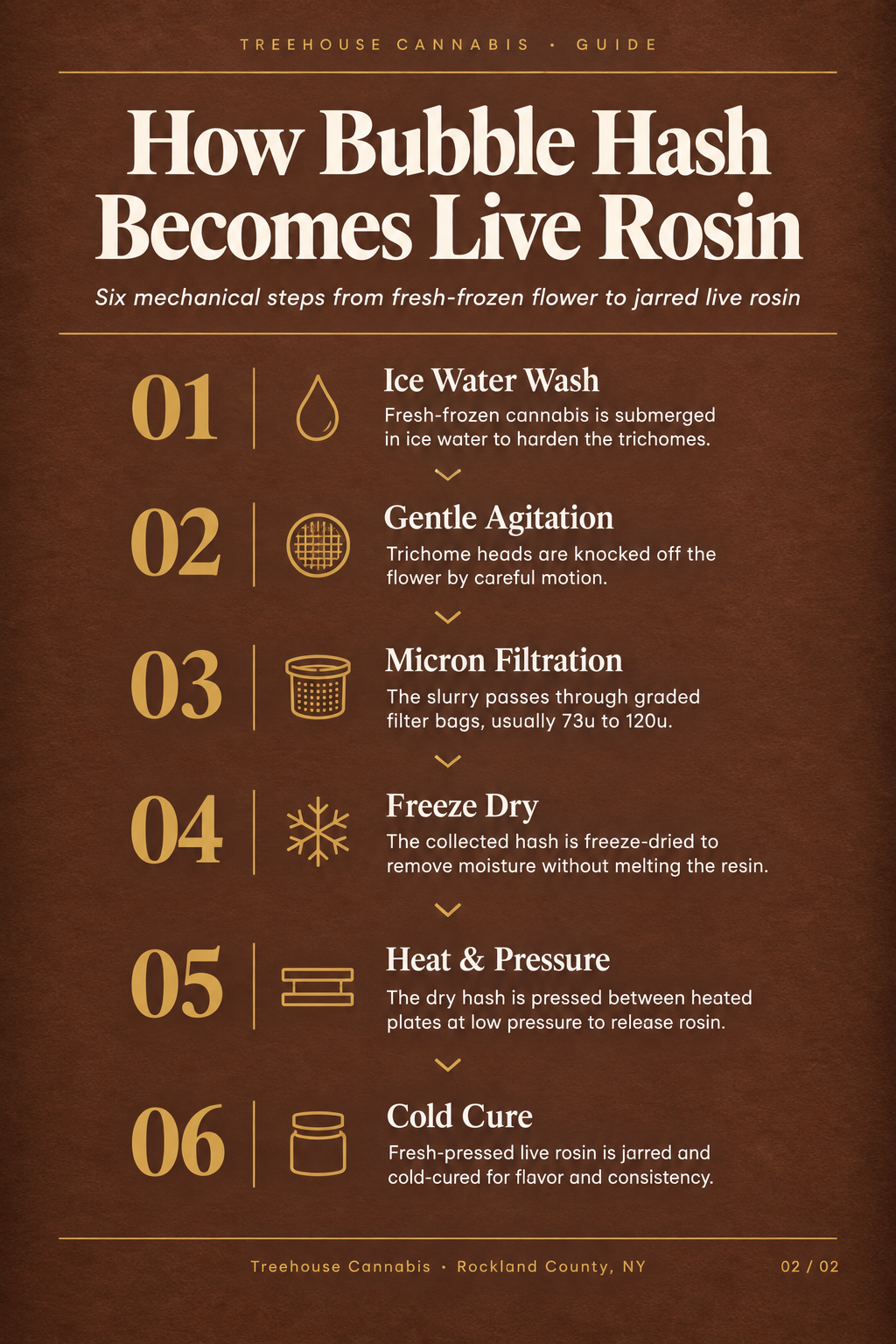
Every solventless method is a different way of coaxing trichome heads off the plant without dissolving them. There are four mechanical routes in regular rotation on adult-use menus, and the biology behind them is straightforward: trichomes are small, brittle resin glands that snap off cleanly when the plant is cold, agitated, or pressed.
The four routes are:
- Dry sifting. Dried flower is tumbled or brushed across a series of fine mesh screens. Trichome heads fall through the mesh, and the collected powder is graded by screen size. What lands in the jar is called kief or dry sift, depending on the operation.
- Ice-water agitation. Cannabis is submerged in ice water, which hardens the trichomes and makes the stems brittle. Gentle stirring knocks the trichome heads free, and the resulting slurry is poured through graded micron bags. The resin collected this way is bubble hash [5].
- Heat and pressure (rosin pressing). Cured flower, kief, or hash is placed inside a mesh bag and pressed between two heated plates. The combination of low heat and high pressure squeezes a sticky, translucent sap out of the starting material. That sap is rosin [4].
- Fresh-frozen washing for live rosin. The same ice-water method is run on cannabis that was frozen immediately after harvest instead of being dried and cured. The resulting fresh-frozen hash is then pressed into live rosin, which is prized for its bright, layered terpene character [6].
If you're new to concentrates and want a pacing guide for your first sessions, our start-low-go-slow guide How to Start Low and Go Slow With Cannabis is a practical companion to the production details above.
What Are the Main Solventless Types on a Dispensary Menu?
Adult-use menus in New York tend to use a small set of names to describe solventless products, and each one corresponds to one of the four mechanical routes above [6]. Once you know which route produced the jar, the rest of the label makes sense.
- Kief. Loose, sandy trichome powder that falls off dried flower. Often sold in small jars or pressed into hash.
- Dry sift. Kief that has been graded through finer mesh screens, giving it a more uniform texture and a higher concentration of intact trichome heads.
- Bubble hash. Resin collected by washing cannabis in ice water and filtering through micron bags. It is named for the way it bubbles when heated, a sign of high trichome purity [5].
- Hash rosin. Bubble hash that has been pressed with heat and pressure into a translucent, sap-like concentrate.
- Live rosin. The same hash-pressing process, but starting from fresh-frozen cannabis instead of dried and cured material.
For a primer on how these categories sit next to flower, vapes, edibles, and topicals on a typical menu, our menu-reading primer How to Read a Cannabis Menu Without Feeling Lost lays out the broader vocabulary.
How Is Solventless Different from Live Resin and Distillate?
Key points:
- The cleanest way to read the difference is to look at what touched the plant.
- The table below compares the three methods side by side before getting into the flavor and potency trade offs.
- Method What touches the plant Starting material Flavor and terpene profile
The cleanest way to read the difference is to look at what touched the plant. The table below compares the three methods side by side before getting into the flavor and potency trade-offs.
| Method | What touches the plant | Starting material | Flavor and terpene profile |
|---|---|---|---|
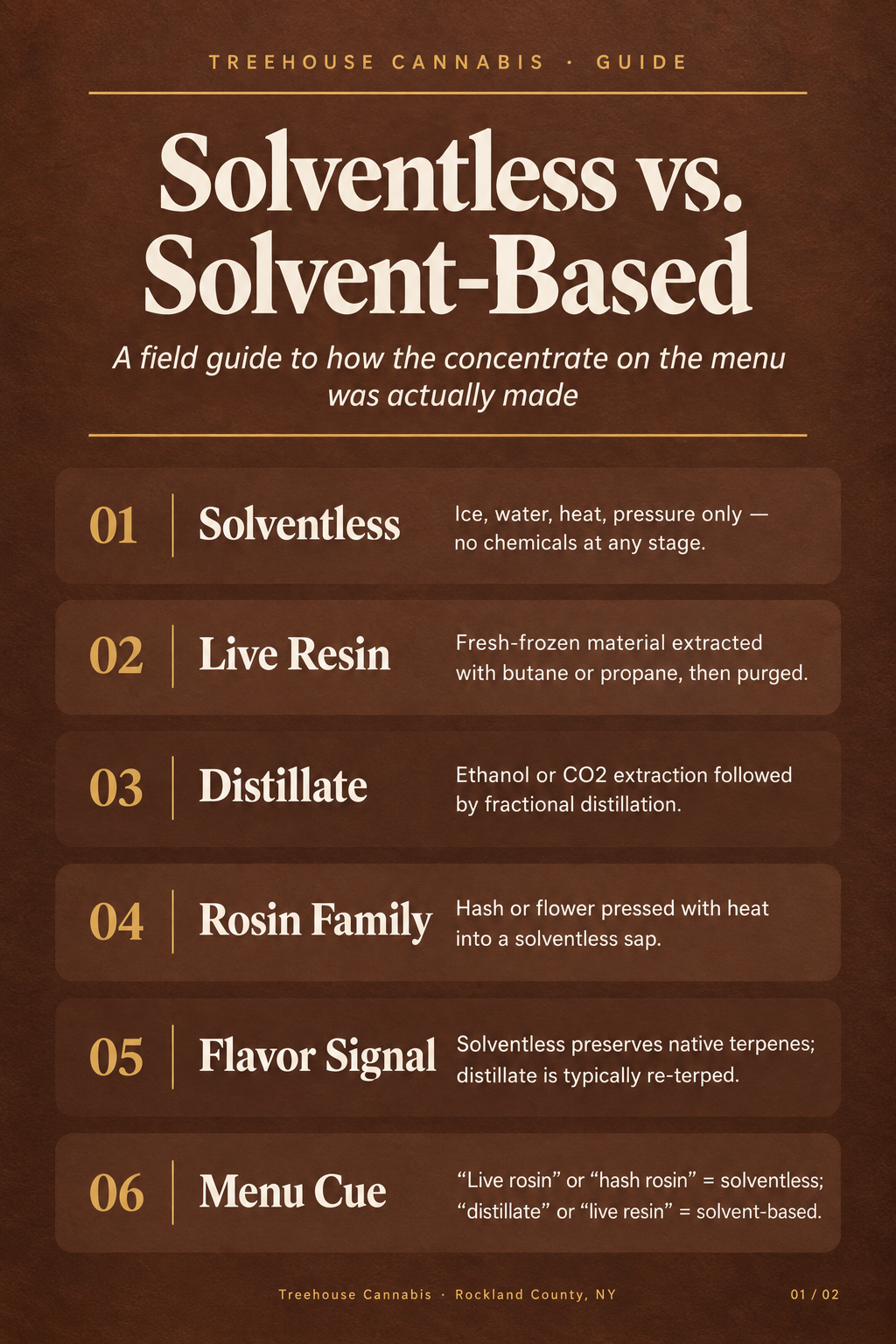
| Solventless | Ice, water, heat, pressure, and mesh screens only | Dried flower, fresh-frozen flower, or hash | Cultivar-native terpenes preserved; full-spectrum character |
| Live resin | Butane or propane, then purged from the extract | Fresh-frozen flower | Bright, fresh-frozen character; sometimes re-terped |
| Distillate | Ethanol or CO2, then fractional distillation | Dried flower, trim, or crude oil | Re-terped with isolated or botanical terpenes in most cases |
Solventless uses only ice, water, heat, and pressure. Live resin uses a chemical solvent — typically butane or propane — on fresh-frozen cannabis, then purges the solvent from the finished extract. Distillate is made by extracting cannabis with ethanol or CO2 and then running the crude oil through fractional distillation to isolate cannabinoids, often leaving the original terpene profile behind [1].
The trade-off is straightforward. Solventless captures trichome heads whole, which is why those products tend to taste like the living plant. Solvent-based methods can hit higher THC numbers and scale more efficiently, but they typically require re-introducing terpenes after the original profile has been stripped or altered by the process [3].
If you want to compare the two side by side in person, our Live Resin subcategory Live Resin Concentrates shows what a solvent-based fresh-frozen product looks like next to the solventless rosin family.
Is Solventless Better Than Solvent-Based Cannabis?
Neither method is automatically better; each one rewards a different priority. Solventless concentrates are favored by customers who want no chemical solvents used during processing and who care about tasting the cultivar's native terpene profile. The mechanical process preserves the trichome head, which is the plant's own delivery vehicle for cannabinoids and terpenes [2]. In practice, that means a well-made rosin or live rosin can express layered aroma in a way that some re-terped solvent-based products do not.
Solvent-based concentrates have their own strengths. Live resin captures the fresh-frozen terpene profile using hydrocarbons, and distillate can reach very high THC numbers while remaining cost-effective at scale. For customers who want maximum potency, or who want a specific texture and flavor profile built from isolated cannabinoids and added terpenes, solvent-based products are a reasonable and often more affordable choice.
A simple way to decide:
- Choose solventless if no chemical processing and a clean, cultivar-forward flavor profile are the priority.
- Choose live resin if you want the fresh-frozen character with a different extraction method.
- Choose distillate if potency, price, and consistency matter most.
Our Rosin subcategory Rosin Concentrates is a good starting point for comparing solventless rosin expressions side by side.
How Can You Tell If a Vape Cart Is Really Solventless?
Cartridge labels can be misleading, and the word "live" alone does not mean solventless. A live resin cart, for example, is solvent-based. To confirm that a cart is genuinely solventless, look for these signals together rather than any single phrase on the box.
A real solventless cartridge usually shows:
- The words "solventless" or "live rosin" on the front label, not just "live" or "full spectrum."
- Single-strain sourcing, often with the cultivar name printed on the cartridge and the box.
- A light blonde to amber color. Darker, almost clear carts are typically distillate with added flavor.
- No distillate, no cutting agents like MCT or vitamin E acetate, and no added botanical terpenes in the ingredients list.
- A strong, strain-specific aroma when the cart is opened, which is a sign that native terpenes survived processing.
Carts labelled "live" but blended with distillate are a common shortcut, and they will not deliver the flavor or aroma of a true rosin cart. If the menu is sorted by hardware type rather than extract method, our Cartridges shelf Cartridges Vaporizers lets you filter to the live rosin and rosin options specifically.
Frequently Asked Questions
What does "solventless" mean on a cannabis menu?
Solventless means the concentrate was made without chemical solvents such as butane, propane, ethanol, or CO2. Instead, producers use only physical methods like ice-water agitation, mesh screens, heat, and pressure to separate the resin glands, called trichomes, from the plant. Every solventless product on a dispensary menu, including kief, dry sift, bubble hash, and rosin, is built from that same mechanical principle.
Is rosin the same as solventless?
Rosin is one specific type of solventless concentrate. It is made by applying a rosin press to dried flower, kief, or hash, using controlled heat and pressure to squeeze the resinous oil out. Rosin is solventless because no chemicals touch the material, but other solventless products like kief and bubble hash are not pressed into rosin.
How is solventless different from live resin?
Live resin is made from fresh-frozen cannabis using a chemical solvent such as butane or propane, which is then purged from the extract. Solventless products are made from the same plant material using only ice, water, heat, and pressure. The result is two concentrates that look similar but were produced through opposite routes: chemical extraction versus purely mechanical separation.
Is solventless cannabis better than solvent-based?
Neither method is automatically better. Solventless concentrates are favored by consumers who want no chemical solvents used during processing, and they tend to express the cultivar's native terpene profile cleanly. Solvent-based concentrates, especially live resin and distillate, can reach very high THC numbers and offer strong flavor in their own right. Choice comes down to preference, starting material, and the specific product.
What is live rosin?
Live rosin is a solventless concentrate made from fresh-frozen cannabis. The fresh-frozen flower is first washed in ice water to make bubble hash, and that hash is then pressed with heat in a rosin press. Because the plant was never cured or dried before processing, live rosin is known for preserving bright, layered terpene flavors that resemble the living plant.
How do you tell if a vape cart is really solventless?
Look for the words "solventless" or "live rosin" on the label, not just "live." A true solventless cartridge contains only rosin pressed from hash, with no distillate, no added botanical terpenes, and no cutting agents. Single-strain labeling, light blonde to amber color, and a strong aroma are additional signals of an authentic solventless cart.
Sources
- Weedmaps Learn — Defines solventless concentrates as products made by physically removing trichom
- National Institutes of Health (PMC) — Frontiers in Plant Science review — Establishes that cannabinoids (THCA, CBDA) and the plant’s terpene profile are s
- National Institutes of Health (PMC) — Molecules journal — Catalogs the monoterpenes and sesquiterpenes found in cannabis trichomes and exp
- Lowtemp Industries — Walks through the mechanical workflow that distinguishes bubble hash (ice water
- Wikipedia — Hashish — Describes bubble hash as a solventless cannabis concentrate produced by mechanic
- Puffco (cannabis hardware vendor) — Categorizes the main solventless types seen on adult-use menus — kief, dry sift,
About Treehouse Cannabis
Treehouse Cannabis is an adult-use dispensary serving Rockland County and the surrounding New York communities. Our menu features flower, concentrates, vapes, edibles, and pre-rolls from licensed New York producers, with a focus on transparent lab results and education-first recommendations for adult-use customers.
Cannabis is for adults 21 and older. Keep all cannabis products out of the reach of children and pets. This article is intended for educational purposes for adult-use customers in New York and does not provide medical, legal, or professional advice. Please consume responsibly and in accordance with local laws.

Shop our products

Shop All

Deals

Flower

Pre-rolls
Vaporizers

Edibles
Drinks

Concentrates
Tinctures

Topicals

CBD

Pet CBD

Accessories