
Cannabis and Meditation: Does THC Help or Distract?
Cannabis and Meditation: Does THC Help or Distract?
Cannabis and meditation do not combine the way the practice suggests: THC raises how mindful people report feeling while it raises reported mind-wandering at the same time. The distraction side is the one with the measurements behind it, which is why the sensation and the measurement split apart.
That gap is the interesting part. A 2022 double-blind experiment found oral THC increased self-reported mindfulness and insightfulness in 25 infrequent cannabis users, and the same study found reported mind-wandering and language entropy rose alongside those scores [2]. Meanwhile the attention studies consistently run the other way: more mind-wandering, more false alarms on a sustained-attention task, and less ability to steer attention on request [4] [7] [8].
This guide walks through what the meditation studies actually measured, how THC and meditation push on the same brain system in opposite directions, how far the potency on shelves has moved past the doses that were studied, and what the federal guidance says about combining the two. It also covers the one trial that tested mindfulness as a way to cut down on cannabis, because it did not work, and what that failure does and does not tell you.
Does THC Actually Help You Meditate?
The evidence does not show that THC improves meditation. Where the effect looks positive, it shows up in how people rate the moment rather than in attention control.
A 2022 double-blind experiment compared 7.5 mg and 15 mg of oral THC against placebo in 25 healthy, infrequent cannabis users [2]. Both doses raised self-reported mindfulness and insightfulness, including both mindfulness of mind and mindfulness of body, with participants endorsing items about increased awareness of their mental contents and their bodily states.
The same experiment found reported mind-wandering and language entropy rose at those same doses. Language entropy is the variability in the words people produce, so a higher score means a broader, less predictable vocabulary rather than a sharper one [2]. A higher mindfulness score therefore did not come with stronger attentional control.
The authors were careful about what that means, and stated that future studies need to determine whether reports of increased mindfulness or insight after THC reflect an enhancement of conscious awareness that can be validated empirically, or something else entirely [2]. That caveat is the honest read of a study with 25 infrequent users in it. Infrequent users are not the typical heavy user, so the finding describes a first-time-ish experience rather than the experience of someone who smokes daily.
Here is what the experiment found, measure by measure:
| What the 2022 experiment measured | Result with THC against placebo |
|---|---|
| Self-reported mindfulness | Higher at 7.5 mg and 15 mg |
| Mindfulness of body | Higher at 7.5 mg and 15 mg |
| Self-reported insightfulness | Higher at 7.5 mg and 15 mg |
| Reported mind-wandering | Higher at 7.5 mg and 15 mg |
| Language entropy | Higher with THC |
- A 2022 double-blind experiment found oral THC at 7.5 mg and 15 mg raised self-reported mindfulness and insightfulness in 25 infrequent cannabis users [2]
- The same experiment found reported mind-wandering and language entropy rose at the same time, so the higher mindfulness score did not come with stronger attentional control [2]
- A 2026 survey of 1,391 people found cannabis use, with or without meditation, showed no consistent association with well-being, peace of mind, psychological flexibility, depression or anxiety [1]
- The clearest finding is about attention rather than mood: people rate the moment as more mindful while their mind-wandering moves in the same direction [2] [4]
- The research base is thinner than the practice suggests, and the 1,391-person survey is the largest study of meditation combined with psychoactive substances so far [1]
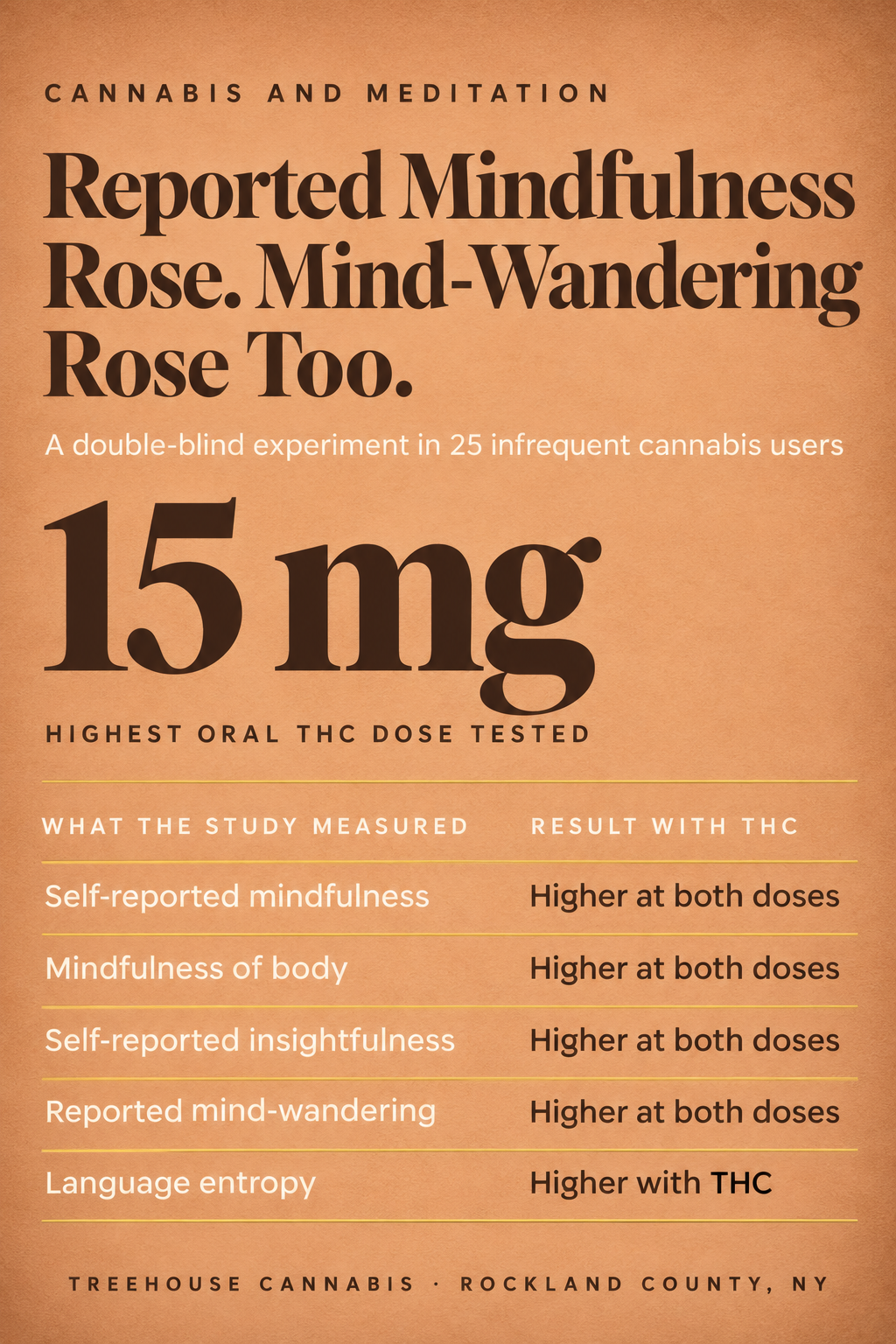
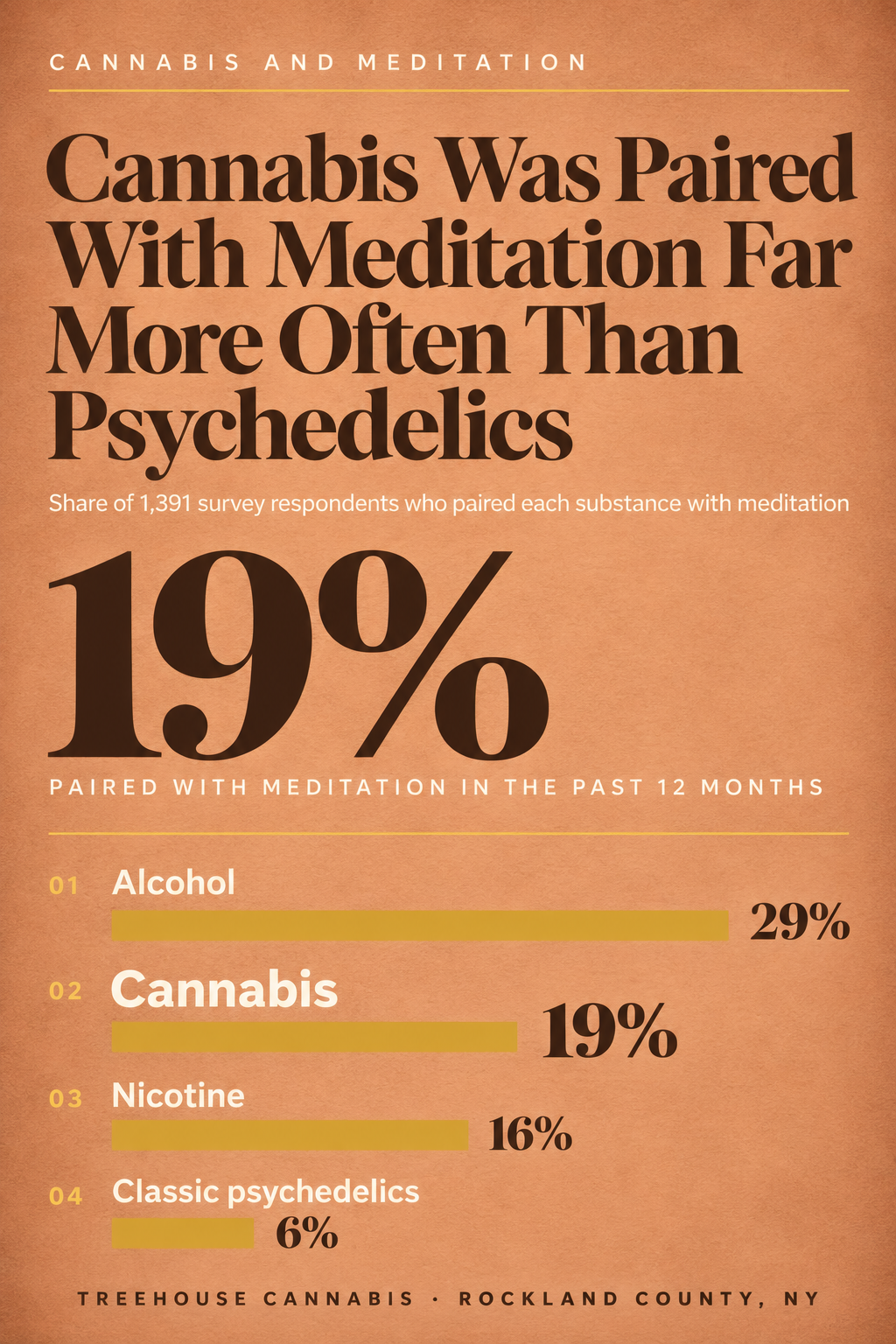
The larger survey is worth reading closely. It examined 1,391 people, with a 397-person subsample focused on classic psychedelic and cannabis users, and found that cannabis was paired with meditation by 19 percent of respondents, behind alcohol at 29 percent and nicotine at 16 percent but far ahead of classic psychedelics at 6 percent [1]. The same study found no consistent association between cannabis use, with or without meditation, and the well-being outcomes it examined, which is a null result on a cross-sectional design and not proof of absence.
If you want the practical read on the format rather than the effect, How to Make Cannabis Tea Without Wasting THC covers how to make cannabis tea without wasting THC, which is a different question from whether the tea improves a sitting.
Does THC Distract You From Meditation?
Both things happen at once, and the distraction side is the one with the measurements behind it.
Here is how the two sides compare in the published work:
| What was measured | Self-report after THC | Task performance after THC |
|---|---|---|
| Mindfulness and insight | Higher at 7.5 mg and 15 mg oral [2] | Not measured in that experiment |
| Mind-wandering | Higher at both oral doses [2] [4] | Worse on instruction-following in the 2025 study [4] |
| Sustained attention | Not measured in those experiments | More false alarms, fewer detected targets at 6 mg inhaled [7] |
Neither column cancels the other, which is exactly why the split matters: the feeling moves one way and the measurement moves the other.
A 2025 naturalistic study of regular cannabis smokers found cannabis use was associated with a large increase in spontaneous mind-wandering, a smaller increase in deliberate mind-wandering, and impaired task performance [4]. The same study found cannabis reduced the instruction-related changes in deliberate mind-wandering, which points to impaired regulation of mind-wandering. That distinction matters: people were less able to shift their attention when asked to, not simply less inclined to focus.
The task performance numbers are unambiguous. In 2013, inhaled 6 mg THC against placebo produced more false alarms and fewer detected targets on a continuous sustained-attention task [7]. A 2020 randomized crossover trial found 15 mg oral THC significantly reduced the share of thought probes rated on task and increased both mind-wandering and zoning out [8].
- A 2025 naturalistic study of regular cannabis smokers found a large increase in spontaneous mind-wandering and a smaller increase in deliberate mind-wandering [4]
- The same study found cannabis users were less able to shift mind-wandering on instruction, which points to impaired regulation of mind-wandering [4]
- Inhaled 6 mg THC against placebo produced more false alarms and fewer detected targets on a continuous sustained-attention task [7]
- A 2020 randomized crossover trial found 15 mg oral THC cut the share of thought probes rated on task while increasing mind-wandering and zoning out [8]
- The CDC lists attention among the brain functions cannabis directly affects and says use within 24 hours immediately impacts thinking and attention [10]
The federal framing matches. The CDC lists attention among the parts of the brain cannabis directly affects, alongside memory, learning, decision-making, coordination, emotions and reaction time, and says that use within 24 hours immediately impacts thinking, attention, memory and time perception [10]. The impact also depends on the THC concentration of the product, how often it is used, age of first use, and whether other substances are used alongside it [10].
The mechanism the researchers named is worth holding onto: a mind that drifts more, drifts less on request, and stays off the task. That is the opposite of what a sitting is trying to build. When THC pushes attention toward internal imagery rather than the breath or the body, the practice becomes watching a film instead of noticing a thought, and the return-to-baseline work that meditation depends on gets harder [4].
Not everyone sees the same pattern, and which effect dominates depends on the person and the dose. Some customers describe a session that settles them, others describe one that fragments attention entirely, and the studies do not predict in advance which one a given person gets. If the drifting is the part you notice rather than the calm, Why Cannabis Can Make You Paranoid (and What Helps) covers why cannabis can make you paranoid and what helps, and Cannabis and Sleep Quality: What Actually Works (and What Doesn't) covers how cannabis and sleep quality interact, since attention problems and sleep problems tend to arrive together.
What Does THC Do to the Default Mode Network?
This is where the mechanism becomes clear: the brain change meditation practice builds and the brain change THC produces point at the same system.
The default mode network is the set of brain regions that stay active when a person is not focused on a task, which is roughly the part of the brain that runs on its own. It is the default rather than the deliberate. When this network is more active, the mind tends to drift, daydream, and construct its own internal narrative without much prompting.
A 2011 fMRI comparison of experienced mindfulness meditators against matched meditation-naive controls found the main nodes of the default mode network, the medial prefrontal cortex and the posterior cingulate cortex, were relatively deactivated in experienced meditators across all three meditation types studied [6]. Those same meditators showed stronger coupling to the dorsal anterior cingulate and dorsolateral prefrontal regions used for self-monitoring and cognitive control, a pattern the authors describe as consistent with decreased mind-wandering [6].
Now the collision. In the 2013 THC study, the impaired sustained-attention performance was tied to impaired deactivation of default mode regions including the posterior cingulate and the angular gyrus, rather than to the central executive system [7]. The same regions that meditation practice quiets are the regions THC leaves loud.
Set the two findings side by side and the direction of travel is hard to miss:
| What was measured | Experienced meditators | After inhaled THC |
|---|---|---|
| Default mode network activity (medial prefrontal, posterior cingulate) | Relatively deactivated across three meditation types [6] | Deactivation impaired after 6 mg [7] |
| Coupling to self-monitoring and control regions | Stronger [6] | Not measured in the 2013 study |
| Sustained-attention performance | Not measured in the 2011 study | More false alarms, fewer detected targets [7] |
- Experienced meditators showed relatively reduced activity in the default mode network's main nodes, the medial prefrontal cortex and posterior cingulate cortex, across all three meditation types studied [6]
- Those same meditators showed stronger coupling between the default mode network and regions used for self-monitoring and cognitive control, a pattern consistent with decreased mind-wandering [6]
- THC pushed the same system the other way: 6 mg inhaled produced sustained-attention impairment tied to impaired deactivation of default mode regions including the posterior cingulate and angular gyrus [7]
- That THC-related impairment was tied to impaired deactivation of default mode regions rather than to the central executive system [7]
- Oral THC also raised language entropy, the variability of the words people produce, at the same doses that raised reported mindfulness [2]
A third piece fits in here. The 2022 experiment found oral THC raised language entropy at the same doses that raised reported mindfulness [2], which fits the same pattern: THC loosens the system that organizes coherent, directed thought, and loosening it can feel like insight while it is also what makes a practice harder to sustain.
In plain language: meditation practice is what quiets the part of the brain that runs on its own, and THC is what pushes that same part louder. If you want the background on how the two main compounds differ, How THC and CBD Work covers how THC and CBD work.
How Has Cannabis Potency Changed the Math?
The doses in the meditation-relevant studies were small, and the products on shelves today are not. That gap is the most practical thing in this article.
Here is the arithmetic, with the studied doses next to what a customer can actually buy:
| What the figure describes | Value | Reported |
|---|---|---|
| Oral THC dose, double-blind experiment | 7.5 mg and 15 mg | 2022 [2] |
| Inhaled THC dose, sustained-attention study | 6 mg | 2013 [7] |
| Oral THC dose, working-memory crossover | 15 mg | 2020 [8] |
| Delta-9 THC in seized cannabis | 3.96 percent (1995) to 16.14 percent (2022) | 2022 [11] |
| Dispensary flower and concentrates | Can exceed 40 percent THC | [11] |
The 2022 experiment used 7.5 mg and 15 mg of oral THC, the 2013 attention study used 6 mg inhaled, and the 2020 working-memory crossover used 15 mg oral [2] [7] [8]. Those are the doses the findings above are based on.
Set that against what is available. Delta-9 THC potency in cannabis seized by law enforcement quadrupled from 3.96 percent in 1995 to 16.14 percent in 2022, and dispensary flower and concentrates can exceed 40 percent THC [11]. The 2026 survey is the largest study of combining meditation with psychoactive substances, and it looked at people who use substances regularly, not people dosing themselves for the first time [1].
- Research doses were small: 7.5 mg and 15 mg oral THC in the 2022 experiment, 6 mg inhaled in the 2013 attention study, and 15 mg oral in the 2020 crossover trial [2] [7] [8]
- Delta-9 THC potency in cannabis seized by law enforcement quadrupled from 3.96 percent in 1995 to 16.14 percent in 2022 [11]
- Dispensary flower and concentrates can now exceed 40 percent THC [11]
- The CDC says impact depends on THC concentration, how often it is used, age of first use and whether other substances are used alongside it [10]
- NIDA notes anxiety, fear, distrust, panic or hallucinations are more common after a large amount, a high-THC product, or with little prior experience [11]
Read this as a factual comparison rather than a warning. A product that reads 25 percent is not the product that was measured in a 15 mg oral study, and a concentrate at 40 percent is further from it still [11]. NIDA's own research overview notes that anxiety, fear, distrust, panic or hallucinations are more common after a large amount, a high-THC product, or with little prior experience [11], which makes the potency gap relevant to anyone combining cannabis with something that asks them to stay alert and composed.
If you are comparing a medicated sitting against a sober one, the products on the shelf are not the products in the papers. A Treehouse "THC" Metal Grinder | Small 1.5'h x 2'w is the kind of small preparation tool that makes handling flower at home more consistent, and consistency in what you are working with matters more than any single session.
Does Mindfulness Training Help People Use Less Cannabis?
Mixed at best, and the trial that tested it most directly found no significant change at all.
A 2025 pre-registered double-blind randomized trial in 66 adults with cannabis use disorder allocated participants 1:1:1 to a brief mindfulness intervention, relaxation, or control over a mean of 16 days [3]. No group showed a significant change in cannabis use days, quantity, craving, relaxation, or mindfulness, and the intervention-by-time effect on use days was F = 0.26 with FDR p = .86 [3].
It matters what that trial was actually testing. It tested mindfulness as a way to cut down on use, not as a way to meditate better, so its null result does not tell you whether a sitting improves your attention [3]. A brief intervention over roughly two weeks is also a short window, and it is worth saying plainly that the study found no significant change rather than rounding it into a small positive.
The more interesting finding is less widely reported. A 2023 latent profile analysis of 683 U.S. college students who reported past-month cannabis use identified three dispositional mindfulness styles: non-judgmentally aware, judgmentally observing, and moderate traits [5].
The judgmentally observing style showed more hazardous cannabis use and more consequences of use than the other two [5]. That is an association among college students, not a cause, but it points somewhere specific: what kind of attention you bring may matter more than how much you practice.
- A 2025 pre-registered double-blind trial assigned 66 adults with cannabis use disorder to a brief mindfulness program, relaxation, or a control over a mean of 16 days [3]
- No group showed a significant change in cannabis use days, quantity, craving, relaxation or mindfulness; the intervention-by-time effect on use days was F = 0.26 with FDR p = .86 [3]
- That trial tested mindfulness as a way to cut down, not as a way to meditate better [3]
- A 2023 analysis of 683 college students who use cannabis found three distinct mindfulness styles: non-judgmentally aware, judgmentally observing, and moderate traits [5]
- The judgmentally observing style showed more hazardous cannabis use and more consequences of use than the other two, so style rather than how much attention you practice tracked with risk [5]
So what does this mean for the question at hand? It means the direction that matters for meditation is attention style, and that is something practice can shape, while the direction that matters for cannabis use is not something a brief program moved. If you are thinking about the attention side rather than the quantity side, the profile research is the more encouraging of the two studies, though it studied students rather than customers.
One note on the products themselves. The research above is about attention and self-regulation, not about any format, and none of it changes what is on the menu. A Small Buds Flower is a format worth knowing about if you prefer smaller buds, and the same goes for the wider range available to customers in Rockland, Orange, and Westchester Counties.
What Should You Know Before Combining Cannabis and Meditation?
Neither cannabis nor meditation is the risk-free option, and the honest comparison is between two trade-offs rather than one good choice and one bad one.
A 2020 federal review of 83 meditation studies covering 6,703 participants found 55 reported negative experiences, and concluded that about 8 percent of participants had a negative effect from meditation practice, most commonly anxiety or depression, at a rate similar to the one reported for psychological therapies [9]. That number is worth knowing not as a reason to avoid meditation, but as a reminder that a practice which asks you to sit still with whatever is present is not automatically gentle.
The cannabis side carries its own profile. The CDC says cannabis use within 24 hours immediately impacts thinking, attention, memory and time perception [10], and NIDA notes anxiety, fear, distrust, panic or hallucinations are more common after a large amount, a high-THC product, or with little prior experience [11]. Put side by side, the honest framing is that combining a practice which requires sustained attention with a substance that impairs sustained attention creates tension that neither side resolves.
- Meditation carries its own risk profile: a 2020 review of 83 studies covering 6,703 people found about 8 percent reported a negative effect from practice, most commonly anxiety or depression [9]
- That rate is similar to the one reported for psychological therapies, so neither cannabis nor meditation is the risk-free option [9]
- The CDC says cannabis use within 24 hours immediately impacts thinking, attention, memory and time perception [10]
- The differences seen in experienced meditators' brains are a change built by repetition, which is why a baseline without cannabis is the fair comparison [6]
- The 2026 survey tied no well-being benefit to cannabis use, with or without meditation [1]
One practical suggestion the evidence supports: learn the practice without it first. The difference in default mode network activity seen in experienced meditators is a change built by repetition [6], so a baseline without cannabis is the only fair comparison you can make, and the 2026 survey tied no well-being benefit to cannabis use either with or without meditation [1]. That is a sequencing suggestion, not a moral one. It simply means you would be comparing the practice against a version of the practice you have not built yet.
If a topical is part of the picture, keep it accurate: topicals are applied to the skin rather than inhaled or eaten, so they sit outside the THC attention effects covered here [11]. And for anyone deciding what to buy, Infused Bud Flower is one of the product formats on the menu, with the same label-reading habit applying as with anything else.
Browse the full lineup: Pre Ground Flower.
What Should You Bring to Your First Combined Sitting?
If you are in Rockland, Orange, or Westchester County and want to talk through the numbers before you decide anything, the team at Treehouse Cannabis will walk you through them.
Bring a few questions with you, because the answers are specific to the product rather than general:
- What the THC percentage actually is on the label for the product in front of you
- How long the format in front of you takes to arrive and how long it lasts, asked separately for a tincture and for an edible
- How long each format tends to run, so you can plan the timing around your sitting instead of guessing mid-session
- Whether the product is intended for inhalation, ingestion, or neither, since topicals are applied to the skin rather than inhaled or eaten [11]
Then decide with the numbers in front of you instead of the mood on the label. Browse the menu or order online for pickup and delivery, for adults 21 and older.
Frequently Asked Questions
Does THC actually help you meditate?
The evidence does not show it. A 2022 experiment found oral THC raised self-reported mindfulness and insightfulness in 25 infrequent users, but it raised reported mind-wandering at the same time. Feeling more mindful is not the same as holding attention better, and a 2026 survey found no consistent link between cannabis use and the well-being outcomes it measured.
Does THC distract you from meditation?
Both things happen at once, and which one dominates depends on the person and the dose. A 2025 naturalistic study tied cannabis use to a large increase in spontaneous mind-wandering, a smaller rise in deliberate mind-wandering and worse task performance, and it dampened people's ability to shift mind-wandering on instruction.
What do researchers know about combining meditation and cannabis?
Less than most people assume. A 2026 survey of 1,391 people, including a 397-person subsample of cannabis and classic psychedelic users, is the largest study so far. Cannabis (19 percent), alcohol (29 percent) and nicotine (16 percent) were all paired with meditation far more often than psychedelics (6 percent), and no consistent association with well-being appeared.
Is CBD a better choice for meditation than THC?
CBD is the non-intoxicating half of the plant, so it does not produce the high THC does. But the meditation research base is thin and the studies that exist largely tested cannabis or THC rather than CBD alone. Nobody has shown CBD reliably improves meditation, and the 2026 survey tied no well-being benefit to cannabis use either.
Can you meditate while high?
Some people do. Higher potency has made that easier to reach, with seized product strength quadrupling from 3.96 percent in 1995 to 16.14 percent in 2022 and dispensary flower above 40 percent. That also means today's products carry far more THC than the 7.5 mg and 15 mg research doses most studies used.
Why does cannabis sometimes make meditation worse?
Because THC widens everything, not only the good parts. The CDC lists attention, memory, decision-making and reaction time among the brain functions cannabis directly affects, and use within 24 hours immediately impacts thinking and time perception. NIDA notes anxiety, fear, distrust and panic are more common after a large amount or a high-THC product.
Does mindfulness training help people use less cannabis?
Mixed at best. A 2025 randomized trial of 66 adults with cannabis use disorder assigned them to a brief mindfulness program, relaxation, or a control for about 16 days. Neither group showed a significant change in days of use, amount, craving, relaxation or mindfulness. That trial tested mindfulness as a way to cut down, not to meditate better.
Should I use cannabis to build a meditation habit?
A reasonable starting point is to learn the practice first without it. Meditation trains the ability to notice that the mind has wandered and return it, and experienced meditators show reduced activity in the default mode network, the brain's mind-wandering system, a change built by repetition. A fair test is time without cannabis to see whether the practice holds.
Sources
- Psychopharmacology (Springer Nature) — Two cross-sectional studies, a broad naturalistic sample of 1,391 people plus a
- Consciousness and Cognition (National Library of Medicine) — Double-blind experiment comparing 7.5 mg and 15 mg oral THC against placebo in 2
- Drug and Alcohol Dependence (Elsevier, via UCL Discovery) — Pre-registered double-blind randomised trial in 66 adults (19 female) allocated
- Heliyon (National Library of Medicine) — Three-session remote ABA study of regular cannabis smokers found that cannabis u
- Mindfulness (Springer Nature, National Library of Medicine) — Latent profile analysis of 683 U.S. college students who reported past-month can
- Proceedings of the National Academy of Sciences (National Library of Medicine) — fMRI comparison of experienced mindfulness meditators with matched meditation-na
- PLOS ONE (Public Library of Science) — Inhaled 6 mg THC against placebo produced more false alarms and fewer detected t
- Neuropsychopharmacology (Springer Nature, National Library of Medicine) — Randomized crossover trial found that 15 mg oral THC significantly reduced the s
- National Center for Complementary and Integrative Health (NIH) — Federal summary of a 2020 review of 83 meditation studies covering 6,703 partici
- Centers for Disease Control and Prevention — Federal guidance stating that cannabis use directly affects the parts of the bra
- National Institute on Drug Abuse (NIH) — Federal research overview noting that the plant contains at least 125 cannabinoi
About Treehouse Cannabis
Treehouse Cannabis is a licensed adult-use dispensary in Rockland County, New York, serving customers across Rockland, Orange, and Westchester Counties. The menu carries flower, pre-rolls, vapes, and edibles with total THC printed per serving and batch testing behind the products, and the team will read the panel with you before you buy.
Cannabis is for adults 21 and older. This article is educational and informational only and is not medical advice. Cannabis affects people differently, and oral products can take up to two hours to take effect. Do not drive or operate machinery while impaired, keep all cannabis products out of reach of children and pets, and consult a licensed healthcare provider if you have questions about how cannabis interacts with your health or medications.

Shop our products

Shop All

Deals
Flower

Pre-rolls
Vaporizers

Edibles

Drinks

Concentrates
Tinctures

Topicals

CBD

Pet CBD

Accessories