
Cannabis and Pets: What's Safe, What's Toxic, What Vets Say
Cannabis and Pets: What's Safe, What's Toxic, What Vets Say
What the veterinary toxicology data actually shows about THC and CBD in dogs and cats, which signs matter, and how to keep a curious pet out of your stash.
The short answer to any cannabis and pets question is that the plant is toxic to dogs and cats, and THC is the reason. The ASPCA lists Cannabis sativa as toxic to both species [1], and no safe dose of psychoactive cannabis exists for a companion animal [6]. Most exposed pets still recover, but knowing which compound your pet actually met changes what happens next.
Is Cannabis Toxic to Dogs and Cats?
Yes. Cannabis is toxic to dogs and cats because of THC, the intoxicating cannabinoid, and veterinary poison control treats every psychoactive exposure as a case worth a phone call. What "toxic" does not mean is "usually fatal." Most exposures produce a miserable, wobbly pet that recovers with time and supportive care.
The volume of those cases is climbing fast, and the two datasets that track it are separate measures from separate organizations rather than one shared number:
- ASPCA Animal Poison Control recorded a 765 percent increase in pet marijuana exposure calls across a decade starting in 2019 [1].
- Pet Poison Helpline reports a 448 percent increase in marijuana cases over six years [6].
Both trends point the same direction. Cannabis is more available, more concentrated, and more often stored in a kitchen where a pet can reach it.
The phrase "cannabis and pets" is not one answer, though, because the plant carries more than one active molecule. THC is the compound that produces the dramatic neurologic signs. CBD is a separate cannabinoid with a much milder toxicity profile, and the veterinary literature treats the two as distinct clinical pictures [2] [3]. If you want the underlying chemistry, our breakdown of CBD vs THC: The Science Behind the Two Most-Discussed Cannabinoids covers how the two differ in the body.
| Compound | Toxicity picture in pets | What drives it |
|---|---|---|
| THC | Wobbling, startle sensitivity, lethargy, urine dribbling, dilated pupils | CB1 receptor activation; dogs carry a higher brain receptor density than humans [5] |
| CBD | Generally mild and gastrointestinal; lethargy in about 30 percent of exposure cases | Poor quality control and unlabeled THC are the usual culprits [3] |
Species matter too, and not in the way most owners assume. The ASPCA notes that dogs are drawn to edibles that smell like baked goods, while cats more often go for raw bud [1]. A dog raids the brownies. A cat knocks over the jar.
The professional stance across every veterinary source here is consistent and blunt: no safe dose of psychoactive cannabis exists for a companion animal [6]. That is not a statement about lethality. It is a statement about the absence of any dose-response data that would let anyone call a given amount safe, which is why every known ingestion belongs in a conversation with a veterinarian rather than a wait-and-see.
What Does Cannabis Poisoning Look Like in a Pet?
Cannabis poisoning looks like a pet that cannot walk straight. The classic presentation of dogs and weed exposure is a swaying hind end, dribbling urine, flinching at ordinary sounds, and staring at nothing. The largest published case series makes the pattern concrete.
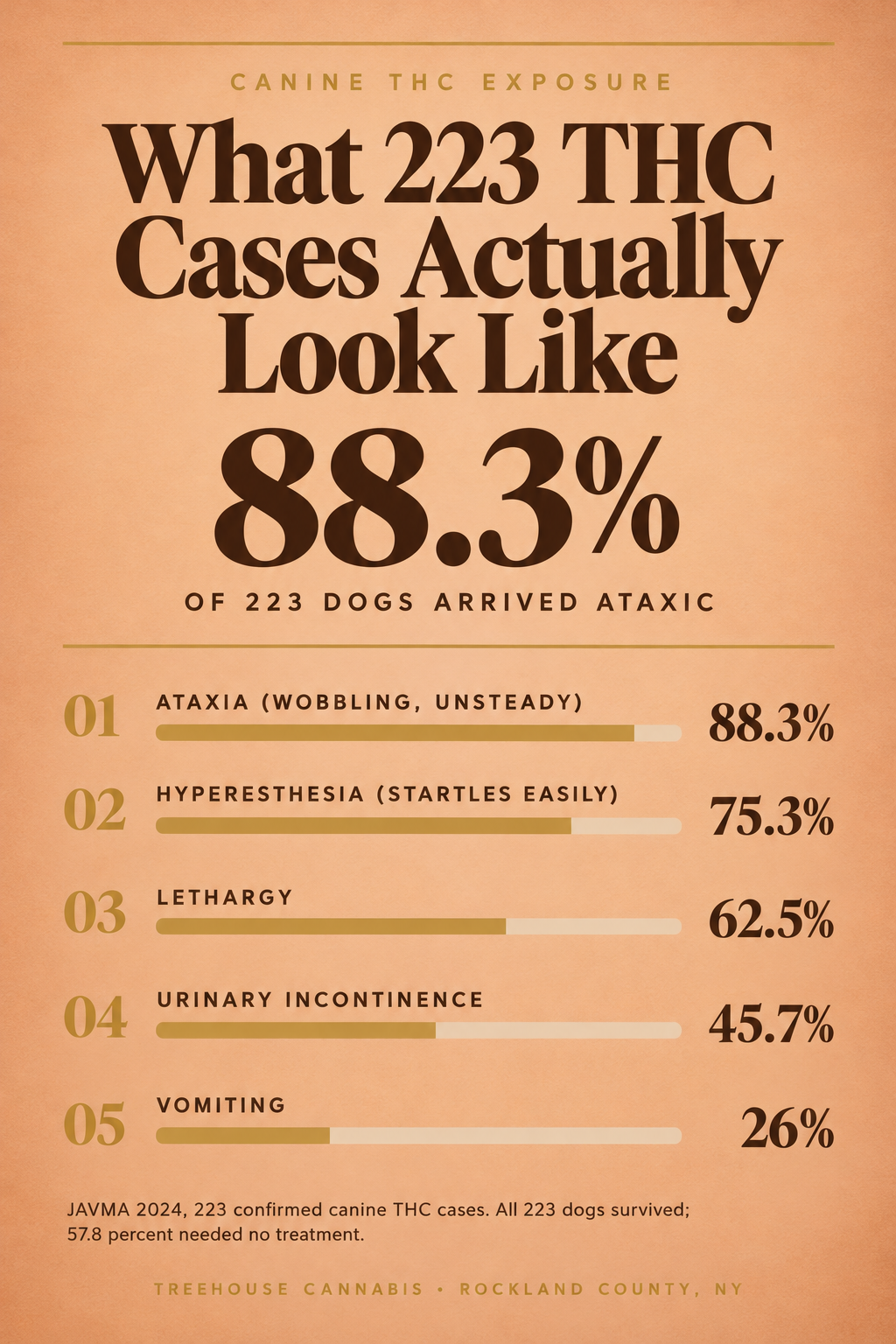
In a JAVMA review of 223 confirmed canine THC cases, the most common findings were ataxia in 88.3 percent, hyperesthesia in 75.3 percent, lethargy in 62.5 percent, urinary incontinence in 45.7 percent, and vomiting in 26 percent [4]. All 223 dogs survived, and 57.8 percent received no treatment at all.
Those clinical words translate into plain descriptions once you are standing in a living room:
- Ataxia — the hind end sways, the gait looks drunk, and stairs or a slippery floor become impossible.
- Hyperesthesia — an exaggerated flinch at a dropped spoon, a hand near the head, or a door closing.
- Lethargy — a normally social pet that lies flat and will not engage with anything.
- Urinary incontinence — the single most useful clue, because a housebroken dog does not usually leak.
- Vomiting — present in a minority, which means its absence proves nothing either way.
Owners also report signs that case series undercount: dilated pupils, a fixed dazed stare, head bobbing, and fine tremors [5]. Cats show the same picture behind stillness — a cat that has stopped grooming, hides, and will not move when picked up is showing the feline version of the same event.
Dogs react this way for two physiological reasons. First, they carry a higher density of cannabinoid receptors in the brain than humans do, so the same exposure lands harder [5]. Second, dogs recycle the dose through enterohepatic recirculation: THC stored in bile is reabsorbed after the next meal, which re-exposes the animal hours after the original ingestion [7].
Route changes the clock. Inhaled smoke or vapor produces signs in roughly 6 to 12 minutes, while an edible, flower, or concentrate that gets eaten takes 30 to 60 minutes [7]. That gap matters in practice — a dog that ate a gummy can look completely normal for half an hour, which is exactly how owners talk themselves out of making the call.
The sign that should worry an owner most is not the wobble. It is anything outside the classic picture: collapse, labored breathing, or a body temperature that feels wrong to the touch. Severe cases and co-ingested toxins are what actually endanger a pet, not the ataxia itself [2].
How Much Cannabis Is Dangerous for a Dog or Cat?
There is no established lethal dose of THC for dogs or cats, and death from THC alone is extremely rare. The Merck Veterinary Manual describes THC toxicosis as self-limiting within one to three days [2], and every one of the 223 dogs in the JAVMA series survived [4]. Dose still matters, but the useful variable is concentration rather than a milligram figure nobody can measure at home.
Potency varies by orders of magnitude across product types, and the same "small amount" means wildly different things depending on which one your pet found:
| Product form | Typical THC content |
|---|---|
| Plant material (flower) | roughly 4 to 20 percent |
| Hash and hash oil | 20 to 50 percent |
| Solvent-extracted concentrates | 80 to 90 percent |
All three ranges come from the Merck Veterinary Manual [2]. A single dropped dab can carry more THC than an entire joint, which is why the format matters more than the volume. The only reliable way to know what a product actually contains is a certificate of analysis, which is the same document that governs Understanding Cannabis COAs: Your Guide to Lab Testing and Safety for the legal market.
Two dangers sit around the THC itself.
The first is co-ingestion. Edibles also carry chocolate, xylitol, raisins, and macadamia nuts, and those are the compounds most likely to actually kill a dog that ate a brownie. A pet that got into a tray of infused baked goods has two poisonings at once, and only one of them is cannabis.
The second is delivery format. The documented canine fatalities described in the veterinary literature involved baked goods made with concentrated marijuana butter — a format that packs a heavy dose into something that tastes exactly like a treat [2].
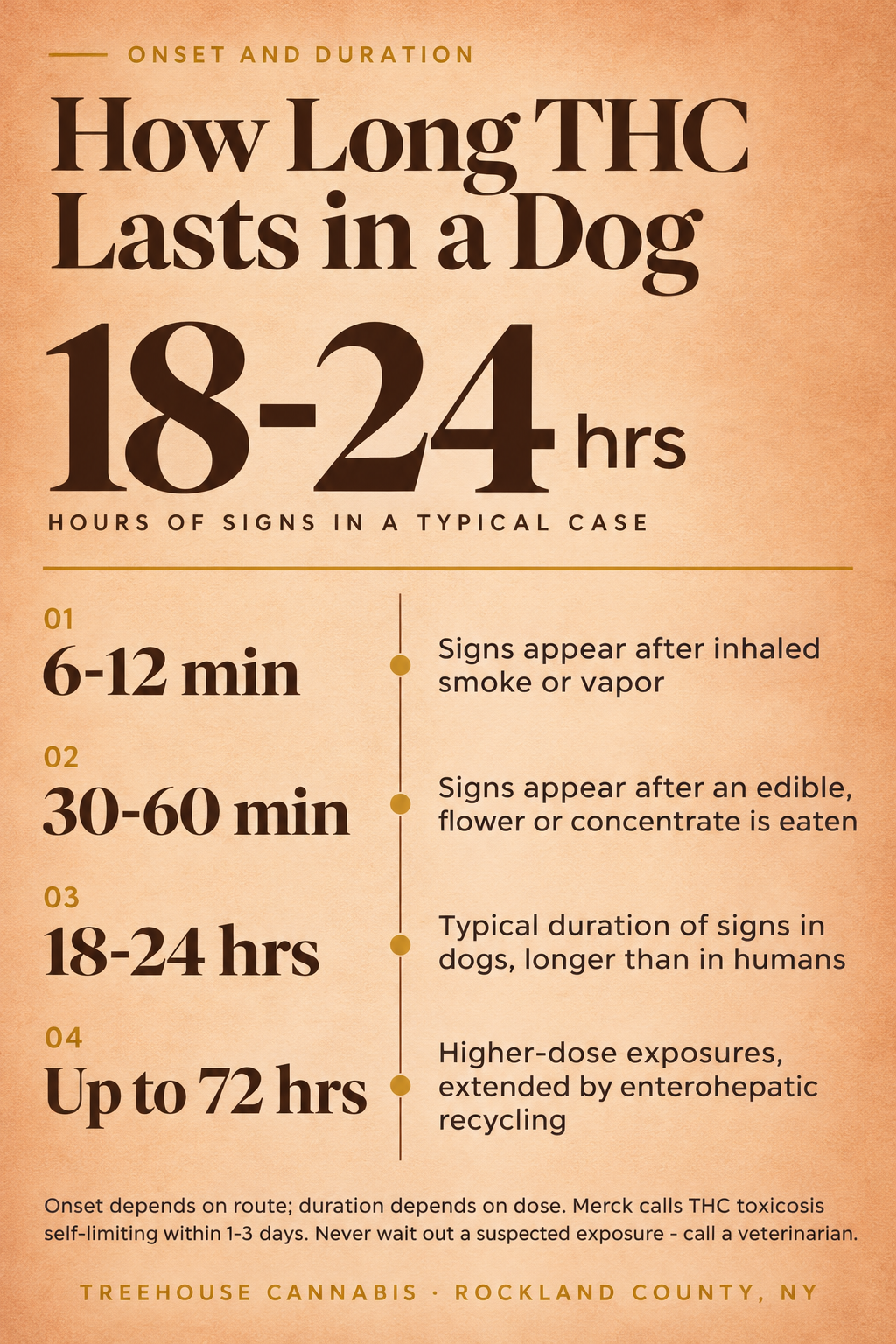
Duration is its own axis. Signs typically last 18 to 24 hours in dogs and can run up to 72 hours in heavier exposures [7] [5]. That is why a pet who looks better at hour six may still be affected tomorrow morning. Body weight changes the picture, and so does the recycling loop: every meal is another chance for stored THC to be reabsorbed [7]. A ten-pound dog and a seventy-pound dog do not clear the same exposure on the same schedule.
What an owner should be able to tell a veterinarian is short and specific:
- The product type — flower, edible, concentrate, tincture, or homemade butter.
- The packaging, photographed or in hand, so potency and other ingredients can be read.
- The estimated amount, in the most concrete terms available ("about a third of a 100 mg chocolate bar" beats "one bite").
- The time of ingestion, and whether anyone saw it happen.
A veterinarian can work backward from those four facts far better than an owner can guess at how much a bite contained. Guessing low is the most common error, and it is the error that postpones care.
What Do Veterinarians Say About Cannabis and Pets?
Veterinarians describe THC exposure as usually survivable and rarely a straight-line emergency — and they say that while still asking owners to call. Both halves are true at once, which is the part public coverage tends to flatten.
The clinical reality from the case data is the honest counterweight to alarmist headlines. Most exposed pets recover with supportive care, and more than half of the dogs in the largest series needed no treatment at all [4]. Cornell's guidance that follows from that is modest: keep the pet calm and warm, prevent injury while the gait is unsteady, and call rather than guess [5].
Human cannabis experience does not transfer, and the veterinary literature is explicit about why. Human-facing cannabis discussion tends to be framed around symptom relief for conditions like Cannabis and Migraines: What Headache Sufferers Should Know or problems with Cannabis and Sleep Quality: What Actually Works (and What Doesn't), and none of that framing survives the species jump. Receptor density differs, metabolism differs, and a dog is not a small person with a smaller dose [5].
The regulatory picture is the part owners rarely hear. The FDA has not approved cannabis for any use in animals, cannot vouch for the safety or effectiveness of products marketed for pets, cautions owners against their use, and directs them to talk with a veterinarian instead [8]. That gap exists because there is no approved veterinary product to prescribe, not because the agency has reviewed specific products and rejected them.
What veterinarians can and cannot do is worth setting straight before an emergency:
- There is no antidote for THC. Treatment is supportive — fluids, monitoring, temperature control, and management of whatever else was eaten [2].
- Vomiting is not a universal first step. A pet already showing sedation should not be made to vomit, because of aspiration risk [5].
- The right contacts are a primary veterinarian, an emergency hospital, or an animal poison control service. Which one depends on the signs and the hour, not on a fixed script.
- Every case gets easier with evidence. The packaging, product type, amount, and time of ingestion are what turn a worried phone call into a workable treatment plan.
The single most useful thing an owner can do in the first ten minutes is pick up the packaging instead of the phone camera. Both, ideally — but the packaging is what carries the potency number, the other ingredients, and the serving size that tells a veterinarian whether this is a THC case, a chocolate case, or both.
Is CBD Safe for Pets?
The short-term safety data in dogs is genuinely encouraging, and nothing about it is approved, guaranteed, or a green light to buy a bottle and start pouring. Pet CBD safety is one of the most-searched questions in this space, and both statements have to be held together, because the evidence and the marketplace are not the same thing.
The evidence side is better than most owners expect. Safety studies at doses up to 10 mg/kg per day for up to 36 weeks suggest CBD is largely safe for long-term use in dogs, with loose stool and rising ALP — an alkaline phosphatase liver enzyme — as the main findings [9]. Those are studied doses, not recommended doses, and the distinction matters: the number describes what researchers administered under supervision, not what anyone should give a pet at home.
The exposure data is similarly mild. An acute oral overdose up to 62 mg/kg produced diarrhea in dogs without more severe effects [3], and CBD exposure cases are generally gastrointestinal and self-limiting. Lethargy shows up in roughly 30 percent of cases, ataxia in about 21 percent, and smaller shares show hyperesthesia, trembling, or urinary incontinence [3].
Cats are the weaker link in the evidence chain. They absorb oral CBD far less efficiently than dogs, and in a 12-week study of healthy dogs and cats, one of eight cats developed a persistent ALT elevation above reference range [10]. That is a single cat in a small study, not a pattern, but it is also not nothing — and it is the reason feline CBD questions deserve more caution than canine ones.
Then comes the caveat that undoes most of the optimism: product quality. The failure modes are consistent and none of them appear on the label:
- Misstated cannabinoid content — the bottle says one number and contains another [9].
- Unlabeled THC — the most common explanation for neurologic signs blamed on CBD [3].
- Heavy metals and pesticides — contaminants the plant took up before processing [9].
- Extraction solvents and mycotoxins — residue from manufacturing and from moldy starting material [9].
- Bacterial contamination — a handling problem, not a chemistry one [9].
The dramatic neurologic signs sometimes blamed on CBD are usually traceable to unlabeled THC in the product [3] — meaning the bottle that says "CBD only" is the most likely place for a surprise. Our explainer on CBD for Dogs: Benefits & Safety goes through what that means for the canine side in more detail.
Dose behavior adds another wrinkle. Dogs given a 1:20 THC:CBD herbal extract developed tolerance to the cannabinoid effects across repeated doses, and the same authors warn that higher doses carry more adverse-event risk because some formulations show non-linear kinetics [11]. In plain terms, doubling the amount does not reliably double the effect, which makes "just a bit more" a bad strategy.
It is also worth being explicit about what a product is for. A balanced 2:1 cannabis product made for adult consumers, like Sunny Days 2:1 | 10 Pack | Gummies | THC: 100mg, CBD: 50mg, is a human product with a human serving size. Nothing about a CBD-forward ratio makes it appropriate for an animal, and the FDA's position on animal use does not change because a label sounds gentle [8].
So "safe in a study" and "safe to buy" are different claims. The evidence supports the first. The regulatory floor is that the FDA has approved no cannabis product for animals [8], which means the second is an open question every time, no matter how the bottle is labeled.
How Do You Keep Cannabis Away From Pets?
Keep cannabis where you keep medication, not where you keep food or houseplants: locked, sealed, and out of reach — never on a counter, a coffee table, or a nightstand. That single reframe solves most of the problem, because the failures below are all variations on "it was only there for a minute."
Edibles are the top hazard because they look and smell like baked goods, which is exactly the cue that draws dogs in [1]. An infused brownie, cookie, or gummy on a coffee table is the highest-risk object in the house, and an infused beverage in a glass is the same hazard with a lower profile — an open cup of something like Holidaze Tea | 10mg THC / 10mg CBD | 16oz reads as a drink, not as a dose.
Cats are a different problem with a different solution. They target raw flower, so an open jar or a loosely closed bag on a shelf is a feline hazard rather than a canine one [1]. If flower lives in your house, Flower is the format to think about when you are deciding where it is stored.
Secondhand smoke is a real route, not a technicality. Inhaled exposure produces signs in roughly 6 to 12 minutes [7], so a pet in the room during a session is exposed in a way that a pet in another room is not. Smoking outdoors or in a separate ventilated room, and keeping the pet out until the smoke clears, is the practical version of that advice.
The vectors owners forget are the ones that cause repeat visits:
- Roaches and ash trays left on a table or in an ashtray on the porch.
- Already-vaped flower (ABV) set aside in an open container, which still carries active THC.
- Homemade butter, oils, and tinctures, often stored in a fridge in a container that looks like food.
- Capsules and vape cartridges loose in a purse, backpack, or jacket pocket.
- Compost and trash, especially kitchen scraps from an infused batch.
- Guests who do not know the rule, which is where a large share of exposures actually originate.
Child-resistant packaging is not pet-resistant. A determined dog can chew through a pouch, and a cat can work a zipper pull given time. A locked container beats a high shelf for the same reason: counters and shelves are reachable, and the pet that can reach a shelf is the pet that already found it once. A smell-proof locking bag or case does double duty here, because sealing the scent removes the cue that starts the search in the first place. If you need somewhere to start, Black | Slim Pen 510 Vape Battery is the category built for exactly that.
Finally, do not treat improvement as resolution. Enterohepatic recycling means a pet can look better, eat, and then look worse again [7]. "It passed" is a conclusion for a veterinarian to reach, not an owner watching from the couch.
What Should You Do If Your Pet Ate an Edible?
Call your veterinarian, an emergency hospital, or an animal poison control service now — before signs appear, and without inducing vomiting on your own. The timeline matters more than the symptom, and the second half of that instruction is the most important safety point in this article.
Do not make your pet vomit at home. Cornell advises against it once sedation is present, because of aspiration risk [5]. A sedated animal that vomits can inhale material into the lungs, and aspiration is a far more immediate threat than the THC itself. This is the single most common well-intentioned mistake owners make.
Have five things ready for the call, because they determine what happens next [2]:
- The packaging, front and back, including the potency and serving size.
- The product type — edible, flower, concentrate, tincture, or homemade.
- The estimated amount eaten, in concrete terms.
- The pet's weight and approximate age.
- The time of ingestion, and whether it was witnessed.
Expect supportive care rather than a fix. Monitoring, fluids, temperature control, and treatment for anything else that was eaten is the shape of it, because there is no antidote [2]. Some pets need nothing more than observation; others need to stay for the night. Neither outcome is predictable from the driveway.
Set expectations on the clock honestly. Signs usually resolve within 18 to 24 hours and can run to 72 [7], so a single good hour is not the end of the event. Improvement followed by a return of signs is consistent with enterohepatic recycling, not a new exposure.
Go in person rather than staying on the phone if you see collapse, labored breathing, tremors that will not stop, or a pet you cannot rouse. Those are the signs that separate a miserable night from a dangerous one [2].
And mention the co-toxins out loud. Chocolate and xylitol in the same brownie change the risk calculation entirely, and a veterinarian who knows both were involved will treat the case differently than one who is only tracking THC.
Frequently Asked Questions
The questions owners ask most about cannabis and pets, answered from the veterinary sources above.
- Is weed toxic to dogs?
- How much marijuana can kill a dog?
- What are the signs of cannabis poisoning in dogs?
- How long does weed stay in a dog's system?
- Is CBD safe for pets?
- Are CBD products for pets regulated?
- Can pets get high from secondhand smoke?
- What should I do if my dog ate an edible?
Is weed toxic to dogs?
Yes. THC is toxic to dogs, and the ASPCA lists Cannabis sativa as toxic to both dogs and cats. Dogs are more sensitive than humans because they carry a higher density of cannabinoid receptors in the brain. Most exposures are not fatal, but every ingestion deserves a call to a veterinarian or animal poison control.
How much marijuana can kill a dog?
There is no established lethal dose, and death from THC alone is extremely rare. The documented canine fatalities involved baked goods made with concentrated marijuana butter. The bigger risks are co-ingested toxins like chocolate and xylitol, plus falls, overheating, or aspiration in a sedated pet.
What are the signs of cannabis poisoning in dogs?
In a study of 223 confirmed cases, 88 percent of dogs were ataxic, 75 percent were hypersensitive to touch and sound, 63 percent were lethargic, 46 percent dribbled urine, and 26 percent vomited. Dilated pupils, a dazed stare, and head bobbing are also common. Urinary incontinence is a strong clue.
How long does weed stay in a dog's system?
Expect clinical signs to last 18 to 24 hours and occasionally up to 72. Dogs recycle cannabinoids through enterohepatic recirculation, meaning THC stored in bile is reabsorbed after the next meal and re-exposes the pet. That is why dogs stay affected longer than humans do.
Is CBD safe for pets?
Short-term safety data looks encouraging. Studies at doses up to 10 mg/kg per day for up to 36 weeks suggest CBD is largely safe in dogs, with loose stool and rising liver enzyme ALP as the main concerns. Cats absorb CBD far less efficiently, and one cat in a 12-week study developed a persistent ALT elevation.
Are CBD products for pets regulated?
No. The FDA has not approved any cannabis product for use in animals and cannot vouch for the safety or effectiveness of what is sold for pets. Independent testing has found products that misstate cannabinoid content or carry THC, heavy metals, pesticides, solvents, or mycotoxins.
Can pets get high from secondhand smoke?
Yes, though usually mildly. Inhaled smoke can produce intoxication, and signs appear faster than with ingestion, roughly 6 to 12 minutes versus 30 to 60. Pets should be kept in a separate, well-ventilated room while anything is being smoked or vaporized, and until the smoke clears.
What should I do if my dog ate an edible?
Call your veterinarian, an emergency hospital, or animal poison control immediately, and do not induce vomiting on your own. A sedated dog can aspirate. Have the packaging ready so the vet can identify other toxins such as chocolate or xylitol and estimate the THC dose.
Sources
- ASPCA Animal Poison Control Center (ASPCApro) — ASPCA Poison Control recorded a 765 percent increase in pet marijuana exposure c
- Merck Veterinary Manual — THC content ranges from roughly 4 to 20 percent in plant material, 20 to 50 perc
- Merck Veterinary Manual — CBD intoxication in pets is generally mild and GI-focused, with an acute oral ov
- Journal of the American Veterinary Medical Association — In 223 confirmed canine THC cases the most common signs were ataxia (88.3 percen
- Cornell University College of Veterinary Medicine, Riney Canine Health Center — Dogs are more sensitive to THC than humans because they have a higher density of
- Pet Poison Helpline — Pet Poison Helpline reports a 448 percent increase in marijuana cases over six y
- UC Davis School of Veterinary Medicine — Clinical signs appear within 30 to 60 minutes of ingestion or 6 to 12 minutes of
- U.S. Food and Drug Administration — The FDA states it has not approved cannabis for any use in animals, cannot ensur
- Cornell University College of Veterinary Medicine, Riney Canine Health Center — CBD product quality is a major unknown for pet owners because labels can misstat
- National Library of Medicine / PubMed Central (Animals, 2019) — A 12-week CBD-rich hemp study in healthy dogs and cats found few changes in bloo
- Frontiers in Veterinary Science — Dogs given a 1:20 THC:CBD herbal extract developed tolerance to cannabinoid effe
About Treehouse Cannabis
Treehouse Cannabis is an adult-use dispensary in Rockland County, serving Rockland, Orange, and Westchester counties. Most of what this article recommends is not a product at all — it is a locked container, a room with a door, and a five-minute conversation with a veterinarian. If you keep cannabis in a house with a dog or a cat, store it like medication: sealed, locked, and out of reach. Treehouse carries locking smell-proof storage cases and bags, and our team is glad to talk through safer household storage. This article is education, not veterinary advice — for any suspected pet exposure, call your veterinarian or an animal poison control service.
Cannabis is for adults 21 and older. Keep all cannabis products locked and out of reach of children and pets. This article is educational and is not veterinary or medical advice; it does not diagnose, treat, or cure any condition in an animal or a person. If you suspect a pet has ingested cannabis, contact your veterinarian or an animal poison control service immediately. Do not drive or operate machinery while impaired, and buy cannabis only from licensed New York dispensaries.



Shop our products

Shop All

Deals

Flower

Pre-rolls

Vaporizers

Edibles

Drinks

Concentrates

Tinctures

Topicals

CBD

Pet CBD

Accessories