
Red Velvet Strain: Genetics, Flavor, and Lab Profile
Red Velvet Strain: Genetics, Flavor, and Lab Profile
The Red Velvet strain is a hybrid bred by Grandiflora Genetics in Oakland and popularized by Cookies, and most published sources describe it as Lemon Cherry Gelato crossed with Pina Acai. Its reputation rests on a cinnamon and red-hot spice nose over cherry and vanilla cream, plus a reported potency spread so wide that the batch in front of you matters more than the name on the jar.
This article takes the three claims that circulate most often and separates what is documented from what is repeated. The lineage is breeder-confirmed but never formally published. The name does not guarantee the genetics, because several different plants are sold under it. And a THC number describes one tested lot, not a strain. Where a real certificate of analysis exists, it gets walked through line by line.
What Is the Red Velvet Strain?
The Red Velvet strain is a dessert-leaning hybrid bred by Grandiflora Genetics in Oakland and brought to market by Cookies. Most published sources describe it as Lemon Cherry Gelato crossed with Pina Acai, and its signature is a cinnamon and red-hot spice aroma layered over cherry, citrus, and vanilla cream [1][5].
The breeding credit is consistent across sources, which is more than can be said for most strain histories. Grandiflora developed the plant, and Cookies carried the cut into wider distribution. Leafly named it a Buzz strain in May 2022, which is roughly when the name started appearing on menus outside California [1].
The basic facts sort out like this:
- Breeder: Grandiflora Genetics of Oakland, with Cookies bringing the cut to market.
- Timing: a Leafly Buzz strain of May 2022, which tracks with its spread onto menus.
- Parents: most sources give Lemon Cherry Gelato crossed with Pina Acai, and Grandiflora's Prada confirmed that cross on the record [6].
- Aliases: Red Cake and RdV, both listed by Leafly, which is why one plant can appear three ways on the same menu [1].
- Character: a dessert hybrid with cinnamon and red-hot spice over cherry and vanilla, finishing calm and full-bodied rather than sharp [1][3].
The character description is worth taking at face value only as a description. Reviewers consistently report a calming, full-bodied finish, and the aroma is the cake it is named after. Neither observation is a measurement, and neither is a promise about what any specific package will do.
The caveat that frames everything below is this: Grandiflora never published a formal pedigree for Red Velvet, and SeedFinder notes the exact genetics were not revealed by either Grandiflora or Cookies [2]. Weedmaps repeats the Lemon Cherry Gelato and Pina Acai parentage while observing that a public breeder confirmation of the exact cross remains hard to pin down [4]. So the reported cross is the most commonly repeated version, confirmed by the breeder in conversation but not documented in a published family tree.
That distinction sounds academic until you are standing in front of a menu. A strain whose lineage lives in interviews rather than in records is a strain whose name drifts, and the sections below show exactly how much drift has happened. For contrast, Sour Diesel Strain Family: History, Genetics, and Terpenes traces a diesel family whose parentage and terpenes are documented in far more detail, which makes the gap between a recorded pedigree and a repeated one easy to see.
Is the Red Velvet Strain Indica or Sativa?
The Red Velvet strain is a hybrid, and the reported split depends on who compiled it. AllBud places it near 60 percent indica and 40 percent sativa, SeedFinder calls it a fairly even split, and Leafly publishes no percentage at all while its effect ratings lean calming [3][2][1].
Three reputable directories, three different answers, for the same plant:
| Source | Reported split | What the number actually is |
|---|---|---|
| AllBud | About 60% indica / 40% sativa | An editorial rating for the directory |
| SeedFinder | Fairly even, no strong lean | A rating assembled from breeder and grower submissions |
| Leafly | No percentage published | Effect ratings that lean calming |
None of those figures are laboratory output. There is no test that returns an indica-to-sativa ratio, because the two words describe a folk taxonomy and a marketing shorthand rather than a measurable chemical difference. Every published percentage is a directory's editorial judgment, usually blended from grower submissions and user-reported effects. That is the whole reason the numbers disagree.
What the sources do agree on is the shape of the reported experience:
- Onset: the dessert aroma is the first thing people mention, before any effect.
- Body: a calm, full-bodied finish rather than a sharp or jittery one [1].
- Timing: most reviewers treat it as an evening strain rather than a daytime one.
- Consistency: the effect descriptions converge far more tightly than the percentage splits do.
That last point is the useful one. A percentage split is a rating three sources cannot agree on, while the effect descriptions are a pattern reviewers keep producing independently. The practical consequence for a store visit is straightforward: if someone quotes you a 60/40 split, they are repeating a directory rating, not reading a lab result. For background on why terpenes carry more information than the indica label, The Cannabis Terpene Wheel: A Visual Guide to Every Common Terpene lays out the common compounds and what each one contributes to aroma. If you want to see the same label problem worked through on a different cultivar, Death Star Strain: Genetics, Aroma, and Profile tracks a strain whose reported categories have shifted for years.
The aroma, terpene, and potency sections below are where the measured information actually lives.
Where Do Red Velvet Genetics Come From?
The Red Velvet genetics trace to Grandiflora Genetics in Oakland, who crossed Lemon Cherry Gelato with Pina Acai. Grandiflora's Prada confirmed that cross directly, though the breeder never published a formal pedigree and Pina Acai's own parents remain unknown [6][8].
Building the tree one generation at a time is the only honest way to do it, because it runs out quickly:
- The breeder: Grandiflora Genetics in Oakland, with Cookies popularizing the cut [5].
- The cross: Lemon Cherry Gelato with Pina Acai, confirmed on the record by Prada [6].
- Lemon Cherry Gelato's parents: generally described as Sunset Sherbet crossed with Girl Scout Cookies, which is where the cherry and cream side of the profile comes from [5].
- Pina Acai: a Grandiflora creation with unpublished genetics that regularly tests around 26 percent THC [8].
- The stop: Pina Acai's parents appear in no public source, so the family tree genuinely ends there.
- The competing claim: an older three-way lineage naming Girl Scout Cookies, Thin Mint Cookies, and Pinkman that still circulates on strain databases [2].
Lemon Cherry Gelato is the well-documented half. Sunset Sherbet contributes the cream and the dessert softness, Girl Scout Cookies contributes the cherry and the fuel edge, and the combination is a reasonable explanation for why Red Velvet smells like a bakery. That is a description of a reported lineage, not a chemical proof.
Pina Acai is where the trail stops, and it is worth being blunt about why. Leafly states plainly that Pina Acai's genetics are publicly unknown [8]. This is not an oversight that better research would fix. It is a breeder decision that has held, and anyone who tells you they know Pina Acai's parents is reconstructing, not reporting.
The competing three-way claim deserves the same honesty, because readers will find it. SeedFinder records a version naming Girl Scout Cookies, Thin Mint Cookies, and Pinkman, and in the same entry notes that the exact genetics were never revealed by Grandiflora or Cookies at all [2]. Both statements sit in the same source, which tells you something about how strain databases actually work.
Why do two stories coexist? When a breeder keeps lineage private, the industry fills the gap. Growers look at leaf shape, flower structure, finish time, and above all aroma, then propose the cross that would produce those traits. Those proposals get published, cited, and eventually repeated without their original hedging. After a few years the reconstruction reads exactly like a record.
What is actually verifiable comes down to three things: a named breeder, a named person who confirmed the cross, and two named parents. Everything past Pina Acai is convention. For a look at how a lineage reads when the parents were published and the paperwork exists, Black Diesel Strain: Genetics and Terpene Profile works through a diesel family where the documentation is much thicker.
What Does the Red Velvet Strain Smell and Taste Like?
Cinnamon and red-hot candy lead, cherry and citrus follow, and vanilla cream sits underneath. The finish is creamy and earthy with a spicy edge rather than a sweet fade, which is why the dessert comparison holds up past the first impression [1][5].
Each descriptor traces to a specific source rather than to marketing copy:
- The lead: cinnamon and red-hot candy, the note Leafly uses to define the cultivar [1].
- The middle: cherry and citrus, with vanilla cream underneath [5].
- The secondary notes: rose, floral, and fuel, which appear in reviews but not in every description [5].
- The finish: creamy and earthy with a spicy edge, not a sweet fade.
- The visual: minty green buds with deep purple undertones, thick red-orange hairs, and purple-tinted trichomes [3].
Where the sources converge is what a customer can rely on. Cinnamon plus cherry is the constant. The floral and fuel notes are where cut-to-cut variation shows up, so a jar that reads rose-forward is not wrong, it is a different expression of the same name.
The spice note deserves a more careful explanation than "it has caryophyllene in it." Cannabis pungency is not fully accounted for by terpenes. Researchers using two-dimensional gas chromatography identified a family of prenylated volatile sulfur compounds responsible for the characteristic skunky, pungent note, with 3-methyl-2-butene-1-thiol tracking most closely with how pungent a sample smelled across 13 cultivars [12]. Those compounds do not appear on a standard terpene panel.
That matters here because a cinnamon-and-spice impression is partly aroma chemistry the label cannot show you. A terpene panel listing limonene and caryophyllene describes part of the smell. It does not describe all of it, and no panel will tell you whether the flower in your hand has the red-hot note the name promises.
The practical consequence is about storage. This is a loud, aromatic flower, and loudness is volatile by definition. A jar that has gone flat has lost the compounds that made it worth buying, and no terpene percentage printed on the packaging brings them back. Aroma at the moment of opening is the only real test.
Which Terpenes Shape Red Velvet Cannabis?
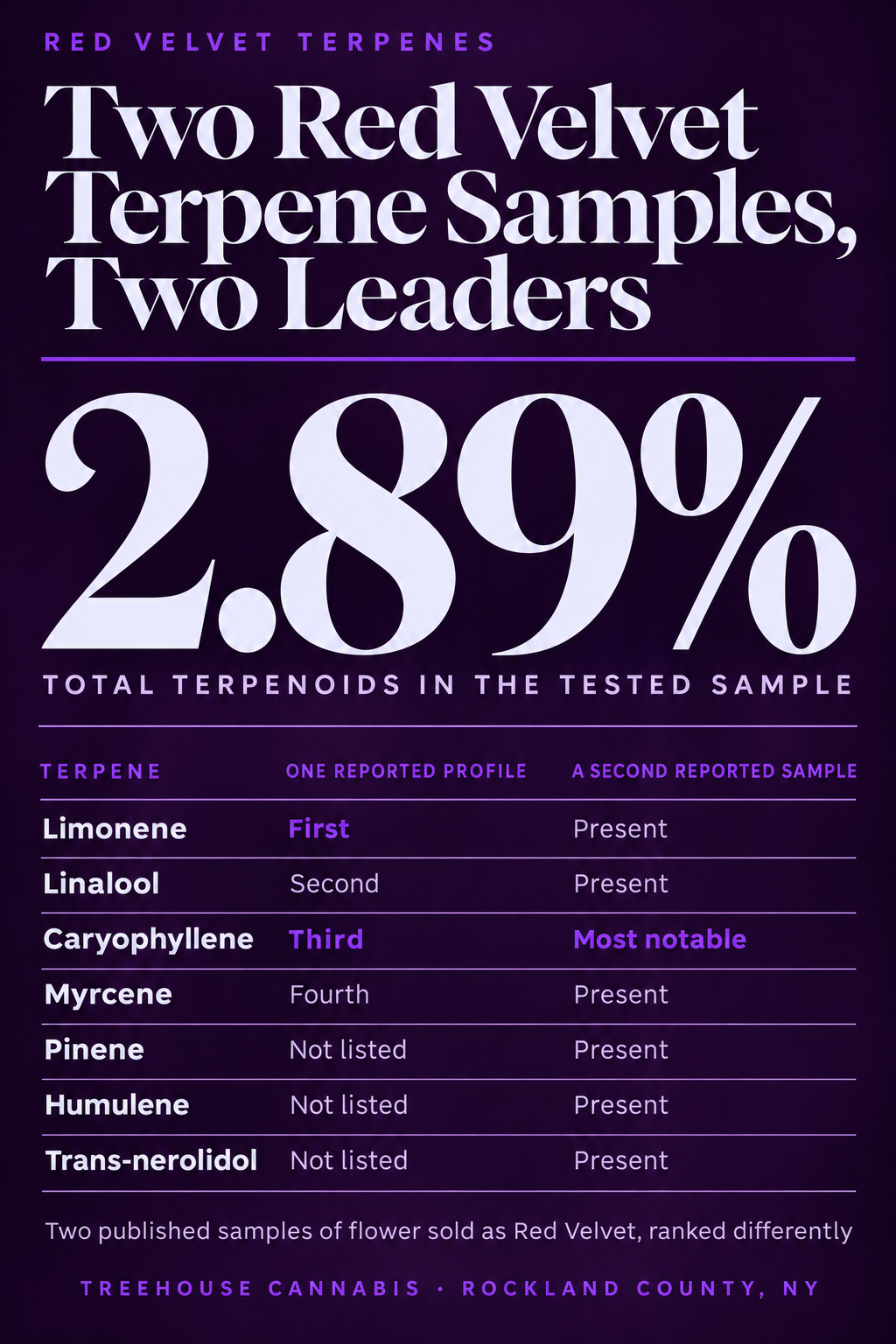
Limonene leads the reported terpene order in one published profile, ahead of linalool, beta-caryophyllene, and beta-myrcene. A second published sample put caryophyllene at the front instead, and that disagreement is more informative than either list on its own [6][5].
Here is the comparison, side by side:
| Terpene | One reported Red Velvet profile | A separate flower sample |
|---|---|---|
| Limonene | First | Present |
| Linalool | Second | Present |
| Beta-caryophyllene | Third | Most notable |
| Beta-myrcene | Fourth | Present |
| Pinene | Not listed | Present |
| Humulene | Not listed | Present |
| Trans-nerolidol | Not listed | Present |
One cultivar profile lists delta-limonene dominant ahead of linalool, beta-caryophyllene, and beta-myrcene [6]. A Florida flower sample sold under the name was reported with notable caryophyllene plus limonene, myrcene, pinene, humulene, linalool, and trans-nerolidol [5]. Same name, different leader, longer tail on one side.
Each compound has a documented property worth knowing, separate from its marketing reputation:
- Limonene: the simplest monocyclic monoterpene and the compound responsible for citrus fragrance, with preclinical antioxidant and anti-inflammatory activity in the literature and clinical evidence still early-stage [13].
- Linalool: the floral and rose note that reviewers keep describing.
- Beta-caryophyllene: pepper and spice, and the lead terpene in that separate Florida sample.
- Beta-myrcene: the earthy, herbal base sitting under the sweetness.
- Pinene, humulene, and trans-nerolidol: secondary notes recorded in the second sample, none of them dominant.
Stacked together, those compounds explain the sweet-spice-and-cream impression better than any single one does. Limonene supplies the citrus lift, linalool the floral middle, caryophyllene the pepper, myrcene the earthy floor. That is a description of aroma contribution, not of effect, and no terpene on that list treats anything.
Why the order flips between samples is the part worth carrying out of this section. A study characterizing foliar terpene profiles across 32 seed sources found large variation both within and between sets of plants labeled as the same cultivar, and identified incorrect cultivar labeling plus differences in terpene synthase gene expression as major drivers [9]. Two jars with the same name can genuinely hold different chemistry, and the study is measuring exactly that.
So the defensible position is narrow. A terpene panel is the best available description of how a specific batch will smell. It is a batch measurement, not a strain constant, and treating it as a fixed profile is how people end up disappointed by a jar that tested clean and smelled like hay. If you want the aroma delivered without combustion variables, All In One Vaporizers covers the hardware side of that choice.
How Strong Is the Red Velvet Strain?
Reported THC for the Red Velvet strain runs from about 15 to 38 percent depending on the source, with most listings clustering in the mid twenties. Leafly lists 26 percent, Weedmaps 20 to 29, SeedFinder near 27, HENDRX 21 to 35, and AllBud the widest band at 15 to 38 [1][4][2][6][3].
That spread is enormous, and it is not a data error:
| Source | Reported THC |
|---|---|
| Leafly | 26% |
| Weedmaps | 20-29% |
| SeedFinder | About 27% |
| HENDRX | 21-35% |
| AllBud | 15-38% |
A directory figure is a composite compiled from many submissions. A reported range is a spread across many grows. The low end of 15 percent describes a materially different product from the high end of 38, so the number is telling you about batches and measurement methods rather than about a strain.
A real certificate makes the point better than any range. An SC Labs PhytoFacts certificate for a Red Velvet flower sample collected in April 2023 reported 39.8 percent THCA, 0.5 percent THC, 1.0 percent CBGA, 0.4 percent CBCA, 0.2 percent THCVA, 0.2 percent CBG, and 0.1 percent CBDA, for 42.24 percent total cannabinoids and 2.89 percent total terpenoids at 13.1 percent moisture [7].
Two numbers on that panel matter more than the rest, and they are not the same number. THCA is the raw acid form. THC is what has already converted. Total THC is roughly THCA multiplied by 0.877, plus the listed THC:
- 39.8 percent THCA x 0.877 = about 34.9 percent
- plus 0.5 percent already-decarboxylated THC
- equals roughly 35.4 percent total THC [7]
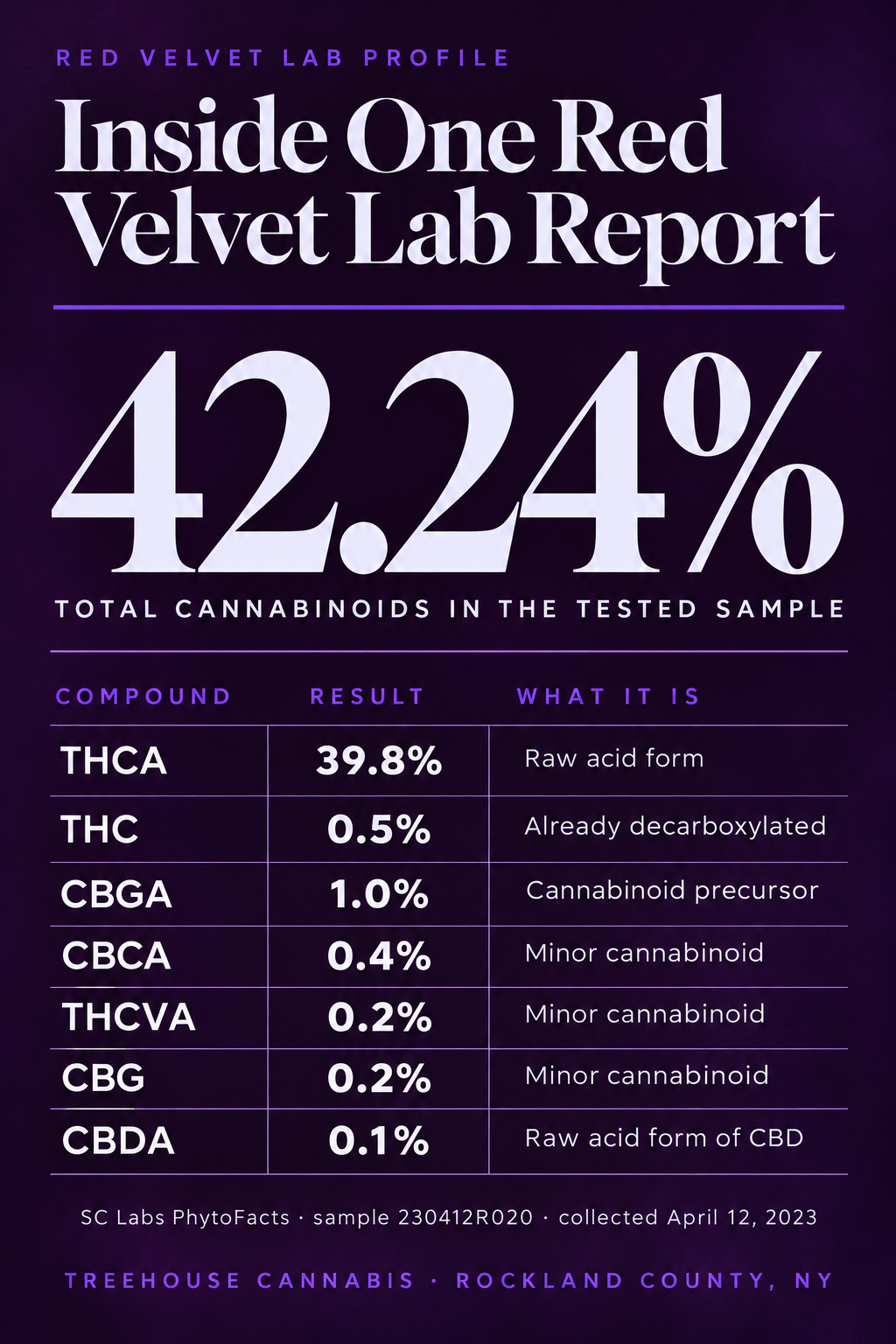
So the honest headline for that sample is about 35.4 percent total THC, not 39.8 percent. A menu quoting the THCA figure is not lying, but it is quoting the raw acid number, which is always the larger one. This is the single most common way potency gets inflated on a shelf talker without anyone intending to mislead.
The certificate also has limits worth naming. It identifies a tested sample, not a breeder, so a flower that tests under the name Red Velvet is not proof of the Grandiflora cut [7][2]. And one lot says nothing about the next harvest. Potency is batch language, and a certificate is a snapshot with a date on it, which is why the collection date belongs in the same sentence as the percentage.
One category distinction closes this out, because the two get conflated constantly. Regulated adult-use cannabis is not hemp. The federal hemp threshold is no more than 0.3 percent delta-9 THC on a dry-weight basis under the 2018 Farm Bill [14]. A product at that threshold is a different legal category entirely, and a 35 percent flower sample has nothing to do with it.
If you prefer the convenience format, Single Infused Pre Roll Pre_rolls covers pre-rolls, where the same potency variables apply to a smaller package.
Why Do Red Velvet Strain Batches Vary So Much?
Two things drive the variation. Several genetically different plants circulate under the Red Velvet name, and the chemistry of any single plant shifts with light, harvest timing, and cure. Genetics explains the first half, environment explains the second [2][11].
Start with the naming problem, because it is bigger than most customers expect:
- The naming problem: beyond the Grandiflora cut, breeders sell Cherry Pie and Burmese Thai crosses plus Orange Velvet and Redrum versions under the same words [2].
- Why it happens: strain names are valuable marketing terms with no enforced genetic standard behind them.
- The color pigment: cyanidin-3-rutinoside is the dominant anthocyanin in cannabis tissue [10].
- The color range: total anthocyanins measured up to 1187 mg per 100 g fresh weight in purple leaf against 3 mg per 100 g in green leaf from the same genotype [10].
- The environment: cannabinoids and terpenes accumulate in glandular trichomes as photo-protectants, and light spectrum shifts CBGA, THC, and terpene levels [11].
- The takeaway: batch evidence beats strain reputation when the name is this loosely held.
A jar labeled Red Velvet may contain no Lemon Cherry Gelato and no Pina Acai at all. That is usually not deception. It is what happens when a name is commercially valuable and unregulated as a genetic designation, so the words travel independently of the plant.
The color question deserves its own answer, because people buy this strain expecting purple and are surprised by green flower. The purple comes from anthocyanins, chiefly cyanidin-3-rutinoside, which is the dominant pigment in cannabis vegetative and floral tissue and determines the red-to-purple phenotype [10]. In one comparison, purple leaf measured as high as 1187 mg per 100 g fresh weight while green leaf from the same genotype measured 3 mg per 100 g [10].
That is a pigment pathway switching on or off under particular conditions, not a potency marker. Nothing about anthocyanin content tells you how strong the flower is, and a purple batch is not a stronger batch. This is also why many Red Velvet expressions show deep purple running through green with red-orange pistils while plenty of batches stay mostly green with only purple undertones - the visual traits the cultivar is described with are real, just inconsistent [3].
The environment side compounds it. Cannabinoids and terpenes accumulate in glandular trichomes as photo-protectants, and light spectrum and UV exposure measurably shift CBGA, THC, and terpene accumulation [11]. Two clones of the same plant, grown under different light and harvested a week apart, do not finish the same. Genetics sets the range, and the grow decides where inside that range a batch lands.
How Do You Choose a Red Velvet Strain at a Dispensary?
Judge the batch, not the name. Check bud structure, aroma intensity, trichome condition, and whether the package carries a certificate of analysis that matches the lot you are buying. With several plants sharing this name, the label on the jar is a starting point and the evidence attached to the batch is the answer [2][7].
Each check has a specific thing to look for:
- Structure: tree-shaped minty green buds with deep purple undertones and thick red-orange hairs, so a pale, loose, or heavily machined sample is not showing the traits the cultivar is known for [3].
- Aroma: cinnamon and red-hot spice over cherry should be immediate when the package opens, and hay or weak tea means the volatiles are gone [1][5].
- Trichomes: frosty and intact reads as fresh resin, while dull and matte reads as oxidation that has already started.
- The certificate: it ties the potency figure and the terpene panel to a specific tested lot rather than to a strain reputation [7].
- The terpene line: a batch with low limonene will not deliver the citrus the name promises, no matter what the THC number says [6].
- Cannabinoid form: check whether the quoted percentage is THCA or total THC, because those differ by roughly 12 percent at the top of the range [7].
Structure and trichome condition are condition indicators, not measurements. A dense, frosty bud does not guarantee a good experience and a slightly looser one is not spoiled. What those traits tell you is how the flower was handled and how long it has been sitting, which is genuinely useful information the potency number does not carry. Aroma does more work than any other check, because the cinnamon and red-hot note is the most fragile thing about this strain. If the package opens flat, the chemistry that made the name has already left, and a 30 percent THC figure will not put it back.
The question worth asking at the counter is short: which cut is this, and can I see the test for this batch? With several plants sharing the name and a breeder that never published a formal pedigree, lineage and lot data are the only things that separate one jar from another. A vague answer is itself information, because it usually means the name is all anyone has.
Flower is where the aroma traits are easiest to judge, so NY Diesel | Flower | 28g is a reasonable place to start comparing batches, and Green Crack | 7pk Hash infused Pre-Rolls | 3.5g covers the same ground in a single-serving format when you would rather not commit to an eighth. NY Diesel | Flower | 28g shows the format we use on our own labels: cultivar, weight, and potency tied to the batch.
Frequently Asked Questions
What is the Red Velvet strain?
Red Velvet is a dessert-leaning hybrid bred by Grandiflora Genetics in Oakland and popularized by Cookies. Most sources describe it as Lemon Cherry Gelato crossed with Pina Acai. It is known for cinnamon and red-hot spice layered over cherry, citrus, and vanilla cream, with a calming, full-bodied finish.[1][5][6]
Is the Red Velvet strain indica or sativa?
It is a hybrid, and the reported split varies by source. AllBud places it near 60 percent indica and 40 percent sativa, SeedFinder calls it fairly even, and Leafly's effect ratings lean calming. Treat it as an evening-friendly hybrid rather than a strict indica or sativa.[1][2][3]
What are the parents of Red Velvet cannabis?
The widely reported cross is Lemon Cherry Gelato and Pina Acai, both Grandiflora creations, confirmed on the record by Grandiflora's Prada. Lemon Cherry Gelato is generally described as Sunset Sherbet crossed with Girl Scout Cookies. Pina Acai's own parents have never been published, so the family tree stops there.[5][6][8]
Why do two batches of Red Velvet taste so different?
Several genetically different plants circulate under the name, including Cherry Pie and Burmese Thai crosses plus Orange Velvet and Redrum versions. Research across 32 seed sources also found large terpene variation within and between plants labeled the same cultivar, so genetics, lighting, and cure all shift the flavor.[2][9]
How potent is the Red Velvet strain?
Published ranges run roughly 15 to 38 percent THC depending on the source, with most listings clustering in the mid twenties. One SC Labs certificate for a Red Velvet flower sample reported 39.8 percent THCA, which works out to about 35.4 percent total THC after decarboxylation. Potency varies widely by batch.[3][4][6][7]
What does Red Velvet smell and taste like?
The nose typically leads with cinnamon or red-hot candy, then cherry and citrus, with vanilla and cream underneath. Reviewers also describe rose, floral, and fuel notes. On exhale it turns creamy and earthy with a spicy finish rather than staying purely sweet.[1][3][5]
Does the Red Velvet strain actually turn purple or red?
Sometimes, and not reliably. The color comes from anthocyanins, chiefly cyanidin-3-rutinoside, which accumulate in cannabis tissue under the right conditions. Many Red Velvet expressions show deep purple through green with red-orange pistils, but plenty of batches stay mostly green with only purple undertones.[3][10]
How do you read a Red Velvet lab report?
Check four things. THCA is the raw acid form, so total THC is roughly THCA multiplied by 0.877 plus the listed THC. Total terpenoids indicate aroma intensity. The test date tells you freshness. Then confirm the sample was flower from the batch you are buying, not a different lot.[7]
Sources
- Leafly — Leafly lists Red Velvet as a hybrid crossing Lemon Cherry Gelato with Pina Acai,
- SeedFinder — SeedFinder reports that the exact genetics of Red Velvet were never revealed by
- AllBud — AllBud describes Red Velvet as a 60% indica / 40% sativa hybrid from Lemon Cherr
- Weedmaps — Weedmaps gives a 20-29% THC range, repeats the Lemon Cherry Gelato and Pina Acai
- GreenState — GreenState reports Red Velvet was created by Grandiflora Genetics and popularize
- HENDRX Farm — HENDRX reports Grandiflora's Prada confirmed the Red Velvet cut came from Lemon
- SC Labs (PhytoFacts certificate of analysis) — An SC Labs certificate for a Red Velvet flower sample collected April 12, 2023 r
- Leafly — Leafly states that Pina Acai, one of Red Velvet's two parents, has publicly unkn
- Plant Physiology (PubMed Central) — Characterizing foliar terpene profiles across 32 seed sources, the authors found
- Antioxidants (PubMed Central) — This study identifies cyanidin-3-rutinoside (keracyanin) as the major anthocyani
- Frontiers in Plant Science — This review establishes that cannabinoids and terpenes accumulate in glandular t
- ACS Omega (PubMed Central) — Using two-dimensional gas chromatography, the authors identify a family of preny
- International Journal of Molecular Sciences (PubMed Central) — This review describes D-limonene as the simplest monocyclic monoterpene and the
- USDA Agricultural Marketing Service — The USDA sets the federal hemp threshold at no more than 0.3% delta-9 THC on a d
About Treehouse Cannabis
Treehouse Cannabis is a licensed adult-use dispensary in Rockland County, New York, serving customers 21 and older across Rockland, Orange, and Westchester Counties. The team lists genetics and potency for the flower and pre-rolls on the shelf, keeps terpene panels available on request, and will pull a package so you can read the label before it goes in the bag. Browse the current menu or order online for pickup and delivery.
Cannabis is for adults 21 and older. Keep all cannabis products out of reach of children and pets. Do not drive or operate machinery after use.
This article is educational and is not medical advice; it does not diagnose, treat, or cure any condition. Reported effects, potency, and terpene profiles vary between growers, harvests, and batches, and individual responses differ. Always buy cannabis from a licensed New York adult-use dispensary.


Shop our products

Shop All

Deals

Flower

Pre-rolls

Vaporizers

Edibles

Drinks

Concentrates

Tinctures

Topicals

CBD

Pet CBD

Accessories