
Topicals vs Transdermal Patches: Local vs Systemic Effects
Topicals vs Transdermal Patches: Local vs Systemic Effects
Topicals vs transdermal patches comes down to one question: does the cannabinoid need to enter your bloodstream? A topical is formulated to act in the skin where you put it, while a transdermal patch is engineered with permeation enhancers to carry cannabinoids through the skin and into circulation. That single design difference explains almost everything else — the blood levels, the onset, the intoxication risk, and whether a drug test can see it.
Both categories start with cannabinoids applied to skin, and both sit on the same shelf in packaging that talks about milligrams, which is where the confusion comes from. But a balm and a patch are solving different problems. One is built to stay put. The other is built to get through.
Topicals vs Transdermal Patches: What Is the Actual Difference?
The distinction is a delivery question, and the pharmaceutical literature spells it out. A 2022 review in Pharmaceutics separates topical delivery — creams, gels, lotions and oils used for local treatment of skin conditions — from transdermal delivery, which uses patches or gels engineered for systemic delivery over hours to days [1]. Local versus systemic is the whole distinction. It is not about potency, and it is not about which one is "stronger."
There is a hard physical reason the two behave differently. Cannabinoids are extremely lipophilic, with a logP of roughly 6 to 7, while the FDA's target range for transdermal drugs is 1 to 3. Transdermal candidates are also generally expected to be under about 500 Daltons, and cannabinoids sit at or above that line. Crossing skin is genuinely difficult for these molecules, which is why a patch has to add permeation enhancers and a rate-controlling layer to do it deliberately [1]. A lotion does not bother, because it is not trying to get anywhere.
Consumer-facing guidance draws the same line in plainer language: topicals are absorbed through the skin for localized effect and are non-intoxicating because they do not penetrate deep enough to reach the bloodstream, while transdermal patches do deliver cannabinoids to the bloodstream [12]. That framing holds up against the pharmacokinetic data, which is unusual for a shelf-talker claim.
In practice, the difference shows up in five places:
- Topical delivery means creams, balms, gels and oils intended to act in the skin where applied
- Transdermal delivery means a patch or gel engineered for systemic delivery over hours to days
- Cannabinoids have a logP of 6 to 7 against the FDA's 1 to 3 target for transdermal drugs
- Transdermal drugs are also expected to be under about 500 Daltons, so cannabinoids need chemical or physical permeation enhancement
- Local versus systemic is the whole distinction, not potency or strength
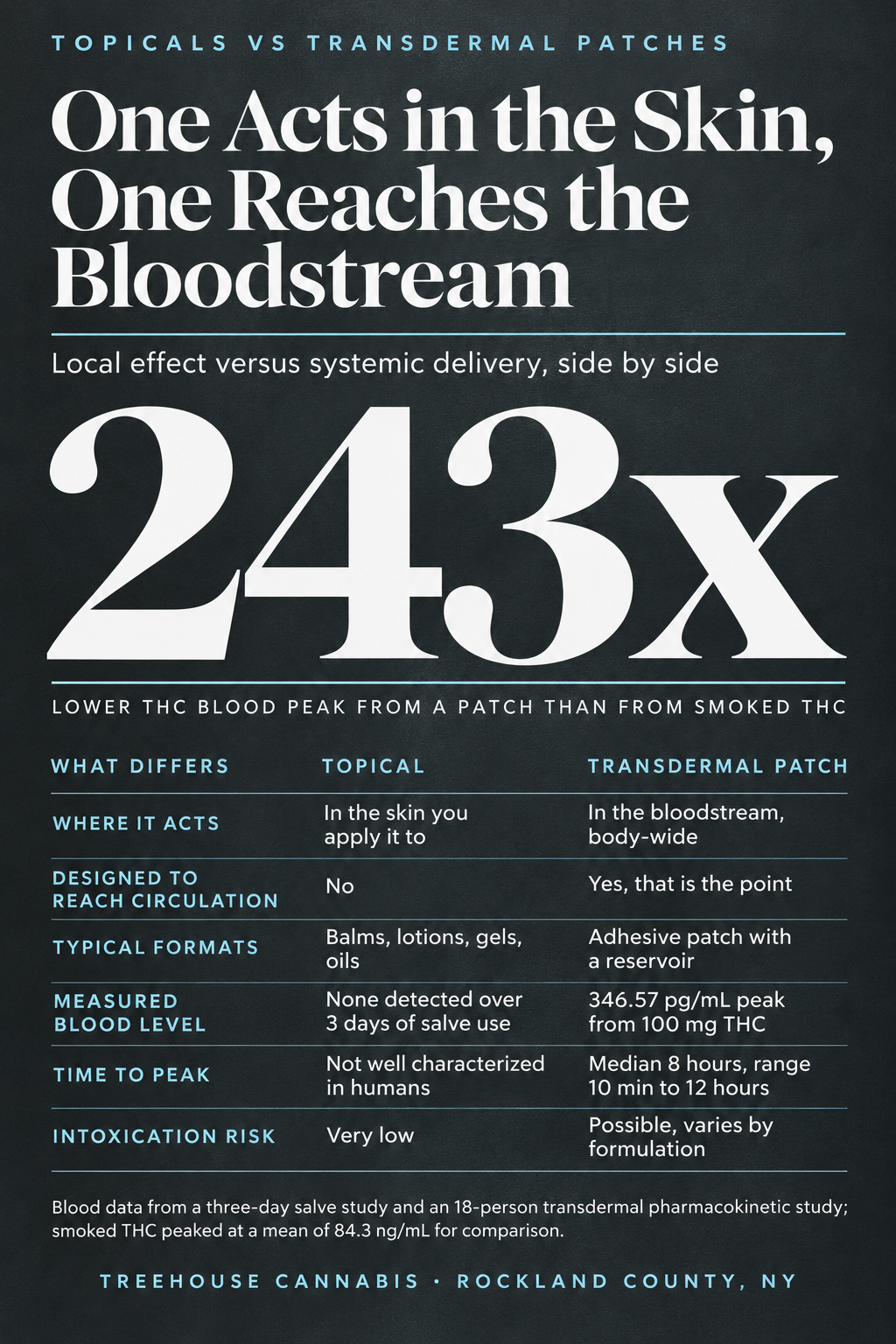
| What differs | Topical | Transdermal patch |
|---|---|---|
| Where it acts | In the skin you apply it to | In the bloodstream, body-wide |
| Designed to reach circulation | No | Yes, that is the design goal |
| Typical formats | Balms, lotions, gels, oils | Adhesive patch with a cannabinoid reservoir |
| Formulation strategy | Carrier that keeps cannabinoids in skin | Permeation enhancers plus rate control |
| Measured blood level | None detected over three days of salve use | 346.57 pg/mL peak from a 100 mg THC system |
| Time to peak | Not well characterized in humans | Median 8 hours |
| Intoxication risk | Very low | Possible, varies by formulation |
If you mainly want the short answer to whether a topical can intoxicate you, our explainer on Cannabis Topicals: Do They Get You High? covers that question on its own. The mechanics are the same ones described here: without meaningful absorption into circulation, there is nothing to produce a high.
How Do Cannabis Topicals Work Without Entering the Bloodstream?
A topical works without entering the bloodstream because skin is not a passive wrapper. It carries its own cannabinoid signaling machinery, so a topical does not need to reach the brain to do something. A review in Molecules documents that normal skin expresses CB1 and CB2 receptors across a wide range of structures [6]. The distribution is the point:
- Keratinocytes, the main cells of the outer epidermis, express both receptor types
- Hair follicles and sebaceous glands carry CB1 and CB2 receptors
- Melanocytes and fibroblasts express the same receptors
- Sensory nerve fibers in the skin express them as well
- TRP channels sit in many of the same structures, which is how a topical can affect sensation
Activating those receptors is a local event. The effect scales with where you applied the product, not with whole-body exposure, and that is exactly why the category exists.
The strongest human evidence for that local action is a forensic study that also happens to be the cleanest negative result in the literature. Three volunteers applied two commercial THC salves every two to four hours for three days, covering 50 to 100 square centimeters each time. All ten blood samples and all ten urine samples per volunteer came back negative for THC, 11-hydroxy-THC and 11-nor-9-carboxy-THC by GC-MS [4]. Nothing showed up because nothing got through in meaningful quantity.
The clearest controlled result comes from a double-blind randomized trial in 60 people receiving hemodialysis for chronic kidney disease who had persistent itch. A cannabis-containing cream beat placebo at week four, with a mean difference of -1.0 on the 0-10 worst-itch scale (95% CI -2.0 to -0.1, P = 0.03) [5]. It is one trial in one specific medical population, not proof of general benefit. Treehouse sells adult-use products rather than medicines, and a topical is not a substitute for medical care.
The honest limit is worth stating plainly. Clinical detailers at the University of Saskatchewan found that percutaneous absorption data for topical cannabis were almost entirely in vitro and animal work, and that the clinical evidence base was thin [9]. The receptor biology is real. The human outcome data is early. If you want the broader picture of how formats differ in practice, Flower, Vapes, Edibles, or Concentrates: Which Format Fits You? walks through the whole menu, and How Grind Size Changes the Way Cannabis Burns explains why preparation details change how plant material behaves at the other end of the spectrum.
How Do Transdermal Patches Get Cannabinoids Into the Bloodstream?
A patch gets cannabinoids into the bloodstream by defeating the skin barrier on purpose. Where a topical simply deposits cannabinoids on the surface, a transdermal system uses permeation enhancers to loosen the outer layer of skin and a rate-controlling element so release is slow and steady rather than front-loaded [1]. The engineering is not decoration. Without it, these molecules mostly stay where you put them.
The reason that engineering is necessary comes down to chemistry. Cannabinoids are highly hydrophobic, so crossing the aqueous layer of the skin is the rate-limiting step [3]. They are also not equally good at it: CBD and CBN permeate human skin about ten-fold better than delta-8-THC [3]. A patch formulator is therefore working against the molecule as much as against the skin.
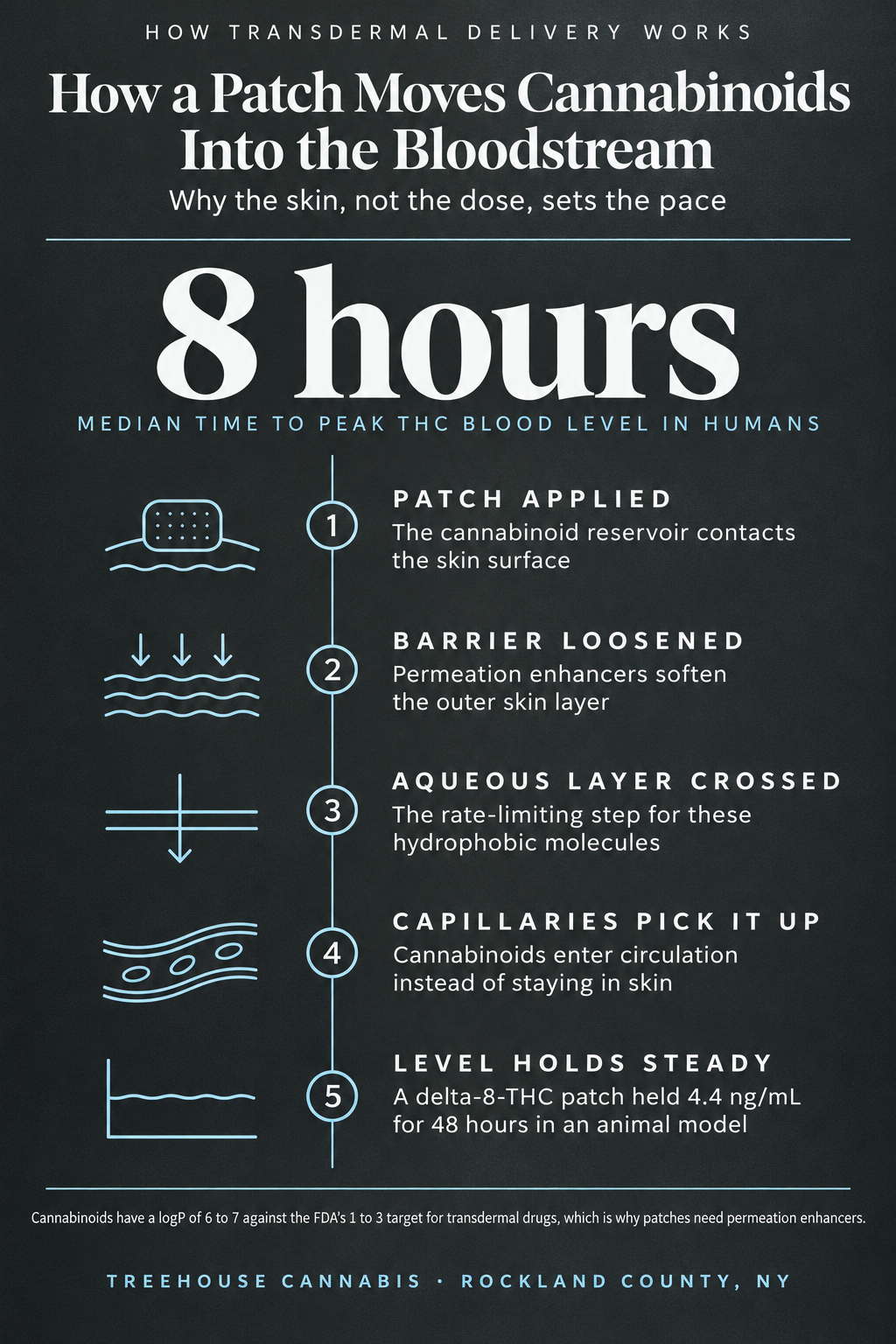
The delivery sequence looks like this:
- The patch is applied, bringing a cannabinoid reservoir into contact with the skin surface
- Permeation enhancers soften the outer skin layer
- The cannabinoid crosses the aqueous layer, which is the rate-limiting step
- Capillaries in the dermis pick it up and it enters circulation
- Blood levels hold on a plateau rather than spiking and falling
The numbers behind that plateau come from two different studies, and the species matters. In a transdermal therapeutic system built for delta-8-THC, human skin and hairless guinea pig skin showed comparable flux, meaning the skin itself — not the device — set the delivery rate, and mean steady-state plasma concentration reached 4.4 ng/mL within 1.4 hours and held for at least 48 hours [10]. That 4.4 ng/mL figure is an animal result, summarized in Huestis's pharmacokinetic review [3]. It is not a human measurement.
The human data are lower and slower. Eighteen healthy adults given 100 mg CBD plus 100 mg THC through a purpose-built transdermal system reached a CBD peak of 576.52 pg/mL and a THC peak of 346.57 pg/mL, with a median time to peak of 8 hours [2]. To compare in one unit: 346.57 pg/mL is about 0.347 ng/mL, and the animal steady state of 4.4 ng/mL is roughly 4,400 pg/mL.
Different molecules, different formulations, different species — which is exactly why no one should treat a patch as a standardized dose. None of these studies tested a retail product. For how patches compare with another systemic route, CBD Topicals vs Tinctures for Joint Pain looks at topicals and tinctures side by side.
Will a THC Topical or a Transdermal Patch Get You High?
The split answer is the accurate one: a topical realistically will not, and a patch can but the measured blood levels are tiny. Neither statement is a blanket guarantee, and the numbers are worth knowing rather than the vibe.
For topicals, the forensic study is unusually decisive. Three volunteers, two commercial THC salves, applied every two to four hours for three days over 50 to 100 square centimeters, and every one of ten blood and ten urine samples per volunteer was negative for THC and its two main metabolites by GC-MS [4]. The assay's limit of detection was 0.40 ng/mL for THC in blood, so this is a real negative from a sensitive method, not a loose screen that simply missed a low level [4].
For patches, the human pharmacokinetic study tells a different story. A 100 mg transdermal THC system in 18 healthy adults peaked at 346.57 pg/mL, which is about 0.347 ng/mL [2]. A 1.75% THC cigarette produced a mean peak of 84.3 ng/mL in the same body of pharmacokinetic work [3]. Divide one by the other and the patch peak is roughly 243 times lower. No psychoactive effects were reported at any timepoint in the patch study [2].
| Route | Measured peak | Notes |
|---|---|---|
| THC salve, applied every 2-4 hours for 3 days | None detected | GC-MS limit of detection 0.40 ng/mL in blood |
| Transdermal system, 100 mg THC | 346.57 pg/mL (0.347 ng/mL) | 18 adults, no psychoactive effects reported |
| Smoked, 1.75% THC cigarette | 84.3 ng/mL mean peak | Range across smoked studies 84.3 to 162.2 ng/mL |
What the three rows actually establish:
- Three days of frequent THC salve use produced zero detectable THC or metabolites in blood and urine
- The assay limit of detection was 0.40 ng/mL for THC, so this is a real negative, not a loose screen
- A 100 mg transdermal THC system peaked at 346.57 pg/mL, about 0.347 ng/mL
- A 1.75% THC cigarette peaked at a mean of 84.3 ng/mL, roughly 243 times higher
- No psychoactive effects were reported in the patch study, but one formulation at one dose does not cover the category
That 243-times gap is arithmetic between two specific studies, not a rule about the category. A 243-fold margin is large. It is also not a guarantee, because the study tested one formulation at one dose, and patch designs vary widely. Consumer guidance notes that patches can be intoxicating at high enough THC content [12]. The reasonable position is that a balm is very unlikely to intoxicate you and an engineered transdermal product deserves the same caution you would give any THC product you swallow.
How Long Does a Topical or a Patch Take to Work?
A patch takes hours, not minutes: in the human transdermal study, THC reached peak blood levels at a median of 8 hours, with individual peaks ranging from 10 minutes to 12 hours [2]. A median of 8 hours with that spread means a patch is not a fast-acting product, and that timing varies enormously between people. Being slow is a design feature rather than a flaw.
Earlier transdermal development work points at the intended behavior: steady state within about 1.4 hours, held for at least 48 hours in hairless guinea pigs [10]. A plateau rather than a spike is the whole point of a rate-controlling layer. Whether a given commercial patch holds anywhere near that long in a human is not established, so treat the animal 48-hour figure as a design target and nothing more.
Inhalation is the opposite profile. Smoked THC peaks within minutes and falls fast, with mean peaks between 84.3 and 162.2 ng/mL [3]. That is a spike, and it is why the subjective experience of smoking is so different from wearing a patch.
For topicals, the honest answer is that onset is not well characterized in humans. Most percutaneous absorption data are in vitro or animal work [9], so any specific minute figure you see quoted for a balm is not well supported by human measurement. What can be said is practical: a topical is reapplied to a specific area as needed, while a patch is placed once and left for its wear window.
| Format | Time to peak | Shape of the curve |
|---|---|---|
| Topical balm or lotion | Not well characterized in humans | Local, reapply as needed |
| Transdermal patch | Median 8 hours (range 10 min to 12 hours) | Slow rise, plateau |
| Smoked | Within minutes | Sharp spike, fast fall |
The timing points worth remembering:
- Median Tmax for transdermal THC in humans was 8 hours
- Individual peaks ranged from 10 minutes to 12 hours, so timing varies a lot between people
- A delta-8-THC patch held a plateau for at least 48 hours in an animal model
- Smoked THC peaks within minutes, between 84.3 and 162.2 ng/mL
- Topical onset in humans is not well characterized because most absorption data are preclinical
If you prefer an oil-based topical for a larger area, the Topical Oils Topicals selection is where to look, and texture matters more than most people expect when you are covering ground.
Which Is Better for Sore Muscles or Dry Skin, a Topical or a Patch?
A topical fits a specific sore spot you want to treat and re-apply. A patch fits a single area where you want slow, steady release that you do not have to think about for hours. That is the decision, and it usually resolves itself once you know which of those two situations you are in.
The tradeoffs are about control. With a topical you choose the exact area, the amount, and how often you go back to it, and the effect stays local. With a patch you commit to one placement and a delivery rate you cannot adjust once it is on your skin. Neither is more sophisticated. They answer different questions.
| Question | Topical | Transdermal patch |
|---|---|---|
| Can you choose the exact area? | Yes, apply it where it hurts | One placement, fixed once applied |
| Can you adjust the amount? | Yes, reapply as needed | No, the release rate is set by the patch |
| How long does one application last? | Until you reapply | Its wear window, several hours or more |
| Does it reach the bloodstream? | Not in measurable amounts | Yes, that is the design goal |
| Who controls the dose timing? | You do | The formulation does |
Format matters more than a milligram number on a topical. Balms, lotions, gels and oils differ in texture and in how they sit on skin, and in a porcine skin model permeation tracked particle size and formulation stability rather than labeled CBD content [7]. Two products with the same stated milligrams can therefore behave very differently. That finding is the single best argument for judging a topical by its formulation and its lab documentation rather than by the biggest number on the front of the jar.
Where each format tends to make sense:
- A topical when the area is specific and you want to reapply through the day
- A topical when you want to avoid anything systemic
- A patch when you want one placement and steady release without reapplication
- A patch when the area is awkward to reach repeatedly
- Neither when pain or a skin problem persists, which is a conversation with a clinician
The rule of thumb: control the spot, use a topical. Set it and forget it, use a patch. For a classic local product, our Balms Topicals collection covers the category, and a heavier option like Warrior Balm 2.0 | 1800mg is the kind of thing people reach for after a long day on their feet.
Do Cannabis Topicals and Patches Show Up on a Drug Test?
Ordinary topicals are very unlikely to show up on a drug test, while a patch engineered to reach circulation can. The two categories genuinely differ, so split the answer: for ordinary topicals the evidence points strongly toward no, and for patches built for systemic delivery, treat the risk as real.
The topical evidence comes from the three-day forensic study. Three volunteers, two commercial THC salves, application every two to four hours for three days over 50 to 100 square centimeters, and ten blood plus ten urine samples per volunteer, all negative for THC, 11-hydroxy-THC and 11-nor-9-carboxy-THC [4]. The method was GC-MS with limits of detection of 0.40 ng/mL for THC in blood and 1.2 ng/mL for THC-COOH in urine. Those are tight limits, and nothing crossed them.
The mechanism explains why. Cannabinoids are highly hydrophobic, and crossing the aqueous layer of the skin is the rate-limiting step [3]. A lotion does not build blood levels because it cannot get enough material through that barrier fast enough to matter.
| Category | Blood or urine finding | Practical read |
|---|---|---|
| Ordinary topical (salve, balm, lotion) | Zero positives across 10 blood and 10 urine samples per volunteer | Very unlikely to affect a test |
| Transdermal patch engineered for systemic delivery | Measurable plasma THC, 346.57 pg/mL peak from 100 mg | Carries real risk, do not assume otherwise |
The specifics behind that table:
- Three volunteers, salve applied every 2 to 4 hours for three days, zero positives in ten blood and ten urine samples each
- Detection limits were 0.40 ng/mL for THC in blood and 1.2 ng/mL for THC-COOH in urine
- Hydrophobic cannabinoids cross the skin's aqueous layer slowly, so a lotion does not build blood levels
- A product engineered to reach circulation did produce measurable plasma THC in 18 adults
- This is not legal or medical advice, and one small study does not guarantee any individual's result
Patches are the harder case because they are designed to do the thing topicals do not. The human study produced measurable plasma THC in 18 adults [2], so a product built to reach circulation should be treated as capable of contributing to a test rather than assumed clean.
Two caveats close this out. One small study is not a guarantee for any individual, and anyone facing a test with consequences should treat any THC product as a possible risk and get proper advice rather than relying on a blog post. This is not legal or medical advice. If you want to see the local product range in one place, the Topicals category page lists what is available.
Can You Trust the Label on a Cannabis Topical or Patch?
There is no FDA approval behind these products, so the label is a marketing claim rather than a regulatory guarantee. That is the frame to hold before reading any milligram number. NCCIH states that the FDA has not approved the cannabis plant for any medical use, and has only cleared isolated-cannabinoid drugs such as Epidiolex and dronabinol for specific conditions [11]. The same source describes the evidence for chronic pain as modest.
The product-testing picture is worse than the regulatory one. Thirteen over-the-counter cannabis products were tested in a porcine skin model, and nearly every label understated or misstated actual cannabinoid content. Permeation tracked particle size and formulation stability rather than the labeled CBD content [7]. A confident number on a jar is not evidence of anything except confidence.
Reviews in the clinical literature land in the same place. Dermatologists concluded that consumer use of over-the-counter topical cannabinoids has far outpaced scientific investigation into their safety and efficacy [8]. Clinical detailers found no well-designed randomized controlled trials supporting topical cannabis, with the few available studies unblinded and lacking control groups [9]. It is worth noting the demand is not irrational: a pilot survey reported in the Pharmaceutics review found 75% of dermatologists willing to recommend topical cannabinoids, citing convenience and the absence of psychoactive concern [1]. Interest and evidence are simply at different stages.
A practical label checklist:
- Total cannabinoids per unit, and whether the number is per container or per application
- Whether a batch-specific lab result is published, not just a general claim
- Who manufactured it, with a real business name and address
- Whether the seller holds a New York cannabis license
- Whether the product is described as cosmetic or adult-use rather than as a treatment
That last point has a legal floor under it. New York's adult-use framework sets purchase and possession at 21 and older and runs a separate medical program [13]. Products sold through licensed adult-use channels are not medicines, and a label that implies otherwise is telling you something about the seller.
Topicals vs Transdermal Patches: What Is the Bottom Line?
Topicals and transdermal patches are two solutions to the same starting problem, and the difference is entirely about where the cannabinoids end up. A topical is formulated to act in the skin, and three days of heavy salve use produced no detectable THC in blood or urine [4]. A patch is engineered with permeation enhancers and rate control to reach circulation, and a 100 mg transdermal system peaked at 346.57 pg/mL — about 0.347 ng/mL — roughly 243 times below a smoked peak [2][3].
| At a glance | Topical | Transdermal patch |
|---|---|---|
| Acts where | In the skin you apply it to | Body-wide, via circulation |
| Detectable blood THC | None over three days of salve use | 346.57 pg/mL peak from 100 mg |
| Time to peak | Not well characterized in humans | Median 8 hours |
| Intoxication risk | Very low | Possible, varies by formulation |
| Onset control | You reapply as needed | Fixed once you put it on |
| FDA approved as a medicine | No | No |
The four points that matter:
- A topical acts locally, in the skin where you apply it, without needing to reach the bloodstream
- A patch is built to cross the skin barrier slowly and steadily, and it does reach circulation
- Measured blood levels from a patch are real but far lower than smoking, so intoxication is possible rather than inevitable
- Label claims are not FDA approvals, so formulation and lab documentation matter more than a milligram number
Treehouse Cannabis carries topicals for adults 21 and older in Rockland, Orange and Westchester County, with clear labeling so you know what you are putting on your skin. If you want a local product you control, start with a balm or lotion and read the batch information before the milligram count.
Frequently Asked Questions
What is the difference between topicals and transdermal patches?
Topicals are creams, balms, gels and oils meant to act in the skin where you apply them, and they are not designed to reach the bloodstream. Transdermal patches use permeation enhancers and a rate-controlling layer to move cannabinoids through the skin into circulation over hours or days. Local effect versus systemic effect is the entire distinction.
Will a THC topical get you high?
Realistically, no. In a forensic study, volunteers who applied THC salves every 2 to 4 hours for three days produced no detectable THC or metabolites across ten blood and ten urine samples each. THC is highly lipophilic and crosses the skin's aqueous layer slowly, so a lotion or balm does not deliver enough to reach psychoactive blood levels.
Can a transdermal cannabis patch get you high?
It is possible, but the measured levels are small. Healthy adults using a purpose-built transdermal system with 100 mg THC peaked at about 347 picograms per milliliter, roughly 243 times lower than a typical smoked peak of 84 nanograms per milliliter. That formulation produced no reported psychoactive effects, though patch designs vary widely.
How long does a cannabis patch take to work?
Slower than anything you smoke or eat. In human pharmacokinetic work, transdermal THC reached peak blood levels at a median of 8 hours, with individual peaks ranging from 10 minutes to 12 hours. An earlier patch study in guinea pigs reached steady state in about 1.4 hours and held it for 48.
Do topicals or patches show up on a drug test?
Ordinary topicals are very unlikely to. Three days of frequent salve application produced no positives in blood or urine at detection limits of 0.40 ng/mL for THC. Patches that genuinely deliver cannabinoids to the bloodstream carry more risk, so treat an engineered transdermal product differently from a muscle balm.
Why do topicals work if they don't enter the bloodstream?
Because skin has its own endocannabinoid system. CB1 and CB2 receptors sit on keratinocytes, sebaceous glands, melanocytes, fibroblasts and sensory nerve fibers, and TRP channels are distributed through many of the same structures. Activating those locally can affect inflammation, itch signaling and nerve activity without a whole-body effect.
Are cannabis topicals FDA approved?
No. The FDA has not approved the cannabis plant for any medical use and has only cleared isolated-cannabinoid drugs like Epidiolex and dronabinol for specific conditions. Over-the-counter topicals and patches are sold as cosmetic or adult-use products, not approved medicines, so label claims deserve skepticism.
Which is better for sore muscles, a topical or a patch?
A topical is the better fit for a specific sore spot, because you control where it goes and how much you use, and the effect stays local. A patch makes more sense when you want slow, steady release over many hours on one area. Neither is a substitute for medical care if pain persists.
Sources
- Pharmaceutics (PubMed Central) — This review draws the line between the two product classes directly: topical del
- Advances in Therapy (PubMed Central) — In 18 healthy adults given 100 mg CBD and 100 mg THC through a purpose-built tra
- Chemistry & Biodiversity / NIDA (PubMed Central) — Huestis reports that after application of a transdermal patch, mean steady-state
- Forensic Science International (Bonn Institute of Forensic Medicine) — Three volunteers applied two commercial THC salves every 2-4 hours for three day
- Kidney Medicine (PubMed Central) — This double-blind randomized trial in 60 hemodialysis patients found a cannabis-
- Molecules (PubMed Central) — This review documents that normal skin is rich in CB1 and CB2 receptors across k
- ACS Pharmacology & Translational Science (PubMed Central) — Thirteen over-the-counter cannabis products were tested in a porcine skin model
- Cutis (MDedge) — Dermatologists reviewing the literature concluded that patient use of over-the-c
- RxFiles Academic Detailing (University of Saskatchewan) — This clinical Q&A states that no well-designed randomized controlled trials exis
- Journal of Pharmaceutical Sciences — Valiveti and colleagues built a transdermal therapeutic system for delta-8-THC,
- National Center for Complementary and Integrative Health (NIH) — NCCIH confirms the FDA has not approved the cannabis plant for any medical use,
- Leafly — Leafly's consumer guide states that topicals are lotions, balms and oils absorbe
- New York State Office of Cannabis Management — New York's adult-use framework sets purchase and possession at 21 and older and
About Treehouse Cannabis
Treehouse Cannabis is a licensed adult-use dispensary in Rockland County, New York, serving customers across Rockland, Orange, and Westchester Counties. The shop carries topicals, balms, lotions and gels, and the team will walk you through which format fits the area you are treating before you buy.
Cannabis is for adults 21 and older. This article is educational and is not medical advice. Keep all cannabis products out of reach of children and pets, do not drive or operate machinery after use, and talk to a clinician if pain, itch or a skin problem persists. Treehouse Cannabis sells adult-use products, not medicines.


Shop our products

Shop All

Deals

Flower

Pre-rolls
Vaporizers

Edibles

Drinks

Concentrates
Tinctures

Topicals

CBD

Pet CBD

Accessories