
Why Does Cannabis Cause Dry Mouth and Red Eyes?
Why Does Cannabis Cause Dry Mouth and Red Eyes?
The science behind cottonmouth, bloodshot eyes, and what your body is actually doing.
Cannabis causes dry mouth and red eyes because THC binds to CB1 cannabinoid receptors in the salivary glands and in the blood vessels of the eye. The same compound drives both effects, and both come from pharmacology, not from smoke or dehydration [7].
A quick note before we dig in: strain labels like "indica" and "sativa" don't actually predict whether you'll get cottonmouth or red eyes. Both effects come from THC's pharmacology, not from the cultivar name. Indica vs Sativa: Why the Labels Are Mostly Meaningless
Why Does Cannabis Cause Dry Mouth and Red Eyes in the First Place?
Cannabis causes dry mouth and red eyes because THC binds to CB1 cannabinoid receptors in two different places at once. In the salivary glands, that binding tells the glands to make less saliva. In the blood vessels of the eye, that binding tells the vessels to widen and fill with more blood.
Both effects are pharmacological, not mechanical, which is why they show up the same way whether you smoke, vaporize, or eat your cannabis. It's also why the effects feel so automatic and so hard to push through with willpower: THC is plugging into a signaling system your body already uses every day (the endocannabinoid system) and rerouting it.
A quick map of the two pathways:
- Cottonmouth: THC → CB1 receptors → cholinergic nerves → submandibular salivary gland → less saliva
- Red eyes: THC → CB1 and CB2 receptors → blood vessel walls in the conjunctiva → wider vessels → red sclera
This is also why THC's other well-known effects show up through the same family of receptors. If you've ever wondered why a single session can leave your mouth dry, your eyes red, and your snack cravings suddenly urgent, the answer is one system doing three things at once. Why Does Cannabis Give You the Munchies?
What Is Cottonmouth and Why Does Weed Give It to You?
Cottonmouth from weed is caused by THC plugging into CB1 receptors on the nerves that control the submandibular salivary gland under your jaw, which tells the gland to release less acetylcholine and produce less saliva [1].
A 2022 NIH study confirmed the exact mechanism. CB1 receptors sit directly on the cholinergic axons that innervate the submandibular gland, and activating them turns down saliva production step by step. The same pathway is used by the body's own endocannabinoids to regulate baseline salivation, which is why cottonmouth feels so automatic and hard to override with willpower alone.
A clinical review of chronic cannabis use confirmed the broader picture: regular cannabis use is associated with xerostomia (the clinical term for persistent dry mouth), and CB1 and CB2 receptors have been identified in the submandibular glands themselves [2]. The review noted direct implications for oral comfort, dental health, and anesthesia planning for regular users.
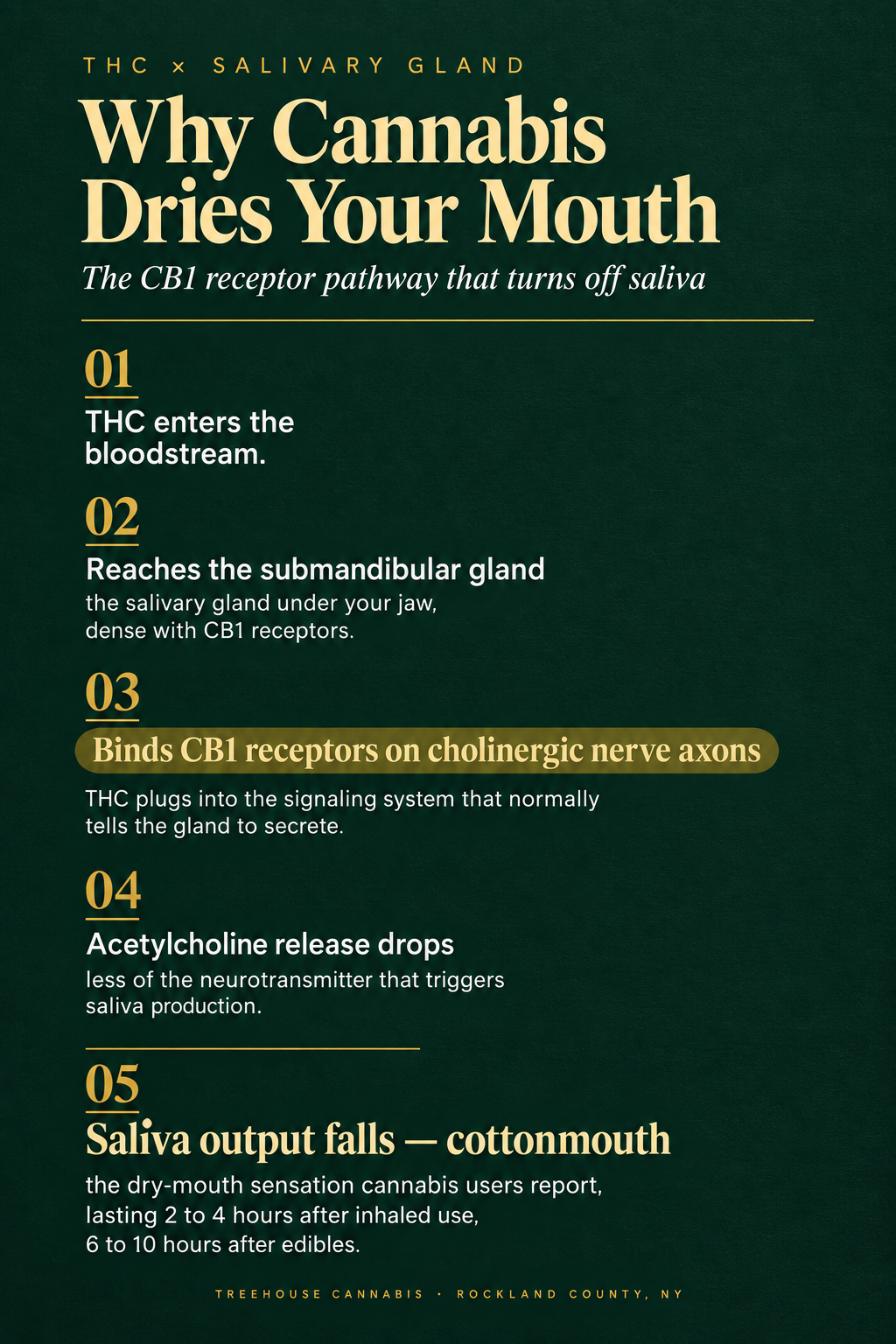
Step by step, the cottonmouth pathway looks like this:
- You inhale or ingest cannabis. THC enters the bloodstream and circulates through the body.
- THC reaches the submandibular salivary gland under your jaw.
- THC binds CB1 receptors on the cholinergic nerve axons at the gland.
- The gland releases less acetylcholine, the chemical signal for saliva production.
- Saliva output drops sharply — that is cottonmouth.
The practical upshot: drinking more water helps, but it doesn't fix the underlying signal. Your gland isn't producing less because you're thirsty — it's producing less because THC has temporarily turned down the acetylcholine tap. Stimulating saliva production through chewing or sour flavors tends to work better than gulping liquids.
Is the Smoke Making Your Eyes Red, or Is It the THC?
Red eyes after cannabis are caused by THC, not by smoke. Cannabinoids bind to receptors in blood vessel walls and cause vasodilation, which increases blood flow to the eyes and turns the normally white sclera pink or red [6].
The clearest proof is that edibles and tinctures, which involve no smoke at all, produce the same red-eye effect. If smoke were the cause, capsules and gummies wouldn't make your eyes red. They do. That fact alone settles the question.
- Edibles with no smoke: still produce red eyes.
- Tinctures with no smoke: still produce red eyes.
- Topical cannabis: generally does not produce red eyes because THC does not reach the bloodstream in significant amounts.
- Smoking cannabis: produces red eyes, but the cause is the THC, not the combustion.
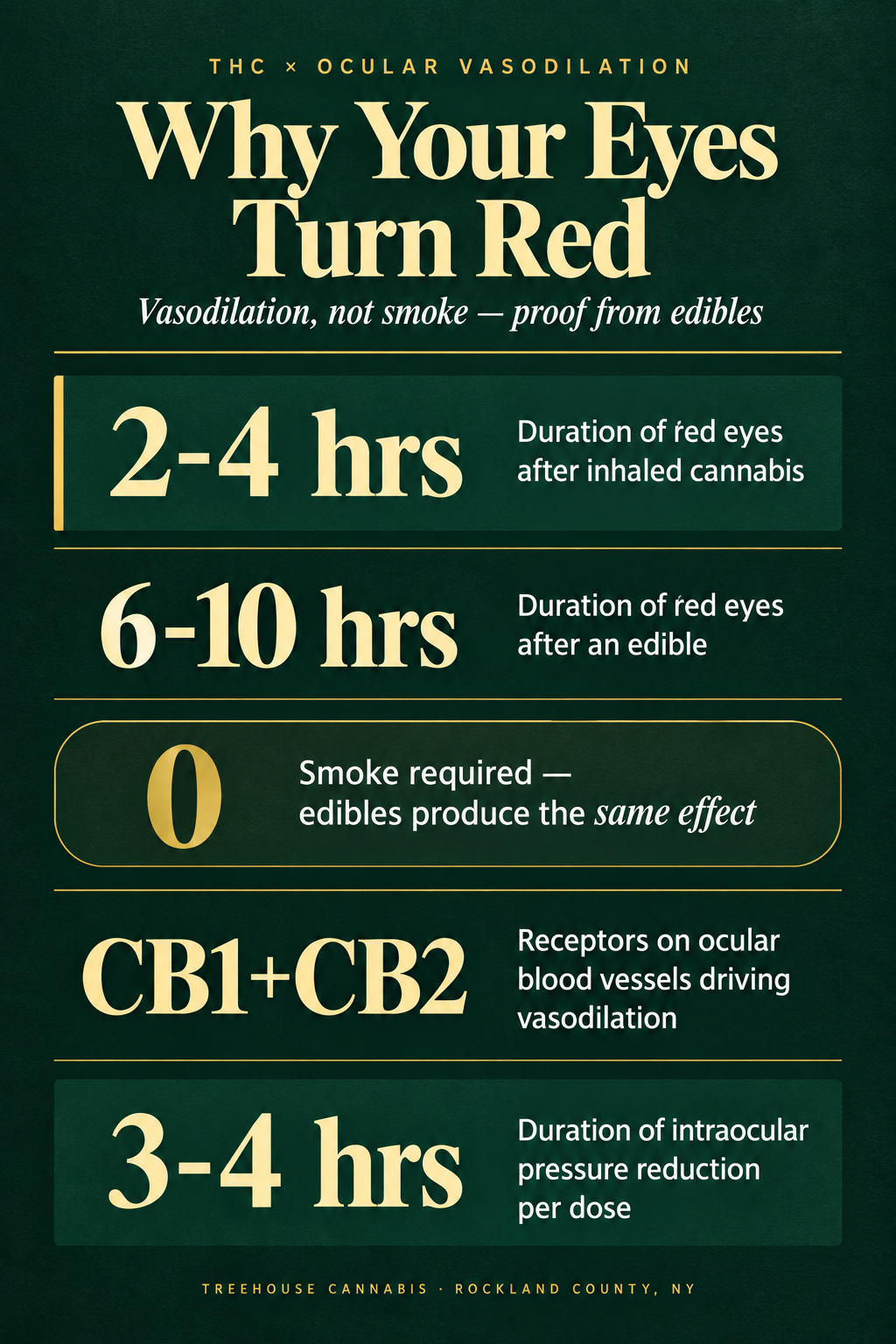
The mechanism is pharmacological. THC binds CB1 and CB2 receptors on vascular smooth muscle and triggers vasodilation. As the conjunctival capillaries expand and fill with blood, the white of the eye takes on a pink or red cast. The same vasodilation also produces a small drop in blood pressure, which is one reason some customers feel briefly lightheaded when they stand up after a session [8].
This is also why over-the-counter get-the-red-out eye drops work — they constrict the same blood vessels, reducing the visible redness without changing how high you feel.
How Does THC Lower Blood Pressure and Make Your Eyes Red?
THC lowers blood pressure and produces red eyes through the same vasodilation pathway, just expressed in different parts of the body. Cannabinoids bind receptors on vascular smooth muscle and trigger the vessels to widen, dropping peripheral resistance and lowering blood pressure while also increasing blood flow to the conjunctiva [8].
In the eye, that widening is visible. The conjunctival capillaries sit right at the surface, so when they fill and expand, the normally white sclera takes on a pink or red appearance. In the rest of the body, the same vasodilation is invisible — but it can show up as a warm flush, a slight drop in blood pressure, or a brief head-rush when you stand up too fast.
There is one eye-specific effect that runs through the same general pathway. THC can lower intraocular pressure (IOP) for roughly three to four hours per dose [5]. A 2024 NIH review noted that marijuana and THC lower intraocular pressure in roughly 60% to 65% of healthy adults and glaucoma patients, with a mean reduction around 25% in some studies [4].
The same review also notes why this hasn't translated into a glaucoma treatment: the effect is short-lived, and glaucoma is a 24-hour disease that requires steady pressure control. The American Academy of Ophthalmology does not recommend cannabis as a glaucoma treatment because the short duration and side effects outweigh the modest pressure reduction [5].
A separate 2024 narrative review confirmed that the red-eye effect comes from the same vascular mechanism — THC-induced vasodilation in conjunctival vessels — and that the same pathway drives both the visible redness and the IOP drop [3].
Quick recap of what the vasodilation pathway produces:
- Red eyes: THC widens conjunctival capillaries, making the white sclera look pink or red.
- Lowered blood pressure: the same vasodilation drops peripheral resistance across the body.
- Lightheadedness on standing: the temporary BP drop shows up as a head-rush when you stand up quickly.
- Brief IOP reduction: the same vascular effect can lower eye pressure for three to four hours per dose.
Does CBD Cause Dry Mouth and Red Eyes the Same Way THC Does?
CBD can cause mild dry mouth, but the mechanism is different and generally less intense than THC's. THC is a strong direct agonist at the CB1 receptor that drives saliva production down, while CBD works more indirectly and at lower binding affinity [1].
Red eyes are much less common with CBD-only products for the same reason. The pronounced vasodilation that produces the red-eye look is driven primarily by THC's action on vascular CB1 and CB2 receptors. If red eyes are a problem for you, choosing a high-CBD or balanced product over a high-THC flower is one of the most reliable ways to avoid the effect.
How CBD and THC compare on the two visible side effects:
- Cottonmouth: THC is a direct CB1 agonist and reliably drops saliva output; CBD is a weak indirect modulator and only sometimes produces mild dryness.
- Red eyes: THC-driven vasodilation is strong and visible; CBD alone rarely produces the red-eye look.
- Onset: both products produce dryness and eye effects only after THC has reached the bloodstream.
- Dose dependence: cottonmouth and red-eye severity scale with THC dose, not with CBD dose.
- Reversibility: the effects fade as the cannabinoids clear — faster for inhaled, slower for ingested.
| Product type | Cottonmouth risk | Red-eye risk | Why |
|---|---|---|---|
| CBD-only products | Mild | Uncommon | Indirect CB1 modulation, no strong vasodilation |
| Balanced THC:CBD | Moderate | Mild to moderate | CBD softens the THC response for some users |
| High-THC flower | High | High | Direct CB1/CB2 activation in salivary nerves and blood vessels |
This is also part of why product choice matters more than strain labels. What Makes Premium Cannabis Flower Cost More? The indica/sativa split doesn't predict these effects — THC percentage and route of administration do. Flower
For customers looking to compare options side by side, our flower menu shows current THC and CBD percentages, terpene profiles, and pricing so you can pick a product that fits your tolerance. NY Diesel | Flower | 28g
What Actually Helps with Cottonmouth from Weed?
Water helps with cottonmouth, but it's not the strongest fix. The most effective steps are the ones that stimulate saliva production rather than just adding liquid — because the underlying problem is a turned-down signal from the CB1 receptors, not a hydration deficit.
Practical steps that work:
- Sip water slowly rather than gulping — slow sipping keeps your mouth moist between drinks.
- Chew sugar-free gum or suck on a lozenge — the chewing action triggers saliva production through a separate pathway that THC doesn't block.
- Eat tart or crunchy foods — sour flavors (lemon, pickles, sour candy) and crisp textures (apples, celery) both kick saliva production into gear.
- Avoid alcohol-based mouthwashes — they make the dryness worse by stripping moisture from the oral tissues.
- Try an OTC saliva substitute for stubborn cases — dry-mouth rinses and sprays coat the tissues and buy comfort until the effect wears off.
For most adult customers, the discomfort fades on its own within a few hours as THC clears the system. A popular balanced option that customers in Rockland County reach for is the NY Diesel | Flower | 28g — the moderate THC content is enough to be effective without making the dryness unmanageable. NY Diesel | Flower | 28g
How Do You Get Rid of Red Eyes from Cannabis?
Time, eye drops, and lower-THC products are the most reliable ways to clear red eyes from cannabis. The cause is vasodilation, not dehydration, so drinking more water before or during a session won't shrink the blood vessels and won't prevent the redness.
What does work:
- Time. The redness fades as THC clears your system — typically within two to four hours for inhaled cannabis [7].
- Antihistamine or get-the-red-out eye drops. They work by constricting the blood vessels in the conjunctiva, which reduces the visible redness without affecting how high you feel.
- Lower-THC products. Choosing a balanced or high-CBD product over a high-THC flower dramatically reduces the vasodilation response.
- Caffeine. Caffeine also constricts blood vessels, which is why a cup of coffee can take the edge off the redness for some users.
For most adult customers, red eyes from cannabis are harmless and temporary. See an optometrist if the redness persists without cannabis use, if it comes with pain, blurred vision, or discharge, or if it doesn't resolve within a few hours after a session. Those are signs of a different problem.
How Long Do Cottonmouth and Red Eyes from Cannabis Last?
Both effects are temporary and track the active window of THC in your system. For inhaled cannabis, expect dry mouth and red eyes to fade within two to four hours as the high tapers. For edibles, the effects can last six to ten hours, sometimes longer at high doses [7].
How long symptoms last depends on how the THC got into your system:
- Inhaled: onset within minutes; symptoms last 2 to 4 hours.
- Edibles: onset 30 to 90 minutes; symptoms last 6 to 10 hours.
- Sublingual tinctures: onset 15 to 30 minutes; symptoms last 4 to 6 hours.
| Route of administration | Onset | Duration of dry mouth + red eyes |
|---|---|---|
| Inhaled (smoked or vaporized) | Within minutes | 2 to 4 hours |
| Edibles | 30 to 90 minutes | 6 to 10 hours |
| Sublingual tinctures | 15 to 30 minutes | 4 to 6 hours |
A quick note on freshness: how your cannabis is stored affects the smell, flavor, and potency over time, but it doesn't affect whether you get cottonmouth or red eyes. How Long Does Weed Stay Fresh? Those effects are driven by THC itself, not by how old the flower is. Properly stored flower can stay fresh for many months without losing potency.
For customers in Rockland, Orange, and Westchester Counties, the practical takeaway is to plan around the timing. If you have a meeting, an event, or any situation where dry mouth or red eyes would be a problem, give yourself a few hours between your session and the commitment.
What Are the Most Common Questions About Cannabis and Your Body's Response?
Here are the answers customers ask most often:
- Why does cannabis cause dry mouth (cottonmouth)?
- Why does cannabis make your eyes red?
- Is the smoke or the THC actually responsible for red eyes?
- How long do cottonmouth and red eyes usually last?
- Does CBD cause the same dry mouth and red eyes as THC?
- Can cannabis actually help with glaucoma?
- What really helps with cottonmouth from weed?
- Does drinking more water prevent red eyes from cannabis?
Why does cannabis give you dry mouth?
Cannabis triggers dry mouth because THC binds to CB1 cannabinoid receptors on the nerves that control the submandibular salivary gland under your jaw. When those receptors fire, the gland releases less acetylcholine, the chemical signal that tells the gland to produce saliva, and saliva output drops sharply [1]. A 2022 NIH study confirmed this is the same CB1 pathway the body's own endocannabinoids use to regulate baseline salivation.
Why does weed make your eyes red?
THC widens blood vessels throughout the body, including the tiny capillaries in the whites of your eyes. As those vessels expand and fill with more blood, the normally white sclera takes on a pink or red appearance [3]. The same vasodilation also lowers blood pressure, which is one reason some people feel lightheaded when they stand up after a session.
Is it the smoke that makes your eyes red, or is it actually the THC?
It is the THC, not the smoke. Cannabinoids bind to receptors in blood vessel walls and cause them to dilate, increasing blood flow to the eyes. The clearest proof is that edibles and tinctures, which involve no smoke at all, produce the same red-eye effect [6].
How long do cottonmouth and red eyes from cannabis usually last?
Both effects are temporary and generally track the active window of THC in your system. For inhaled cannabis, expect dry mouth and red eyes to fade within two to four hours as the high tapers. For edibles, the effects can last six to ten hours, sometimes longer with very high doses [7].
Does CBD cause dry mouth and red eyes the same way THC does?
CBD can cause mild dry mouth, but the mechanism is different and generally less intense than THC. THC is a strong direct agonist at the CB1 receptor that drives saliva production down, while CBD works more indirectly and at lower binding affinity. Red eyes are much less common with CBD-only products for the same reason [1].
Can cannabis actually help with glaucoma by lowering eye pressure?
Cannabis does lower intraocular pressure in many users, typically for three to four hours per dose, which is why early research in the 1970s and 1980s explored it as a glaucoma treatment [5]. The problem is that glaucoma is a 24-hour disease and standard prescription eye drops control pressure steadily throughout the day. Neither the American Academy of Ophthalmology nor current clinical guidelines recommend cannabis as a glaucoma treatment because the short duration and side effects outweigh the modest pressure reduction.
What actually helps with cottonmouth from weed?
The most effective steps are the ones that stimulate saliva production rather than just adding liquid. Sip water slowly rather than gulping, chew sugar-free gum or suck on a lozenge, eat tart or crunchy foods, and avoid alcohol-based mouthwashes that make the dryness worse. For a stubborn case, over-the-counter saliva substitutes or dry-mouth rinses coat the tissues and buy comfort until the effect wears off [2].
Will drinking more water prevent red eyes from cannabis?
No. Red eyes are caused by vasodilation in the capillaries of the eye, not by dehydration. Drinking extra water before or during a session will not shrink those blood vessels. The most reliable fixes are time, over-the-counter antihistamine or get-the-red-out eye drops that constrict the vessels, and choosing lower-THC products when the redness is a problem for you [6].
Sources
- National Center for Biotechnology Information (NCBI / NIH) — A peer-reviewed study in a mouse model showing that CB1 receptors sit on the axo
- National Center for Biotechnology Information (NCBI / NIH) — A clinical review confirming that chronic cannabis use causes xerostomia (dry mo
- National Center for Biotechnology Information (NCBI / NIH) — A narrative review of the eye effects of cannabis concluding that THC induces va
- National Center for Biotechnology Information (NCBI / NIH) — A peer-reviewed review summarizing that marijuana and THC lower intraocular pres
- American Academy of Ophthalmology — The American Academy of Ophthalmology's patient-facing article confirming that r
- McGill University Office for Science and Society — A McGill University science explainer establishing that red eyes after cannabis
- Healthline Media — A medically reviewed consumer health article confirming the two most visible sho
- Centers for Disease Control and Prevention (CDC) — The CDC's official public-health overview of cannabis noting that cannabis can m
About Treehouse Cannabis
Treehouse Cannabis is an adult-use dispensary serving Rockland, Orange, and Westchester Counties in New York. We carry a curated selection of flower, edibles, vaporizers, tinctures, and accessories from licensed New York producers, with team members on hand to help you find the right product for your experience level and goals.
Curious which products pair with a smoother experience? Browse our flower menu and chat with our team about low-THC and balanced options that keep the dry mouth and red eyes to a minimum.
Cannabis is for adults 21 and older. Keep all cannabis products out of reach of children and pets. This article is intended for educational purposes only and is not medical advice. Consult a qualified healthcare provider about any health concerns related to cannabis use. Customers at Treehouse Cannabis must follow New York State adult-use regulations, and effects can vary based on the individual, the product, and the dose.

Shop our products

Shop All

Deals

Flower

Pre-rolls
Vaporizers

Edibles
Drinks

Concentrates
Tinctures

Topicals

CBD

Pet CBD

Accessories