Cannabis and Dating: How to Talk About Consumption
Cannabis and Dating: How to Talk About Consumption
The cannabis and dating conversation goes best before the date, in plain language, as a question rather than a confession. Most people land somewhere in the middle on the subject, and the research on couples points in one consistent direction: matched habits and moderation go with smoother conflict than mismatched or heavy use.
The hard part is not the fact of consumption. It is the wording, the timing, and the assumption that the other person already knows what you mean.
This guide covers what the survey data says about how people react, when disclosure actually needs to happen, how to phrase it without a prepared speech, what the couple research found, how to set workable boundaries, and how to tell the difference between a preference and a problem.
What Does Cannabis and Dating Look Like Right Now?
Roughly six in ten U.S. adults say a partner's cannabis use is acceptable, and just over four in ten say it would have some negative impact. That split is the most useful fact in this entire conversation, because it means the answer to "is this a dealbreaker" is genuinely person-dependent rather than settled.
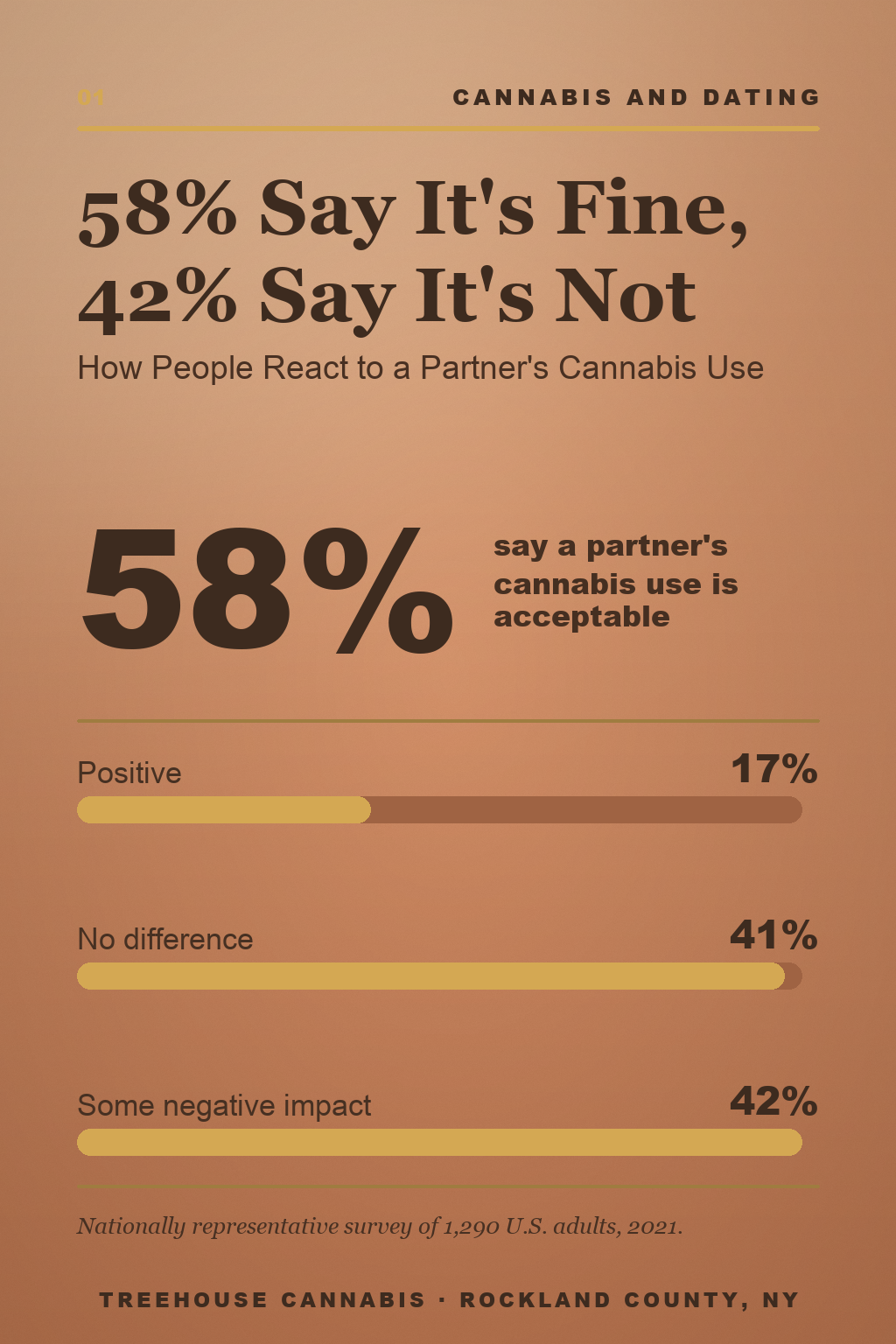
In a 2021 nationally representative survey of 1,290 U.S. adults conducted for eharmony, 58% said a partner's cannabis use was acceptable [5]. That group splits unevenly: 17% called a partner's use a positive, and 41% said it made no difference to them at all. The remaining 42% reported some negative impact.
A second finding sharpens the picture. 60% of the same respondents said they would be upset if a date showed up high [5]. Notice what that separates. Discomfort is not primarily about whether someone uses cannabis in general. It is about state of mind at the moment of the date, which is a much easier thing to manage than a lifestyle difference.
That distinction reframes the whole exercise:
- 58% acceptable, split into 17% who see it as a positive and 41% who say it makes no difference
- 42% report some negative impact, so reactions land close to an even split rather than a clear majority
- 60% would be upset by a date arriving high, which puts timing and sobriety ahead of the bare fact of use
- The practical work is choosing the moment and the words, not defending the habit
For the intimacy side of the same question, Cannabis and Sex: What Research Says About Intimacy and THC covers what the research actually shows rather than what people assume. The rest of this article is ordered the way the conversation usually goes: when to say it, how to say it, what the couple research found, how to set boundaries, and where a preference ends and a bigger issue begins.
Dating a Cannabis User: When Should You Say So?
Say it before the first date that involves cannabis, before you start spending regular time at each other's homes, and before the exclusivity conversation. There is no legal requirement and no single correct timeline, but those three moments are where a late reveal stops reading as a fact and starts reading as withheld information.
The reason is not that cannabis is shameful. It is that concealment has a half-life. A qualitative review of cannabis stigma research in the Journal of Cannabis Research found that both medical and nonmedical users experience real stress over how and when to disclose, and that the concealment strategies people develop carry straight into intimate relationships and dating [7]. In other words, the habit of not mentioning it is the thing that causes the problem, not the product.
The three practical triggers:
- Before a date that will involve cannabis, so the plan is not a surprise that arrives at the door
- Before regular visits to each other's homes, where the stash, the smell, and the routine become visible anyway
- Before the exclusivity conversation, when expectations about lifestyle quietly start getting set
- Keep the first mention casual and short, because a serious sit-down over a minor detail creates the awkwardness it was meant to avoid
If your use is functional rather than recreational, mention the reason in one clause and move on. Something like "I use a little at night because I sleep badly" is a complete disclosure. It gives your date the context without asking them to process a confession, and it leaves room for a follow-up question rather than a verdict. If sleep is the specific reason, Cannabis and Sleep Quality: What Actually Works (and What Doesn't) is the practical background worth having read first.
The same disclosure question shows up in friendships, often earlier and with less ceremony, and Cannabis and Social Life: How Sharing Weed Shapes Friendships covers how that usually plays out. The pattern transfers: people who mention it once, early, and without an apology tend to have fewer recurring conversations about it later.
One caveat about waiting for the "right moment." There is no moment that announces itself. If you find yourself planning the reveal around a milestone, that is usually a sign to say it now, in a smaller way, while the stakes are still low.
How Do You Talk About Weed in Relationships Without Making It Awkward?
Ask a question instead of delivering a confession. A certified Gottman therapist and master addiction counselor, writing for the Gottman Institute, recommends opening cannabis conversations with the goal of understanding rather than problem-solving, using open questions about the role cannabis plays and what each partner would ideally want [6]. That single shift does most of the work, because a question invites an honest answer while a speech invites a position.
The stigma research explains why the confession framing backfires. When someone has rehearsed the disclosure, they have usually also rehearsed a defense, and the other person can hear the defense in the room even when nothing hostile is said [7]. Curiosity has no defense attached to it.
Four openers that work in ordinary conversation:
- "Do you use cannabis, or how do you feel about it?" asked early, before it matters
- "What role does it play in your week?" which is a different question from how much
- "What would your ideal setup look like?" which surfaces the real concern behind a reaction
- "Is there anything you would want to know from me?" which hands the other person the agenda
The two reliable failure modes are worth naming. The first is opening with a justification, which tells your date the topic is contested before they have said a word. The second is treating the conversation as a negotiation to be won, where every answer gets a counter-argument. Both turn a fifteen-second exchange into a recurring argument with no new information in it.
Keep the first conversation short. You are establishing that the topic is safe to raise, not settling the household rules in one sitting. If your partner's use started for a specific reason you do not share, such as symptom relief, The Menopause-Cannabis Connection: How Women Are Finding Natural Relief is a useful primer on why that reads as necessity rather than preference. And expect the conversation to come up again in a different form, because the useful version of it is ongoing rather than a one-time clearance.
Does Cannabis Affect Relationships?
Yes, in measurable ways, and mostly in the direction of match versus mismatch rather than good versus bad. Four studies make the case, and every one of them is correlational, so none of them prove that cannabis caused the pattern observed.
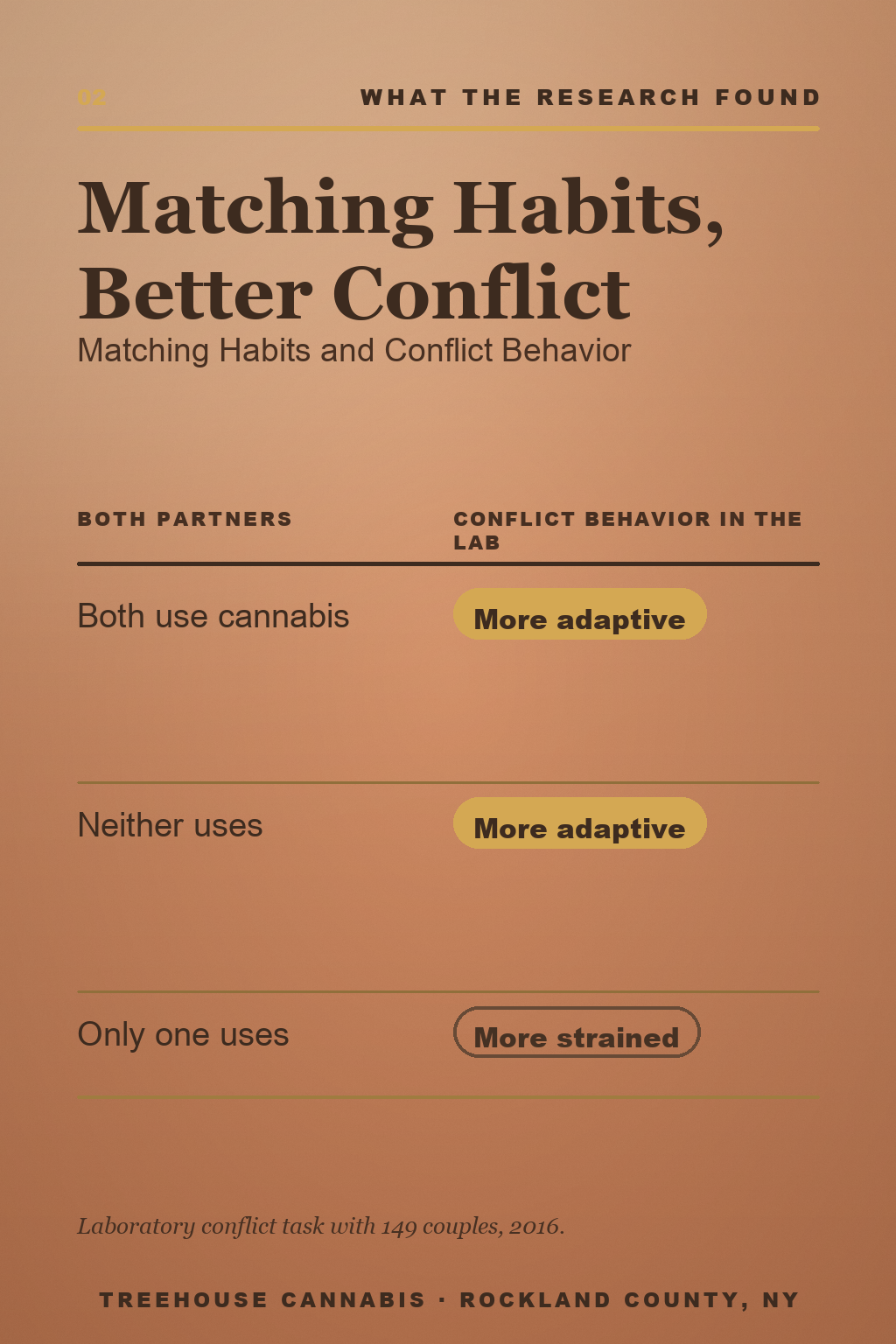
The first is the most-cited. A laboratory conflict task with 149 couples found that couples where both partners used cannabis, and couples where neither did, showed more adaptive conflict behavior and higher relationship satisfaction than couples where only one partner used [1]. The mismatch penalty was strongest when the female partner used and the male partner did not.
The second study looks at timing rather than status. Across 30 days of daily reports from 183 frequent-using couples, using cannabis in the same hour as a partner raised the likelihood of a reported intimacy experience for both men and women, while using when the partner was not present did not [2]. Shared timing mattered more than quantity, which is a different finding than most people expect.
The third is the cautionary one. In a Rutgers and Mount Holyoke study of 145 couples, more frequent cannabis use was linked to more criticism, demands, and avoidance during conflict, and less ability to re-engage positively afterward. Those same partners rated the conversation as better resolved than independent raters did [3]. That gap between self-report and observation is the finding worth remembering.
The fourth adds scale. Among 1,214 young adults in committed relationships, 81.9% were concordant infrequent users, and that group reported higher well-being than concordant heavier users, while use patterns did not predict change over a year [4].
The four findings, compressed to one line each:
- 149 couples: matched use or matched abstinence beat one-partner-only use on conflict behavior and satisfaction
- 183 couples over 30 days: same-hour use raised reported intimacy for both partners, solo use did not
- 145 couples: frequent use tracked with more criticism and avoidance, plus overrated repair
- 1,214 young adults: 81.9% were concordant infrequent users, and that group reported higher well-being
| Couple pattern | Conflict behavior observed | Reported satisfaction |
|---|---|---|
| Both partners use | More adaptive, better repair | Higher |
| Neither partner uses | More adaptive, better repair | Higher |
| Only one partner uses | More strained, weaker repair | Lower |
| Frequent use by either partner | More criticism and avoidance | Overrated by the couple |
What the four studies share is a single theme: matching and moderation keep showing up, and couples are poor judges of their own conflict patterns. Format matters less here than frequency, though Whole Flower Flower is the full-bud version most people would recognize on a shelf. If you want to test the pattern in your own relationship, watch how a disagreement ends rather than how it felt, because the felt version is exactly the measure the research found unreliable.
Now the caveat, stated once and plainly. These are correlations. Nothing here says cannabis improves a relationship, causes conflict, or is good or bad for couples. It says the couples who matched and used moderately looked better on these measures, and the couples who did not looked worse.
The same logic shows up in a grocery list. A larger format such as Thai Sunrise Flower - 70g lasts long enough that restocking stops being a weekly errand, which is one small way the moderation finding turns into a purchase decision.
How Do You Set Cannabis Boundaries as a Couple?
Set them in five specific domains and put a review date on the calendar. Vague intentions fail because nobody can tell when one has been broken, and a boundary you cannot describe in behavior is not a boundary yet.
The domains couples actually argue about:
- Timing: agree on when cannabis is off the table, such as before work, before driving, or before a family event
- Money: set a monthly figure both partners can name out loud, instead of relitigating it purchase by purchase
- Space: decide where cannabis is stored and where it is used, including shared rooms, balconies, and cars
- Guests: agree on whether use happens around visiting friends, family, or roommates, and who gets told
- Cannabis-free time: name specific windows, like a weekly date night, that stay clear for either partner
Money is the domain where concrete beats abstract fastest. A smaller format bought more often usually costs more per gram than one planned purchase, which is why Small Buds Flower is often the better value conversation starter than a lecture about spending. The same logic applies to portion control: pre-ground flower comes in fixed amounts, so "how much is enough" becomes a number on a label rather than a feeling in an argument, and Pre Ground Flower makes that easier to point at. If edibles are part of the household, one shared format keeps the dose question on a label instead of in a negotiation, and a current example carried at Treehouse Cannabis is New Morning Highs | 20 Pack | Gummies | THC: 100mg, CBD: 100mg.
Two design rules make agreements stick. First, frame safety items as shared rules rather than restrictions on one person. "Neither of us drives after using" is a rule the couple keeps. "You need to cut back" is a rule one person enforces on another, and it invites resistance instead of agreement.
Second, schedule the check-in before you need it. Pick a date two to four weeks out and treat the first version of the agreement as a draft, because the first version is always wrong in some small way. Cannabis use also sits inside the wider risk picture NIDA describes, which is covered in the next section [8].
When Is Cannabis Use a Sign of Cannabis Use Disorder?
Cannabis use disorder is more common than most people assume, and frequency is the strongest single predictor. NIDA reports that studies estimate 22% to 30% of people who use cannabis develop cannabis use disorder, and notes there is no FDA-approved medication for it [8]. That base rate is worth knowing before a couple decides which one of them has a problem.
The observable signs a partner can actually notice are behavioral, not chemical:
- Using more, or for longer, than intended on a recurring basis
- Repeated failed attempts to cut back or stop
- Use that interferes with work, school, relationships, or responsibilities
- Continued use despite it causing friction at home
- Needing more to get the same effect, or feeling off without it
The partner-facing question is not "does my partner use cannabis." It is "is use producing consequences that keep getting explained away." That reframe matters because the 145-couple study found precisely this blind spot: the partners reporting more criticism and avoidance during conflict also rated those same conversations as better resolved than trained observers did [3]. A couple can be in trouble and feel fine about it, which is why outside input is not an insult.
Telling a preference apart from a problem, at a glance:
| What you are looking at | What it looks like | What actually helps |
|---|---|---|
| A preference | A stable pattern with no consequences, and both partners can name the terms | The boundary conversation in the previous section |
| A friction point | One partner wants less and the other wants more, but behavior stays negotiable | A specific agreement with a review date |
| A possible use disorder | Using more than intended, repeated failed cutbacks, consequences that keep getting explained away | A professional assessment, not a partner's verdict |
The honest next step is a professional assessment, not a diagnosis delivered by a boyfriend or girlfriend. A partner can describe what they observe and ask for a conversation. A partner cannot run the assessment. For a real referral path, SAMHSA's National Helpline is free, confidential, and available at 1-800-662-4357, and it takes calls from concerned partners as well as from people who use.
If the answer turns out to be a preference rather than a disorder, say that out loud too. Plenty of couples negotiate a workable middle, and the boundary conversation above is the tool for it. Treehouse Cannabis serves customers across Rockland, Orange, and Westchester Counties with staff who will walk you through what is on the shelf without a lecture attached, whether you are working out how to bring it up at all or comparing a few low-key options for a night in.
Frequently Asked Questions
- When should you tell a date that you use cannabis?
- How do you bring up cannabis without making it awkward?
- Is dating a cannabis user a dealbreaker for most people?
- Does cannabis use affect relationships?
- What if my partner wants me to stop using cannabis?
- How do you set boundaries around cannabis as a couple?
- When is cannabis use a sign of a bigger problem?
When should you tell a date that you use cannabis?
There is no single right timeline, but most people bring it up before a date that involves cannabis or before spending significant time at each other's homes. Early, casual disclosure during a getting-to-know-you conversation tends to land better than a reveal later that feels like withheld information.
How do you bring up cannabis without making it awkward?
Treat it like any other lifestyle detail. Ask a question instead of making a confession, such as whether they use cannabis or how they feel about it. Framing it as curiosity rather than disclosure keeps the tone light and gives the other person room to answer honestly.
Is dating a cannabis user a dealbreaker for most people?
No. In an eharmony and YouGov survey of 1,290 U.S. adults, 58% said a partner's cannabis use was acceptable, including 41% who said it made no difference to them. Roughly 42% said it would have some negative impact, so reactions vary widely.
Does cannabis use affect relationships?
Research points both ways. Daily-report studies find that couples who use together report more intimacy in the following hours. Laboratory studies also find that frequent users can underrate conflict problems, and that couples with mismatched use patterns show more strained conflict behavior than couples who match.
What if my partner wants me to stop using cannabis?
Ask what specifically concerns them before negotiating. Frequency, money, sleep, motivation, and driving are different issues with different fixes. A useful next step is agreeing on what would count as a problem for both of you, rather than debating cannabis in general.
How do you set boundaries around cannabis as a couple?
Be concrete. Agree on timing, such as not before work or driving, on where cannabis is stored and used, and on whether either partner wants cannabis-free time. Written or explicit agreements beat vague intentions, and revisiting them after a few weeks keeps them realistic.
When is cannabis use a sign of a bigger problem?
NIDA estimates 22% to 30% of people who use cannabis develop cannabis use disorder, and frequency is the strongest predictor. Warning signs include using more than intended, failing repeated attempts to cut back, and use that interferes with work, relationships, or responsibilities.
Sources
- National Library of Medicine (PMC) / Psychology of Addictive Behaviors — In a laboratory conflict task with 149 couples, couples where both partners used
- National Library of Medicine (PMC) / Cannabis — Across 30 days with 183 frequent-using couples, using cannabis in the same hour
- Rutgers University / Drug and Alcohol Dependence — In a Rutgers and Mount Holyoke study of 145 couples, more frequent cannabis use
- National Library of Medicine (PMC) / Emerging Adulthood — Surveying 1,214 young adults in committed relationships, researchers found 81.9%
- eharmony / YouGov — In a nationally representative survey of 1,290 U.S. adults, 58% said a partner's
- The Gottman Institute — A certified Gottman therapist and master addiction counselor recommends opening
- Journal of Cannabis Research (Springer Nature) — A qualitative review of cannabis stigma research finds that both medical and non
- National Institute on Drug Abuse (NIDA) — NIDA reports that studies estimate 22% to 30% of people who use cannabis develop
About Treehouse Cannabis
Treehouse Cannabis is an adult-use dispensary serving Rockland, Orange, and Westchester Counties in New York. The menu runs from flower and pre-rolls to vaporizers and measured edibles, and staff will talk through format, portion, and timing without turning it into a lecture. Everything here is written for adults 21 and older.
This article is educational and intended for adults 21 and older. Cannabis is for adults 21 and older only. Keep all cannabis products out of reach of children and pets, store them in their original child-resistant packaging, and do not drive or operate machinery after use. Cannabis affects people differently, and this article does not provide medical advice - consult a qualified healthcare provider with any health questions.
Shop our products

Shop All

Deals

Flower

Pre-rolls
Vaporizers

Edibles
Drinks

Concentrates
Tinctures

Topicals

CBD

Pet CBD

Accessories