
Cannabis and Sleep Hygiene: Building a Routine That Actually Works
Cannabis and Sleep Hygiene: Building a Routine That Actually Works
What the sleep-lab data really shows, how to time cannabis around bedtime, and which parts of the routine are doing the actual work.
A cannabis sleep routine works when a fixed nightly schedule carries it and the product rides along at a consistent time, not when cannabis is reached for whenever sleep fails. The schedule does most of the work, and the daily-diary data is what shows it.
In a study of 85 adults who use cannabis frequently, tracked across 1,021 daily diaries, days with more adaptive sleep-hygiene behaviors predicted longer sleep, higher efficiency, and better self-rated sleep quality [1]. The authors concluded that sleep hygiene belongs as a first-line approach to sleep health for people who use cannabis, which is a plain statement that the habits come before the product.
This piece separates the two. It covers what the sleep-lab measurements actually show, how to time cannabis around a fixed lights-out, which format matches which problem, and where a routine stops being enough.
What Does a Cannabis Sleep Routine Actually Need to Work?
A working cannabis sleep routine needs three things: a fixed lights-out time, a consistent point in the evening for cannabis, and a wind-down hour that would still exist if the product disappeared. Everything else is detail.
The data behind that framing is unusually concrete. Participants averaged 7.36 of 11 tracked sleep-hygiene behaviors per day and reported cannabis use on 70.1 percent of diary days [1]. Their average last use landed at 9:12 PM, which is the number to look at first when a routine is not working.
Why that time matters more than the amount:
- More sleep-hygiene behaviors on a given day predicted longer same-night sleep and higher efficiency [1].
- Consistency was measured at the day level, so a schedule that drifts night to night loses the thing that was doing the work.
- Adults are generally advised to sleep 7 to 9 hours a night, and a lights-out time counts backward from the wake time, not forward from bedtime [12].
- Individual sleep-hygiene recommendations — timing, caffeine, alcohol, stress, noise, light — are supported by epidemiologic and experimental evidence, even where direct effects remain untested in the general population [11].
- The hour before bed is a separate variable from the product, and it is the one most people leave unmanaged.
Build the frame first. Pick a wake time, count backward 7 to 9 hours, and treat that lights-out as fixed for a week.
Then place cannabis inside the frame at one consistent point. The 9:12 PM average is a baseline from a study population, not a target to hit, and it is more useful as a reference than an instruction.
The schedule is the active ingredient. The product is a smaller lever layered on top, and treating it as the main lever is where routines quietly fall apart.
Does Cannabis Actually Improve Sleep Quality?
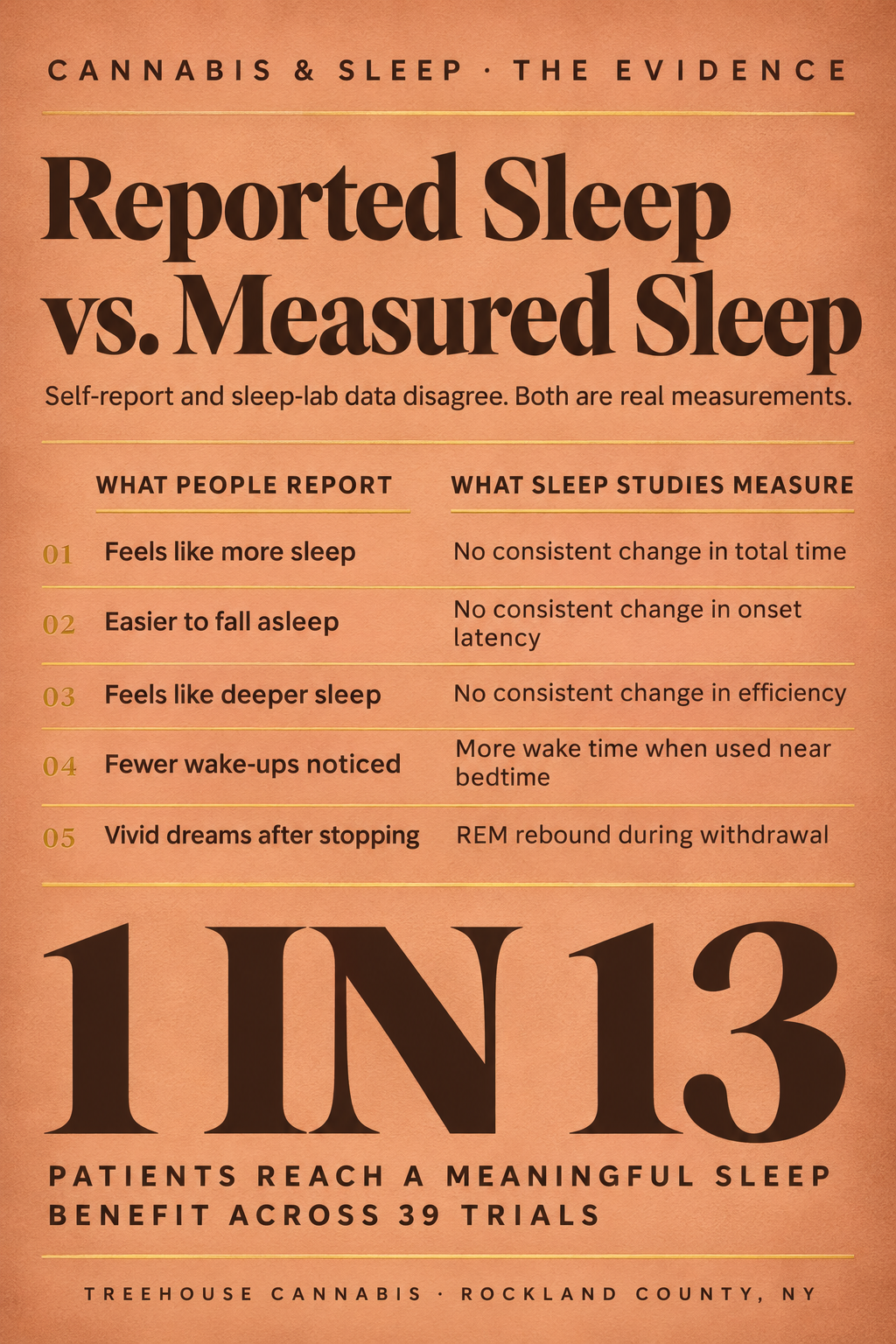
The honest answer has two halves that do not agree. People reliably report sleeping better after cannabis, and the measurements are far less flattering. Both are real findings.
On the self-report side, 347 adults with mild to moderate anxiety tracked for 30 days reported better sleep quality on nights they used cannabis, with the strongest association among people with higher baseline affective symptoms and those using CBD-dominant edibles [13]. That is a real signal in daily life, not a placebo story.
On the measured side, the picture narrows sharply:
- A 2025 meta-analysis of 18 polysomnographic studies found cannabis administration did not consistently change sleep duration, latency, wake time, efficiency, or sleep staging [3].
- Across 39 randomized trials and 5,100 participants, medical cannabis produced only a small sleep-quality improvement over placebo, and roughly one in 13 reached a benefit large enough to count [5].
- Dizziness was substantially more common with medical cannabis than placebo in trials running at least three months [5].
- In 88 adults using cannabis at least three times weekly and tracked for 14 days, cannabis use was not independently associated with sleep duration or quality [6].
The popularity of the belief is its own data point. Between 50 and 74 percent of adults who use cannabis say they do so to help with sleep [6], which is a lot of people reporting a consistent experience.
That gap between felt and measured benefit is worth understanding rather than dismissing. Sedation and the sensation of drifting off are not the same thing as a change in architecture, and a person can genuinely feel more rested without their sleep stages shifting.
For a fuller pass through that literature, see Cannabis and Sleep Quality: What Actually Works (and What Doesn't). The practical takeaway is that a routine should be judged on how the week went, not on how the first twenty minutes felt.
What Does the Sleep-Lab Evidence Say About THC and Sleep Stages?
The sleep-lab evidence shows acute THC suppresses REM and shifts sleep architecture without improving how long or how efficiently anyone sleeps. Polysomnography measures brain waves, eye movement, and muscle tone, which is why it disagrees with how a night feels.
The acute finding is specific and dose-bound. In a randomized trial of 20 adults with diagnosed insomnia, a single oral dose of 10 mg THC with 200 mg CBD taken one hour before bed reduced total sleep time by 24.5 minutes and cut REM sleep by 33.9 minutes versus placebo, with no measurable next-day impairment [2].
The same dose pushed REM latency out by 65.6 minutes [2]. That is a large shift for a single night, and it lines up with the broader pattern of acute REM suppression.
The three patterns sit side by side, and they measure different things:
| Measure | Acute oral 10 mg THC / 200 mg CBD dose | Use within 3 hours of sleep | Stopping regular use |
|---|---|---|---|
| Total sleep time | Down 24.5 minutes | No improvement | Consistently reduced |
| REM sleep | Down 33.9 minutes, latency out 65.6 minutes | Not reported | Rebound |
| Wake after sleep onset | Not reported | Median 60.5 minutes versus 45.8 further out | Not reported |
| Sleep efficiency | Not reported | No improvement | Not the reported endpoint |
Proximity to bedtime matters independently of dose:
- Among 177 healthy adults who completed an overnight home sleep test, using cannabis within three hours of sleep was associated with a median 60.5 minutes awake after sleep onset, versus 45.8 minutes for use further out [4].
- The same near-bedtime group spent a larger share of the night in light stage 1 sleep [4].
- Neither group showed an improvement in total sleep time or sleep efficiency [4].
The withdrawal side runs the opposite direction. Across the same meta-analysis of 18 studies, stopping active use was consistently associated with reduced total sleep time, longer sleep onset latency, and REM rebound [3].
So there are two patterns, not one contradiction. REM suppression is acute and depends on what was taken and how close to sleep. Rebound arrives when use stops. Neither is the same thing as sleeping better, and neither is automatically a harm — the evidence describes a shift in architecture, not a verdict on it.
The REM mechanics, including what a tolerance break does to dreaming, are covered in You Can't Dream on Weed: The Science of REM Suppression and What Happens After a T-Break.
Two caveats keep this honest. The 20-person trial is a pilot with a single dose, route, and population, so it describes what that dose did in that group rather than what any customer should expect. And "no measurable next-day impairment" is a lab finding, not a statement about driving.
How Do You Time Cannabis Around Bedtime?
Finish cannabis two to three hours before lights-out rather than in the final hour. Use inside the three hours before sleep tracked with more wake after sleep onset in a 177-adult home sleep test [4].
The operational version depends on the format:
- Inhaled cannabis reaches effect within minutes, so Flower and vape sit closest to lights-out, roughly 20 to 30 minutes before bed.
- Edibles and tinctures need about 60 to 90 minutes of lead time, so they belong earlier in the evening, around 90 minutes out.
- Whichever format a customer picks, landing on the same point in the window every night matters more than the exact minute.
- The 9:12 PM average last-use time from the diary study is a reference point, not a recommendation [1].
The evening window that follows from this is not complicated, and it is worth writing down once so it stops being a decision every night.
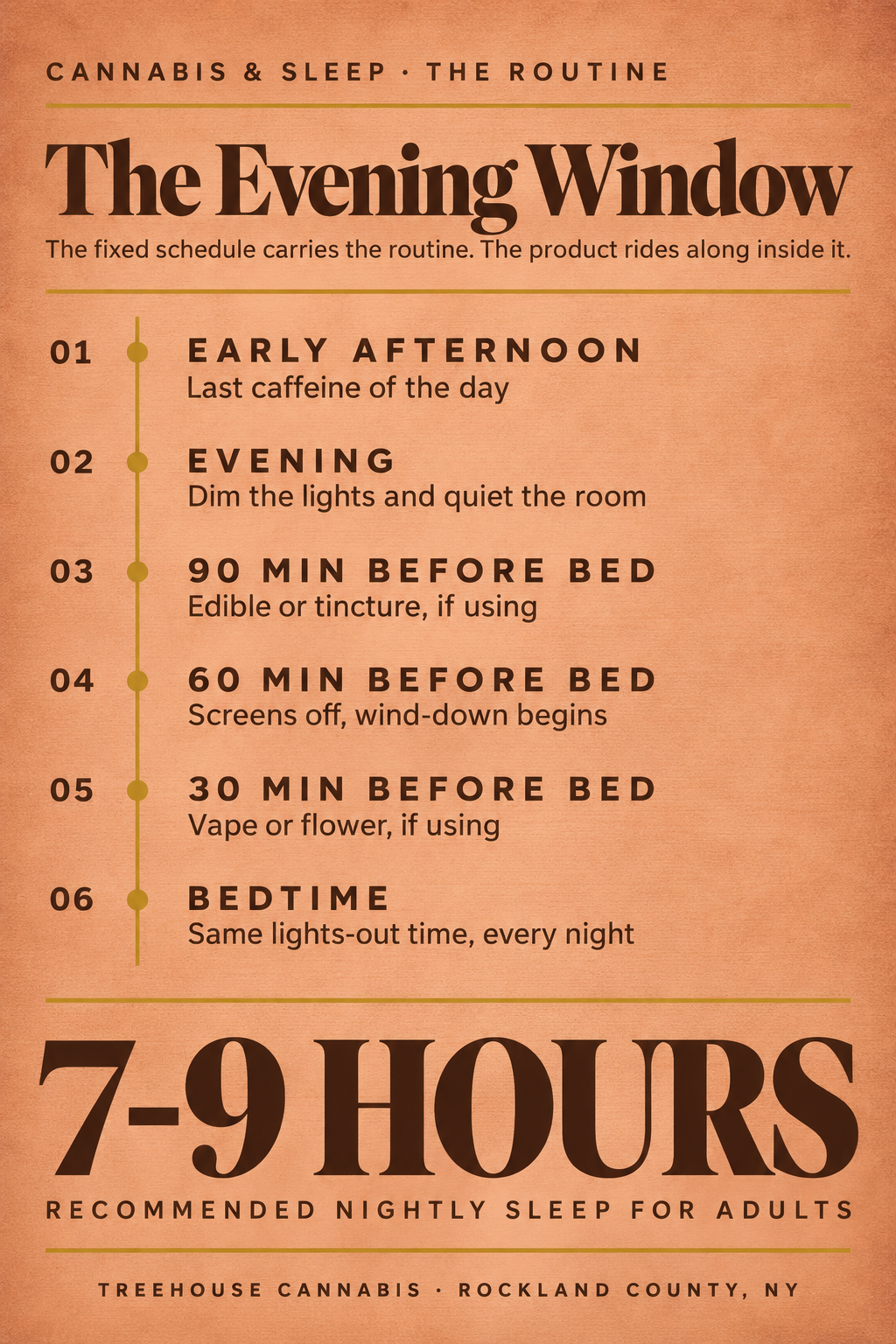
Cannabis is one line in that sequence, not the sequence itself. A fixed lights-out, caffeine stopped early enough to matter, a dim room, and screens off an hour out are the parts that persist on nights without the product.
Bedtime consistency deserves its own note. The diary study measured sleep hygiene at the day level, which means the comparison was between nights that looked alike and nights that did not [1]. A window that moves by two hours on weekends is a different experiment from one that holds.
The useful test is one variable at a time. Hold lights-out fixed for a week, move only the use window, and change nothing else, so the result is readable instead of a guess about which change helped.
If you want a starting point on paper rather than a rotation of products, BOOST+ Drops 3-Pack and Laughing Gas | House Of Sacci | Disposable Vape | 2g sit at opposite ends of the onset curve, which makes the difference easy to feel for yourself.
One caution on lead time: eating later, on a fuller stomach, or after a heavy meal shifts onset later than the label suggests. The 60-to-90-minute figure describes a typical curve, not a guarantee for a given evening.
Which Cannabis Format Fits Which Sleep Problem: Flower, Vape, Edible, or Tincture?
Format is a matching exercise between onset profile and the problem, not a ranking. The right question is not which one is strongest. It is which one is shaped like the night you are having.
If the problem is lying awake unable to fall asleep, fast formats fit the shape of it. If the problem is waking at two in the morning, slow formats fit better, because they come on gradually and hold longer.
| Format | Onset | Duration | Best match |
|---|---|---|---|
| Flower | Within minutes | Tapers through the night | Trouble falling asleep |
| Vape | Within minutes | Tapers through the night | Trouble falling asleep |
| Tincture | Faster than an edible, slower than inhaled | Moderate to long | Falling asleep with some hold |
| Edible or capsule | Roughly 60 to 90 minutes | Longest, with a late tail | Waking overnight |
That late tail is the tradeoff. The same slow curve that carries an edible through a 2 AM wake-up is where next-morning grogginess comes from, and it is longer than most people expect the first time.
Tinctures land between the two because sublingual absorption starts faster than a swallowed edible, which makes Tinctures a reasonable middle option for someone whose problem is both falling and staying asleep.
The evidence on format is thinner than the marketing suggests. In the 30-day study of 347 adults, the strongest self-rated sleep-quality association was among people using CBD-dominant edibles [13]. The acute trial that reduced REM used an oral dose, not inhaled [2]. Neither comparison was designed to rank formats against each other.
What the format decision actually turns on:
- When the night goes wrong. Falling asleep responds to a fast onset; staying asleep responds to duration.
- How long the tail can be tolerated. A slow format that holds until 4 AM also holds until the alarm.
- Whether the timing can be held steady. A format with a predictable curve is easier to place in the same window every night.
- What the label supports. Cannabinoid content and serving size are more useful than a strain name.
That gap is worth naming plainly: no head-to-head trial has compared formats on sleep outcomes. This is a matching framework built on onset and duration, not a leaderboard.
Strain labels will not settle it either. The indica-sativa split is a poor guide to what a product will do, which is the argument in Indica vs Sativa: Why the Labels Are Mostly Meaningless, and the more useful information is on the label's cannabinoid panel.
For anyone who already knows flower is the format they want, NY Diesel | Flower | 28g is the kind of listing to read for cannabinoid content rather than for a name that sounds sedating.
Two practical rules. Match the format to the problem the customer actually has, not the one that sounds more serious. And pick one format per night rather than layering, because stacking a fast onset onto a slow one makes the timing impossible to read.
How Do You Build a THC Sleep Schedule That Holds Up?
Frequency is where routines stop working quietly. A schedule that requires cannabis every night is a schedule with a built-in interruption cost, and that cost is measurable.
Cannabis withdrawal occurs in roughly half of regular and dependent users after abrupt cessation. A meta-analysis pooling more than 20,000 people put standardized withdrawal prevalence at 47 percent, with symptoms typically beginning 24 to 48 hours after stopping and peaking around days 2 to 6 [9].
Sleep is front and center in that picture:
- Disturbed sleep and vivid or disturbing dreaming are among the most commonly reported withdrawal features [9].
- A review of 36 human studies found sleep frequently interrupted during withdrawal, while cautioning that methodological weaknesses in most studies prevent firm conclusions about which specific aspects of sleep are affected [10].
- The dreams that arrive during that window are the REM rebound described earlier, not a new symptom [3].
- The vivid-dreaming side of it, and what a tolerance break does to the pattern, is covered in Cannabis and Lucid Dreaming: What Happens When You Smoke Before Bed.
The practical implication is not abstinence advice. It is that reserving cannabis for higher-stress nights, or for a set number of nights a week, keeps the routine from resting entirely on the product.
That is where the diary finding does double duty. If sleep hygiene behaviors carried the outcomes in a group using cannabis on 70 percent of days [1], then the off-nights are not a gap in the routine — they are the test of whether the rest of it is load-bearing.
Build the off-nights the same way as the on-nights. Same lights-out, same wind-down, same room conditions. The only variable that changes is whether cannabis is part of the evening.
A schedule where sleep collapses without the product is information worth having. It is a signal to look at, and a conversation worth having with a clinician, rather than a personal failing.
What Should You Do When Cannabis Sleep Hygiene Still Isn't Working?
Get clinical help when poor sleep is persistent rather than occasional, or when it interferes with daytime function. A routine built on diaries and guesses has done what it can at that point.
The first-line answer is unusually well settled. The American College of Physicians strongly recommends cognitive behavioral therapy for insomnia as the initial treatment for chronic insomnia in all adults, with medication considered only as an add-on when CBT-I alone fails [8].
What that actually involves is less abstract than the name suggests:
- A standard course runs 6 to 8 weeks [7].
- It is built on cognitive therapy, relaxation training, sleep education, sleep restriction, and stimulus control [7].
- Stimulus control includes going to bed only when sleepy and reserving the bed for sleep and sexual activity [7].
- Sleep restriction compresses time in bed to the amount actually slept, then expands it as efficiency improves [7].
Stimulus control overlaps directly with the routine described earlier, which is why the habit work is not wasted if a customer ends up in treatment. The bed-as-sleep-only rule is the same instruction from a different direction.
Three things belong in a clinician conversation rather than at a dispensary counter: sleep that has run for months rather than weeks, daytime sleepiness that is affecting work or driving, and any question about withdrawal or cutting back. The withdrawal prevalence figure — 47 percent of regular users on standardized scales [9] — is exactly the kind of thing to raise with someone who can assess it properly.
None of this is a reason to feel bad about using cannabis in the evening. It is a reason to keep the routine separate from the product, so that a bad week is a bad week rather than a problem with no off-ramp.
If you want to build the routine around real products instead of guesswork, Treehouse Cannabis in Rockland County organizes the edible and tincture cases so onset and duration are readable before potency, and staff will walk through what each format is built for. Ask which options act fastest if falling asleep is the problem, or which hold longest if waking overnight is. Customers in Orange and Westchester County are welcome to make the trip or call ahead with a question about a specific product.
Frequently Asked Questions
How long before bed should you take cannabis for sleep?
It depends on the format. Inhaled flower or vaporizer takes effect within minutes, so 20 to 30 minutes before bed is a common window. Edibles and tinctures need 60 to 90 minutes of lead time, and a fuller stomach pushes onset later. Pick one window and hold it steady for a week before judging whether it worked.
Does cannabis actually improve sleep quality?
The evidence splits, and both halves are real. People consistently report better sleep after using cannabis, but a 2025 meta-analysis of 18 polysomnographic studies found cannabis did not consistently change sleep duration, latency, efficiency, or staging. Across 39 randomized trials and 5,100 participants, medical cannabis produced only a small improvement over placebo, with roughly one in 13 reaching a meaningful benefit.
Does THC suppress REM sleep?
Acutely, yes. In a randomized trial of 20 adults with insomnia, a single oral dose of 10 mg THC plus 200 mg CBD one hour before bed cut REM sleep by 33.9 minutes and pushed REM latency out by 65.6 minutes, with no measurable next-day impairment. The effect appears tied to dose, route, and proximity to bedtime rather than to cannabis in general.
Why does my sleep get worse when I stop using cannabis?
That is withdrawal rather than a sign the body needs cannabis. Symptoms typically begin 24 to 48 hours after stopping and peak around days 2 to 6, and disturbed sleep with vivid or disturbing dreams is among the most commonly reported features. A meta-analysis pooling more than 20,000 people put standardized withdrawal prevalence at 47 percent.
What is a realistic cannabis sleep routine?
Set a fixed lights-out time, dim the room about an hour before bed, put screens away, keep the room cool and dark, and place cannabis at the same point in that window on nights you use it. The behaviors are what predicted longer and more efficient sleep in 1,021 daily diaries, so the routine has to stand on its own before the product is added.
Should you use cannabis every night for sleep?
A nightly-only schedule carries a built-in interruption cost, because about 47 percent of regular and dependent users report withdrawal on standardized scales and disturbed sleep is a leading feature of it. Reserving cannabis for higher-stress nights, or a set number of nights a week, keeps the rest of the routine load-bearing instead of decorative.
Do edibles or flower work better for a sleep routine?
They serve different jobs, and no trial has compared formats head to head on sleep outcomes. Inhaled flower and vaporizer act within minutes, which suits trouble falling asleep but fades before morning. Edibles and tinctures come on over roughly 60 to 90 minutes and last longer, which suits waking overnight, though that same tail is where next-morning grogginess comes from.
When should you talk to a clinician about sleep instead of managing it yourself?
When poor sleep is persistent rather than occasional, or when it is interfering with daytime function. At that point cognitive behavioral therapy for insomnia is the guideline-recommended first-line treatment for chronic insomnia in all adults, typically delivered as a 6- to 8-week program, with medication considered only as an add-on when CBT-I alone fails.
Sources
- Health Psychology (Livingston & Looby, University of Wyoming / University of Washington) — In 85 adults with frequent cannabis use tracked across 1,021 daily diaries, grea
- Journal of Sleep Research (Suraev et al., Woolcock Institute / University of Sydney) — A single oral dose of 10 mg THC plus 200 mg CBD taken one hour before bed in 20
- Sleep Medicine Reviews (Velzeboer et al.) — Across 18 polysomnographic studies, cannabis administration did not consistently
- Journal of Clinical Sleep Medicine (Althoff et al.) — Among 177 healthy adults who completed an overnight home sleep test, cannabis us
- SLEEP (AminiLari et al., McMaster University) — Across 39 randomized trials enrolling 5,100 patients, medical cannabis produced
- Alcoholism: Clinical and Experimental Research (Wycoff, Miller & Trull) — In 88 adults reporting cannabis use at least three times weekly and tracked for
- National Heart, Lung, and Blood Institute (NIH) — NHLBI describes cognitive behavioral therapy for insomnia as a 6- to 8-week firs
- Annals of Internal Medicine (Qaseem et al., American College of Physicians) — The American College of Physicians strongly recommends cognitive behavioral ther
- Addiction (Connor et al., University of Queensland) — Cannabis withdrawal occurs in roughly half of regular and dependent users after
- Substance Abuse (Gates, Albertella & Copeland, UNSW) — A review of 36 human studies found sleep was frequently interrupted during canna
- Sleep Medicine Reviews (Irish et al., University of Pittsburgh) — A review of the evidence behind sleep hygiene recommendations on exercise, stres
- National Heart, Lung, and Blood Institute (NIH) — NHLBI states that experts recommend adults sleep between 7 and 9 hours a night a
- Behavioral Sleep Medicine (Bidwell et al., University of Colorado) — Over 30 days of daily data from 347 adults with mild to moderate anxiety, cannab
About Treehouse Cannabis
Treehouse Cannabis is an adult-use dispensary in Rockland County, serving Rockland, Orange, and Westchester counties. Most of what this article describes is not a product at all — it is a fixed lights-out time, a consistent use window, and an hour before bed that would still exist without cannabis. If you want help matching a format to the night you are actually having, our team can walk through onset and duration on the edible, tincture, and vaporizer cases so the cannabinoid panel on the label does the work instead of a strain name. This article is education, not medical advice.
Cannabis is for adults 21 and older. Keep all cannabis products out of reach of children and pets, and never drive or operate machinery while impaired. This article is educational and is not medical advice; it does not diagnose, treat, or cure any condition. Talk with a clinician about persistent sleep problems, and buy cannabis only from licensed New York dispensaries.
Shop our products

Shop All

Deals

Flower

Pre-rolls
Vaporizers

Edibles
Drinks

Concentrates
Tinctures

Topicals

CBD

Pet CBD

Accessories