Why Does Cannabis Affect Time Perception?
Why Does Cannabis Affect Time Perception?
Cannabis time perception changes because THC speeds up the brain's internal clock. More ticks accumulate during the same real-world second, so a five-minute wait reads as longer than five minutes. It is a measurable misjudgment that laboratory timing tasks capture at ordinary doses, not a mood or a metaphor.
The effect is common enough that federal researchers treat it as a baseline feature of the drug rather than a rare reaction. The National Institute on Drug Abuse lists altered time perception alongside impaired thinking, memory, and body movement when it describes what cannabis does [1]. Consumer-facing summaries of the same literature make the same point in plainer language: time stretches, usually on the scale of seconds and minutes, not hours [10].
How reliable is it? Across the published record, roughly 70 percent of time-estimation studies found cannabis users overestimating duration [4]. Not every study, and not every person, but a clear majority. That consistency is what separates a real perceptual effect from an anecdote about one strange evening.
How Does Cannabis Change Time Perception?
Cannabis changes time perception by making short intervals feel longer than they are. In timing tasks, people under the influence of THC consistently judge a span of seconds as having lasted longer than it did, and they mark out requested intervals as shorter than asked. The result is the familiar sensation that a song, a conversation, or a line at the counter has stretched out in front of you.
This is not a fringe report or a byproduct of extreme doses. NIDA lists altered time perception among the documented effects of cannabis, in the same company as impaired memory and coordination [1]. That placement matters. It frames the distortion as a predictable consequence of how the drug works, not a quirk of one person, one product, or one bad night.
A few things are worth holding onto before the mechanism:
- Altered time perception is a recognized cannabis effect, listed by federal researchers next to impaired memory and coordination
- The distortion is measurable in laboratory tasks, not just a subjective report from customers
- It operates mainly on the scale of seconds and minutes, not on whole hours
- Roughly 70 percent of published time-estimation studies found overestimation [4]
- The experience shows up at ordinary doses, not only at extreme ones
The scale point is the one people get wrong. Cannabis does not make an afternoon vanish or a week compress. It bends short intervals, the kind you count in seconds, which is why a red light can feel endless while the evening as a whole seems to have passed at a normal rate [10].
That mismatch, short intervals stretching while long stretches stay roughly intact, is the fingerprint of a clock problem rather than a memory problem. Memory does shape how a duration is reconstructed after the fact, and the overlap between the two is covered in Can Cannabis Affect Memory? What Current Research Shows. But the immediate effect is about counting moments as they arrive, not about recalling them afterward.
Why Does THC Speed Up Time Perception in the Brain?
THC speeds up time perception in the brain by accelerating an internal pacemaker: the brain generates ticks, counts them, and converts that count into a felt duration. Speed the pacemaker and more ticks accumulate during the same real-world second, so the brain concludes more time has passed. Nothing outside the body changed. The counter ran hot.
The strongest human evidence for that model comes from imaging. O'Leary and colleagues used PET scans on 24 volunteers and found that smoking cannabis increased blood flow in the cerebellar cortex and sped up self-paced counting and tapping. The size of the speed-up tracked the size of the blood-flow increase, which is what you would expect if the cerebellum were acting as the clock [6].
A 2023 systematic review filled in the circuit around that finding. It reports that cannabis mainly produces time overestimation and impairs both time estimation and time reproduction, and it ties the pattern to indirect dopaminergic action plus structural and functional changes in the cerebello-thalamo-cortical circuit [3]. Indirect is the operative word. The review does not claim THC presses a dopamine button labeled time, and neither should anyone reading it quickly.
The evidence stack looks like this:
- The internal clock model: generate ticks, count them, convert the count into a felt duration
- A faster pacemaker means more ticks per real second, which reads as more time having passed
- PET imaging found cannabis raised cerebellar blood flow and sped self-paced counting and tapping
- A 2023 systematic review points to indirect dopaminergic action and the cerebello-thalamo-cortical circuit
- A 2025 animal study separated impaired interval perception from intact short-interval production
- All of it is a working model, not a settled anatomical answer
That 2025 animal study is the useful complication. Cannabinoid administration impaired perception of intervals in the tens-of-seconds range while production of intervals in the hundreds-of-milliseconds range stayed intact [5]. If a single clock drove everything, both should have moved together. They did not, which suggests perceiving a duration and producing one are at least partly separate processes.
Reach is the other reason the effect is not clean. The same receptor system that drives appetite, covered in Why Does Cannabis Give You the Munchies?, acts across the cerebellum and striatum, so timing, hunger, and memory tend to arrive in the same hour rather than on separate schedules. Strain names do not simplify that picture, for the reasons laid out in Indica vs Sativa: Why the Labels Are Mostly Meaningless.
Why Does Time Feel Slower When the Clock Says Otherwise?
Time feels slower than the clock says because two different tasks are being described with one word. Estimation asks a person to judge how long something lasted. Production asks them to mark out an interval that was requested. THC pushes the first longer and the second shorter, and both directions are consistent with one faster internal clock.
| Timing task | What the person actually does | What THC tends to produce |
|---|---|---|
| Estimation | Judges how long an interval lasted | Overestimation: the interval comes out longer than it was |
| Production | Marks out an interval that was requested | Underproduction: the marked interval comes out shorter than asked |
| Reproduction | Copies a duration they were just shown | Mixed results, weaker and less consistent than estimation |
Both patterns describe one faster clock, not two separate effects.
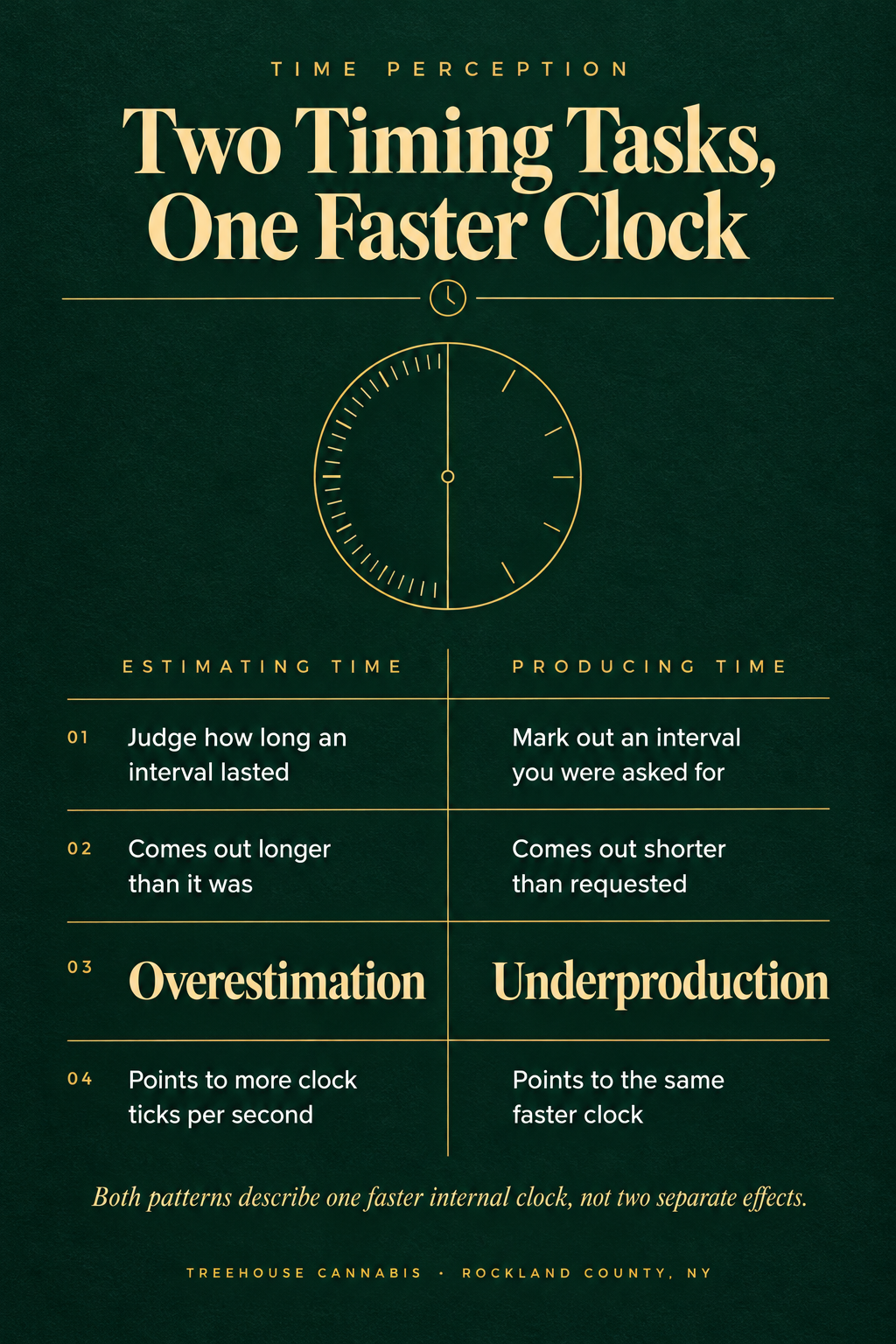
The apparent contradiction dissolves once you hold the two tasks side by side. If your internal counter is running fast, a real minute contains more ticks than it should, so you judge a minute as having taken longer than a minute. Ask the same person to sit still for what feels like a minute, and they will stand up after about 45 seconds, because their fast counter reached sixty ticks early. External time drags precisely because the internal one sprints.
The direction holds across potencies. A 2006 study found that both low- and high-potency cannabis produced a bias toward judging intervals as long, which the authors read as subjective time passing more quickly during intoxication [7]. The strength of the effect varied with potency. The direction did not.
Sober time sense is approximate before any drug enters the picture. In the 44-volunteer crossover study, participants already overestimated time by about 16 percent and underproduced intervals by about 9 percent before receiving anything [2]. Those figures belong to that study and that task design, not to human beings in general, but they make an important point: everyone is already guessing. Cannabis widens a gap that was always there.
The honest gap in the literature sits on the production side. Estimation results are strong and repeatable. Time production and reproduction findings are weaker and less consistent, a weakness the 2012 critical review attributes to small samples and inconsistent methods rather than to the absence of an effect [4]. Anyone who tells you the production data are settled is reading past the caveats.
Where each task lands, in one place:
- Estimation: judge how long something lasted, and THC pushes the answer longer
- Production: mark out a requested interval, and THC pushes the answer shorter
- Reproduction: copy a duration you were shown, and results scatter in both directions
- Both main patterns point at the same faster clock, which is why real time feels slow
- Production and reproduction findings are the weaker half of the literature because of small samples and inconsistent methods
One practical note on how this feels. The stretched minute is often pleasant or neutral, but it can turn uncomfortable when it arrives with anxiety, which is the territory covered in Why Cannabis Can Make You Paranoid (and What Helps).
Does Tolerance Blunt Cannabis Time Perception?
Research suggests yes, at least for people who use regularly. In the 44-volunteer crossover study, intravenous THC across a range of doses produced time overestimation and underproduction overall, but the effect was blunted or absent in volunteers who used cannabis two to three times per week or more [2]. Infrequent users showed the distortion clearly. Frequent users largely did not.
The detail that makes this tolerance rather than a permanently different brain: sober baseline timing did not differ between the two groups. Frequent and infrequent users estimated and produced intervals about equally well when no drug was on board. What changed was the response to the drug, not the underlying clock.
- Heavy-user threshold in that study: two to three times per week or more
- Frequent users showed little to no timing difference between THC and placebo
- Infrequent users showed the effect clearly
- Sober baseline timing was the same in both groups, so the clock itself was not reset
- Tolerance is not immunity, and it is not a reason to use more
Tolerance is a general phenomenon in cannabis, not something specific to timing. It develops across many effects as the system adapts to repeated exposure, and it fades when exposure stops. The practical implication is modest and worth stating plainly: people who use often may notice less time distortion, and people who use rarely may notice it sharply. Format does not change the pharmacology, so Blunts Pre_rolls deliver THC to the same receptors as any other method.
None of that means a tolerant person is unaffected. Blunted is not absent. The study measured timing tasks rather than real-world competence, and tolerance to one effect does not tell you anything reliable about impairment, reaction time, or judgment.
Do Strain, Dose, and Route Change How Much Time Stretches?
They shift the size and duration of the effect, though the evidence is uneven across the three. Strain has the thinnest and most surprising data. Dose and route are better established, mostly by physiology rather than by dedicated timing studies.
Start with strain. A study of 50 regular users found that the group overall overproduced time intervals, but indica users showed significant underproduction compared with controls, with sativa users, and with hybrid users, both before and after smoking [8]. Before and after is the striking part. That pattern suggests strain labels may track something real about the people who choose them, even though the labels themselves are applied inconsistently across the legal market.
Concrete labels do not resolve that ambiguity. NY Diesel | Flower | 28g is one named cultivar with one listed strain type, and that label is roughly the extent of what the market tells you about how it will affect time.
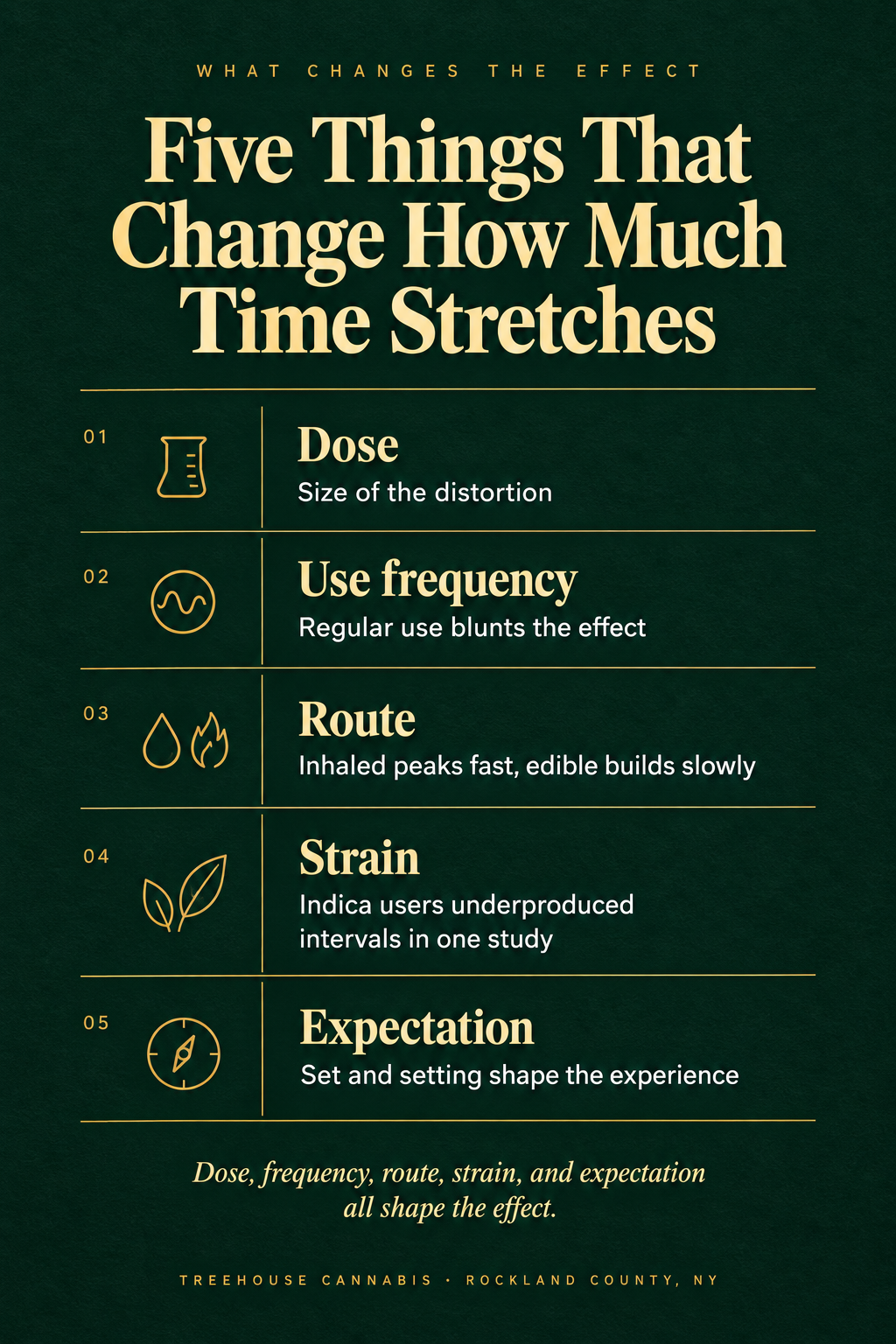
Dose and context set the size of the distortion. A 2026 review argues that cannabis functions as a temporal modulator whose effects depend on dose, use frequency, expectation, and setting rather than producing one fixed distortion in everyone [9]. That framing is more useful than a single number, because it explains why two customers can report completely different experiences from products that look identical on a label.
Route changes the window rather than the direction:
- Inhaled formats peak quickly and fade over a few hours, so the distorted window is short and sharp
- Edible formats build slowly and last longer, which widens the window in which timing can drift
- Sublingual and liquid formats sit between the two, usually faster than a solid edible and slower than smoke
- Route does not change what THC does to the clock, only how long it keeps doing it
The five variables compared:
| Factor | What it changes | What the evidence shows |
|---|---|---|
| Dose | The size of the distortion | Effects scale with dose and are shaped by expectation and setting |
| Use frequency | How strongly a person responds | Two to three times per week or more blunts the timing effect |
| Route | How long the distorted window stays open | Inhaled peaks fast and fades in hours, edibles build slowly and last longer |
| Strain | The direction of the timing error, tentatively | Indica users underproduced intervals compared with controls, sativa, and hybrid users in one 50-person study |
| CBD ratio | Nothing protective | Four common CBD-to-THC ratios showed no protection against acute THC effects |
Format is a real variable for customers comparing options. Disposables such as Beast Quake | Jeeter x Dodi | XL Disposable Vape | 2g sit at the fast end, edibles such as Peach x Oishii Live Resin Gummies | 10 pk at the slow and long end, and tinctures such as High Dose "UP" | Tincture | 1000MG fall in between. Strain differences are easiest to compare in flower, where the plant material itself is the product; NY Diesel | Flower | 28g is one place to start.
CBD is the variable most people expect to help, and the trial evidence does not support that expectation. A randomized, double-blind, crossover trial testing four common CBD-to-THC ratios found no evidence that CBD protects against the acute adverse effects of cannabis [11]. A high-CBD product is a different experience. It is not a documented shield.
Treat strain differences as a hint about variability rather than a rule. The labeling in the legal market is inconsistent, sample sizes in the strain literature are small, and no study has produced a strain-by-strain timing chart worth relying on. Anyone who offers you one is extrapolating.
When Does Cannabis Time Perception Become a Problem?
Time distortion is usually harmless, and it is not by itself a sign of overconsumption. It shows up at low doses in laboratory work, which means a stretched minute says more about pharmacology than about how much anyone consumed [2]. The sensation is uncomfortable for some customers and genuinely interesting for others, and neither reaction is a diagnosis.
It becomes a warning sign when it arrives with other things:
- Panic or a spike of anxiety that does not settle
- A sense that your thoughts are not your own
- Feeling detached from your body or from the room
- Losing track of where you are or how you got there
Those experiences are more likely at high doses, and they are the point at which the sensible move is to stop, sit somewhere calm, and wait rather than to try to push through. Time distortion alone is not the signal. The company it keeps is.
Driving is the clearest practical risk, and it deserves to be stated without hedging. Reaction time and coordination are impaired by THC independently of how time feels. A driver who misjudges how long they have been traveling, or how fast events are unfolding, is a hazard regardless of whether they feel sharp. A subjective sense of feeling normal is not a fitness-to-drive test, and neither is tolerance.
The reassuring half of the picture is that the effect ends. Measurable timing differences in the 44-volunteer study were gone within a few hours of dosing [2]. Nothing about a smaller bud changes that chemistry, so Small Buds Flower carry the same considerations as any other flower: the effect is temporary, the impairment during it is not imaginary, and the clock resets on its own.
If you want to compare formats before you choose, Treehouse Cannabis serves customers across Rockland, Orange, and Westchester Counties with a full menu of flower, edibles, vaporizers, and tinctures. Browse what is in stock at treehousecannabis.com, or ask the team about onset and duration differences between formats.
Frequently Asked Questions
Why does time feel slower when you are high?
Cannabis speeds up the brain's internal clock. THC raises signaling in circuits that count passing moments, so more ticks accumulate during the same real-world interval and the brain concludes more time has passed. The effect is measurable in laboratory timing tasks and typically fades within a few hours. [2] [6]
Does cannabis make time speed up or slow down?
Usually it feels slower. Studies consistently find THC causes time overestimation and underproduction: people judge an interval as longer than it was, and produce a shorter interval when asked to mark one out. Both patterns point to a faster internal clock, which is experienced as external time dragging. [2] [4]
How long does cannabis time distortion last?
In controlled studies, THC's effects on timing tasks faded within a few hours of dosing. Inhaled cannabis is generally associated with one to three hours of noticeable effect, while edibles run longer because absorption is slower. Duration depends on dose, potency, route, and individual tolerance. [2] [9]
Does tolerance reduce time distortion?
Research suggests yes, at least for regular users. In one study, people who used cannabis two to three times a week or more showed no significant difference between THC and placebo on timing tasks, while infrequent users did. Sober baseline timing did not differ between the groups, so the effect was blunted rather than permanently reset. [2]
Do edibles distort time more than smoking?
Likely, though research on edibles specifically is thinner. Edibles deliver THC more slowly and produce longer, sometimes stronger effects, so any timing distortion has a wider window to play out. Overconsumption is a common cause of unpleasant intensity, which is why edibles reward patience over early redosing. [2] [9]
Does CBD affect time perception?
Evidence points to THC, not CBD, as the driver. Receptor studies show that activating or blocking cannabinoid CB1 receptors changes timing behavior, and THC acts directly at CB1. A randomized trial testing four common CBD-to-THC ratios found no evidence that CBD protects against the acute adverse effects of cannabis. [11] [3]
Do sativa and indica strains distort time differently?
One study of 50 regular users found strain mattered. After use, the group overall overproduced time intervals, but indica users showed significant underproduction compared with controls and with sativa and hybrid users, both at baseline and after smoking. Strain labeling is inconsistent, so treat this as a hint about variability rather than a rule. [8]
Is time distortion a sign you are too high?
Not by itself. Altered time perception is one of the most commonly reported cannabis effects and appears at low doses in laboratory studies. It becomes a warning sign when paired with panic, a sense that your thoughts are not your own, or feeling detached from your body. Those are more likely at high doses. [1] [2]
Sources
- National Institute on Drug Abuse (NIDA) — Federal drug-abuse agency states that cannabis can cause altered time perception
- Psychopharmacology (Sewell et al.) — Intravenous THC across a range of doses produced time overestimation and underpr
- International Journal of Mental Health and Addiction (Escelsior et al.) — Systematic review finds cannabis produces mainly time overestimation and impairs
- Current Pharmaceutical Design (Atakan et al.) — Critical review reports that 70% of time estimation studies found over-estimatio
- Neuropsychopharmacology — Cannabinoid administration in animals impaired perception of intervals in the te
- Neuroreport (O'Leary et al.) — PET imaging of 24 volunteers found smoking cannabis increased cerebellar blood f
- Behavioural Pharmacology (Lieving et al.) — Both low- and high-potency cannabis produced a bias toward judging intervals as
- Experimental Psychology (Muro et al.) — Among 50 regular users, cannabis intake produced time overproduction overall, bu
- Frontiers in Psychiatry — Review argues cannabis acts as a temporal modulator whose effects depend on dose
- Leafly (Hoffman) — Consumer-facing explainer summarizing the research consensus that cannabis disto
- Nature Neuropsychopharmacology (CBD:THC trial) — Randomised trial across common CBD-to-THC ratios found no evidence that CBD prot
About Treehouse Cannabis
Treehouse Cannabis is a licensed adult-use dispensary serving customers across Rockland, Orange, and Westchester Counties in New York. The menu spans flower, edibles, vaporizers, and tinctures, and the team can walk you through how onset and duration differ between formats before you choose.
Cannabis is for adults 21 and older. Keep all cannabis products out of reach of children and pets. This article is educational and is not medical advice. Do not drive or operate machinery while impaired. Follow applicable state and local laws.


Shop our products

Shop All

Deals

Flower

Pre-rolls
Vaporizers

Edibles

Drinks

Concentrates
Tinctures

Topicals

CBD

Pet CBD

Accessories