Why Fat Matters When Cooking With Cannabis
Why Fat Matters When Cooking With Cannabis
The chemistry behind a cannabis fat infusion, and how the fat you choose changes what your edible actually delivers
A cannabis fat infusion works because cannabinoids are lipophilic. THC and CBD dissolve in fat, not in water, so the fat in your recipe does two jobs at once: it pulls the cannabinoids out of the plant material during infusion, and it carries them into a form your digestive system can absorb. Skip the fat and most of what you started with stays behind in the plant.
That is the whole premise. Fat is not a texture decision or a flavor decision. It is the extraction solvent, the storage medium and the delivery vehicle, all in one ingredient. Change the fat and you change how much THC and CBD actually reach your bloodstream.
This guide walks through the chemistry in plain terms, compares the fats people actually cook with, covers why decarboxylation has to happen before the fat gets involved, and explains the two absorption levers that catch most home cooks off guard. Nothing here is a dosing protocol. It is the reasoning behind the method, so the choices you make in the kitchen are deliberate rather than guessed.
Why Does a Cannabis Fat Infusion Need Fat at All?
Because cannabinoids are fat-loving molecules, and fat is the only common kitchen ingredient that will hold them. During infusion the fat is the solvent that pulls THC and CBD out of the plant material.
After you eat it, that same fat carries the cannabinoids through digestion and into the bloodstream.
The pharmacokinetics are well documented. THC and CBD are both highly lipophilic, oral bioavailability is estimated as low as 6 percent, and both compounds undergo extensive hepatic first-pass metabolism before they reach circulation. [2] In plain language: you lose most of an edible's cannabinoid content on the way through the body, and the fat you cooked with is one of the few variables you control in that journey.
What fat is doing, step by step:
- Cannabinoids are lipophilic, so they dissolve in fat and not in water
- During infusion, the fat is the solvent that pulls THC and CBD out of the plant material
- After you eat it, fat carries cannabinoids through digestion and into the bloodstream
- Oral bioavailability of THC is estimated as low as 6 percent, versus higher by inhalation
- Because cannabinoids store in body fat, effects from edibles can run long
That last point explains a lot of edible confusion. Cannabinoids accumulate in adipose tissue and are released slowly over weeks, not hours. [2] It is why a heavy edible session can still be felt the next morning, and why the same brownie can land differently on a Tuesday than it did on a Saturday. The fat in your body is a reservoir, and it does not empty on your schedule.
One more distinction worth keeping straight, because it gets muddled constantly: fat does not activate THC. Heat does that. Fat carries what heat has already unlocked. [7] Those are two separate steps with two separate failure modes, and the rest of this article treats them that way.
The type of fat, the amount of fat, the temperature it is held at and what else you ate all shift the outcome. If you have not infused before, the walkthrough in Cooking with Cannabis: A Simple Guide to Cannabis-Infused Edibles covers the basic mechanics before you commit a batch of flower to a saucepan.
Is THC Fat Soluble or Water Soluble?
THC is fat soluble, not water soluble. CBD behaves the same way. Their molecular structure binds readily to lipids, which is why cannabis infuses cleanly into butter, oil and cream, and why it barely infuses into water at all.
The practical consequence is easy to see side by side:
| Carrier | What it pulls from the plant | What you end up with |
|---|---|---|
| Water | Water-soluble compounds: chlorophyll, salts, some sugars | A bitter, green liquid carrying almost no THC |
| Butter or oil | Cannabinoids, terpenes, some plant waxes | An infusion that actually delivers THC |
| Alcohol | Cannabinoids and terpenes, plus a harsher extraction of plant matter | A tincture, which is a different route with a different onset |
Common kitchen fats and roughly how much actual fat they carry:
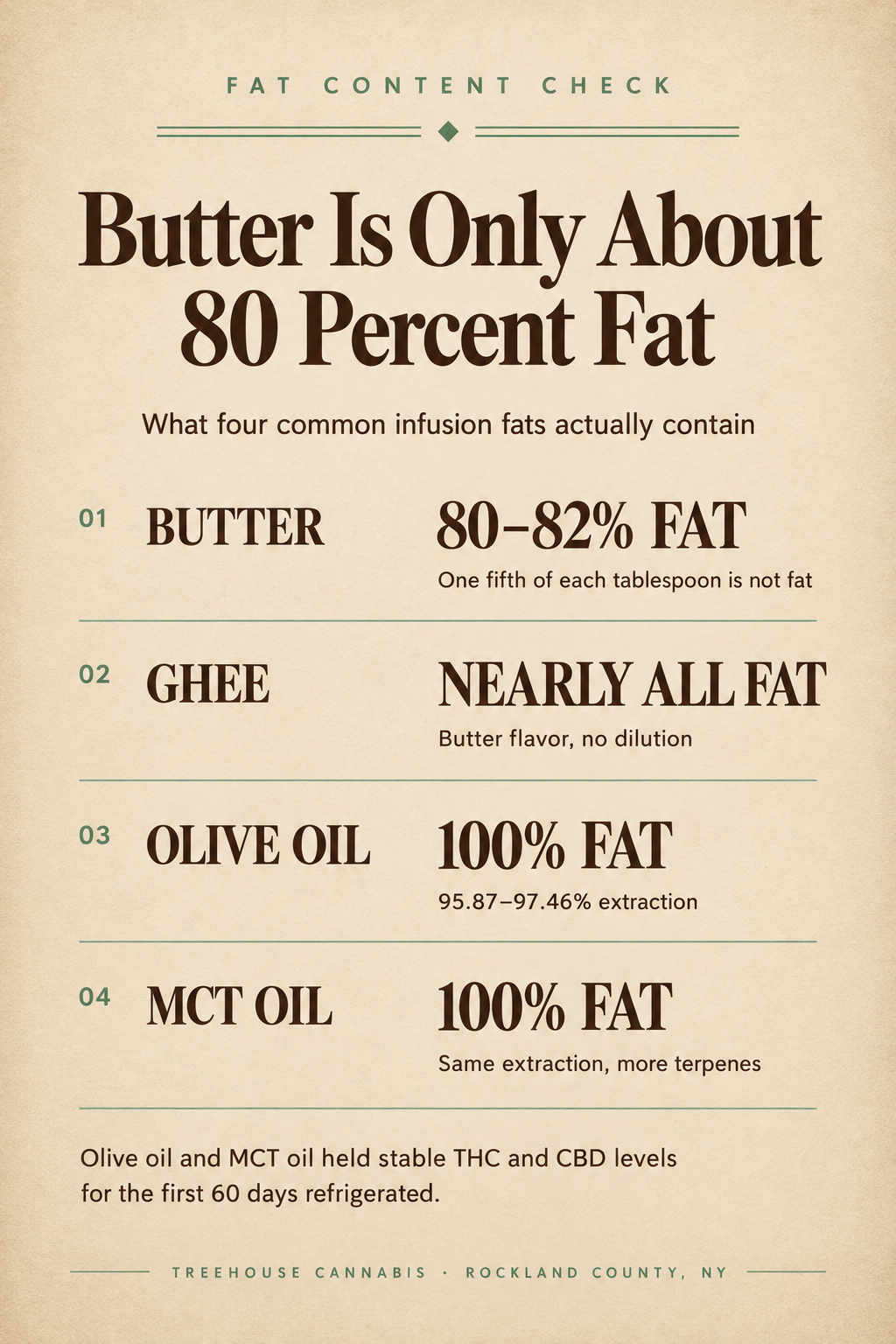
- Butter: typically 80 to 82 percent fat, 16 to 17.5 percent water, plus a small amount of milk solids and salt
- Clarified butter or ghee: nearly all fat, with the water and milk solids removed
- Olive oil: essentially all fat
- Coconut oil: essentially all fat, solid at room temperature
- MCT oil: all fat, liquid, and the most neutral in flavor
- Heavy cream: high fat but still a substantial water fraction, so it dilutes faster
Those butter figures come from dairy research describing butter as a water-in-oil emulsion, which is the reason a tablespoon of butter carries less usable lipid than a tablespoon of pure oil. [8]
Now the myth. Soaking cannabis in water before infusing it does not strip THC. Water cannot dissolve cannabinoids, so it leaves them in the plant material where they started.
What water does lift out is chlorophyll and some salts, which is why a water bath can make a finished infusion taste less grassy. It is a flavor step, not a potency step. Anyone telling you water curing removes THC has the chemistry backwards.
Body fat storage is the other half of the fat-solubility story. Because cannabinoids deposit in adipose tissue and release slowly, the tail of an edible can be long and flat rather than sharp. [2]
For the butter side of this, How to Make Cannabutter: A Beginner-Safe Guide covers the mechanics of infusing fat and straining plant material without scorching either. If you are still deciding which carrier to commit to, Cannabis Oil vs Cannabutter: Which Infusion Should You Make? compares the two main options on effort, shelf life and where each one works best in a recipe.
Which Fat Works Best for Infusing Cannabis?
There is no universal winner, and any guide that names one is overselling. The right fat depends on what you are making, how much usable lipid you need per tablespoon, and how long the infusion has to keep.
Here is how the four common choices actually compare:
| Fat | Fat content | Extraction behavior | Flavor impact | Best for |
|---|---|---|---|---|
| Butter | 80 to 82 percent fat, 16 to 17.5 percent water | Good, but roughly a fifth of each tablespoon is not fat | Distinctive, rich, expected in baked goods | Brownies, cookies, shortbread |
| Clarified butter or ghee | Nearly all fat | Better than butter per tablespoon, water removed | Nutty, still recognizably butter | Sauteing, sauces, baked goods that need butter flavor |
| Olive oil | All fat | 95.87 to 97.46 percent cannabinoid extraction efficiency | Savory, peppery, can clash with sweets | Salad dressings, savory dishes, low-heat cooking |
| MCT oil | All fat | Same extraction efficiency, significantly more terpenes pulled | Nearly neutral | Anything where you do not want the carrier to taste like anything |
The extraction numbers come from a direct comparison of olive oil and MCT oil maceration, which also found that both preparations held stable THC and CBD levels through the first 60 days of refrigerated storage. [4] MCT oil pulled significantly more terpenes than olive oil. Whether that is a feature depends on whether you want the plant's aroma in the finished product or a blank carrier that lets the recipe speak.
Butter's weakness is arithmetic. It is 80 to 82 percent fat with 16 to 17.5 percent water and around 1 percent milk solids, so a cup of butter delivers meaningfully less lipid than a cup of oil. [8] That water fraction is also why butter infusions spoil faster and why the emulsion can break when it gets too hot.
Carrier fat may matter beyond extraction efficiency as well. In a mouse study comparing carrier oils, sesame oil produced significantly higher cannabinoid concentrations across serum, adipose tissue, brain, liver, heart and muscle than EPA/DHA-rich oils, and the authors noted that long-chain fatty acid carriers can raise oral bioavailability upwards of threefold. [3] That is animal data, not a human result, and it should be read as a direction of travel rather than a promise about your brownies. The honest takeaway is that fat choice can influence delivery, not just flavor.
If you want butter flavor without paying the water tax, clarify it. Ghee is butter with the water and milk solids cooked off, so you keep the taste and get closer to an all-fat carrier. That is the single most useful swap in this section.
A short version, if you would rather not overthink it:
- Baking something sweet: butter, or clarified butter when you want more fat per tablespoon
- Savory dishes, dressings or sauces: olive oil
- Anything where the carrier should not taste like anything: MCT oil
- Longest refrigerated shelf life: an oil rather than butter, since butter's water fraction spoils first
- Coconut oil: all fat and solid at room temperature, useful when a recipe calls for a firm texture
One caution on the tea question: water alone carries almost nothing, which is exactly the trap How to Make Cannabis Tea Without Wasting THC addresses. Read that before you steep flower and wonder where the effect went.
Does Cannabis Have to Be Decarboxylated Before It Meets the Fat?
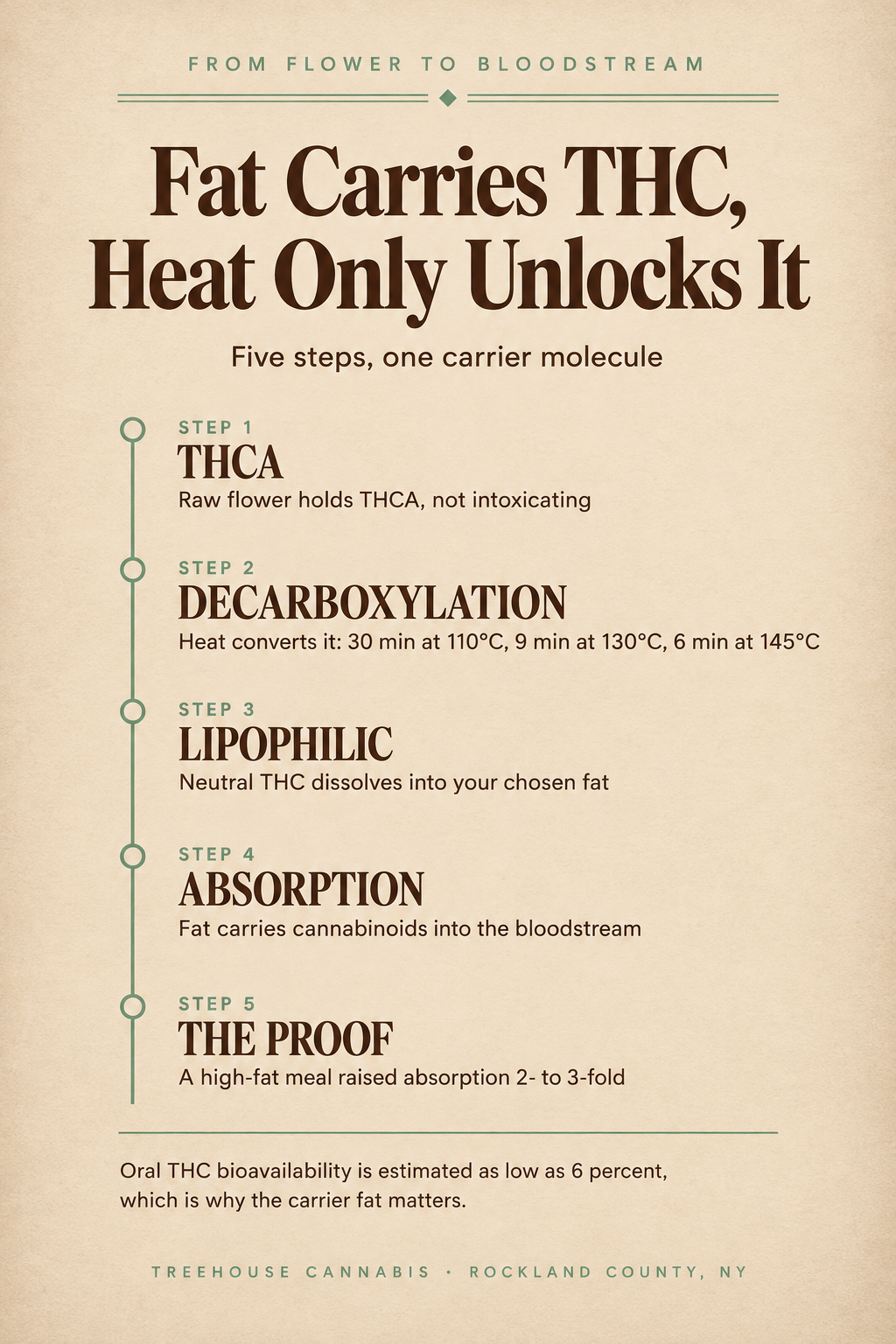
Yes, if you want an intoxicating edible. Raw cannabis contains THCA and CBDA rather than THC and CBD, and those acidic forms are not intoxicating. Heat has to remove the carboxyl group before the fat has anything active to carry. [7]
That conversion is decarboxylation, and it is a loss of a carboxylic acid group released as carbon dioxide. [6] The reaction is driven by temperature and time together, not by heat alone, which is why a short blast of high heat and a long stretch of low heat are not interchangeable.
Measured conversion times for THCA-A to THC:
- 30 minutes at 110 C (230 F) produced almost complete conversion
- 9 minutes at 130 C (266 F) produced almost complete conversion
- 6 minutes at 145 C (293 F) produced almost complete conversion
- Temperatures below 100 C (212 F) did not finish the reaction within 60 minutes
- Total cannabinoid loss at 110 C was about 7.94 percent, so hotter and longer costs you material
Read those numbers as a trade. There is a floor below which the reaction will not complete in any reasonable time, and a ceiling above which you are burning off cannabinoids faster than you are converting them. The 7.94 percent loss at 110 C is the cost of doing business, not a defect.
Here is where home cooks get caught: infusing into warm fat does not reliably finish decarboxylation. Fat bath temperatures sit well below the conversion range, the plant material is often damp, and the fat insulates as much as it heats. Decarboxylate in the oven first, then infuse. Two steps, in that order.
A little residual THCA is not a failure. It simply means that fraction of the material is not intoxicating.
For the starting material itself, grind size and bud size matter less than consistency, which is why Small Buds Flower are a practical choice for cooking: small buds decarboxylate and infuse the same way larger ones do, and you are grinding them anyway.
What Temperature and Ratio Should a Cannabis Fat Infusion Follow?
Hold the fat somewhere between roughly 160 F and 200 F (71 to 93 C) for one to three hours, and stay under about 250 F (121 C) once the cannabis is decarboxylated.
That range is common home practice, not a finding from the studies cited here, which cover decarboxylation chemistry, extraction efficiency and storage stability rather than infusion temperature curves.
The reasoning behind the range is straightforward. Below about 160 F the fat is thick and the transfer is slow. Above roughly 250 F you are driving off terpenes and pushing the flavor toward bitter, and you risk degrading cannabinoids you already paid to convert.
The full sequence, in order:
- Decarboxylate the ground flower in the oven at one of the time and temperature pairs above
- Combine the decarboxylated flower with your chosen fat in a saucepan or double boiler
- Hold the fat in the 160 F to 200 F band for one to three hours, stirring occasionally
- Strain through cheesecloth or a fine mesh strainer, pressing gently to recover the fat
- Cool, then refrigerate in a sealed container
- Label the batch with the fat used, the flower weight in grams and the date
On ratio, the working range is one cup of fat per 7 to 14 grams of decarboxylated flower. More fat per gram gets you a milder infusion that is easier to portion out. Less fat gets you a more concentrated one that is harder to measure accurately. Neither is better, but the milder batch forgives a rounding error and the concentrated one does not.
Once made, the infusion is not as fragile as people assume. Olive oil and MCT preparations held stable cannabinoid levels through 60 days of refrigerated storage. [4] Past that window, treat it as an ingredient with a shelf life, not a preservative.
Label everything. Potency cannot be judged by taste, color or smell. A jar of cannabutter and a jar of plain butter look identical in the fridge, and the only reliable record is the note you wrote on the lid.
Whole flower is the usual starting point for cooking, and a straightforward option like Whole Flower Flower gives you a consistent material to work with batch to batch. If you would rather start from a single named cultivar so the flavor is predictable, something like NY Diesel | Flower | 28g works the same way in the recipe.
What Raises THC Absorption From a Cannabis Fat Infusion?
Two things move absorption more than most people expect: how the fat is emulsified, and what else is in your stomach when you eat it.
The formulation side first. Research on cannabinoid bioavailability found that delivery can be substantially improved through formulation design, with medium-sized emulsions around 16 micrometers producing the most pronounced benefit. The same work found that excessive lecithin or surfactant content actually reduced systemic exposure. [9] In practice, a modest amount of lecithin can help a fat disperse into a water-based mixture. A heavy hand works against you.
The meal side is the more consequential finding. In a study of 28 healthy adults, a 5 mg or 10 mg oral THC capsule taken after a high-fat meal increased mean THC absorption 2- to 3-fold and delayed the time to peak plasma concentration compared with the fasted state. [1] Read that again, because it is the most useful sentence in this article: the same labeled amount can hit noticeably harder depending on what you ate alongside it.
What that means in the kitchen:
- A high-fat meal raised THC absorption 2- to 3-fold and pushed the peak later
- Emulsion droplet size around 16 micrometers produced the largest bioavailability gain
- Excess lecithin or surfactant reduced exposure rather than increasing it
- Keep meal context consistent so a batch behaves predictably from one session to the next
- Start low and wait before redosing, because fat content is impossible to taste
- A small amount of lecithin is the right amount
The delay matters as much as the increase. A later peak means the window in which an edible feels like it is not working gets longer, and that window is where most overconsumption happens. If you eat a fatty meal with an edible, the curve is both taller and slower, and patience is the only tool that helps.
Consistency is the underrated practice here. If a batch performed one way after a light breakfast, it will perform differently after a heavy dinner, and there is no way to correct for that after the fact. The same logic applies to grind: a uniform particle size extracts more evenly than a mix of dust and chunks, which is one practical argument for Pre Ground Flower when you want the starting material to behave the same every time. Keeping the surrounding meal roughly the same is boring advice that works.
Which brings the argument back to where it started. The fat is doing the work: extracting, carrying, and shaping how fast and how fully the cannabinoids arrive. Everything you add to that fat, from lecithin to clarified butter to the meal you eat with it, changes the delivery.
If you would rather skip the infusion entirely, Peach x Oishii Live Resin Gummies | 10 pk are already made and labeled, and High Dose "UP" | Tincture | 1000MG offer a measured alternative to a jar of homemade oil. Treehouse Cannabis is a licensed New York adult-use dispensary serving Rockland County, and our budtenders are happy to walk you through what is currently on the menu before you decide.
What Do People Ask Most About Fat and Cannabis Cooking?
Here are the answers customers ask most often:
- Why does cannabis need fat to work in edibles?
- Is THC fat soluble or water soluble?
- Does butter or oil make a better cannabis infusion?
- Do you have to decarboxylate cannabis before infusing it into fat?
- What temperature should a cannabis fat infusion be held at?
- How much fat do you need per gram of cannabis?
- Does adding lecithin to a cannabis infusion actually help?
- Does eating a fatty meal change how an edible hits?
Why does cannabis need fat to work in edibles?
THC and CBD are lipophilic, meaning they dissolve in fat rather than water. A fat source pulls cannabinoids out of the plant material during infusion and carries them into a form your digestive system can absorb. Without fat, most of the active compounds stay behind and the edible underperforms.
Is THC fat soluble or water soluble?
THC is fat soluble, not water soluble. Its chemical structure binds readily to lipids, which is why cannabis infuses into butter, oil and cream but barely into water. This same property explains why THC accumulates in body fat and releases slowly over time.
Does butter or oil make a better cannabis infusion?
Both work, but pure oil carries more usable fat per gram. Butter is roughly 80 to 82 percent fat with 16 percent water and some milk solids, while cooking oils are essentially all fat. Oil also stores longer and resists spoilage better, though butter tastes better in baked goods.
Do you have to decarboxylate cannabis before infusing it into fat?
Yes, for intoxicating edibles. Raw cannabis holds THCA, which is not psychoactive. Heat converts it to THC, and research shows complete conversion takes about 30 minutes at 110 C, 9 minutes at 130 C or 6 minutes at 145 C. Infusing alone rarely finishes that job.
What temperature should a cannabis fat infusion be held at?
Most home infusions sit between 160 F and 200 F for one to three hours. Staying under roughly 250 F protects the cannabinoids and terpenes from degrading after decarboxylation, while higher heat shortens shelf life and can push the flavor toward burnt or bitter.
How much fat do you need per gram of cannabis?
A practical ratio is one cup of fat per 7 to 14 grams of decarboxylated flower. More fat per gram produces a milder infusion that is easier to portion out; less fat produces a more concentrated one. Label the batch, because potency is hard to judge by taste.
Does adding lecithin to a cannabis infusion actually help?
It can, in moderation. Lecithin is an emulsifier that helps fat disperse into water-based mixtures and supports lipid digestion. Research on cannabinoid formulations found medium-sized emulsions helped most, but excess lecithin reduced exposure, so a small amount is better than a heavy hand.
Does eating a fatty meal change how an edible hits?
Yes. A clinical study found a high-fat meal increased THC absorption two to three fold and delayed the time to peak concentration. That means the same labeled amount can feel noticeably stronger depending on what else you ate, so start low and wait before redosing.
Sources
- Cannabis and Cannabinoid Research (National Library of Medicine) — In 28 healthy adults, taking a 5 mg or 10 mg oral THC capsule after a high-fat m
- British Journal of Clinical Pharmacology (Lucas, Galettis & Schneider) — THC and CBD are both highly lipophilic with oral bioavailability estimated as lo
- Journal of Cannabis Research (Lust et al.) — The choice of carrier fat changes cannabinoid delivery: sesame oil produced sign
- Molecules (MDPI) — Comparing olive oil and medium-chain triglyceride (MCT) oil for cannabis macerat
- Cannabis and Cannabinoid Research (National Library of Medicine) — THCA-A converted almost completely to THC in 30 minutes at 110 C, 9 minutes at 1
- Cannabis and Cannabinoid Research (Filer, PerkinElmer) — Reviews the chemistry of cannabinoid decarboxylation - loss of a carboxylic acid
- Project CBD — Explains in consumer-facing terms that raw cannabis contains THCA and CBDA rathe
- Center for Dairy Research, University of Wisconsin-Madison — Documents typical butter composition as 80 to 82 percent fat, 16 to 17.5 percent
- Journal of Cannabis Research (BMC) — Found that cannabinoid bioavailability can be substantially improved through for
About Treehouse Cannabis
Treehouse Cannabis is an adult-use dispensary serving Rockland, Orange, and Westchester Counties in New York. We carry a curated selection of flower, edibles, vaporizers, concentrates, tinctures, and accessories from licensed New York producers, with team members on hand to help you find the right product for your experience level and goals.
If you would rather cook with a labeled product than guess at a homemade batch, our team can walk you through the edibles and tinctures currently on the menu. Everything we sell is tested and labeled with its cannabinoid content, which takes the guesswork out of the part that matters most.
Cannabis is for adults 21 and older. Keep all cannabis products out of reach of children and pets. This article is intended for educational purposes only and is not medical advice. Do not drive or operate machinery after consuming cannabis. Customers at Treehouse Cannabis must follow New York State adult-use regulations, and effects can vary based on the individual, the product, and the amount consumed.

Shop our products

Shop All

Deals

Flower

Pre-rolls
Vaporizers

Edibles
Drinks

Concentrates
Tinctures

Topicals

CBD

Pet CBD

Accessories